2027 Most Affordable Online Pharmacy Technician Certificate Programs

Co-Founder and Chief Data Scientist
Choosing an affordable online pharmacy technician certificate program is not just a tuition comparison. You also need to know whether the program prepares you for national certification, whether it helps with externship placement, whether your state has separate registration or licensure rules, and whether the total cost includes books, exam fees, technology access, and hands-on training.
This guide is for students who want a lower-cost route into pharmacy work without committing to a long degree program. It explains what online pharmacy technician certificates cover, how to compare programs, what the listed affordable options include, how certification affects employability, and what salary and job-market data suggest about the return on this training.
Quick Answer: Are affordable online pharmacy technician certificate programs worth considering?
Yes, an online pharmacy technician certificate can be a practical entry point into healthcare if the program fits your state requirements, prepares you for exams such as the PTCB or ExCPT, and includes or helps arrange hands-on experience. The strongest programs are transparent about tuition, externships, exam preparation, accreditation or institutional recognition, and certification eligibility.
Pharmacy technician pay varies by location, employer, certification status, and specialization. The U.S. Bureau of Labor Statistics reported median annual pay of $43,460, or $20.90 per hour, as of May 2024. Entry-level salaries commonly fall around $30,000 to $36,000 annually, while experienced technicians in hospital, specialty, or certified roles may reach $50,000 to $60,000 or more.
What are the main benefits of earning an online Pharmacy Technician Certificate?
- Faster career entry: Certificate programs are designed to prepare students for entry-level pharmacy technician jobs in retail, hospital, mail-order, long-term care, and related settings.
- Defined certification pathway: Many programs align coursework with national certification exams, including the Pharmacy Technician Certification Board exam.
- Flexible scheduling: Online and self-paced formats can work well for adults balancing school with jobs, caregiving, or other responsibilities.
- Affordable healthcare training: Compared with many degree programs, pharmacy technician certificates can provide a lower-cost route into patient-support and medication-related work.
- Room for advancement: Certified and experienced technicians may move into hospital practice, sterile compounding, specialty pharmacy, purchasing, informatics, or supervisory roles.
What should you expect from an online Pharmacy Technician Certificate program?
A strong online pharmacy technician certificate teaches the technical, legal, and practical knowledge needed to support pharmacists safely. Most programs combine online lessons, quizzes, practice calculations, case examples, and exam-preparation materials. Some also include virtual labs, externships, or clinical rotations.
| Program component | What it usually covers | Why it matters |
| Pharmacology and terminology | Drug names, classifications, dosage forms, body systems, abbreviations, and prescription language | Helps technicians understand medication orders and communicate accurately with pharmacists and patients |
| Pharmacy law and ethics | Federal and state rules, controlled substances, confidentiality, patient safety, and professional standards | Reduces legal and safety risks in pharmacy practice |
| Pharmacy calculations | Dosage calculations, conversions, compounding math, and measurement systems | Builds accuracy for medication preparation and dispensing support |
| Dispensing workflow | Prescription intake, labeling, packaging, inventory, drug references, and pharmacy software | Reflects the daily work technicians perform in retail and institutional settings |
| Certification preparation | PTCB, ExCPT, PTCE, CPhT, PTAC, or related exam review depending on the program | Can improve readiness for credentials that many employers prefer or require |
| Externship or clinical practice | Hands-on experience in a pharmacy, hospital, or partner site when available | Gives students workplace exposure and may strengthen job applications |
Where can you work after completing an online Pharmacy Technician Certificate?
Online pharmacy technician certificate graduates can pursue roles in several pharmacy environments. The best option depends on your state rules, certification status, schedule needs, and comfort with patient interaction, technology, or specialized medication handling.
- Retail pharmacies: Chain and independent pharmacies commonly hire technicians to help with prescription processing, inventory, customer service, and insurance claims.
- Hospitals: Hospital pharmacy technicians may support medication distribution, automated dispensing systems, sterile preparation, unit-dose packaging, and medication delivery.
- Mail-order pharmacies: These operations process high prescription volumes and often emphasize workflow accuracy, data entry, packaging, and shipping coordination.
- Long-term care facilities: Technicians help manage medication distribution for nursing homes, assisted living centers, and other residential care environments.
- Compounding pharmacies: These pharmacies prepare customized medications and may require careful measurement, documentation, and safety procedures.
- Federal hospitals and clinics: Pharmacy technician opportunities may exist in government healthcare settings, depending on hiring requirements and credential expectations.
How much can you make with an online Pharmacy Technician Certificate?
Salary outcomes are not guaranteed by any certificate. Pay depends on where you live, whether you become certified, the employer type, local demand, union or health-system wage structures, and your level of experience.
- Entry-level pay: New technicians often start around $30,000 to $36,000 annually.
- Median annual pay: National median pay is approximately $40,074 to $43,460, or $19-$21 per hour.
- Experienced technician pay: Technicians with several years of experience may reach $50,000 to $60,000 or more, especially in hospitals or specialized roles.
- Higher-paying locations: California, Washington, and the District of Columbia frequently report higher average wages, and some metropolitan areas exceed $60,000 - $80,000 annually.
- Certification effect: Certified Pharmacy Technicians generally have stronger access to higher-paying and more specialized positions than non-certified applicants.
- Employer setting: Hospital and ambulatory healthcare roles often pay more than traditional retail pharmacy jobs.
- Affordable online pharmacy technician certificate programs for 2027
- How to choose the right online pharmacy technician certificate program
- Admissions requirements and application steps
- Skills taught in online pharmacy technician training
- Career options after completing a certificate
- Program costs and ways to pay
- Salary expectations after certification
- Online vs. in-person pharmacy technician programs
- Specializations and advancement paths
- Job market for pharmacy technician graduates
- Industry trends shaping pharmacy technician work
Most Affordable Online Pharmacy Technician Certificate Programs for 2027
How we evaluated these programs
Affordability matters, but a low advertised price is not enough. When comparing pharmacy technician certificate options, students should look at tuition, program length, certification preparation, externship availability, institutional recognition, and whether the program’s claims are supported by public information.
Research.com uses established education data sources where applicable, including the IPEDS database, Peterson's database including its Distance Learning Licensed Data Set, the College Scorecard database, and the National Center for Education Statistics.
The following programs and training options are listed because they provide lower-cost or employer-supported routes into pharmacy technician preparation. Students should confirm current pricing, certification eligibility, state requirements, externship availability, and refund policies before enrolling.
| Program | Format | Listed cost | Notable feature |
| Ashworth College | Self-paced online | $1,459 (full pay) | Includes externship opportunities with Walgreens and CVS/Pharmacy |
| Community College of Philadelphia | Online coursework with practical training | Non-credit $1,525.00 | Includes optional externship support through an Externship Coordinator |
| CVS LearnRX | Employer-sponsored training | Not publicly disclosed; employer-sponsored | Designed for CVS employees and retail pharmacy workflow |
| Phlebotomy Career Training | 100% online, self-paced | $650 course price | Includes Zoom tutoring and a clinical rotation option |
| San Francisco State University | Hybrid or self-paced online | $1,499 | Includes 60 hours of coursework plus an 80-hour clinical externship |
| Salt Lake Technical College | In-person and self-study structure | Total Estimated Cost: $2,204.50 | Prepares students for licensure with the Utah Division of Occupational and Professional Licensing |
| U.S. Career Institute | Self-paced online | $69/month | Designed for completion in about 4 months, with part-time pacing of 4-9 months |
| University of Tennessee Health Science Center | Fully online, self-paced | $1,800 total (Payment Plan Available) | Includes 164 hours of training and a certification exam voucher |
| Walgreens | Externship provider | No additional cost for externship | Provides an 80-hour externship, usually through partner training programs |
1. Ashworth College
Ashworth College offers a self-paced online Pharmacy Technician Certificate for students preparing for entry-level pharmacy technician roles and exams such as the PTCB. The program includes instruction in pharmaceutical terminology, pharmacy law, dosage calculations, drug classifications, community and hospital pharmacy practices, and pharmacy operations. Students also have access to hands-on externship experience with Walgreens and CVS/Pharmacy, which can be valuable for learners who need practical exposure before applying for jobs.
- Program length: Self-paced, typically a few months
- Tracks or concentrations: None specified
- Tuition cost: $1,459 (full pay)
- Required credits to graduate: Not specified
- Accreditation: Distance Education Accrediting Commission (DEAC)
2. Community College of Philadelphia
The Community College of Philadelphia offers a Pharmacy Technician Certificate that combines online learning with practical preparation for certification and employment. Coursework includes pharmacy medical terminology, prescription interpretation, generic and brand-name drug classifications, pharmacy law, medication administration, insurance billing, drug reference tools, and technology used in pharmacy practice. Graduates may be prepared for nationally recognized exams, including the PTCB Certified Pharmacy Technician credential and the NWCA Pharmacy Technician Associate Certification. Students may also pursue an optional externship with assistance from an Externship Coordinator during the eLearning program.
- Program length: Approximately one year
- Tracks or concentrations: None specified
- Tuition cost: Non-credit $1,525.00 (Pharmacy Technician Training with Externship)
- Required credits to graduate: 50 Hours
- Accreditation: Middle States Commission on Higher Education (MSCHE)
3. CVS LearnRX
CVS LearnRX is a company-based Pharmacy Technician Training Program focused on retail pharmacy work. The program covers customer service, inventory management, pharmacy workflow, prescription processing, medical terminology, pharmacy law, ethics, and customer interaction. Because it is employer-sponsored and designed for CVS employees, it should be viewed as workforce training rather than a traditional academic certificate program.
- Program length: 12 weeks
- Tracks or concentrations: Retail pharmacy technician training
- Tuition cost: Not publicly disclosed; employer-sponsored
- Required credits to graduate: Not applicable
- Accreditation: Not accredited as a formal educational institution; company training program
4. Phlebotomy Career Training
Phlebotomy Career Training provides a 100% online, self-paced Pharmacy Technician Certification course. The curriculum includes pharmaceutical terminology, prescription abbreviations and symbols, dosage calculations, pharmacy law, hazardous materials handling, patient confidentiality, ethics, and the responsibilities of pharmacy technicians and pharmacists. Students may use Zoom tutoring and may choose a clinical rotation option. After finishing the course, students must pass the online certification exam to earn the Pharmacy Technician Certification.
- Program length: Self-paced, typically a few months
- Tracks or concentrations: None specified
- Tuition cost: $650 course price
- Required credits to graduate: Not specified
- Accreditation: Distance Education Accrediting Commission (DEAC)
5. San Francisco State University
San Francisco State University offers a Pharmacy Technician Certificate in hybrid and fully self-paced online formats. The program includes 60 hours of coursework plus an 80-hour clinical externship and is designed to prepare students for retail and other pharmacy settings as well as the PTCB exam. The course has no prerequisites, so students may enroll without a high school diploma; however, a high school diploma or GED is required to take the national certification exam through the Pharmacy Technician Certification Board. Externship placement through partners is available only to students who are at least 18 years old.
- Program length: 2-3 months (hybrid), up to 9 months (self-paced online)
- Tracks or concentrations: None specified
- Tuition cost: $1,499 (includes externship and exam fee)
- Required credits to graduate: 60 contact hours plus 80-hour externship
- Accreditation: Western Association of Schools and Colleges Senior College and University Commission (WSCUC)
6. Salt Lake Technical College
Salt Lake Technical College offers a three-semester Pharmacy Technician program that combines classroom learning with pharmacy-based externship experience. Coursework includes pharmacology, pharmacy calculations, compounding, and medical terminology. Published program details describe a minimum of 180 externship hours, 31 program credits, 3 general education credits, and a total program length of 600 hours, including a 200-hour externship. Students meet in person for six hours per week and should expect 5-9 additional hours of self-study and assignments. The program prepares graduates for licensure with the Utah Division of Occupational and Professional Licensing.
- Program length: 1 year (three semesters)
- Tracks or concentrations: None specified
- Tuition cost: Total Estimated Cost: $2,204.50
- Required credits to graduate: 20 Credit Hours
- Accreditation: Northwest Commission on Colleges and Universities (NWCCU)
7. U.S. Career Institute
The U.S. Career Institute offers a self-paced online Pharmacy Technician Certificate designed to prepare students for certification and employment in about 4 months. The curriculum includes pharmacy technician responsibilities, prescription handling, patient interaction, medical terminology, body systems, drug classifications, medication effects, drug interactions, pharmacy operations, drug references, inventory management, dosage forms, medication orders, pharmacy calculations, financial management, compounding, vaccines, analgesics, respiratory agents, and other specialized medications.
- Program length: 4-9 months, part-time
- Tracks or concentrations: None specified
- Tuition cost: $69/month
- Required credits to graduate: Not specified
- Accreditation: Distance Education Accrediting Commission (DEAC)
8. University of Tennessee Health Science Center
The University of Tennessee Health Science Center offers a fully online, self-paced Pharmacy Technician Training Program with 164 hours of instruction and faculty support. The program prepares students for certification exams including PTCE, ExCPT, and CSPT, and it includes a certification exam voucher. Through a partnership with the Therapeutic Research Center, students access Pharmacy Technicians University, which uses multimedia courses, short modular lessons, interactive activities, and on-demand print materials. Students can work from any internet-connected device and follow cohort start dates.
- Program length: Self-paced with cohort start dates
- Tracks or concentrations: None specified
- Tuition cost: $1,800 total (Payment Plan Available)
- Required credits to graduate: Not specified
- Accreditation: Not explicitly stated on the website
9. Walgreens
Walgreens does not provide a standalone pharmacy technician certificate program. Instead, it offers an 80-hour externship for pharmacy technician students, generally through partnerships with accredited training providers. The externship gives students practical experience inside Walgreens pharmacies and is listed at no additional tuition cost.
- Program length: 80-hour externship
- Tracks or concentrations: Externship only
- Tuition cost: No additional cost for externship
- Required credits to graduate: Not applicable
- Accreditation: Not applicable (externship provider)
How do I choose the best online pharmacy technician certificate program for my specific needs and career goals?
The best program is the one that meets your state’s requirements, fits your schedule, prepares you for the certification exam you plan to take, and provides enough practical preparation for the type of pharmacy where you want to work.
| Decision factor | What to check | Best choice if... |
| State requirements | Registration, licensure, age, education, background check, certification, and training rules from your state board of pharmacy | You need a program that aligns with your state before you can work as a technician |
| Certification exam preparation | Whether the curriculum prepares for PTCB, PTCE, ExCPT, CPhT, CSPT, or another credential | Your target employers prefer or require national certification |
| Externship access | Whether placement is included, optional, or left entirely to the student | You have little pharmacy experience and need hands-on practice |
| Accreditation or recognition | Institutional accreditation, program-level recognition, and employer acceptance | You want a credential that is easier to explain to employers or transfer into further education |
| Total cost | Tuition, books, exam fees, externship costs, background checks, technology fees, and payment-plan charges | You need the most affordable true cost, not just the lowest advertised tuition |
| Schedule format | Self-paced versus cohort-based deadlines, live sessions, and expected weekly study time | You are working while studying or want a faster completion timeline |
| Career setting | Retail, hospital, long-term care, mail-order, compounding, or specialty pharmacy emphasis | You already know which pharmacy environment you want to enter |
- Choose retail-focused training if you want the fastest path into community pharmacy and customer-facing prescription workflow.
- Choose a program with externship support if you have no prior pharmacy or healthcare experience.
- Choose a university or community college option if institutional recognition, advisor access, or structured learning matters to you.
- Choose employer-sponsored training if you already work for a pharmacy chain and want job-connected preparation.
- Consider a different healthcare route if you want management, public health, counseling, or clinical roles that require higher degrees.
Students interested in broader healthcare administration careers may also compare pharmacy technician training with the cheapest online healthcare management degree options, especially if their long-term goal is supervision, operations, or health services leadership.
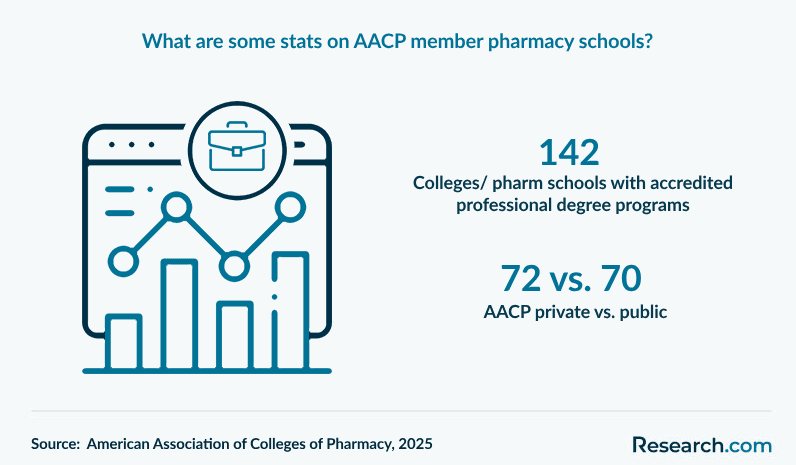
As of December 2023, the United States has 142 colleges and schools of pharmacy offering accredited professional degree programs overseen by the Accreditation Council for Pharmacy Education. Among American Association of Colleges of Pharmacy member institutions, 72 are private institutions and 70 are publicly supported universities, as shown below.
What are the prerequisites and application process for online pharmacy technician certificate programs?
Most online pharmacy technician certificate programs are accessible compared with degree programs, but requirements still vary by school, externship partner, certification exam, and state board of pharmacy.
- Confirm your state rules first. Some states require registration, licensure, certification, training approval, or background screening before you can work.
- Check education requirements. Many programs require a high school diploma or GED, and national certification exams may also require one.
- Verify age requirements. Students often need to be at least 18 years old for externships, certification, or employment.
- Review technology expectations. Online learners need reliable internet, a computer or compatible device, and basic comfort using learning platforms.
- Submit registration materials. Most certificate programs use a straightforward registration form rather than a selective college admissions process.
- Arrange payment. You may need to pay in full, start a payment plan, or confirm employer sponsorship before gaining course access.
- Prepare for externship screening. Programs with clinical placements may require immunization records, a background check, drug screening, or site-specific paperwork.
If you expect to continue beyond technician-level work, compare certificate training with degree pathways. Some students eventually pursue healthcare administration, public health, nursing, or pharmacy-related graduate study rather than staying in entry-level technician roles.
What essential skills will I learn in a top online pharmacy technician certificate program?
A good pharmacy technician certificate should train students to work accurately, follow regulations, communicate professionally, and support pharmacists without exceeding the technician scope of practice.
| Skill area | What students learn | Where it is used |
| Medication knowledge | Drug classifications, indications, contraindications, dosage forms, and common abbreviations | Prescription intake, drug reference checks, and pharmacist support |
| Pharmacy calculations | Conversions, dosage math, quantity calculations, and compounding formulas | Dispensing, preparation, inventory, and quality checks |
| Legal and ethical practice | Confidentiality, controlled-substance rules, state and federal regulations, and professional boundaries | All pharmacy settings |
| Prescription processing | Reading prescriptions, entering data, labeling, packaging, and identifying issues for pharmacist review | Retail, mail-order, hospital, and long-term care pharmacies |
| Inventory management | Ordering, storage, expiration checks, stock rotation, and medication handling | Retail, hospital, specialty, and long-term care operations |
| Insurance and billing | Third-party claims, payment collection, rejections, prior authorization basics, and patient communication | Retail and specialty pharmacy settings |
| Patient safety | Error prevention, quality assurance, double-check processes, and escalation to pharmacists | Any environment where medications are prepared or dispensed |
| Professional communication | Customer service, teamwork, documentation, and respectful patient interaction | Front counter, phone, hospital units, and interdisciplinary teams |
| Pharmacy technology | Pharmacy software, dispensing systems, patient profiles, electronic records, and workflow tools | Modern pharmacy operations across practice settings |
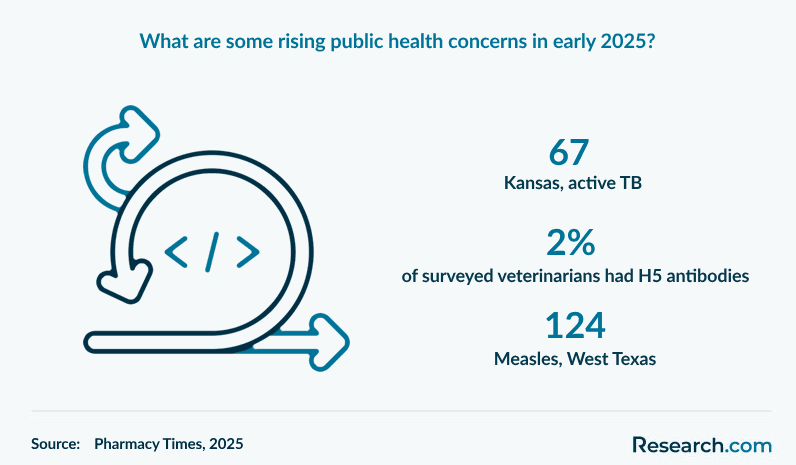
Pharmacy technicians also work in a healthcare environment affected by public health trends. According to Pharmacy Times (2025), norovirus, respiratory syncytial virus, influenza, and COVID-19 cases increased across the United States in what has been described as a "Quad-demic." Kansas reported 67 confirmed active tuberculosis cases and 79 latent cases across two counties as of January 24, 2025. A study of H5N1 found that 2% of surveyed veterinarians had antibodies to recent highly pathogenic avian influenza A(H5) infection without reporting respiratory symptoms or conjunctivitis. West Texas reported a measles outbreak involving 124 infected individuals, 1 death, and 18 hospitalizations, while New Mexico reported 9 cases as of February 25, 2025.
Students who are more interested in population health, infectious disease response, prevention, or health policy may want to compare pharmacy technician training with an affordable online public health degree pathway.
What are some career prospects after completing an online pharmacy technician certificate program?
Graduates usually begin in entry-level technician roles, then move into higher-responsibility positions as they gain experience, certification, and specialized training.
- Retail pharmacy technician: Supports prescription filling, patient service, inventory, payment, and insurance processes in community pharmacies.
- Hospital pharmacy technician: Helps pharmacists with medication preparation, distribution, sterile products, automated dispensing systems, and unit-based delivery.
- Mail-order pharmacy technician: Processes, packages, and ships prescriptions from large-volume distribution centers.
- Long-term care pharmacy technician: Assists with medication coordination for nursing homes, assisted living communities, and residential care settings.
- Compounding pharmacy technician: Prepares customized medications under pharmacist supervision and follows strict measurement and documentation procedures.
- Pharmacy benefits manager technician: Works with prescription benefit processes, coverage rules, claims support, and drug-cost management functions.
- Pharmacy informatics technician: Supports pharmacy technology, automated systems, electronic records, and workflow troubleshooting.
- Pharmacy purchasing technician: Manages medication purchasing, supply tracking, inventory costs, and vendor-related tasks.
Healthcare demand is also shaped by broader treatment trends. National Center for Health Statistics National Health Interview Survey data show that mental health treatment rates for all ages increased from 19.2% in 2019 to 23.9% in 2023. Among adults aged 18–44 years, the rate rose from 18.5% in 2019 to 26.6% in 2023. For adults aged 45–64 years, it increased from 20.2% in 2019 to 22.6% in 2023. For the 65+ age group, it moved from 19.4% in 2019 to 20.3% in 2023.
The data shown below points to rising engagement with mental health treatment, especially among younger adults. For students drawn to counseling or behavioral health rather than pharmacy operations, the most affordable online Masters in Mental Health Counseling programs may be a better long-term fit.
These trends do not change the basic pharmacy technician role, but they show why healthcare support workers need strong communication, privacy awareness, medication-safety habits, and the ability to work with patients managing complex conditions.
How much do online pharmacy technician certificate programs cost and what financing options are available?
Online pharmacy technician certificate programs are often less expensive than degree programs, but the real cost can be higher than the headline tuition. Before enrolling, ask for a written breakdown of every required and optional expense.
| Cost item | Why it matters | Question to ask |
| Tuition | Program prices can vary by institution, format, and included services | Is the advertised price the full program cost? |
| Books and materials | Some programs include all materials; others require separate purchases | Are textbooks, digital resources, and study guides included? |
| Certification exam fees | Exam vouchers may or may not be included in tuition | Does tuition include the PTCB, ExCPT, PTCE, CPhT, CSPT, or other exam fee? |
| Externship expenses | Students may need background checks, drug screens, transportation, uniforms, or immunization records | What costs are required before clinical placement? |
| Technology fees | Online platforms, proctoring, or testing systems may add charges | Are there platform, exam-proctoring, or graduation fees? |
| Payment-plan charges | Monthly plans can improve access but may increase total cost | Does the payment plan add fees or interest? |
- Program tuition: Many programs fall in the approximate range of $1,000 to $4,000, although some listed options cost less or use employer sponsorship.
- Payment plans: Monthly payment structures can make training easier to start, but students should confirm the total amount paid.
- Employer reimbursement: Healthcare employers or pharmacy chains may help cover training for employees pursuing technician roles.
- Institutional support: Some schools offer scholarships, grants, or internal payment options, though federal financial aid may be limited for some certificate programs.
- Veterans benefits: Eligible students should ask whether their benefits can be applied to the specific program.
- Private loans: These may be available, but students should compare interest, repayment terms, and whether the expected wage justifies borrowing.
Students comparing costs across healthcare fields can also review the cheapest online public health degree programs to understand how certificate costs differ from degree-level training.
How much can you earn after obtaining an online pharmacy technician certificate qualification?
A certificate can help you qualify for technician roles, but certification, work setting, experience, and geography usually have a larger influence on pay. Hospital, compounding, senior, and certified roles often pay more than general entry-level retail positions.
| Role or category | Reported pay information | What it suggests |
| Pharmacy technician | Average annual salary of $36,525 nationally in 2025, according to PayScale.com | Represents a general technician benchmark across settings |
| Certified pharmacy technician | National average of $39,258; California at $43,285, New York at $41,000, and Texas at $38,000 | Certification may improve earnings and job competitiveness |
| Compounding pharmacy technician | National average of $41,309; California at $38,770, Texas at $40,000, and Florida at $37,500 | Specialized preparation can support higher pay, though location still matters |
| Hospital pharmacy technician | National average of $42,182; California at $45,000, New York at $44,000, and Texas at $43,000 | Hospital roles often compensate above general retail positions |
| IV pharmacy technician | National average of $34,507; California at $35,000, Texas at $33,000, and Florida at $32,500 | This specialty shows lower reported averages than some other technician categories |
| Senior certified pharmacy technician | National average of $42,267; California at $44,000, Texas at $42,000, and Florida at $41,000 | Seniority and certification can support wage growth |
According to 2025 PayScale.com data, pharmacy technicians in California earn approximately $39,000, New York at $38,000, and Texas at $35,000. The same data show that certified pharmacy technicians average $39,258 nationally, while compounding pharmacy technicians average $41,309, hospital pharmacy technicians average $42,182, IV pharmacy technicians average $34,507, and senior certified pharmacy technicians average $42,267.
Students who want to move from technical pharmacy work into management may eventually consider an affordable online Masters in Healthcare Administration degree, especially if their goal is operations, compliance, leadership, or health-system administration.
The strongest salary strategy is not simply choosing the cheapest program. It is choosing a program that helps you qualify for certification, gain practical experience, and enter a work setting with advancement opportunities.
What are the key benefits and drawbacks of online versus in-person pharmacy technician certificate programs?
Online and campus-based pharmacy technician programs can both work. The better format depends on how you learn, how quickly you need to finish, whether you need hands-on practice built into the program, and how much schedule flexibility you require.
| Format | Advantages | Trade-offs | Best for |
| Online self-paced | Flexible schedule, no commute, often lower total cost, easier for working adults | Requires discipline, may offer limited live support, externship may not be guaranteed | Independent learners with reliable internet and strong time management |
| Online cohort-based | Structured deadlines, instructor pacing, remote access, clearer timeline | Less flexible than self-paced programs and may require scheduled activities | Students who need accountability but cannot attend campus regularly |
| Hybrid | Combines online convenience with in-person practice or externship support | Requires travel for some components and may limit geographic access | Students who want flexibility but still value hands-on learning |
| In-person | Direct lab practice, immediate instructor feedback, peer interaction, structured schedule | Less flexible, may cost more after commuting and campus fees, location-dependent | Students who learn best through face-to-face instruction and supervised practice |
Online programs may be the better choice if:
- You work full time or need to study around family responsibilities.
- You live far from a campus-based program.
- You are comfortable learning through reading, videos, modules, and online quizzes.
- You can independently schedule study time and meet deadlines.
In-person or hybrid programs may be the better choice if:
- You need hands-on repetition to understand calculations, compounding, or pharmacy workflow.
- You want direct access to instructors and classmates.
- You prefer a fixed schedule that reduces procrastination.
- You want a program that coordinates local externship placement more directly.
Online learning is now common across healthcare education. For example, some affordable healthcare MBA programs also use online delivery to serve working professionals.
What subspecialties and career paths are available for online pharmacy technician certificate graduates?
After building experience, pharmacy technicians can pursue specialized roles that require stronger technical skills, additional training, employer-specific competency checks, or advanced certification.
- Sterile compounding technician: Prepares IV medications, sterile products, chemotherapy drugs, or infusion medications under strict safety procedures.
- Nuclear pharmacy technician: Assists with radioactive medications used in diagnostic imaging or therapy and requires specialized safety training.
- Chemotherapy technician: Supports preparation and handling of chemotherapy medications, where accuracy and hazardous-drug precautions are critical.
- Medication therapy management technician: Helps pharmacists support adherence, medication review workflows, and patient follow-up.
- Clinical pharmacy technician: Works in hospitals or clinics, often assisting with medication reconciliation, patient profiles, and care-team support.
- Research pharmacy technician: Supports clinical trials, investigational drug handling, documentation, and research pharmacy operations.
- Specialty pharmacy technician: Works with complex medications for chronic, rare, or high-cost conditions and may coordinate patient support services.
- Lead or supervisory technician: Oversees workflows, trains newer technicians, coordinates schedules, and supports pharmacy operations.
- Pharmacy informatics technician: Uses pharmacy and technology knowledge to support software systems, automated dispensing, and electronic health records.
- Pharmacy purchasing or inventory technician: Manages medication purchasing, inventory control, storage, stock levels, and supply costs.
What is the job market like for online pharmacy technician certificate graduates?
The job market for pharmacy technicians is stable, with opportunities across retail, hospital, mail-order, long-term care, specialty, and other pharmacy settings. Employers may hire non-certified technicians in some locations, but certification can make applicants more competitive and may be required by certain states or employers.
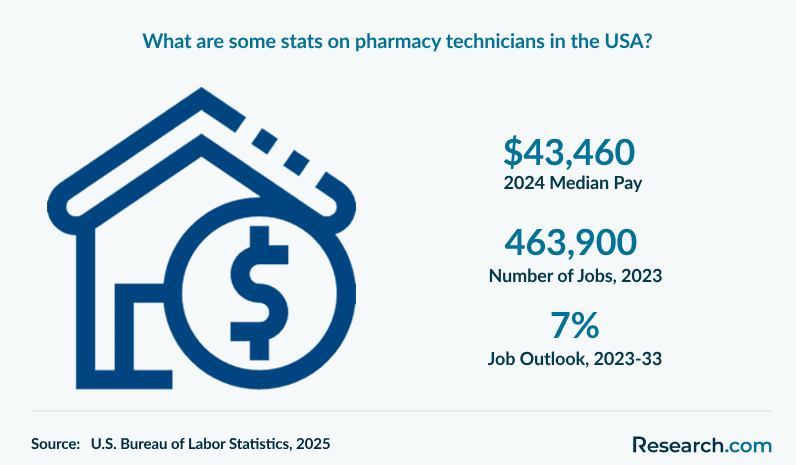
- Employment base: The United States had 463,900 pharmacy technician jobs in 2023, according to the U.S. Bureau of Labor Statistics.
- Projected growth: BLS projects 7% growth for pharmacy technicians from 2023 to 2033, which is faster than the average for all occupations.
- Openings: About 47,400 job openings are projected each year on average over the decade.
- Entry requirements: BLS notes that entry typically requires a high school diploma or equivalent, with moderate-term on-the-job training and no typical related work experience requirement.
- Demand drivers: Prescription medication use, aging populations, chronic conditions, pharmacy service expansion, and technician turnover all influence hiring.
- Certification advantage: CPhT or ExCPT credentials may improve access to hospital, specialty, and advanced technician roles.
According to the U.S. Bureau of Labor Statistics, pharmacy technicians earned median annual pay of $43,460, or $20.90 per hour, as of May 2024. The field’s 463,900 jobs in 2023 and projected 7% growth from 2023 to 2033 indicate an accessible healthcare support occupation with steady openings.
For new graduates, the most practical job-search approach is to apply broadly, highlight certification readiness, document externship experience, and target employers that provide structured training after hire.
What are the current industry trends and future outlook for online pharmacy technician certificate graduates?
Pharmacy technician work is changing as pharmacies adopt more technology, pharmacists expand clinical services, and employers seek technicians who can handle more complex workflows. Graduates who are comfortable with software, automation, patient safety procedures, and certification standards will be better positioned.
- Expanded technician responsibilities: As pharmacists spend more time on patient care and clinical services, technicians may take on broader operational duties within permitted scope.
- Automation and robotics: Dispensing machines, inventory systems, and automated workflows require technicians who can use technology accurately and troubleshoot basic issues.
- Telepharmacy and remote support: Remote medication management and virtual pharmacy services may create roles that require strong digital communication and documentation skills.
- Greater emphasis on certification: Employers increasingly value validated skills, especially for hospital, sterile compounding, and specialty pharmacy roles.
- Patient safety focus: Medication-error prevention, quality assurance, and accurate documentation remain central to the technician role.
- Specialization opportunities: Sterile compounding, specialty pharmacy, informatics, medication therapy management support, and purchasing can provide advancement paths.
- Healthcare demand: Aging populations and chronic disease treatment contribute to ongoing prescription volume and pharmacy service needs.
Common mistakes to avoid when choosing an online pharmacy technician program
| Mistake | Why it can hurt you | Better approach |
| Choosing only by lowest tuition | The cheapest option may exclude exam fees, books, externship costs, or support services | Compare total cost and included services before enrolling |
| Ignoring state requirements | You may complete a program and still be unable to register, certify, or work in your state | Check your state board of pharmacy before paying tuition |
| Assuming online means no hands-on training is needed | Employers may prefer applicants with practical experience or externship exposure | Prioritize programs with externship placement or local practice opportunities |
| Not verifying certification exam eligibility | A program may teach pharmacy topics but not align well with the exam you need | Ask which exam the program prepares for and whether the exam voucher is included |
| Overlooking accreditation and recognition | Employer acceptance and transfer options can vary by institution and program type | Verify institutional accreditation, program recognition, and employer expectations |
| Relying only on rankings | A highly ranked or inexpensive program may not fit your location, schedule, or career goal | Use rankings as a starting point, then compare requirements, outcomes, cost, and support |
| Assuming salary is guaranteed | Pay depends on location, certification, employer, experience, and specialization | Use salary data as a planning tool, not a promise |
Questions to ask before enrolling
- Does this program meet my state’s pharmacy technician registration or licensure requirements?
- Which certification exam does the curriculum prepare me for?
- Is the exam fee or voucher included in tuition?
- Is an externship required, optional, guaranteed, or student-arranged?
- What are the total costs, including books, background checks, drug screens, uniforms, technology fees, and certification fees?
- What happens if I do not complete the program on time?
- Does the program publish certification pass rates, completion rates, or job-placement information?
- Can I contact an advisor before enrolling?
- Are instructors available for tutoring, questions, or exam review?
- Will the credential be recognized by employers in my area?
Key Insights
- An affordable certificate can be worthwhile, but only if it fits your state and certification goals. Before enrolling, confirm state board rules, exam eligibility, and externship requirements.
- Tuition is only one part of affordability. Books, exam vouchers, background checks, drug screenings, externship expenses, and payment-plan fees can change the real cost.
- Hands-on experience matters. Online coursework can teach the theory, but externships or employer-based training help students apply prescription workflow, inventory, customer service, and safety procedures.
- Certification can improve marketability. Certified Pharmacy Technicians often have better access to hospital, specialty, compounding, and senior technician roles.
- The job outlook is steady. BLS reports 463,900 pharmacy technician jobs in 2023, projected 7% growth from 2023 to 2033, and about 47,400 openings per year on average over the decade.
- Pay varies widely. BLS reported median annual pay of $43,460, or $20.90 per hour, as of May 2024, while PayScale.com 2025 data show different averages by certification, specialty, and state.
- The best program is not always the cheapest. The strongest value comes from a program that is transparent, recognized, certification-aligned, flexible enough to finish, and connected to practical pharmacy experience.
References:
- American Association of Colleges of Pharmacy. (2025). Academic pharmacy's vital statistics.
- Antrim, A. (2025, February 28). Bird flu, tuberculosis, measles, and more: Top news from February 2025. Pharmacy Times.
- Hilas, O. (2025, May 14). Recent trends in mental healthcare. U.S. Pharmacist.
- PayScale. (2025, April 17). Pharmacy Technician Salary. PayScale.
- PayScale. (2025, April 22). Certified Pharmacy Technician (CPHT) Salary. PayScale.
- PayScale. (2025, March 2). Compounding Pharmacy Technician Salary. PayScale.
- PayScale. (2025, January 27). Pharmacy Technician Hourly Pay in New York, New York. PayScale.
- PayScale. (2025, March 1). Hospital Pharmacy Technician Salary. PayScale.
- PayScale. (2025, May 6). Senior Certified Pharmacy Technician Salary. PayScale.
- PayScale. (2025). IV Pharmacy Technician Salary. PayScale.
- U.S. Bureau of Labor Statistics. (2025, April 18). Pharmacy technicians. Occupational Outlook Handbook. U.S. Bureau of Labor Statistics.
Other Things You Should Know About Online Pharmacy Technician Certificate Programs
Most affordable online pharmacy technician certificate programs in 2027 can typically be completed in about 6 to 12 months. The duration depends on the program's structure, allowing students to balance their studies with other commitments more effectively.
Many affordable online pharmacy technician certificate programs are accredited by ASHP or offered by schools accredited regionally, but ACPE does not accredit technician certificate programs. A strong program should prepare students for PTCB’s Pharmacy Technician Certification Exam and meet state board requirements for externships or hands-on training.
Admission requirements typically include a high school diploma or GED, and some programs may require an entrance exam or background check. In 2027, online pharmacy technician certificate programs often expect applicants to submit transcripts and may ask for letters of recommendation.