# 1 position

Audited and Verified:
Our Editorial and Data Verification Process
Research.com uses government datasets, official education statistics and primary institutional information to support its career and degree guides. Our review process checks factual accuracy, occupational definitions, source dates and the requirements associated with the credentials discussed.
How This Article Was Fact-Checked
Our editorial team verifies salary estimates, employment projections, education requirements and program information against original data providers and official organizations. Salary figures are checked against the relevant occupational definitions and reporting periods. Information about licensure, accreditation and required in-person training is reviewed separately.
Fact-checked and verified on:

Co-Founder and Chief Data Scientist

Reviewed by Karolina Broda
Fact-Checker and Data Verification
A low tuition price does not tell you whether a dental assisting program will prepare you for clinical work - or for California's credential requirements. This guide accompanies the Most Affordable Dental Assistant Trade Schools in San Jose for 2027 ranking, created by the Research.com team of data scientists to help students identify training programs worth considering. With U.S. dental assistant employment projected to grow 7.4% from 2025 to 2035, according to the U.S. Bureau of Labor Statistics, the guide compares costs, hands-on training, credentials, and routes into local work.
Expect classroom instruction, simulated practice, and supervised clinical experience rather than a lecture-only course. Dental assistants prepare treatment areas, help dentists during procedures, manage infection control, and communicate with patients; their permitted duties depend on California rules and training (U.S. Bureau of Labor Statistics; Dental Board of California).
San Jose applicants may encounter certificate or diploma programs at public colleges and private career schools, as well as longer options that award an associate degree. San Jose City College, Gurnick Academy of Medical Arts, and Carrington College-San Jose are providers to investigate, but confirm the specific program, campus, start date, and credential directly. A shorter program can be a sensible choice if it provides the practical experience needed for your intended job; a broader program may be worth the extra time if its additional coursework serves a defined goal. Readers comparing short occupational routes can also consult best 6 month programs that pay well, while checking that any dental assisting option meets California's requirements.
Working directly in a dental office and receiving employer training is another possible entry route for basic assisting duties. It can reduce upfront school costs, but the employer's instruction may not cover every course or experience needed for later Registered Dental Assistant (RDA) eligibility. Ask what duties you can perform upon hire and what training the office will provide (Dental Board of California).
Dental offices are the principal workplace for dental assistants; specialty practices may involve orthodontic, pediatric, or oral-surgery workflows (U.S. Bureau of Labor Statistics). A San Jose student should therefore judge clinical placement by the work it offers: chairside exposure, sterilization, patient communication, and supervision are more useful than a placement described only as "hands-on." Ask whether the school arranges placements in reachable offices and whether travel is your responsibility.
Training for an assisting role is a focused route into dental practice, not a substitute for every other education path. If you are weighing an entirely different long-term occupation, compare that goal separately rather than paying for dental assisting training you do not intend to use; a guide to easy bachelor degrees that pay well addresses a different decision.
The U.S. median annual wage for dental assistants was $48,070 in May 2025, according to the U.S. Bureau of Labor Statistics. That national figure describes workers across experience levels and locations; it should not be used as a promised first salary in San Jose. Compare current local job postings for the duties you would qualify to perform, and ask employers whether pay differs for radiography authorization, RDA status, or specialty-office experience.
For an investment decision, estimate take-home earnings using realistic entry-level offers and the hours you expect to work. Then compare those earnings with your current income, training costs, and any wages you would forgo while studying. A higher advertised wage has limited value if the role requires a credential your program does not prepare you to obtain.
Length varies by credential, schedule, and the amount of required clinical work. A full-time certificate or diploma may be faster than a part-time program or an associate-degree pathway, but the shortest calendar duration is not necessarily the fastest route to the duties you want. California has distinct eligibility routes for RDA applicants, including approved education and qualifying work-experience routes; verify the current requirements with the Dental Board of California before relying on a school's advertised finish date.
Request a written schedule showing classroom hours, lab hours, clinical hours, placement dates, and any courses you must complete separately. If you will keep working, ask when clinical shifts occur: a manageable class timetable can still become impractical if required office hours conflict with your job.
Online coursework can help with subjects such as terminology, anatomy, and office procedures. It cannot replace supervised practice in infection control, chairside assisting, or patient-facing clinical work. A hybrid program is useful only if its in-person labs and clinical arrangements are accessible from San Jose and satisfy the requirements relevant to your intended California duties (Dental Board of California).
Before enrolling, get the location and scheduling of every practical component in writing. Also ask which costs are covered by your aid package; the fact that a school offers online classes does not itself establish federal-aid eligibility. A guide to online school financial aid can help frame those questions, but confirm eligibility with the program's financial aid office and Federal Student Aid.

There is no reliable single San Jose program average that captures public-college, private-school, and employer-training routes on the same basis. Published tuition may also exclude expenses that matter to a commuter attending labs or a clinical placement. Ask each provider for an itemized, current estimate through the point at which you can seek your intended job.
Use the following cost categories to make competing quotes comparable. A charge may be included at one school and billed separately at another:
| Cost category | What to verify |
| School charges | Tuition, mandatory fees, books, supplies, uniforms, and equipment |
| Clinical participation | Travel, parking, required health checks, and any background-check charges |
| Career entry | Required courses, examinations, certification, and applicable license or application fees |
| Time and financing | Lost work hours, aid or employer contributions, borrowing, and repayment terms |
A lower-priced program can be the better investment if it supports completion and the duties you want; an accelerated program can cost more than expected if its schedule forces you to stop working. Ask about eligible federal or state aid, scholarships, workforce funding, and employer-paid training, then compare your remaining cost and likely debt - not just the sticker price (Federal Student Aid; California Student Aid Commission).
The school may award a certificate, diploma, or associate degree. Those are educational credentials, not the same thing as a California RDA license or a professional certification. A program's name also does not establish that its graduates qualify for every dental assisting duty (Dental Board of California).
Distinguish the claims on a school's website before you apply. Institutional accreditation concerns the school; CODA accreditation concerns a dental assisting program; California Dental Board approval and eligibility rules concern state-regulated pathways and duties. DANB certification is a separate professional credential. Ask the program to identify which of these applies, provide its current status, and explain exactly which next steps a graduate must complete (Commission on Dental Accreditation; Dental Assisting National Board; Dental Board of California).
Schools set their own admission rules, which may include prior education, an application, and health or safety documentation before clinical placement. An employer hiring a trainee may use different criteria. Do not confuse admission with eligibility for radiography duties, an RDA license, or a particular clinical assignment; those are separate questions (Dental Board of California).
Before paying an enrollment deposit, ask admissions staff for the catalog requirements and the clinical-site requirements. If you already have dental-office experience, ask whether it can affect placement or credit, and obtain the answer in writing. Do not assume prior work automatically replaces a course or satisfies a state eligibility route.
Relevant training covers dental anatomy, instruments and materials, chairside procedures, infection prevention, records, and patient communication. Practical teaching should let students demonstrate these tasks in a lab and, where the program includes it, under supervision in a dental office (U.S. Bureau of Labor Statistics). Ask how performance is assessed - not merely whether a topic appears in a course outline.
California-specific instruction matters when you want duties beyond basic assisting. For example, do not assume that a general introduction to dental imaging authorizes you to take radiographs; check the applicable Dental Board of California training and certification rules. Digital records and imaging make careful documentation and equipment use valuable workplace skills, but neither replaces supervised clinical competence.
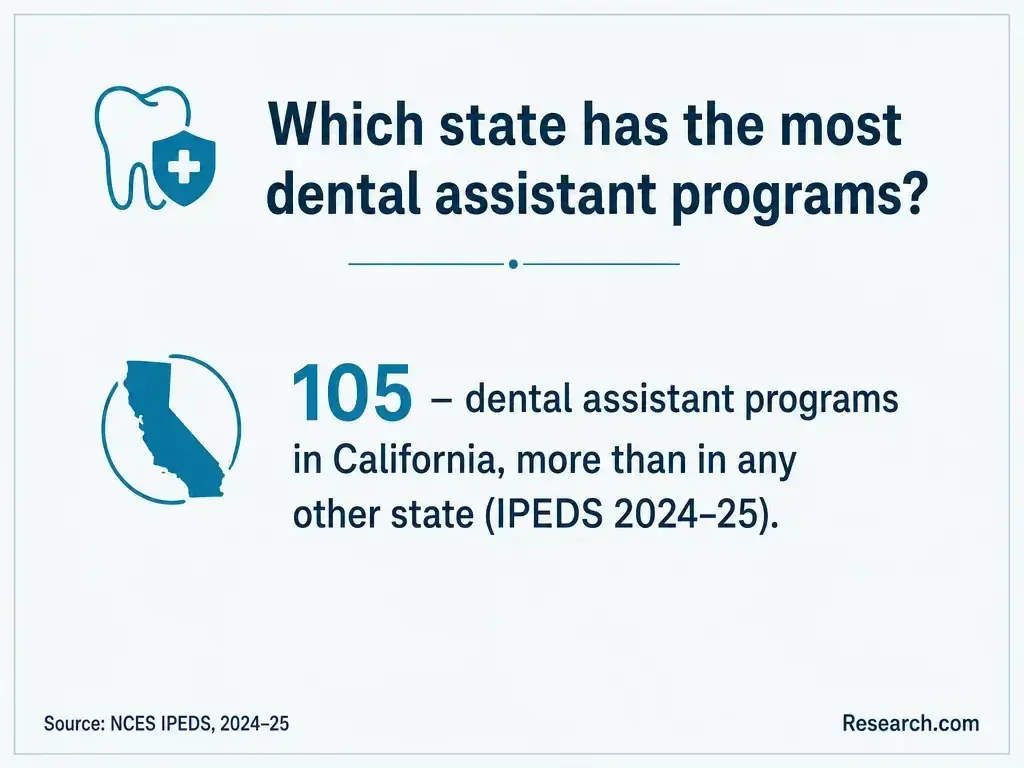
Not for every dental assisting role. California permits appropriately supervised basic assisting duties without making every assistant an RDA. However, particular duties have training or authorization requirements, and the RDA title is a state license with separate eligibility and examination rules (Dental Board of California). A school completion certificate alone should not be treated as that license.
Tell each school which tasks and title you want, then ask it to document how its curriculum supports the applicable California pathway. Verify the answer with the Dental Board of California before enrolling. DANB certification is distinct from California licensure; confirm whether an employer values it rather than assuming it is either mandatory for all jobs or interchangeable with an RDA license (Dental Assisting National Board; Dental Board of California).
Start with the job you want, then compare only programs that can plausibly prepare you for its duties. An affordability ranking is a useful shortlist, not proof of clinical quality or licensing eligibility. Use the same questions with each provider so differences in price and preparation become visible:
Be cautious if a school promises licensure on graduation, cannot identify its clinical arrangements, or quotes tuition while leaving required costs unspecified. The best-value choice depends on your chance of finishing, debt, lost work time, and the duties you can pursue afterward - not the lowest advertised price alone.
A common progression is from supervised entry-level assisting to broader responsibilities after meeting California's applicable training and authorization rules. With experience, an assistant may pursue RDA licensure, work in a specialty practice, or take on office coordination. Each step has its own employer expectations; advanced duties should not be inferred from time on the job alone (Dental Board of California; U.S. Bureau of Labor Statistics).
If earnings are your main reason for enrolling, compare dental assisting's training cost and realistic entry pay with other occupations before committing. The guide to trade school highest paying jobs provides a broader comparison, but pay alone does not show whether a role fits your interests or local opportunities.
National dental assistant employment is projected to grow 7.4% from 2025 to 2035, according to the U.S. Bureau of Labor Statistics. That supports considering the occupation, but it is not a forecast of openings at a particular San Jose practice or a guarantee of work after graduation. Review current local postings for required duties, schedules, and credentials before deciding which program's clinical training is worth paying for.
Dental assisting is best evaluated as a direct occupational-entry investment. If your intended career requires a substantially different educational route, assess that route on its own terms rather than treating this short training program as a necessary first step; a guide to fast masters degrees concerns such a separate decision.
Investing in training is an important decision. To make the accompanying ranking credible and useful, Research.com compares dental assisting programs with other programs in the same occupation and location, using reported education, cost, and debt information. Only programs with completions reported to IPEDS are eligible; an unlisted employer-training route or provider should not be assumed to be inferior or unavailable.
Most affordable rankings score tuition, cost of attendance, median student debt, and federal loan default rate. Indicator weights are assigned through an entropy-based method, which gives more weight to measures that vary more across eligible programs. Accreditation and other quality measures are not part of this affordability score. For context, Research.com's separate best-program rankings assess outcomes, earnings and return on investment, costs and debt, and quality and recognition; their current weights assign 20% to relevant programmatic accreditation or industry recognition, 10% to institutional accreditation, 10% to student support, and 60% to outcomes, earnings, and costs, with entropy-based weighting within that final group.
The ranking draws on the following databases and organizations. Some cover broad education measures; others help assess occupation-specific recognition or training context:
Use the ranking to narrow your price comparison, then verify each program's current charges, clinical training, and California credential alignment before enrolling. Research.com explains its broader approach on its methodology page.
# 1 position
# 2 position
# 3 position
# 4 position
# 5 position
Compare the full cost of a public-college program, a private career-school program, and any available employer-paid training. Include supplies, travel, lost wages, and any later coursework needed for your intended duties; the lowest tuition is not always the lowest total cost.
California permits entry into some supervised basic assisting work without an RDA license. Employer training may be an option, but specific duties and later RDA eligibility have separate requirements; verify them with the Dental Board of California.
Online classes may cover theory, but chairside skills and clinical practice require in-person training. Confirm where a hybrid program provides those components and whether they align with your California career goal.
No. A school credential and a California RDA license are different. Check the Dental Board of California's current eligibility and examination requirements for the route you plan to use.
It can be if its schedule lets you finish and its practical training supports your target job. Compare total cost, missed work, clinical access, and credential eligibility before paying more for speed.