# 1 position


Audited and Verified:
Our Editorial and Data Verification Process
Research.com uses government datasets, official education statistics and primary institutional information to support its career and degree guides. Our review process checks factual accuracy, occupational definitions, source dates and the requirements associated with the credentials discussed.
How This Article Was Fact-Checked
Our editorial team verifies salary estimates, employment projections, education requirements and program information against original data providers and official organizations. Salary figures are checked against the relevant occupational definitions and reporting periods. Information about licensure, accreditation and required in-person training is reviewed separately.
Fact-checked and verified on:

Co-Founder and Chief Data Scientist

Reviewed by Karolina Broda
Fact-Checker and Data Verification
Choosing an affordable dental assistant program means looking beyond tuition: a short course may cost less upfront but offer too little chairside practice. The U.S. Bureau of Labor Statistics reports a national median annual wage of $48,070 for dental assistants in May 2025. For students and career changers in Augusta, Maine, this guide explains training routes, costs, credentials, and state requirements. It accompanies the Most Affordable Dental Assistant Trade Schools in Augusta for 2027 ranking, created by the Research.com team of data scientists to help you identify programs worth considering.
Expect a mix of dental terminology, infection-control instruction, simulated chairside procedures, and supervised practice with patients or in a dental office. Programs vary substantially in what they award and how much real clinical experience they arrange. A short certificate may suit someone seeking prompt entry into basic assisting; a longer diploma or associate-level occupational program may provide broader practice, but its additional time and cost should serve a clear employment goal.
These pathways differ most in who supplies practical training and who pays for it. Ask each provider for its actual schedule, required hours, and credential rather than assuming programs with similar names are interchangeable.
| Pathway | Typical credential or outcome | Best fit and principal trade-off |
| Career-school or public-college program | Certificate or diploma; some occupational programs award an associate degree | Structured labs and possible clinical placement; compare total cost and verified placement arrangements. |
| Employer-sponsored entry | Office training; a school credential may not be awarded | Potentially earns wages sooner, but training breadth and preparation for additional duties may vary by employer. |
| Registered apprenticeship, if locally available | Work-based training and a registered apprenticeship completion credential | Paid, supervised learning; openings and occupation-specific registration must be verified rather than assumed. |
For a student who already has a dental-office offer, employer training may be more economical than paying for a course. Someone who wants structured practice before applying should examine lab access and the quality of the clinical placement. Academic programs in unrelated fields - including a 1 year online masters degree - are not substitutes for chairside dental training.
Dental offices are the primary employment setting for dental assistants nationally, according to the U.S. Bureau of Labor Statistics. In and around Augusta, compare general practices with specialty offices, community dental clinics, and positions within commuting distance. A longer commute can change the value of a low-cost program or a job offer, especially if a clinical placement requires travel on unpaid days.
Ask prospective employers which duties they expect a new assistant to perform, whether they train new hires, and whether radiography eligibility is needed at hiring. Front-desk work may be part of a dental assistant's day, but it is different from chairside competency. If quiet, independently performed work is your priority, browsing best online jobs for introverts may help clarify your preferences; dental assisting itself involves frequent patient and team interaction.
A reliable Augusta-specific wage should be taken from a clearly identified metro-area or Maine occupational wage release, not inferred from national pay. The U.S. Bureau of Labor Statistics' May 2025 national median is $48,070 annually for dental assistants. That is the midpoint across experienced and newer workers nationwide - not a starting-pay quote for an Augusta graduate.
For a useful local comparison, ask employers about starting hourly pay, paid hours, benefits, and raises tied to additional responsibilities. Compare those offers with your current earnings and the time you would spend training. A higher advertised wage may be less valuable if the job provides fewer hours or requires a costly commute.
There is no single required duration for basic dental assistant training in Maine. A short course, a longer certificate or diploma, and employer training can have different calendars and substantially different amounts of supervised practice. Full-time and part-time schedules also change how soon a student can seek work. Obtain the provider's total clock or credit hours, lab hours, clinical hours, and placement dates in writing before comparing completion times.
An accelerated schedule makes sense if you can attend every required lab and secure clinical access without giving up essential income. A part-time route may be cheaper overall for someone who must keep working, even if graduation takes longer. Do not treat a fast completion date as evidence that the program prepares you for radiography or other regulated duties.
Online instruction can cover terminology, anatomy, documentation, and some infection-control concepts. Chairside assisting, instrument handling, patient positioning, and supervised clinical work require in-person practice. A hybrid program is worth considering only when its lab location, clinical arrangements, and travel demands are workable from Augusta.
Before paying for an online course, ask exactly where skills are assessed and who arranges any externship. A course described as "fully online" should not be assumed to satisfy Maine requirements for additional dental assisting duties or an employer's hands-on expectations. Lists of accredited universities online with no cost to apply address a different selection question; application-fee savings do not establish dental clinical training or eligibility.
There is no defensible Augusta-wide average program price without a defined set of current, comparable programs and their published charges. An advertised tuition figure alone omits expenses that can change which option is genuinely most affordable. Request an itemized, program-specific quote and compare the total cost to become job-ready.
Build your comparison from these charges and offsets so that a lower sticker price does not conceal a more expensive route:
Federal aid eligibility depends on the student and the program, not simply on a school's advertising; verify it through Federal Student Aid and the provider. Maine workforce-training assistance may also be worth checking before enrollment. If you are comparing education investments more broadly, a cheap phd listing uses a fundamentally different cost and career framework, not a useful price benchmark for dental assistant training.
The award depends on the provider: it may be a certificate, diploma, or occupational associate degree. Employer training may produce no school credential, while a registered apprenticeship, where available, has a separate completion credential. Ask for the exact award name and whether the program has Commission on Dental Accreditation (CODA) accreditation if that matters to your intended certification route.
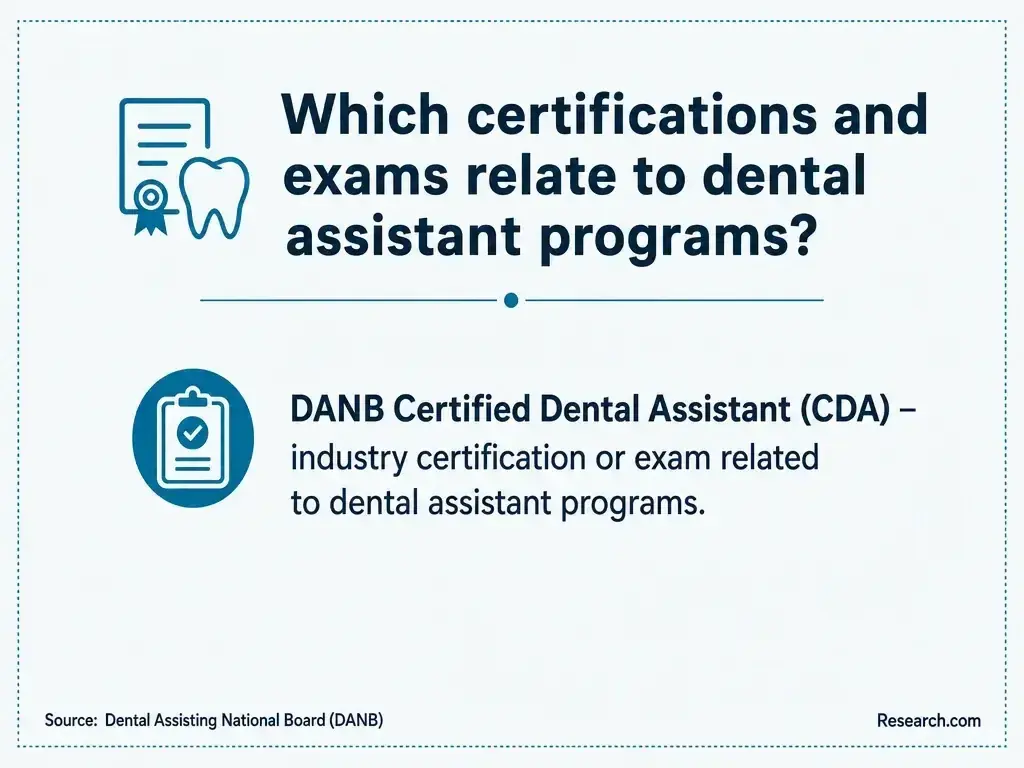
A school award, institutional accreditation, CODA program accreditation, Dental Assisting National Board (DANB) certification, and permission to perform a particular duty under Maine law are distinct. None automatically substitutes for the others. If you may later change programs, ask whether credits or prior dental-office training can be evaluated for transfer or advanced standing; never assume a short course will transfer.
Admissions rules vary by provider. Common items to check include a high school diploma or equivalent, an application, readiness for laboratory work, and any health documentation or background screening required for clinical placement. Employers offering direct training set their own hiring standards. Ask whether a student can enroll before securing a clinical site and what happens if that site falls through.
School admission is not the same as eligibility for an examination, certification, or a Maine-regulated duty. Obtain written answers about prerequisites for the precise credential or function you want, particularly if radiography is part of your plan.
A useful curriculum connects classroom knowledge to repeatable chairside skills: preparing treatment rooms, maintaining infection-control procedures, identifying instruments, assisting during procedures, recording information accurately, and communicating with patients. The U.S. Bureau of Labor Statistics describes these as core areas of dental assistant work. Radiography instruction may be offered, but its presence in a catalog does not by itself establish eligibility to perform radiographs in Maine.
Ask to see the skills checklist and how instructors assess performance on real or simulated patients. A program that offers extensive online content but little observed practice may be a poor match for a first-time assistant, even if its credential title matches a more hands-on program.
Do not assume that all dental assisting duties share one entry rule. Maine's Board of Dental Practice distinguishes basic assisting from regulated additional functions, including dental radiography and expanded functions. Before enrolling, check the board's current rules for the duties you want to perform and ask whether the proposed training meets the applicable education, examination, or application requirements. A school's certificate alone does not establish that eligibility.
National DANB certification is a separate professional credential with its own eligibility routes and examinations, according to DANB. It can be relevant to employment or advancement, but it is not identical to Maine authorization for a regulated function. CODA accreditation concerns a program; institutional accreditation concerns a school. Verify each separately rather than treating "accredited" or "certification-ready" as a complete explanation.
Start with the duties you want, then compare only programs that can demonstrate the relevant instruction and practical experience. The most affordable ranked option is not necessarily the least expensive job-ready path if it lacks a workable clinical placement or requires additional training.
Ask each provider the following questions before paying a deposit; the answers expose cost and eligibility gaps that a ranking cannot resolve:
Two common mistakes are assuming that accreditation alone permits every duty and comparing tuition without accounting for lost earnings. Someone seeking a different learning experience can explore top college degrees for older adults online, but that comparison should not replace checking dental-office practice and Maine-specific requirements.
A common first step is general chairside assisting, followed by greater responsibility as skills and employer trust develop. Depending on additional training and applicable Maine rules, an assistant may pursue radiography or expanded functions, move into specialty-office assisting, or take on scheduling, patient coordination, or lead-assistant responsibilities. These are possible paths, not automatic promotions conferred by an entry-level certificate.
Choose training against the next role you actually want. If your goal is immediate chairside work, a longer program is worth its added cost only if its practice and employer recognition improve your prospects. If you aim for regulated additional functions, confirm the precise eligibility route before choosing the shortest course.
The U.S. Bureau of Labor Statistics projects 7.4% growth nationally from 2025 to 2035 for dental assistants. That indicates continuing national demand, not a guaranteed opening or an Augusta-specific growth rate. Local hiring can differ across general practices, specialties, and nearby communities.
Use the projection as a reason to investigate opportunities, not as a substitute for them. Check current local postings for requested clinical experience and radiography qualifications, then ask programs which nearby practices host trainees. That evidence is more useful for choosing an Augusta training route than a national projection alone.
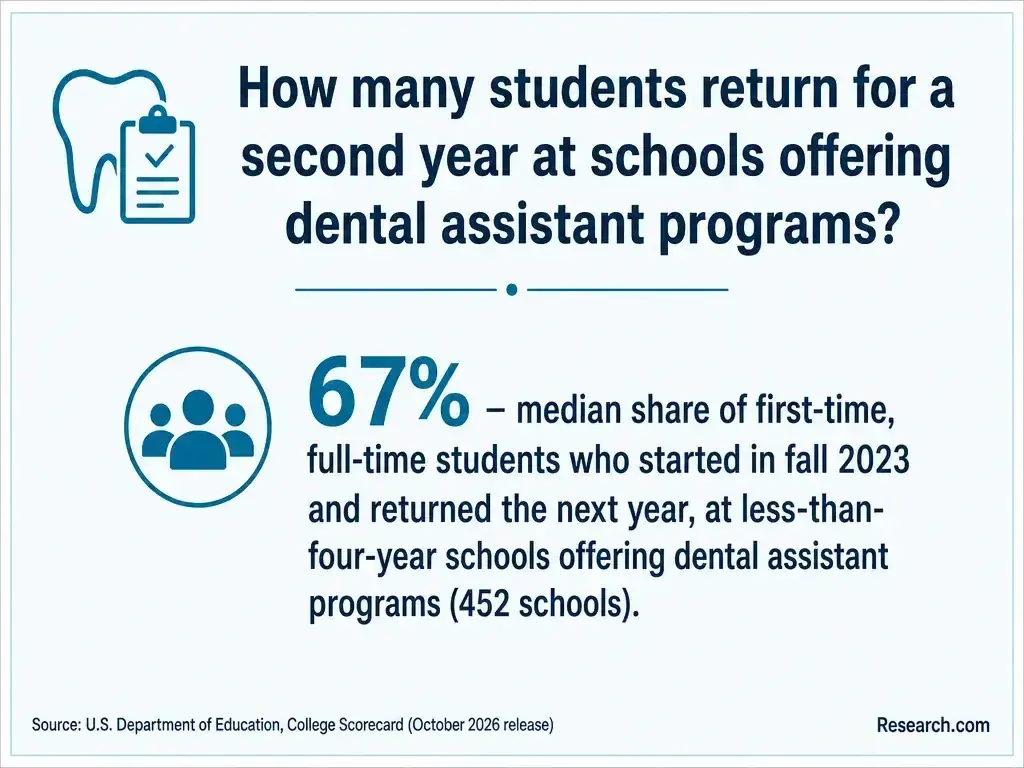
Education is a consequential investment, so the Research.com team designed this ranking to help readers compare affordable dental assistant programs against their relevant local options - not against unrelated occupations. The team uses standardized education and cost data and checks occupation-relevant sources to support the ranking's credibility. Only programs with completions reported to the Integrated Postsecondary Education Data System (IPEDS) are eligible; an unlisted provider is not necessarily unapproved or poor quality.
The most affordable ranking scores tuition, cost of attendance, median student debt, and the federal loan default rate. Weights are assigned using an entropy-based method, which gives more weight to measures that vary more across eligible programs. Accreditation, support services, and earnings are not part of this affordability score. Research.com's separate best-program rankings also consider outcomes, earnings, accreditation or industry recognition, and support services. Readers should therefore use an affordability rank as a cost-screening tool, then independently verify hands-on training and career-entry fit.
The ranking draws on these data sources. Dental-specific sources help interpret credentials and recognition; inclusion of a broader trade source does not make it a dental-assisting accreditor.
For additional detail on ranking design, see Research.com's methodology. A ranking cannot confirm that a particular graduate will qualify for every dental-office duty in Maine; that requires checking the program and the Maine Board of Dental Practice.
# 1 position
# 2 position
Not necessarily. Compare the full cost after aid alongside supervised practice, clinical placement, and preparation for the duties employers request. A cheap course that requires substantial additional training may cost more overall.
Employer-sponsored training may be an option for basic assisting. Ask the employer what training is provided and check Maine Board of Dental Practice requirements before planning to perform regulated additional functions.
Some theory can be taught online, but chairside and patient-care skills need in-person practice. Verify where labs and clinical experience occur before enrolling.
No. A school certificate and DANB certification are separate. Check DANB's current eligibility and examination rules for the credential you want.
Compare wages during training, total out-of-pocket cost, supervised skill development, and the time until you can perform your intended duties. Ask whether either route leaves you needing additional coursework or examinations.