# 1 position


Audited and Verified:
Our Editorial and Data Verification Process
Research.com uses government datasets, official education statistics and primary institutional information to support its career and degree guides. Our review process checks factual accuracy, occupational definitions, source dates and the requirements associated with the credentials discussed.
How This Article Was Fact-Checked
Our editorial team verifies salary estimates, employment projections, education requirements and program information against original data providers and official organizations. Salary figures are checked against the relevant occupational definitions and reporting periods. Information about licensure, accreditation and required in-person training is reviewed separately.
Fact-checked and verified on:

Co-Founder and Chief Data Scientist

Reviewed by Karolina Broda
Fact-Checker and Data Verification
Choosing dental assistant training in El Paso means looking beyond a school's name: Will its clinical practice, cost, and Texas credential preparation match the job you want? The U.S. Bureau of Labor Statistics projects dental assistant employment to grow 7.4% nationally from 2025 to 2035. This guide explains local training pathways, career-entry rules, costs, and earnings so you can compare them realistically. It also accompanies the Best Dental Assistant Trade Schools in El Paso for 2027 ranking, created by the Research.com team of data scientists to help students identify programs worth considering.
Expect instruction in chairside procedures, infection control, patient communication, dental materials, records, and radiography concepts, followed by practice that lets an instructor assess your technique. Dental assisting is a hands-on occupation: a program's value depends partly on how much supervised lab or clinical experience it provides and what students actually do during that experience.
El Paso Community College and Pima Medical Institute-El Paso are two providers to investigate. Ask each for its current credential, schedule, clinical-placement arrangements, and documented eligibility for the Texas duties you want. A shorter program may get you into a workplace sooner, while a longer one may offer more structured practice; neither advantage is automatic.
Direct-entry employment with supervised training is another possible route for permitted assisting duties. It can reduce upfront school costs, but the employer may not teach every skill or arrange the preparation needed for radiography registration. Compare the work you would be allowed to do at the end of each route, not just how quickly you could start.
Dental assistants primarily work in dental offices, where they prepare treatment areas, support dentists during procedures, process instruments, and help patients understand next steps, according to the U.S. Bureau of Labor Statistics. In El Paso, compare openings in general dentistry with specialty practices such as orthodontics and oral surgery: the daily tasks and preferred experience can differ.
Ask a prospective clinical site whether students rotate through different procedures or repeatedly perform a narrow set of tasks. That answer can matter as much as the provider's name when applying for a first job. Training can strengthen an application, but it does not guarantee placement; the broader question of does trade school help you get a job depends on practical skills, local openings, and employer requirements.
The U.S. Bureau of Labor Statistics reports a $48,070 national median annual wage for dental assistants in May 2025. A median describes workers across experience levels and locations; it is not a likely first paycheck in El Paso. Use the latest BLS metropolitan occupational wage estimate or Texas workforce wage data when comparing local offers, and check whether an advertised rate assumes radiography duties, specialty experience, or a particular schedule.
To judge whether training is worth its price, compare the wages you could realistically earn before and after training with total program cost, aid, debt, and earnings forgone while studying. Include your chance of finishing and a sensible time horizon. A lower tuition bill does not necessarily produce the better return if it leaves you without the practical experience an employer expects.
Duration depends on the credential, attendance schedule, lab hours, and whether a program includes an externship. A full-time career-school course, a college credential, and employer-based training should not be assumed to have the same calendar length or supervised hours. Request the current catalog's total clock or credit hours, separately identified lab and clinical hours, and the earliest realistic completion date for your intended schedule.
If you need to keep working, ask whether required labs or externships are offered outside your work hours. An accelerated schedule saves calendar time only if you can attend every practical component. A fast track bachelor's degree online serves a different educational goal and does not replace the in-person skills preparation needed for dental assisting.
Online coursework can cover terminology, anatomy, records, and some infection-control concepts. Instrument handling, chairside assistance, equipment use, and patient-facing skills require supervised in-person practice. A hybrid program is useful when its remote coursework reduces commuting without making clinical attendance difficult.
Before enrolling in a program advertised as online, get its lab location, attendance requirements, clinical-site arrangements, and Texas radiography-preparation details in writing. Lists of easy online programs cannot establish that a dental assistant course supplies these competencies. If a provider cannot explain where and how practical skills are assessed, treat that as a warning sign.
There is no single reliable price that covers every El Paso dental assistant pathway. Published tuition may exclude mandatory fees, textbooks, uniforms, protective equipment, health or background requirements for clinical placement, transportation, and any applicable examination or registration costs. Ask El Paso Community College and Pima Medical Institute-El Paso for current, itemized estimates for the exact program and attendance schedule you are considering.
The most useful comparison is total cost to become job-ready, less aid you are actually eligible to receive. Check a school's current federal-aid eligibility rather than assuming every short course qualifies; also ask about scholarships, Texas workforce assistance, payment terms, and whether an employer would provide paid training. Factor in time away from work. A low sticker price can become expensive if clinical travel or a schedule change cuts your earnings.
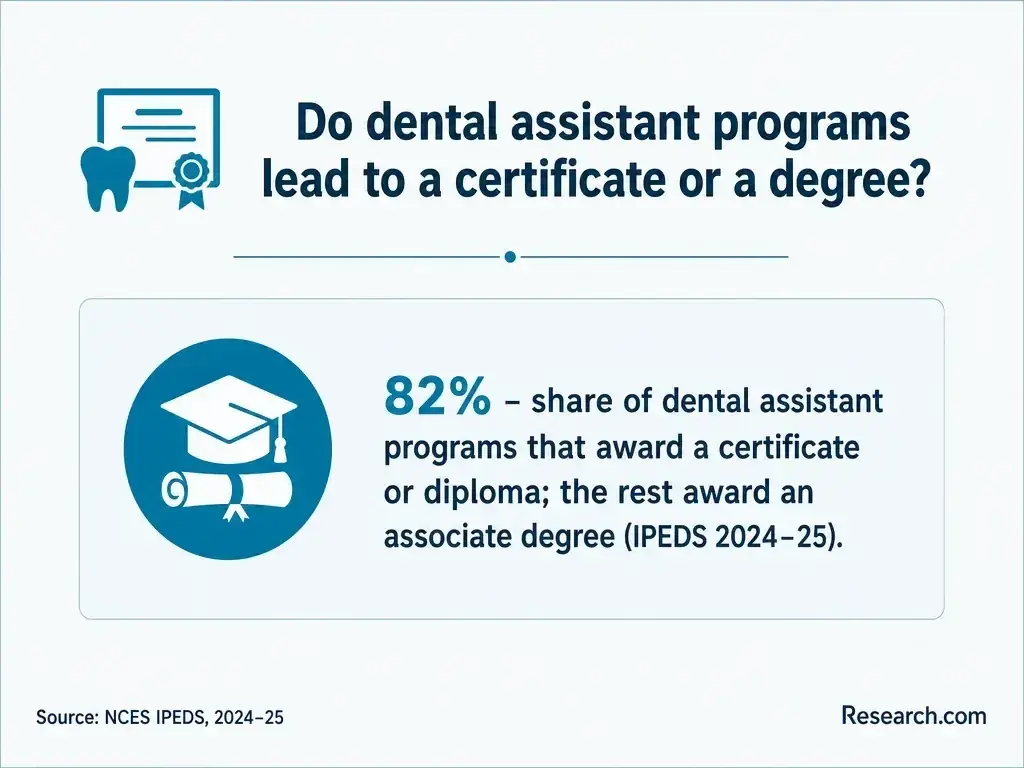
The award may be a certificate, diploma, or, where offered, an associate degree. The school credential documents completion; it is not the same thing as institutional accreditation, Commission on Dental Accreditation program accreditation, Dental Assisting National Board certification, or registration with the Texas State Board of Dental Examiners. Ask for the precise credential name and whether the specific program - not merely the institution - holds any claimed programmatic accreditation.
Match the credential to your goal. If you want rapid entry into permitted assisting duties, a shorter route with strong supervised practice may fit. If you want a broader college pathway, ask whether credits will transfer or count toward another credential; do not assume they will. If radiography is part of your goal, verify the applicable Texas registration steps independently of the credential title.
Schools set their own entry rules, which may include proof of prior education, an application, placement steps, and requirements for participation in clinical settings. A clinical site may impose health, safety, or background conditions beyond basic admission. Ask for those conditions before paying a nonrefundable charge, particularly if a past record or scheduling constraint could affect placement.
Employer-based entry is different: a practice may hire and train a beginner for duties permitted under Texas rules, but its hiring criteria and scope of training are its own. Neither school admission nor a job offer alone establishes eligibility for every dental assisting duty.
Core learning typically combines infection prevention, instrument processing, chairside workflow, dental materials, patient records, and communication, consistent with duties described by the U.S. Bureau of Labor Statistics. Radiography preparation needs particular scrutiny because Texas regulates who may expose dental radiographs. Ask whether students practice positioning and safety procedures under supervision and how the school documents that training.
Look beyond a course-title list. A useful skills demonstration shows whether you can set up and turn over an operatory, anticipate instruments, follow infection-control procedures, and communicate calmly with patients. Digital records and imaging also make accurate documentation important. Request the lab and externship objectives so you can see which tasks are taught, observed, and assessed.
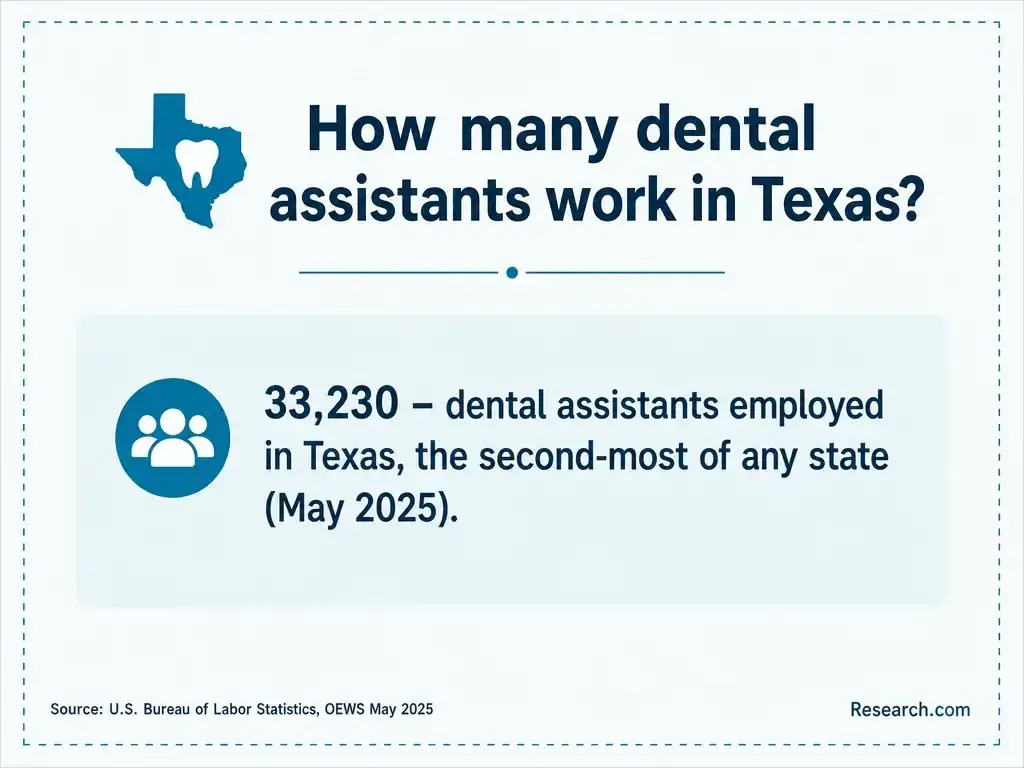
Not every dental assistant duty requires the same credential. Texas allows certain assisting work without treating school graduation as an occupational license, but dental assistants who intend to perform radiography must meet Texas State Board of Dental Examiners requirements for registered dental assistants. The board - not a school's marketing page - defines permitted duties and current registration requirements.
National certification from the Dental Assisting National Board is distinct from Texas registration. Before choosing a program, identify the duties in the jobs you want, then ask the Texas board which education, training, assessment, and application steps apply. Request written confirmation from the school of which steps its program addresses and which remain your responsibility. Institutional or programmatic accreditation does not itself grant permission to perform radiography.
Use the ranking to identify programs to investigate, then test each against the same job-ready standard. An institution's presence on a list of top accredited non-profit colleges, for example, would not establish dental assisting program accreditation, Texas radiography eligibility, or access to a local clinical site. School ownership and institutional accreditation answer different questions from occupational preparation.
Get these answers in writing before enrolling; they reveal differences a tuition figure or ranking position may miss:
Favor the option that fits your schedule, finances, and intended duties. Avoid choosing solely on speed, a low advertised tuition, or an unsupported placement claim.
An entry-level assistant may build experience in general dentistry before pursuing a specialty practice, office coordination, or expanded responsibilities allowed under Texas rules. Additional duties can require separate training or board authorization; advancement is not automatic with experience. If you are considering a different education goal, a list of highest paid masters degrees should not be used to estimate the return on dental assistant training.
Choose training around the next job you actually want. For chairside work, prioritize supervised clinical breadth. For an office-focused role, ask how much time the curriculum devotes to scheduling, records, and patient communication. If a future role requires a different regulated credential, verify that pathway separately rather than assuming dental assisting hours will count toward it.
The U.S. Bureau of Labor Statistics projects 7.4% national employment growth for dental assistants from 2025 to 2035. That supports considering the occupation, but it is not a forecast of El Paso openings or a promise of work after graduation. Local demand depends on practices' hiring, turnover, and the duties they need new staff to perform.
Before committing to training, review current El Paso job postings for required credentials, radiography expectations, schedules, and experience. Compare those requirements with each program's practical training and clinical placement. This check is especially important if a low-cost or online-heavy option leaves a gap between its credential and the work local practices advertise.
Investing in training is an important decision, so Research.com designed its ranking to compare dental assistant programs against other programs serving the same occupation and location. The team uses reported outcomes, costs, recognition, and student-support information to make those comparisons more credible. Only programs with completions reported to IPEDS are eligible; an unlisted training provider is not necessarily unapproved or ineffective.
For its best-program rankings, Research.com evaluates student outcomes, earnings and return on investment, costs and debt, and quality and recognition. Programmatic accreditation or relevant industry recognition accounts for 20% of the score, institutional accreditation for 10%, and student support for 10%. The remaining 60% covers outcomes, earnings, and costs, with weights distributed through an entropy-based method that gives more weight to indicators that differ more across programs. Its most-affordable-program rankings score only tuition, attendance costs, debt, and federal loan default rates; they do not score accreditation or other quality measures.
The ranking draws on the following sources. Some provide college data, while others help identify occupation-specific recognition or alternative training routes:
These sources help readers build a shortlist, not replace a direct check of current tuition, clinical placements, and Texas requirements. See Research.com's methodology for more about how the ranking is created.
# 1 position
# 2 position
# 3 position
It can be if the program supplies supervised skills you need, fits your work schedule, and prepares you for the Texas requirements tied to your target duties. Compare its full cost and forgone earnings with employer-training alternatives and realistic local wages.
Some employers may train beginners for duties Texas permits them to perform. Ask what supervision and skills training the job provides, and verify separately what is required if you intend to perform radiography.
Online lessons can cover theory, but chairside and other practical competencies require in-person training. Confirm the lab and clinical arrangements before enrolling in a hybrid course.
No. A school credential and Texas State Board of Dental Examiners registration are separate. Check the board's current requirements for the duties you plan to perform.
Start with the exact credential, supervised lab and clinical experience, Texas radiography preparation, total cost, and schedule. Then verify each provider's current outcomes and placement arrangements.