# 1 position
Pima Medical Institute-Denver - Dental Assisting/Assistant.
certificate or diploma

Audited and Verified:
Our Editorial and Data Verification Process
Research.com uses government datasets, official education statistics and primary institutional information to support its career and degree guides. Our review process checks factual accuracy, occupational definitions, source dates and the requirements associated with the credentials discussed.
How This Article Was Fact-Checked
Our editorial team verifies salary estimates, employment projections, education requirements and program information against original data providers and official organizations. Salary figures are checked against the relevant occupational definitions and reporting periods. Information about licensure, accreditation and required in-person training is reviewed separately.
Fact-checked and verified on:

Co-Founder and Chief Data Scientist

Reviewed by Karolina Broda
Fact-Checker and Data Verification
Choosing dental assistant training in Denver means comparing more than tuition: the right program must give you usable clinical practice and a realistic route into a dental office. The U.S. Bureau of Labor Statistics projects 7.4% national employment growth for dental assistants from 2025 to 2035, making training quality worth examining. This guide explains costs, credentials, work settings, and Colorado requirements. It also accompanies the Best Dental Assistant Trade Schools in Denver for 2027 ranking, created by the Research.com team of data scientists to help students identify programs worth considering.
Expect a short, occupation-focused program built around chairside procedures rather than an academic degree. Instruction typically combines dental anatomy, instruments, infection prevention, patient communication, records, and practice in a simulated operatory. Some programs add a supervised dental-office externship. Ask for the actual lab and externship hours: two certificates with similar titles may provide very different amounts of patient-facing experience.
In Denver, a public technical-school option such as Emily Griffith Technical College and a private career-school option such as Pima Medical Institute-Denver may suit different schedules and budgets. Compare their current program disclosures directly rather than assuming provider type determines quality or return on investment. If you already have access to a dental office willing to train you, paid entry-level work may be more economical than school; confirm which duties the employer will teach and supervise.
Most dental assistants work in dentists' offices, where duties can include preparing rooms, assisting during procedures, sterilizing instruments, and managing records (U.S. Bureau of Labor Statistics). In the Denver area, applicants can also investigate specialty practices, including orthodontic and oral-surgery offices, and larger multi-location dental groups. A specialty office may value focused experience that a general chairside certificate does not fully provide.
Ask a prospective externship site whether students rotate through procedures, receive direct feedback, and have a chance to interview for openings. If commuting across the metro area is difficult, weigh the location of both the campus and assigned practice sites before accepting a placement.
The U.S. median annual wage for dental assistants was $48,070 in May 2025 (U.S. Bureau of Labor Statistics). This national midpoint is useful for testing whether a training bill is proportionate to the occupation's earning potential, but it is not a Denver wage estimate or an entry-level salary. Local offers can vary with experience, duties, specialty, schedule, and employer.
For a Denver-specific decision, compare current local job postings for the duties you expect to qualify for - not senior or expanded-duty positions - with the complete cost of training. Ask schools for recent, clearly defined placement and earnings outcomes, including how many graduates were counted. A strong national median cannot make a costly program affordable if borrowing or time away from work is substantial.
Dental assistant certificate and diploma programs commonly take several months to about a year, depending on schedule, curriculum, and externship arrangements; published program calendars, not the credential title, determine an individual student's timeline (U.S. Bureau of Labor Statistics; program disclosures). Colorado does not impose one universal classroom-hour requirement for entry into the dental assistant occupation (Colorado Dental Board).
Ask when the next cohort begins, how many clock or contact hours are scheduled, which are supervised hands-on hours, and whether externship placement can delay completion. An accelerated schedule may reduce time out of the workforce but make paid work harder to maintain. A part-time schedule can preserve income while extending the time until you are ready to apply. Readers comparing accelerated degree college options for working adults should note that dental assisting is a different, clinical training route whose pace depends on in-person competencies.
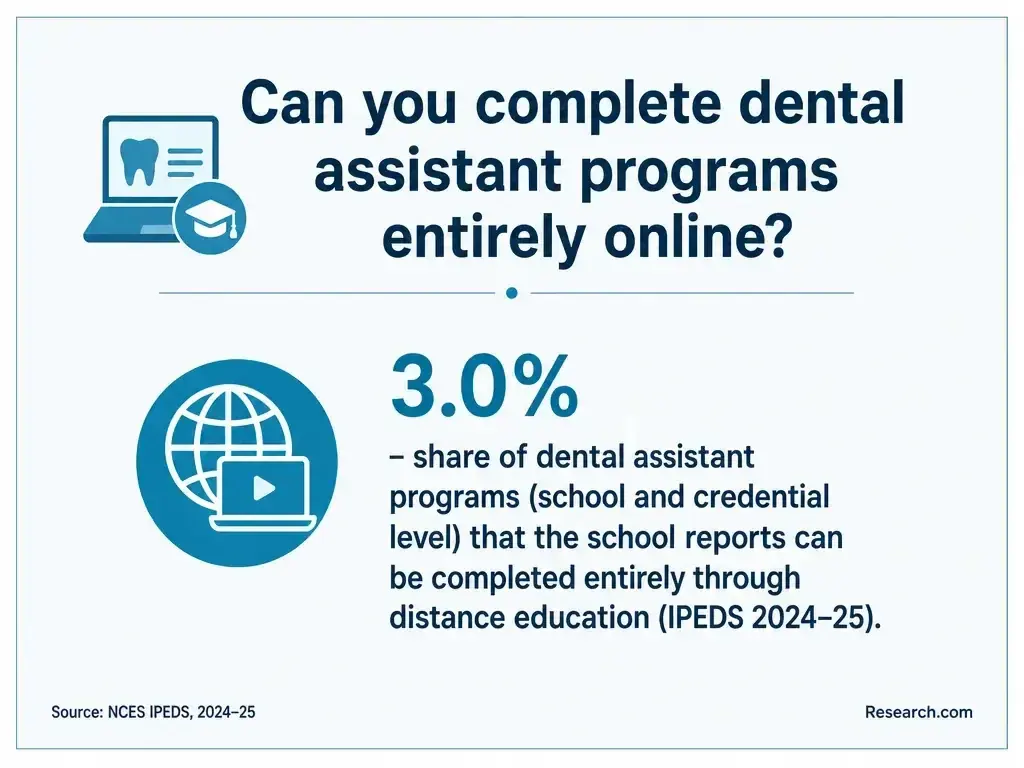
Online coursework can cover terminology, anatomy, records, and some infection-control concepts. It cannot, by itself, demonstrate chairside positioning, instrument transfer, sterilization workflow, or supervised patient interaction. A hybrid program is most useful when remote coursework is paired with scheduled labs and a reliable local practice placement.
Before paying for an online option, get written answers about where Denver-area hands-on training occurs, who arranges it, what happens if a placement falls through, and whether the curriculum supports your intended DANB certification pathway. A fully online certificate should not be treated as equivalent to supervised clinical preparation merely because its course titles match those of a campus program (DANB).
There is no reliable single Denver-wide average that captures public programs, private career schools, and employer training on the same basis. Request a current, itemized total cost to become job-ready from each provider rather than comparing advertised tuition alone. The most useful comparison includes school charges, the expense of reaching clinical sites, and income you may give up while attending.
These cost categories can change the apparent value of a lower tuition quote:
Federal aid depends on the institution's and program's eligibility, not simply on a school calling itself accredited; verify eligibility through Federal Student Aid and the school's aid office. A guide to online accredited colleges that accept financial aid can clarify aid terminology, but confirm funding separately for the specific dental assistant program. Compare net cost and likely debt with completion prospects, current earnings, potential post-training earnings, and the time required to repay; no single tuition figure establishes return on investment.
Most trade-school routes award a school certificate or diploma upon successful completion. That credential documents training; it is not the same as the Certified Dental Assistant (CDA) credential administered by the Dental Assisting National Board (DANB). DANB sets separate eligibility routes and examination requirements, so ask a school to identify precisely which route its curriculum supports and whether additional work experience or documentation is needed (DANB).
Institutional accreditation concerns the school; CODA programmatic accreditation concerns a particular dental program. State authorization permits a school to operate under applicable rules. None of those labels should be assumed to replace certification eligibility or supervised practice. If you arrived through a search for what is the easiest degree to get?, focus instead on whether this occupational certificate develops the clinical skills your intended employer expects.
Requirements vary by provider. Schools may ask for a high school diploma or equivalent, an application, proof of immunizations, a background check, or other documentation before clinical placement; do not assume that acceptance into classes guarantees eligibility for every externship site. Request the current admissions checklist and identify any requirements that carry an extra fee (program admissions disclosures).
School admission is distinct from occupational entry. A Denver dental office may train a new assistant on the job, while another may prefer prior chairside practice or a particular credential. If you have relevant experience, ask whether the provider evaluates prior learning; obtain any credit or advanced-standing decision in writing before budgeting around a shortened program.
Core training should connect classroom knowledge to a safe, efficient dental visit: preparing the operatory, identifying instruments, assisting with procedures, processing instruments, preventing cross-contamination, and communicating with patients and the care team. Programs may also teach impressions, records, scheduling, and dental imaging concepts, subject to applicable supervision and competency rules (U.S. Bureau of Labor Statistics; Colorado Dental Board).
Ask to see a skills checklist, not just a course catalog. Check whether students perform repeated tasks in a lab, receive observed feedback, and then apply those skills at an externship site. Because digital imaging and electronic records are part of many dental workflows, confirm that training uses equipment and software relevant to the offices where you plan to apply (U.S. Bureau of Labor Statistics).
Colorado does not issue a general occupational license for dental assistants. Assistants work under the supervision and within the duties allowed by Colorado dental rules; particular expanded duties and radiographic work require attention to applicable training, competency, and supervision requirements. Verify the duties you want to perform against current Colorado Dental Board rules before choosing a course marketed around "expanded functions" or X-rays (Colorado Dental Board).
National certification is a separate matter. DANB's CDA credential requires meeting one of its eligibility pathways and passing the required examinations; completing any particular school certificate does not automatically award CDA status (DANB). Ask admissions staff to put their certification-preparation and eligibility claims in writing, then verify them with DANB. This check matters more than a broad claim that a program is "approved" or "accredited."
Start with the duties you want to perform, then work backward to the training and experience employers expect. The best choice is not necessarily the shortest or highest-ranked program: it is the option you can complete affordably that provides credible hands-on preparation and fits your intended certification path.
Use the following checks before enrolling so that a promising brochure does not conceal a costly mismatch:
Red flags include a promised job or salary, an "online-only" claim that overlooks clinical skills, and vague answers about who secures externship sites. Use the accompanying ranking to narrow choices, then verify these details directly; IPEDS-based rankings cannot represent every employer-training route.
The direct path is entry-level chairside assisting in a general dental practice. With experience and appropriate training, an assistant may pursue specialty-office work, greater responsibility for permitted duties, patient coordination, or office operations. DANB certification can document additional qualifications, but it is not a substitute for the training and supervision applicable to a particular Colorado duty (DANB; Colorado Dental Board).
If you prefer structured clinical teamwork, ask about chairside and specialty externships. If frequent patient contact is a poor fit, compare office-coordination tasks before committing: the role itself is not primarily solitary. Readers exploring best career options for introverts should weigh that daily interaction against their strengths, rather than relying on a job title alone. Likewise, comparisons with highest paid master's degrees do not answer whether a short dental assistant training program is a worthwhile investment for your immediate career goal.
The U.S. Bureau of Labor Statistics projects 7.4% growth in dental assistant employment from 2025 to 2035. That national projection supports investigating the occupation, but it is not a forecast of vacancies in Denver or a guarantee that a new graduate will be hired. Use current metro-area postings to identify the duties, schedules, and experience levels employers actually request.
For someone choosing training locally, the practical question is whether a program's clinical placement and job-search support match those openings. Compare offers across general and specialty practices, and ask how many recent students completed externships and obtained relevant work; distinguish verified outcomes from promotional claims.
Education is a significant investment, so Research.com built the accompanying ranking to help readers compare dental assistant programs against other programs serving the same occupation and location. The team checks multiple education, outcomes, accreditation, and industry sources to improve the ranking's quality, credibility, and accuracy. Only programs with completions reported to the Integrated Postsecondary Education Data System (IPEDS) are eligible; absence from the ranking does not mean another provider lacks approval or offers poor training.
For best-program rankings, Research.com evaluates student outcomes, earnings and return on investment, costs and debt, and quality and recognition. Outcomes include completion and full-time and part-time retention. Earnings measures include median earnings one year after completion and earnings relative to annual attendance cost. Cost measures include tuition, attendance cost, median debt - including debt held by students who withdrew - and the federal loan default rate. Quality measures include relevant programmatic accreditation or industry recognition, institutional accreditation, and student support.
Programmatic accreditation or relevant industry recognition receives 20% of the score, institutional accreditation 10%, and student support 10%. The remaining 60% covers outcomes, earnings, and costs, with entropy-based weighting that gives more weight to indicators that differ more across programs. Most-affordable-program rankings instead score only tuition, attendance cost, median debt, and federal loan default rate using entropy-based weights; accreditation and other quality measures are not part of that affordability score. The ranking draws on these sources:
These measures offer a starting point, not a substitute for checking current program prices, clinical opportunities, and certification eligibility. Readers can review additional details on the Research.com methodology page.
# 1 position
# 2 position
Yes. Some dental offices train assistants on the job. Compare the pay, supervision, and skills offered with a school's clinical training before deciding which route better prepares you for the duties you want (U.S. Bureau of Labor Statistics; Colorado Dental Board).
No. A school awards its own completion credential. DANB awards national certification to candidates who meet its eligibility and examination requirements (DANB).
Online lessons can cover theory, but chairside and other practical competencies require in-person practice and assessment. Ask where a hybrid program provides labs and supervised clinical experience.
Colorado does not issue a general dental assistant license. Check current Colorado Dental Board rules for the training and supervision associated with the specific duties you want to perform.
Compare both with the hands-on training provided. A shorter program may reduce lost earnings, while a lower tuition price may be offset by fees, travel, or limited clinical preparation. Request itemized costs and placement details before enrolling.