# 1 position
Pima Medical Institute-Colorado Springs - Dental Assisting/Assistant.
certificate or diploma

Audited and Verified:
Our Editorial and Data Verification Process
Research.com uses government datasets, official education statistics and primary institutional information to support its career and degree guides. Our review process checks factual accuracy, occupational definitions, source dates and the requirements associated with the credentials discussed.
How This Article Was Fact-Checked
Our editorial team verifies salary estimates, employment projections, education requirements and program information against original data providers and official organizations. Salary figures are checked against the relevant occupational definitions and reporting periods. Information about licensure, accreditation and required in-person training is reviewed separately.
Fact-checked and verified on:

Co-Founder and Chief Data Scientist

Reviewed by Karolina Broda
Fact-Checker and Data Verification
Choosing dental assistant training in Colorado Springs means deciding how much hands-on preparation you need - and how much you can afford to spend before working. The U.S. Bureau of Labor Statistics projects 7.4% national job growth for dental assistants from 2025 to 2035, making that decision timely. This guide accompanies the Best Dental Assistant Trade Schools in Colorado Springs for 2027 ranking, created by the Research.com team of data scientists to help students identify programs worth considering. You'll learn how to compare credentials, practical training, costs, and routes into local dental offices.
Expect a mix of classroom instruction, simulation, and practice in a dental setting. Dental assistants prepare treatment rooms, sterilize instruments, support dentists during procedures, take and process records within permitted duties, and communicate with patients (U.S. Bureau of Labor Statistics). Because those tasks involve infection control and coordinated chairside work, a course with only videos and quizzes is not equivalent to supervised practice.
In Colorado Springs, a public-college program such as one offered by Pikes Peak State College and a career-school program such as one offered by Pima Medical Institute-Colorado Springs may differ in scheduling, credential, clinical arrangements, and charges. Request each program's current catalog and confirm which activities occur in a lab, which occur with patients, and whether the school arranges a local externship. Another route is to apply for an entry-level dental-office role with employer-provided training; it may reduce upfront school costs but depends on an employer willing and able to teach the required skills.
General dental practices are the principal workplace for dental assistants nationally; specialty practices, including orthodontic and oral-surgery offices, also employ them (U.S. Bureau of Labor Statistics). In Colorado Springs, the practical question is whether a program's clinical placements and employer contacts match the type of office where you want to work. A general-practice placement can build broad chairside skills, while a specialty office may provide narrower, procedure-specific experience.
Training does not make every duty immediately available. Ask prospective employers which tasks they expect a new hire to perform, what training they provide, and which Colorado requirements apply to radiography or other additional functions. If you need to work while studying, also check whether office and externship hours fit your schedule.
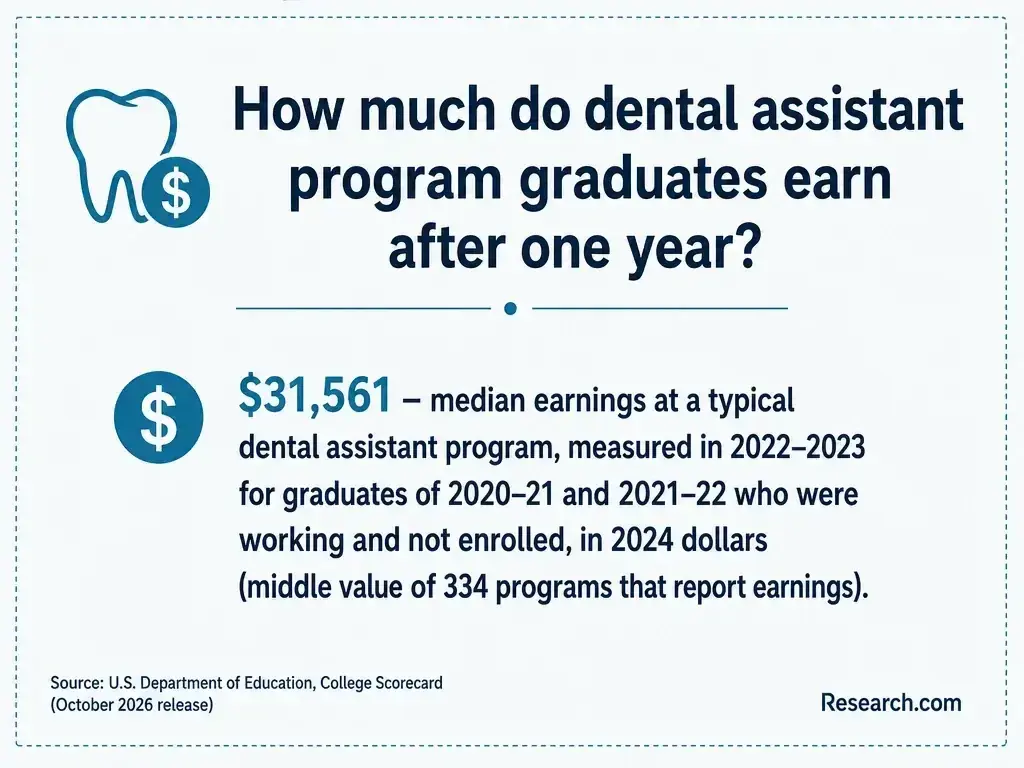
The national median annual wage for dental assistants was $48,070 in May 2025 (U.S. Bureau of Labor Statistics). That is the midpoint for employed assistants across experience levels, not a forecast for a new graduate in Colorado Springs. Use current local job postings and written employer offers to estimate likely entry pay, hours, and benefits before committing to training costs.
Pay comparisons should use the same occupation and geography. A posting for a dental hygienist, for example, describes a different occupation and training path; its wage is not a reasonable expected return on dental assistant training. When comparing offers, consider whether paid hours, benefits, and employer-supported training compensate for a lower advertised hourly rate.
Duration depends on the credential, course schedule, and required clinical experience. A focused certificate or diploma is generally designed for quicker occupational entry than an associate-degree pathway, while part-time attendance extends calendar time. Employer training may let you begin paid work sooner but does not necessarily cover the same curriculum or award a school credential. There is no single Colorado Springs training-hour requirement that makes all these routes interchangeable.
Ask each school for its published total clock or credit hours, lab hours, externship hours, and expected completion date for your chosen schedule. An advertised shortcut should not replace that comparison: a search for a best 6 month associate online degree does not establish that a particular dental assisting program - or its in-person practice - can be completed in that time.
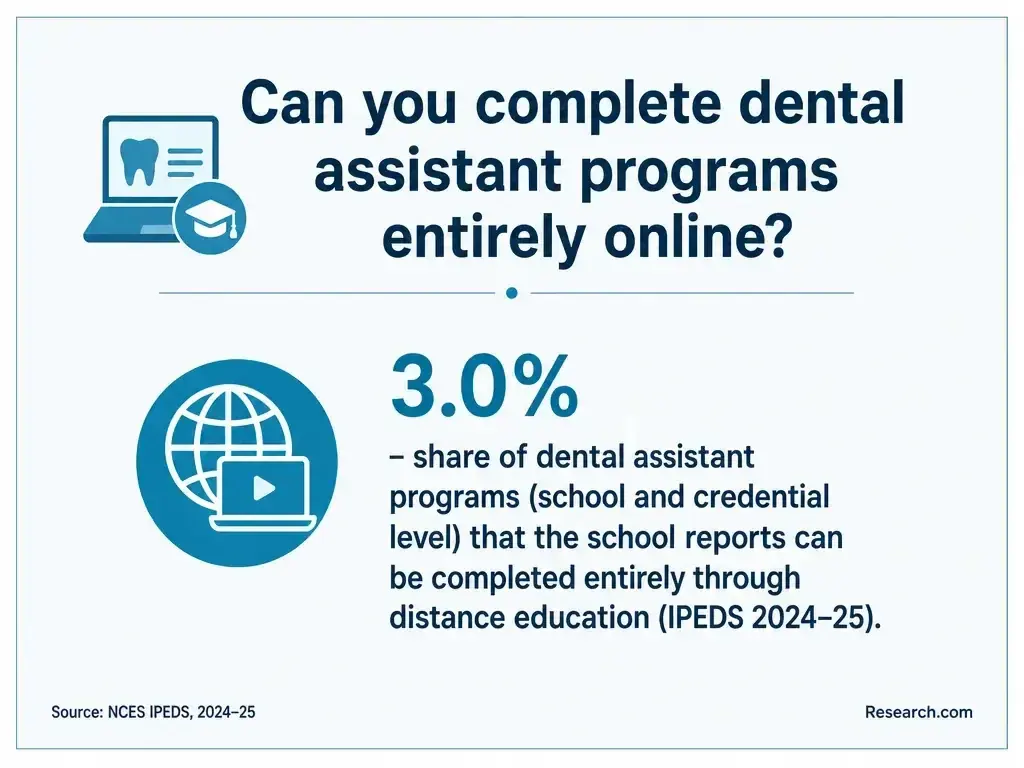
Online instruction can cover terminology, anatomy, recordkeeping, and some infection-control concepts. On-campus or clinical training is needed to demonstrate instrument handling, sterilization procedures, chairside coordination, and other practical competencies. A hybrid option can reduce classroom trips, but students must still reach its lab and clinical sites.
For a Colorado Springs student, the decisive comparison is where practical sessions take place and who secures the placement - not whether the coursework is labeled "online." Verify the required attendance dates, travel distance, supervision, and any radiography preparation against Colorado Dental Board rules. Searches about what is the easiest online degree to get address a different question: dental assisting requires demonstrable workplace skills, regardless of how conveniently theory is delivered.
A reliable citywide average is not available here: providers use different program lengths, credential types, and published price components. Instead of treating an advertised tuition figure as the cost of entry, obtain an itemized, current estimate from each school. For a public-college option, confirm the tuition rate for which you qualify; for any option, confirm what the quoted price includes.
The following costs determine how much you may need before you can work, even when two programs advertise similar tuition.
| Cost component | What to verify |
| School charges | Tuition, mandatory fees, books, supplies, and whether externship is included |
| Clinical readiness | Uniforms, protective equipment, immunizations or screening if required by the placement |
| Career entry | Any optional certification exam and associated preparation costs |
| Time and travel | Transportation to labs and clinical sites, plus earnings forgone while attending |
Compare the final out-of-pocket amount after confirmed grants, scholarships, or eligible aid with the cost of employer-supported training. Federal aid availability depends on the school and specific program, not merely its trade-school label (Federal Student Aid). Lists of most affordable online colleges can help frame a cost search, but they cannot substitute for a dental assisting program's itemized clinical and attendance costs.
The award may be a certificate, diploma, or, where offered, an associate degree. A school-issued credential documents completion of its curriculum; it is not the same as professional certification or permission to perform every dental task in Colorado. Employer training may instead result in work experience without a school-issued award. Confirm the exact credential shown on the current program page before comparing prices.
Recognition has several distinct layers. Institutional accreditation applies to the school; CODA accreditation, if a particular dental assisting program holds it, applies to that program; DANB credentials involve separate certification requirements (Commission on Dental Accreditation; Dental Assisting National Board). Colorado's rules govern permitted duties (Colorado Dental Board). A list of nationally accredited schools cannot establish a program's CODA status, certification eligibility, or fit for Colorado practice. Check each directly rather than assuming one form of recognition replaces another.
Requirements differ by provider and clinical site. Schools may request proof of prior schooling, an application, and placement-related documentation; a dental office hiring trainees may instead prioritize availability and readiness for patient-facing work. Health documentation, background checks, or other screening may apply to a particular externship rather than every applicant. Ask admissions which requirements are mandatory, when they are due, and whether they create additional costs.
If you have previous healthcare coursework or dental-office experience, ask whether the program awards transfer or prior-learning credit - and whether receiving credit changes any required lab or clinical practice. Do not assume experience waives a skill demonstration or a Colorado rule governing a specific duty.
A job-focused curriculum should connect dental anatomy and terminology with instrument identification, infection prevention, treatment-room setup, chairside assistance, patient communication, and documentation (U.S. Bureau of Labor Statistics). Depending on the program, it may also include dental materials, impressions, administrative tasks, and preparation for radiography responsibilities. The important difference is not whether a catalog mentions a topic, but whether you practice it under appropriate supervision and receive feedback.
Ask to see the current skills checklist and clinical evaluation method. For example, a student who wants chairside work should know how many opportunities there are to practice procedures before an externship; someone seeking front-office work should check for scheduling, records, and insurance-related instruction. Neither a similarly named credential nor an attractive course list proves those experiences are equivalent.
Colorado does not issue a general dental assistant occupational license as a condition of entering the role. That does not mean every task is open to an untrained assistant: Colorado Dental Board rules distinguish duties and set conditions for functions such as dental radiography. Confirm the current requirements for the specific tasks an employer expects you to perform before choosing a program.
Professional certification through the Dental Assisting National Board is distinct from state permission to perform a duty. A school credential also does not automatically confer DANB certification or establish eligibility for every exam (Dental Assisting National Board). Ask a provider to identify the Colorado rule and certification pathway its curriculum addresses, and verify both claims with the respective authority.
Start with the job you want, then work backward to its practical and regulatory requirements. A short, lower-cost program may suit someone pursuing basic chairside entry; a longer program may be worthwhile if its added clinical practice, credential, or schedule improves your chances of completing training and meeting your goals. Neither public nor private status alone determines value.
Use these questions when speaking with Pikes Peak State College, Pima Medical Institute-Colorado Springs, and any employer offering structured training. Request answers in writing so you can compare like with like.
A common mistake is choosing by ranking position or tuition alone. For a realistic return-on-investment comparison, consider completion probability, program duration and lost earnings, aid and debt, your current earnings, plausible post-training pay, and the years over which you expect to benefit. If a school cannot explain its hands-on training or total charges, resolve that gap before enrolling.
The direct path is an entry-level chairside or combined clinical-and-front-office role. With experience and any task-specific training required in Colorado, an assistant may pursue more specialized duties, a specialty practice, or office coordination. Advancement depends on demonstrated skills and an employer's needs; an initial training credential alone does not confer a supervisory role or authorize additional clinical functions.
If your goal is primarily office administration, compare programs' records and scheduling content rather than paying for clinical training you do not intend to use. Conversely, someone seeking patient-care work should favor substantial supervised practice. Searches for master degrees that pay well address a different investment decision; they are not evidence of dental assistant pay or advancement.
U.S. Bureau of Labor Statistics projections show 7.4% growth nationally from 2025 to 2035 for dental assistants. That indicates a growing occupation nationwide, not a measured growth rate or guaranteed opening in Colorado Springs. For a local decision, compare recent openings by office type, required experience, schedule, and requested radiography skills with what a program actually teaches.
Dental offices' use of digital records and imaging makes it especially useful to ask whether training includes current equipment and workflows, while still checking Colorado's rules for performing specific tasks. If local postings consistently request skills absent from a program's curriculum, factor the cost and time of acquiring those skills into your choice.
Research.com created the ranking because investing in occupational training is a consequential decision. Its team compares programs against others in the same occupation and location, using multiple sources and checking outcomes, costs, and recognition rather than treating a school's name as proof of value. Only programs with completions reported to IPEDS are eligible; an unlisted employer-training route or career school is not necessarily unsuitable.
For best-program rankings, student outcomes include completion and full-time and part-time retention. Earnings and return-on-investment measures include median earnings one year after completion and earnings relative to annual attendance cost. Cost measures include resident and nonresident tuition, attendance cost, median debt - including debt held by students who withdrew - and federal loan default rate. Quality measures cover institutional accreditation, relevant programmatic accreditation or industry recognition, and student support. Relevant programmatic accreditation or recognition receives 20% of the score, institutional accreditation 10%, and support services 10%. Outcomes, earnings, and costs account for the remaining 60%, allocated through an entropy-based method that gives more weight to indicators with greater differences across programs.
Most-affordable-program rankings use only tuition, attendance cost, median debt, and federal loan default rate, with entropy-based weights; accreditation and other quality indicators do not contribute to that score. The team used the following sources to build and check the ranking. Some sources provide occupational or recognition context rather than evidence that every listed dental assisting program holds a particular accreditation.
The ranking offers a starting point for comparing documented programs, not a substitute for checking current fees, clinical placements, and Colorado practice rules. See Research.com's ranking methodology for further details.
# 1 position
# 2 position

# 3 position
It can be if the program supplies supervised skills you need, fits your schedule, and costs less than the likely benefit over time. Compare its full cost and completion prospects with paid, employer-supported training before deciding.
An employer-trained route may be possible because Colorado does not issue a general dental assistant license. The duties you can perform still depend on applicable Colorado rules and the training you receive (Colorado Dental Board).
Online lessons can cover theory, but chairside and infection-control skills require in-person practice. Check where a program provides its labs and clinical experience before enrolling.
No. A school credential and DANB certification are separate. Check the Dental Assisting National Board's current eligibility and examination requirements for the credential you want.
There is no dependable answer without current, itemized quotes. Compare tuition, fees, supplies, clinical travel, available aid, and earnings you may forgo - not advertised tuition alone.