# 1 position


Audited and Verified:
Our Editorial and Data Verification Process
Research.com uses government datasets, official education statistics and primary institutional information to support its career and degree guides. Our review process checks factual accuracy, occupational definitions, source dates and the requirements associated with the credentials discussed.
How This Article Was Fact-Checked
Our editorial team verifies salary estimates, employment projections, education requirements and program information against original data providers and official organizations. Salary figures are checked against the relevant occupational definitions and reporting periods. Information about licensure, accreditation and required in-person training is reviewed separately.
Fact-checked and verified on:

Co-Founder and Chief Data Scientist

Reviewed by Karolina Broda
Fact-Checker and Data Verification
Choosing an affordable dental assistant program in San Juan means looking beyond tuition: the training must also prepare you for clinical work and any applicable Puerto Rico requirements. The U.S. Bureau of Labor Statistics projects 7.4% national employment growth for dental assistants from 2025 to 2035. For students and career changers, this guide explains costs, credentials, hands-on training, and career prospects. It accompanies the Most Affordable Dental Assistant Trade Schools in San Juan for 2027 ranking, created by the Research.com team of data scientists to help you identify programs worth considering.
Expect instruction in chairside assistance, infection control, patient preparation, instrument handling, records, and dental-office workflow, followed by supervised practice. A program may award a certificate or diploma; a longer associate-degree route may include additional coursework. Neither the credential's name nor its length tells you how much time you will spend practicing with patients.
For a San Juan student, the useful comparison is where practical training happens and whether its schedule works alongside a job. Ask for the current curriculum, lab and clinical hours, placement arrangements, and the duties students actually perform under supervision. If considering Universidad Ana G. Méndez-Cupey Campus, confirm that a dental-assisting program is currently offered and request those details directly rather than assuming campus-wide information applies to that credential.
Dental assistants primarily work in dentists' offices, preparing treatment rooms, supporting procedures, and helping with patient and administrative tasks (U.S. Bureau of Labor Statistics, Occupational Outlook Handbook). In and around San Juan, a student may also consider specialty practices or clinics, depending on openings and the duties an employer needs covered.
Before choosing a program, look at current openings within a commute you can sustain. Compare their required experience, language and patient-service expectations, and any requested imaging or certification qualifications against the program's curriculum. A placement in a real dental office can help you test that fit; a promise of "clinical experience" without a named setting or defined supervision deserves follow-up.
The U.S. Bureau of Labor Statistics reports a $48,070 national median annual wage in May 2025 for dental assistants. That is a midpoint for employed workers nationwide, not a San Juan wage or a prediction of first-year pay. Experience, assigned duties, hours, and the type of practice can all affect an offer.
Use local postings and interviews to establish a realistic starting-pay range before borrowing for training. Compare that range with what you earn now and with the net cost of each program; do not use the national median as the sole basis for a repayment plan.
Completion time depends on the credential, course load, and availability of clinical placements. A short certificate may get you to supervised practice sooner than a longer diploma or associate-degree pathway, but speed is valuable only if the program covers the competencies and eligibility requirements for your intended work. There is no single clock-hour figure that can safely be applied to every San Juan program.
Ask each provider for its required classroom, lab, and clinical hours; the expected calendar time for full-time and part-time students; and what happens if a placement is delayed. If you are weighing an associate-degree route, compare its actual timetable with claims about accelerated associates rather than assuming the label "accelerated" reduces required practical training.
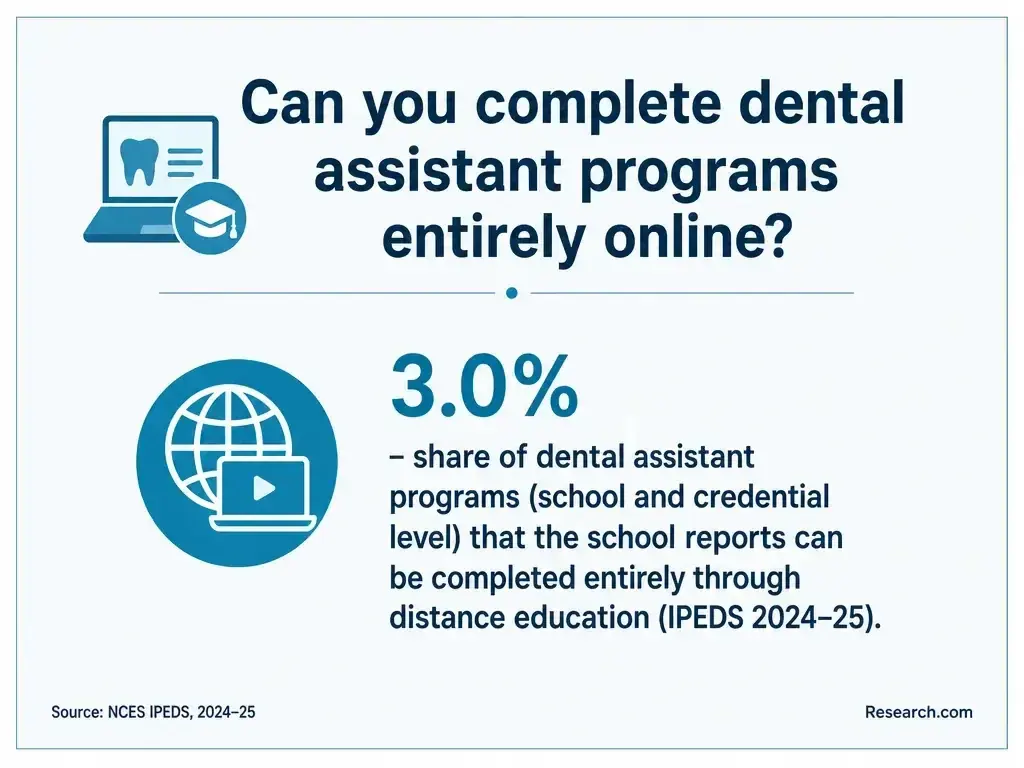
Online coursework can be useful for terminology, records, and other theory. It cannot replace practicing infection-control procedures, instrument transfer, and chairside teamwork under appropriate in-person supervision. A hybrid program may suit someone working in San Juan if its required labs and clinical site are reachable; a campus-based program may make it easier to obtain regular hands-on feedback.
Before paying for a remote option, get the lab and clinical requirements in writing, including who arranges placements and where they occur. An entirely online completion certificate should not be assumed to establish practical competence or eligibility for particular duties. Even when comparing accredited online schools with no application fee, check the dental-assisting program's specific clinical arrangements, not just the school's general admissions terms.
A defensible San Juan average cannot be stated without comparable, current prices for the programs being considered. Published tuition alone is an incomplete measure: mandatory fees, books, uniforms, protective equipment, consumable supplies, screening requirements where applicable, clinical transportation, and any examination or application charges can change the total. Lost earnings during training matter, too.
Request an itemized cost-to-completion estimate from each school and separate charges included in tuition from those paid elsewhere. Ask its financial-aid office which grants, scholarships, or federal aid you may qualify for; eligibility depends on the student and program (Federal Student Aid, U.S. Department of Education). Compare net cost after aid, expected debt, completion time, and the chance you can finish on schedule. Employer-supported training may reduce upfront cost, but confirm what instruction and supervised experience it actually provides.
Depending on the provider, you may earn a certificate, diploma, or associate degree. These are school awards, not interchangeable with professional certification, authorization to perform a regulated duty, or an occupational license. Ask to see the exact credential name on the completion document and whether the curriculum prepares students for any certification they intend to pursue.
The Dental Assisting National Board (DANB) publishes certification information, but eligibility depends on the specific credential and pathway; attending a program does not automatically make a student eligible for every exam. If your aim is to increase earning potential through a short credential, use guides to what certificates make the most money as career context, not as evidence that a particular dental-assisting certificate leads to a particular wage.
Schools set their own admissions standards, which may address prior schooling, language skills, placement testing, or prerequisites. Clinical sites may have additional onboarding rules, such as health documentation or background checks. Ask about these before enrolling: a student who can enter classroom courses but cannot begin a required placement may face extra time and expense.
Request written confirmation of the start date, part-time availability, transfer-credit or prior-learning policies, and the deadline for meeting clinical-site requirements. If you already work in a dental office, ask whether documented experience changes your training plan; never assume experience waives a required course or practical assessment.
Relevant training combines dental anatomy and terminology with infection prevention, chairside procedures, materials and instruments, patient communication, and recordkeeping (U.S. Bureau of Labor Statistics, Occupational Outlook Handbook). Programs may also teach dental imaging, but learning about an imaging task is not the same as receiving any authorization needed to perform it in Puerto Rico.
Look for assessed practice, not just a course title. Ask how students demonstrate sterilization procedures, prepare treatment rooms, communicate with patients, and respond to feedback in labs and supervised clinical settings. That evidence is particularly useful when comparing two similarly named credentials with different amounts of hands-on instruction.
Do not assume that a national certification, a school certificate, and permission to perform specific dental duties are the same thing. Puerto Rico's applicable rules and the duties assigned by a dentist determine what additional eligibility may be required. Confirm current requirements for your intended tasks - particularly dental imaging - with Puerto Rico's dental regulatory authorities before choosing a program. DANB's jurisdiction-specific guidance can help frame questions, but the relevant Puerto Rico authority is the source to confirm current rules.
Check three things separately: whether the institution is appropriately accredited or authorized, whether the program has any relevant accreditation such as Commission on Dental Accreditation recognition, and whether its training supports the specific duty or certification you want. Neither institutional accreditation nor program accreditation alone grants permission to work or perform every procedure (Commission on Dental Accreditation; Dental Assisting National Board).
Start with the work you want to do, then compare programs on eligibility, supervised practice, and total cost - in that order. An inexpensive program is a poor investment if its clinical schedule prevents you from finishing or its training does not match the duties employers expect. Conversely, a longer or costlier credential needs a clear benefit that matters to your goal.
Use the same questions with every admissions office so the answers are comparable:
Request written answers and compare them with the ranking rather than selecting by rank alone. General guidance about universities that offer double majors addresses a different education decision; for dental assisting, the decisive evidence is practical training and the route into the duties you intend to perform.
Training can support entry-level chairside or dental-office work, with experience potentially leading to responsibilities in a specialty practice, patient coordination, or office operations. Additional certifications may be useful for particular goals, but they are not automatic promotions. Dental assisting training also does not, by itself, qualify someone for a different regulated dental occupation.
For someone already employed in a practice, employer-provided supervised training may be worth comparing with a school program, especially if it allows continued earnings. Ask what skills and documentation the employer will provide and whether the route meets your longer-term goals. Lists of easy to get certifications that pay well cannot establish that an online credential replaces clinical experience or applies to a specific dental role.
The U.S. Bureau of Labor Statistics projects 7.4% growth in dental assistant employment nationwide from 2025 to 2035. This indicates national demand for the occupation, not a forecast of openings in San Juan or a guarantee of work after training.
Use that projection alongside current local postings, clinical-placement opportunities, and employer conversations. If openings within your commuting range call for skills a program does not teach, the national growth figure does not resolve the mismatch. Ask a prospective school how it helps students obtain supervised experience and what evidence supports any employment claims.
Investing in training is an important decision, so Research.com designed its ranking to make local program costs easier to compare. Dental assistant programs are evaluated against programs in the same occupation and location; only programs with completions reported to the Integrated Postsecondary Education Data System (IPEDS) are included. That limit matters: an employer training route or a provider absent from IPEDS is not necessarily unavailable or unsuitable.
The most affordable ranking scores tuition, cost of attendance, median student debt, and federal loan default rate. Weights are assigned using an entropy-based method, which gives more weight to measures that vary more across programs. Unlike Research.com's best-program rankings, affordability scores do not include accreditation, student support, or other quality indicators. Readers should use the ranking to build a shortlist, then verify training and career-entry requirements independently. Research.com consulted the following data sources in developing its rankings; some provide context or verification rather than a dental-assisting affordability score:
See Research.com's methodology for more on how rankings are created. An affordable ranking is a starting point, not proof that a program fits your schedule, offers sufficient clinical practice, or qualifies you for a particular duty.
# 1 position
# 2 position
Compare each program's net cost through completion with any credible employer-supported training available to you. Include supplies, travel to clinical sites, lost work time, and potential debt - not just advertised tuition.
Online classes can cover theory, but chairside skills require in-person practice. Verify the program's labs, supervised clinical placement, and Puerto Rico eligibility implications before enrolling.
No. A school certificate records completion of training; professional certification has separate eligibility and assessment rules set by the certifying organization, such as DANB.
Not necessarily. The affordability score addresses costs and debt, not clinical quality or fit. Check required practical experience, schedule, completion terms, and eligibility for your intended duties.
Choose the shortest route that provides adequate supervised practice and meets your specific career-entry needs. A longer route may make sense if its additional training or credential has a benefit you can verify with local employers.