# 1 position
Most Affordable Dental Assistant Schools & Training in Mansfield for 2027
Audited and Verified:
Our Editorial and Data Verification Process
Research.com uses government datasets, official education statistics and primary institutional information to support its career and degree guides. Our review process checks factual accuracy, occupational definitions, source dates and the requirements associated with the credentials discussed.
How This Article Was Fact-Checked
Our editorial team verifies salary estimates, employment projections, education requirements and program information against original data providers and official organizations. Salary figures are checked against the relevant occupational definitions and reporting periods. Information about licensure, accreditation and required in-person training is reviewed separately.
Fact-checked and verified on:

Co-Founder and Chief Data Scientist

Reviewed by Karolina Broda
Fact-Checker and Data Verification
Choosing an affordable dental assistant program means comparing more than tuition: hands-on training, Ohio radiography rules, and time away from work can change the real cost. The U.S. Bureau of Labor Statistics (BLS) reports a $48,070 national median annual wage for dental assistants in May 2025. This guide explains Mansfield-area training routes, costs, credentials, and career prospects. It also accompanies the Most Affordable Dental Assistant Trade Schools in Mansfield for 2027 ranking, created by the Research.com team of data scientists to help students identify programs worth considering.
Key findings about dental assistant degrees in Mansfield
- The lowest-ranked price is not necessarily the lowest cost to become job-ready: compare fees, supplies, travel to clinical sites, and earnings forgone during training.
- BLS reports a $48,070 U.S. median annual wage for dental assistants in May 2025 and projects 7.4% national employment growth from 2025 to 2035; neither figure predicts a new graduate's pay or Mansfield openings.
- Ohio does not require an occupational license for basic dental assisting, but taking dental radiographs and performing certain expanded duties have separate state requirements. Verify a program's preparation for the tasks you want to perform (Ohio State Dental Board).
Table of Contents
- Most Affordable Dental Assistant Schools & Training in Mansfield for 2027
- What can I expect from a dental assistant trade school program in Mansfield?
- Where can I work with a dental assistant trade school training in Mansfield?
What can I expect from a dental assistant trade school program in Mansfield?
Expect instruction in chairside procedures, infection control, patient communication, records, and dental-office workflow, followed by supervised practice where the program provides it. A classroom-only credential and one with substantial clinical experience may have the same name but offer different preparation for a first job.
The routes below differ chiefly in cost, access to practice, and what you receive at completion. Confirm actual offerings and schedules directly with Mansfield-area providers, including North Central State College and Madison Adult Career Center, rather than assuming each offers every route shown.
| Route | Typical credential or outcome | Best fit and main trade-off |
| Career-school or adult-education program | Certificate or diploma, depending on provider | Fits students seeking structured, occupation-focused training; compare clinical access and total charges. |
| Community-college program | Certificate or, where offered, associate degree | Fits students who value a longer academic route; additional coursework can increase time and expense. |
| Employer-sponsored, on-the-job training | Work experience; a school credential is not assured | Fits someone who can secure an entry-level position; instruction and opportunities to practice may vary by office. |
Dental assisting is not generally a trade with a required registered apprenticeship or journeyman progression. If an employer advertises an apprenticeship, ask whether it is formally registered, what training it includes, and whether wages are paid. A school program makes most sense when its supervised practice and credential provide a clear advantage over an available paid entry-level position.
Where can I work with a dental assistant trade school training in Mansfield?
Dental offices are the primary workplace for dental assistants nationally (BLS, Occupational Outlook Handbook). Around Mansfield, that makes general and specialty practices the most relevant places to seek clinical placements and entry-level work. An office's mix of procedures matters: ask whether students practice chairside assistance, sterilization, scheduling, and permitted radiography tasks rather than observing alone.
Work may also be available through larger group practices and public-health dental services, depending on local openings. If placement requires travel beyond Mansfield, include commuting time and transportation in your program comparison; a distant clinical site can make an apparently inexpensive course harder to finish.
BLS reports a $48,070 national median annual wage in May 2025 for dental assistants. That is the midpoint for employed workers across experience levels and locations - not a Mansfield starting wage or a promised outcome for program completers (BLS, Occupational Outlook Handbook). Ask prospective employers about entry pay, hours, benefits, and whether particular duties affect compensation.
For a local return-on-investment estimate, compare the pay you could realistically earn without training against likely entry-level offers after training. Then account for the program's full cost, debt, completion probability, and wages lost while studying. A shorter paid-training route can be financially attractive even when a school credential offers stronger structured preparation.
BLS describes postsecondary dental assisting programs as typically taking about one year; some assistants instead learn through on-the-job training (BLS, Occupational Outlook Handbook). A particular Mansfield-area schedule may be shorter, longer, full-time, or part-time. Do not infer its clock hours, clinical hours, or completion date from the credential name - request the current program calendar and hour breakdown.
If speed is your priority, compare 6 month courses that pay well against the actual requirements of dental assisting. An accelerated course is worthwhile only if its lab and clinical time still prepare you for office work and any Ohio-regulated tasks you intend to perform.
Online delivery can make terminology, records, and some infection-control coursework easier to fit around work. It cannot replace supervised practice in instrument handling, chairside positioning, or other physical tasks. An on-campus or hybrid program may therefore be a better entry route if it provides accessible labs and a confirmed clinical placement.
Use top online trade colleges as a format comparison, not proof that a dental assistant program meets Ohio requirements. Ask who arranges in-person practice, where it occurs, how performance is assessed, and what happens if no nearby placement is available. A fully online certificate should not be assumed to qualify you for radiography duties or professional certification.
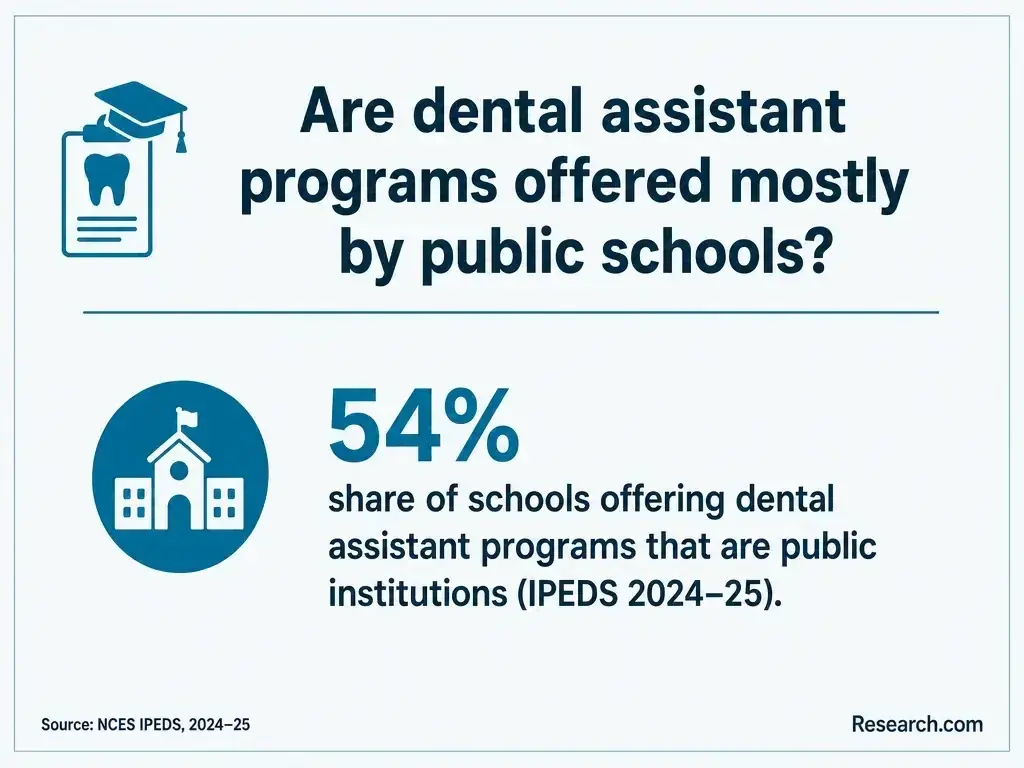
A defensible Mansfield-wide average is not available here: providers publish different combinations of tuition, fees, and included supplies, and employer training may have no school tuition. Quoting a single average would obscure the amount you actually need to pay. Request an itemized, current quote from each program before treating it as affordable.
Your comparison should include tuition, mandatory fees, books, uniforms and protective equipment, consumable supplies, any examination or application charges, travel to labs and clinical sites, and lost earnings. Subtract confirmed grants, scholarships, or employer contributions; treat loans as financing, not a discount. Federal aid eligibility depends on the institution and program, so an online college that accepts fafsa is not evidence that a particular dental assistant course qualifies (Federal Student Aid).
The award depends on the route: a school may issue a certificate or diploma, a community college may offer an associate degree, and employer training may produce work experience without an academic credential. Ask for the exact award name. A completion certificate is not the same as Certified Dental Assistant (CDA), a professional certification administered by the Dental Assisting National Board (DANB).
Institutional accreditation concerns the school; programmatic accreditation concerns a particular training program. CODA accredits dental assisting programs, while a school may hold accreditation through another recognized body. Neither type of accreditation automatically grants DANB certification, Ohio authority to take radiographs, or a job. Confirm the program's accreditation status, the applicable DANB eligibility route, and the Ohio rules for your intended duties with the respective organizations (CODA; DANB; Ohio State Dental Board).
Requirements vary by provider and placement site. Programs may request a secondary-school completion credential and may set health, immunization, background-check, or other conditions for clinical participation. These are not interchangeable with Ohio requirements for performing regulated duties. Ask admissions staff for written entry and clinical-clearance requirements before paying a deposit.
Prior office experience may help you seek employer training, but do not assume it earns school credit. If you have previous healthcare coursework or work experience, ask whether the provider assesses prior learning, whether any credit reduces tuition or time, and whether waived coursework affects clinical or certification eligibility.
Training commonly covers dental anatomy and terminology, infection prevention, chairside assistance, instrument processing, patient communication, and office records (BLS, Occupational Outlook Handbook). Programs preparing students for radiography should identify the relevant safety instruction and explain how their practical training relates to Ohio's separate requirements; classroom exposure alone does not authorize a student to take X-rays (Ohio State Dental Board).
Ask to see the course outline and the division of hours among classroom instruction, simulation, and supervised patient-facing experience. That breakdown is more useful than a broad promise of "hands-on training," especially if you need to be comfortable assisting during procedures soon after hiring.
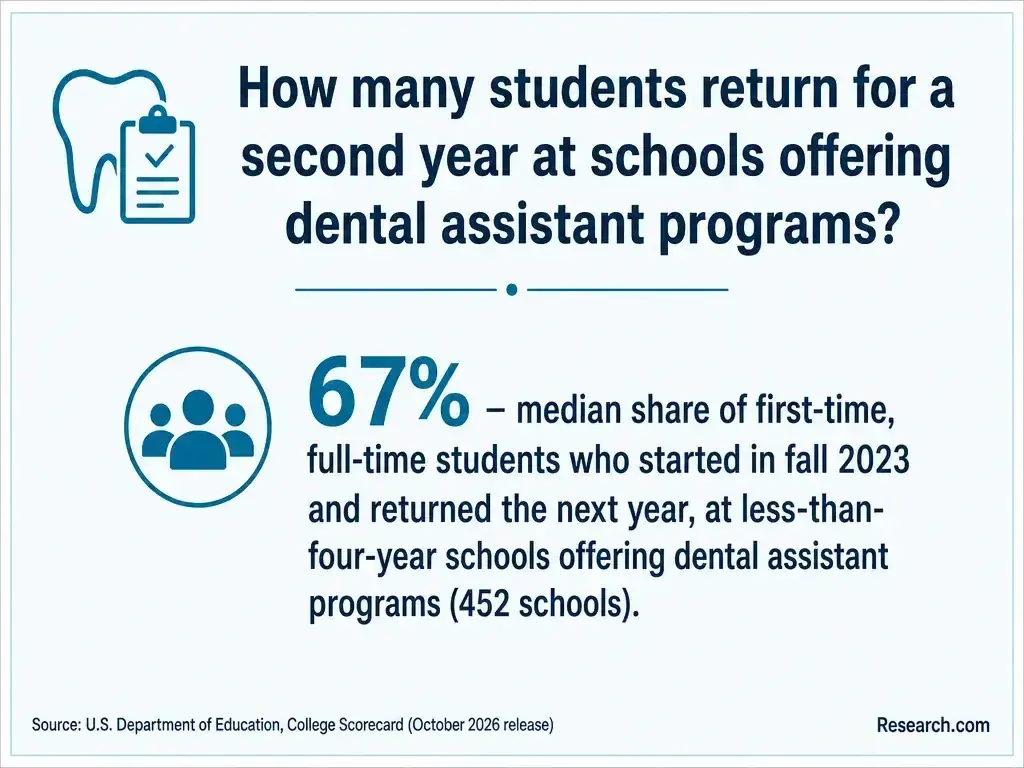
Basic dental assisting in Ohio does not require a general dental assistant occupational license. Taking dental radiographs and performing certain additional functions are different questions: Ohio sets separate qualifications or authorizations for regulated duties (Ohio State Dental Board). Before enrolling, identify which duties local job postings expect and check the board's current eligibility and application rules for those duties.
DANB's CDA is a professional certification, not a substitute for Ohio authorization. Its eligibility pathways and examinations are set by DANB. Ask a provider to specify, in writing, whether its graduates meet a particular certification pathway and what additional examination, experience, or state application steps remain (DANB; Ohio State Dental Board).
Start with the job you want, then compare only programs that provide the relevant practice and a workable path to any regulated duties. An affordability ranking identifies cost-and-debt differences among eligible programs; it does not score clinical quality or verify that an individual graduate can perform every task an employer requests.
Before committing, get answers to these questions in writing:
- What is the full cost through completion, including supplies, examinations, travel, and any extra clinical-placement charges?
- How many supervised lab and clinical hours are included, where do they occur, and who secures the placement?
- What credential is awarded, and how does the training align with DANB eligibility and Ohio rules for the duties I want?
- What are the current completion, placement, and debt figures for this specific program, and how were they measured?
Red flags include an unexplained "all-inclusive" price, an online program with no clear in-person practice arrangement, or a claim that accreditation alone authorizes radiography. Compare a school route with available employer-sponsored training before borrowing; the better investment depends on completion prospects, aid, lost wages, likely starting pay, and how long you expect to work in the role.
A common starting point is general chairside assistance. With office experience, an assistant may take on more responsibility in scheduling, inventory, or practice coordination; specialty practices may offer different procedures and workflows. Those changes depend on employer needs and demonstrated competence, not simply time since graduation (BLS, Occupational Outlook Handbook).
Professional certification can support advancement, while Ohio-regulated functions require meeting the applicable state conditions. If your goal is a specific expanded duty, work backward from the Ohio State Dental Board's requirements before choosing a program. Training for basic assisting should not be mistaken for automatic eligibility to perform every advanced function.
BLS projects 7.4% U.S. employment growth from 2025 to 2035 for dental assistants (BLS, Employment Projections). This national projection suggests continuing demand for the occupation, but it does not measure Mansfield vacancies or guarantee a position after training.
To test local prospects, review current Mansfield-area postings before enrolling: note whether employers offer training, require experience, or expect radiography eligibility. Recheck near graduation because openings change. If few suitable positions are within your commuting range, placement location and travel costs deserve more weight in your school decision.
Most Affordable Dental Assistant Schools & Training in Mansfield for 2027
Education is a consequential investment, so Research.com developed this ranking to help readers compare dental assistant programs against other programs serving the same occupation and location. The team draws on education, cost, debt, and occupational sources to check the credibility and relevance of its comparisons. Only programs with completions reported to IPEDS are eligible; the ranking therefore does not cover every employer-training route or career school.
For a most affordable ranking, scores use tuition, cost of attendance, median student debt, and federal loan default rates. An entropy-based method gives more weight to measures that distinguish programs more strongly. Accreditation and other quality indicators are not part of this affordability score, so readers should verify those separately. The sources used in creating and checking the ranking are:
- IPEDS database
- National Center for Education Statistics
- College Scorecard database
- Peterson's database
- Commission on Accreditation of Allied Health Education Programs (CAAHEP)
- Accrediting Bureau of Health Education Schools (ABHES)
- Commission on Dental Accreditation (CODA)
- Dental Assisting National Board (DANB)
- National Center for Construction Education and Research (NCCER)
- Apprenticeship.gov Partner Finder
Some sources cover broader occupational-training research rather than dental assisting specifically. College-oriented datasets also omit some employer-sponsored and other noncollege training; omission does not mean a route is unavailable or low quality. Use the ranking to narrow your options, then confirm current prices, practical training, and Ohio eligibility with each provider. Research.com explains its broader approach on its methodology page.
# 2 position
Madison Adult Career Center - Dental Assisting/Assistant.
certificate or diploma
Frequently asked questions about dental assistant programs in Mansfield
What is the cheapest way to become a dental assistant in Mansfield?
Compare itemized school costs with any paid entry-level training an employer offers. The cheapest tuition is not necessarily the cheapest route once supplies, travel, lost wages, and completion time are included.
Can I become a dental assistant without trade school?
Yes. Some dental assistants learn on the job, and Ohio does not require a general license for basic assisting. Regulated duties, including radiography, have separate state requirements (BLS; Ohio State Dental Board).
Can I complete dental assistant training entirely online?
Some coursework can be remote, but chairside skills require in-person practice. Ask where supervised training occurs and whether the route supports the duties you intend to perform.
Does a dental assistant certificate let me take X-rays in Ohio?
Not automatically. Check the Ohio State Dental Board's current radiography requirements and ask the program exactly which steps its training fulfills.
Is the most affordable ranked program automatically the best choice?
No. The affordability score covers costs and debt, not clinical training quality or eligibility for regulated duties. Compare those factors separately before enrolling.
- U.S. Bureau of Labor Statistics - Dental Assistants
Used to verify salary, employment outlook, and typical education requirements.
https://www.bls.gov/ooh/healthcare/dental-assistants.htm - CODA - Find a Dental Program
Used to verify programmatic accreditation or industry recognition of programs.
https://coda.ada.org/find-a-program - DANB - Certified Dental Assistant (CDA) exam
Professional certification reference for graduates of this occupation.
https://www.danb.org/exams/exam/cda-exam - North Central State College - official website
Official school website (programs, tuition, admissions).
https://www.ncstatecollege.edu/ - Madison Adult Career Center - official website
Official school website (programs, tuition, admissions).
https://www.madisonadultcc.org/