# 1 position

Audited and Verified:
Our Editorial and Data Verification Process
Research.com uses government datasets, official education statistics and primary institutional information to support its career and degree guides. Our review process checks factual accuracy, occupational definitions, source dates and the requirements associated with the credentials discussed.
How This Article Was Fact-Checked
Our editorial team verifies salary estimates, employment projections, education requirements and program information against original data providers and official organizations. Salary figures are checked against the relevant occupational definitions and reporting periods. Information about licensure, accreditation and required in-person training is reviewed separately.
Fact-checked and verified on:

Co-Founder and Chief Data Scientist

Reviewed by Karolina Broda
Fact-Checker and Data Verification
Choosing dental assistant training in North Canton means looking beyond a program's name: will it give you chairside practice, a useful credential, and a path to the duties you want to perform in Ohio? The U.S. Bureau of Labor Statistics projects 7.4% national employment growth for dental assistants from 2025 to 2035. This guide compares training routes, costs, and career-entry requirements. It also accompanies the Best Dental Assistant Trade Schools in North Canton for 2027 ranking, created by the Research.com team of data scientists to help students make an informed choice about programs worth considering.
Expect a combination of dental science, infection-control instruction, chairside simulation, and supervised practice. Programs differ substantially in how much time students spend handling instruments, preparing treatment rooms, assisting during procedures, and working with patients. Ask for the current curriculum and the number and location of required in-person clinical hours; a shared "dental assistant" label does not make two programs equivalent.
For a North Canton student, a practical comparison includes the commute to labs and clinical sites across the Canton area, not just travel to the classroom. A shorter certificate can make sense for someone seeking prompt entry into an office; a longer diploma or associate-degree route may suit someone who wants more structured clinical practice or broader coursework. An accelerated associates degree online is not a substitute for checking whether a dental assisting program provides required face-to-face skills practice.
Dental assistants primarily work in dental offices, including general and specialty practices; some work in settings such as clinics (U.S. Bureau of Labor Statistics). In the North Canton area, compare general practices with orthodontic, oral-surgery, and pediatric offices because their routines, schedules, and desired skills may differ. Ask prospective clinical sites whether students observe or actively practice chairside tasks under supervision.
Completing training does not authorize every task in every office. Ohio's rules for functions such as dental radiography and expanded functions matter when evaluating a job posting: confirm the duties requested, the credential or authorization involved, and whether the employer will support further training (Ohio State Dental Board).
A reliable North Canton-specific dental assistant median is not established here. For a benchmark, the U.S. median annual wage for dental assistants was $48,070 in May 2025 (U.S. Bureau of Labor Statistics). That figure describes workers across experience levels and locations, not what a new graduate should expect from a local offer.
Compare actual Canton-area postings by hourly pay, guaranteed hours, benefits, commute, and required radiography qualifications. When weighing training costs, use a plausible entry-level offer - not the national median - as your initial earnings scenario.
Length depends on the credential, schedule, and amount of clinical instruction. A focused certificate generally takes less time than a diploma or associate degree, while employer-sponsored training can begin with paid office work and build skills on the job. There is no single training-hour requirement that makes every dental assistant program equivalent under Ohio rules; ask each provider for its published clock or credit hours, lab hours, externship hours, and expected completion date (Ohio State Dental Board; program primary source).
Be skeptical of speed alone. Searches for a 6 month associate degree do not tell you whether a particular dental assisting route fits around work or includes meaningful chairside practice. Compare time until you can apply for the duties you want, including any separate radiography preparation.
Online coursework can cover topics such as terminology, anatomy, and office procedures. Instrument transfer, infection-control technique, patient interaction, and other chairside competencies need supervised, in-person practice. A hybrid program can be useful for a working adult if its lab and clinical schedule is genuinely accessible from North Canton; an entirely remote course should not be assumed to establish clinical competence or satisfy an Ohio credential requirement.
Even when comparing the cheapest online colleges for job holders, ask the dental assisting provider where practical work occurs, who arranges placements, and whether those placements are included in the quoted price. A flexible lecture schedule has limited value if required clinic shifts conflict with your job.
There is no defensible single North Canton average without comparable, current prices for the programs a student can actually attend. Request an itemized, current quote from each provider. Add tuition, mandatory fees, books, uniforms and protective equipment, supplies, any examination or application charges, travel to labs and clinical sites, and income lost if training reduces your work hours. A cheaper advertised tuition can become the more expensive route if substantial costs are excluded.
Check federal-aid eligibility for the specific program, not just the institution; short training offerings may have different aid eligibility. Compare grants and scholarships with borrowing, and ask whether an employer will pay for training or provide paid supervised instruction (Federal Student Aid). Lists of affordable online colleges that accept financial aid do not establish that a particular dental assisting credential or its clinical component qualifies for aid.
Depending on the offering, you may earn a school certificate, diploma, or associate degree. Those are educational awards, not interchangeable with professional certification or Ohio authorization to perform regulated duties. The Dental Assisting National Board's Certified Dental Assistant (CDA) credential has its own eligibility and examination requirements; completing a program does not automatically confer it (Dental Assisting National Board).
Ask which award appears on your transcript, whether the specific dental assisting program holds Commission on Dental Accreditation (CODA) accreditation, and which DANB eligibility route its graduates can use. Institutional accreditation concerns the school; CODA accreditation concerns a program. Neither should be confused with Ohio State Dental Board requirements for a particular duty.
Admissions rules vary. Providers may request evidence of secondary-school completion or an equivalent credential, an application, health documentation, or a background check for clinical placement; confirm the current requirements and who pays for them with the program. A dental office offering direct-entry training may instead assess availability, communication skills, and willingness to learn supervised tasks.
Before enrolling, separate admission from career eligibility. Being accepted into a program does not establish that its courses meet DANB examination eligibility or Ohio requirements for radiography. Ask admissions staff for the written requirements for both the credential you want and the clinical placement you will need (Dental Assisting National Board; Ohio State Dental Board).
Useful training connects dental anatomy and terminology to daily work: preparing treatment rooms, transferring instruments, maintaining infection-control procedures, documenting care, communicating with patients, and supporting the dentist during procedures (U.S. Bureau of Labor Statistics). Digital records and imaging also make technical accuracy important, but instruction about radiographs is not, by itself, proof of authorization to take them in Ohio.
Look for demonstrations, repeated hands-on practice, feedback, and a supervised clinical experience - not only recorded lectures or quizzes. Ask what tasks students perform rather than merely observe, how competencies are assessed, and what happens if a clinical placement falls through.
Ohio does not impose one universal occupational license on everyone doing basic dental assisting work. It does regulate particular functions, including dental radiography, and has separate requirements for expanded-function dental auxiliaries. The Ohio State Dental Board is the authority for current eligibility, applications, examinations, and permitted duties. Do not assume that a school certificate, CODA accreditation, or DANB certification alone authorizes a regulated function (Ohio State Dental Board).
DANB's CDA is a professional certification with eligibility pathways and examinations, not a blanket Ohio license (Dental Assisting National Board). If an office job requires taking radiographs, ask the employer and the Ohio State Dental Board which current dental X-ray machine operator requirements apply to you. If your goal is expanded functions, verify that pathway separately before choosing an entry-level program.
Start with the job duties you want, then work backward to the training and authorization they require. A campus program is often worth its cost when supervised practice, dependable clinical placement, and credential preparation address gaps you cannot readily fill on the job. Direct-entry office training may be the better investment if a willing employer offers substantial supervision and you can arrange any additional preparation needed for regulated duties.
Use this short verification sequence before paying a deposit:
If considering Stark State College, verify its current dental assisting offerings, credential, clinical arrangements, and program-level accreditation directly rather than assuming that an institution's general reputation answers those questions. Compare the same details with any eligible office-training route. The right choice depends on your likely completion, debt, starting pay, and longer-term earnings - not institution type alone.
An initial path is supervised chairside work in a general dental office. With relevant experience and any required qualifications, an assistant might pursue radiography duties, a specialty practice, office coordination, or Ohio's separate expanded-function dental auxiliary pathway. These are distinct roles and permissions, not automatic promotions attached to an entry-level certificate (Ohio State Dental Board).
Choose initial training for the work you actually want. A search for which bachelor degree is easy to study, for example, does not resolve the practical question of whether a dental assisting program teaches chairside skills and supports the relevant Ohio requirements. Ask local offices which qualifications they expect for the next role you hope to reach.
The U.S. Bureau of Labor Statistics projects 7.4% growth in dental assistant employment from 2025 to 2035. This is a national projection, not a forecast of North Canton vacancies. It supports considering the occupation, but it cannot tell you how quickly a new trainee will secure a nearby position.
Test local demand before committing: review current Canton-area postings for chairside, radiography, experience, and schedule requirements, then compare those requirements with the program's actual training. If most suitable openings request a qualification the program does not address, factor the extra training time and cost into your decision.
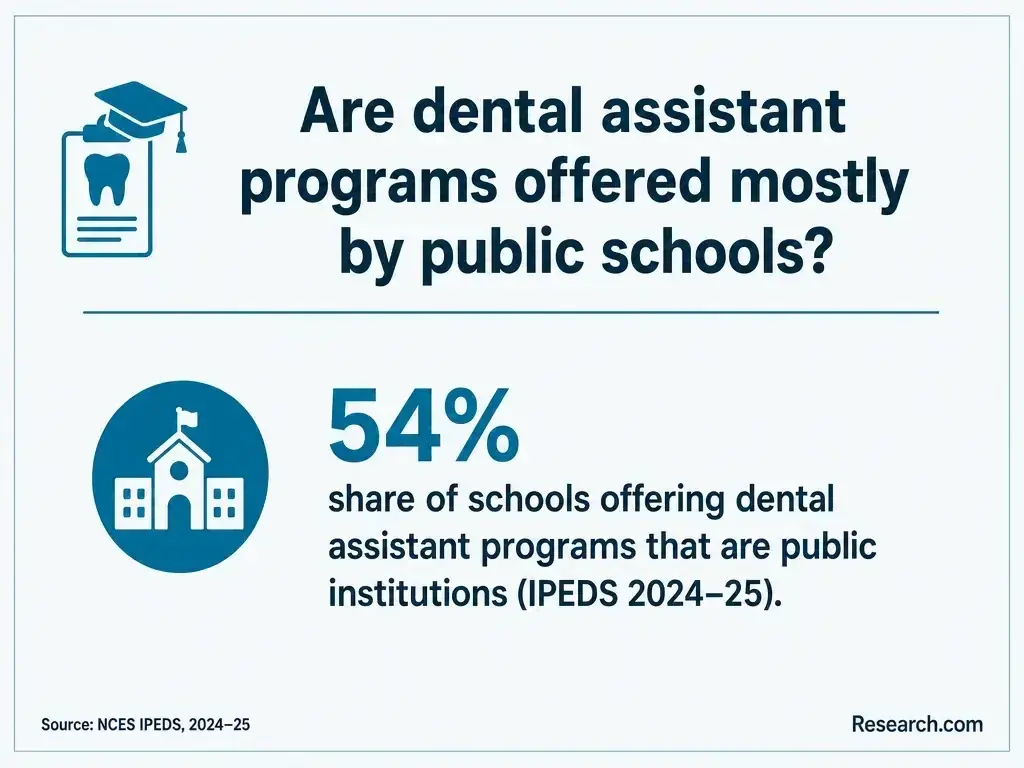
Investing in training is an important decision, so the Research.com team designed the ranking to help readers compare programs against other dental assisting options in the same location - not against unrelated trades or distant markets. The team evaluates reported outcomes, costs, recognition, and support using multiple sources, while checking whether each measure is relevant to the occupation. Only programs with completions reported to IPEDS are included; the ranking therefore cannot represent every employer-training route or nonreporting provider.
Best-program rankings cover student outcomes, including completion and full- and part-time retention; earnings and return on investment, including median earnings one year after completion relative to annual attendance cost; costs and debt, including tuition, attendance cost, median debt for students who withdrew, and federal loan default rate; and quality and recognition, including accreditation, occupation-relevant recognition, and student support. Programmatic accreditation or industry recognition receives 20% of the score, institutional accreditation 10%, and student support 10%. Outcomes, earnings, and costs share the remaining 60%, with entropy-based weighting that gives more weight to indicators that differ more across programs.
Most-affordable-program rankings use only tuition, attendance cost, median debt, and federal loan default rate, weighted through the entropy-based method. Accreditation and other quality indicators are not part of that affordability score. The following sources were used to create the ranking; some support cross-program verification rather than establishing an Ohio dental assisting requirement:
Use the ranking as a shortlist, then confirm each program's current clinical training, Ohio radiography preparation, full price, and eligibility for your intended credential. More detail on the ranking approach is available on Research.com's methodology page.
# 1 position
# 2 position
Basic dental assisting work in Ohio may be learned through supervised employer training. Compare that route's hands-on instruction and pay with a school program, and check separate Ohio requirements before performing regulated duties (Ohio State Dental Board).
No. CODA accreditation applies to a specific dental assisting program; institutional accreditation applies to the school. Verify both separately, along with any credential or Ohio duty-specific requirement relevant to your goal (Commission on Dental Accreditation; Ohio State Dental Board).
Do not assume so. Ask the Ohio State Dental Board which dental X-ray machine operator requirements apply and whether the program supplies the necessary preparation and practical training.
Only if it provides enough supervised practice and supports the duties you intend to perform. Compare clinical hours, scheduling, total cost, and credential eligibility alongside the completion date.
No. It includes programs with completions reported to IPEDS. Employer-sponsored training and other options may not appear, so compare them separately when they fit your goals.