# 1 position
YTI Career Institute-York - Dental Assisting/Assistant.
certificate or diploma

Audited and Verified:
Our Editorial and Data Verification Process
Research.com uses government datasets, official education statistics and primary institutional information to support its career and degree guides. Our review process checks factual accuracy, occupational definitions, source dates and the requirements associated with the credentials discussed.
How This Article Was Fact-Checked
Our editorial team verifies salary estimates, employment projections, education requirements and program information against original data providers and official organizations. Salary figures are checked against the relevant occupational definitions and reporting periods. Information about licensure, accreditation and required in-person training is reviewed separately.
Fact-checked and verified on:

Co-Founder and Chief Data Scientist

Reviewed by Karolina Broda
Fact-Checker and Data Verification
Choosing dental assistant training in York means comparing more than tuition: the right program must teach chairside skills and fit Pennsylvania's rules for the duties you want to perform. The U.S. Bureau of Labor Statistics reports a $48,070 national median annual wage for dental assistants in May 2025, but that is not a York starting salary. This guide helps career changers and first-time students compare training, costs, credentials, and work options. It also accompanies the Best Dental Assistant Trade Schools in York for 2027 ranking, created by the Research.com team of data scientists to help students identify programs worth considering.
Expect instruction in chairside assisting, infection control, instrument preparation, patient communication, and dental-office workflow. A useful program pairs classroom work with supervised practice in a lab and, where offered, a dental office. Ask how students are placed, who supervises them, and which procedures they perform rather than observe.
These routes lead to different experiences and credentials. The comparison can help you decide whether paying for a structured program adds enough value over learning in an office.
| Route | What it typically provides | Best fit and main limitation |
| Career-school certificate or diploma | Sequenced instruction and practical training; a school-issued credential | Fits students seeking a structured entry route; verify clinical access and total cost. |
| Public adult-education training | Occupational instruction that may be scheduled around local workforce needs | Worth comparing for access and price; confirm the current cohort and credential. |
| Employer-sponsored training | Learning under a dental practice's supervision, potentially while earning wages | Fits someone with an office willing to train them; formal coursework and certification preparation may be limited. |
A paid office-training job is not automatically a registered apprenticeship. Ask any sponsor whether its training is registered and what credential it awards. For this occupation, the most useful comparison is often structured school training versus supervised entry-level employment - not an unrelated list of certifications that pay well.
Dental offices are the principal workplace for dental assistants nationally, according to the U.S. Bureau of Labor Statistics. In York, compare general dentistry practices with specialty offices, where workflows and requested skills may differ. Some assistants also work in larger group practices or community dental settings. A York-area externship can help you assess commute times and employer expectations, but an externship is not a job offer.
Ask prospective offices whether new assistants rotate through sterilization, chairside work, and front-desk tasks. If your goal is expanded clinical duties, check which positions actually use those skills before paying for additional training.
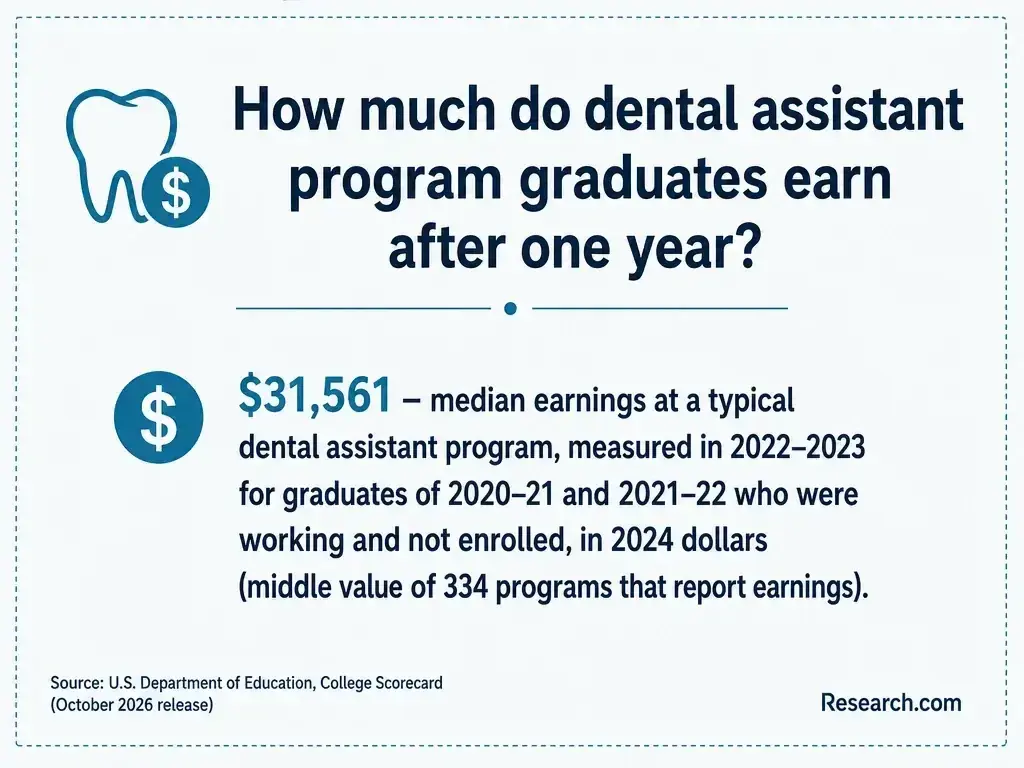
A reliable York-specific starting wage is not established here. The U.S. Bureau of Labor Statistics' national median for dental assistants was $48,070 in May 2025. That figure covers workers across experience levels and locations; it should not be used as an offer estimate for a new graduate in York.
For a practical local comparison, ask York-area employers for the posted hourly range, expected hours, benefits, and pay changes after experience or added credentials. Compare offers on the same basis, including any unpaid commute or variable schedule. Training is more likely to be a sound investment when its full cost is reasonable relative to the pay improvement you can realistically expect, not the national median.
Length depends on the school's schedule, the credential, and whether clinical practice is included. Short entry-level training may take months, while a more extensive program can take longer. There is no single program-length or clock-hour figure that establishes eligibility for every dental-assisting duty in Pennsylvania. Request each York provider's current calendar, total contact hours, lab hours, and externship hours in writing.
An accelerated schedule can reduce time away from work but compresses practice and may conflict with a job. Part-time training can preserve earnings while delaying completion. If you see a quick associate's degree in a broader education search, do not assume its timeline or credential is required for an entry-level dental assistant position; compare the actual occupational training and clinical experience instead.
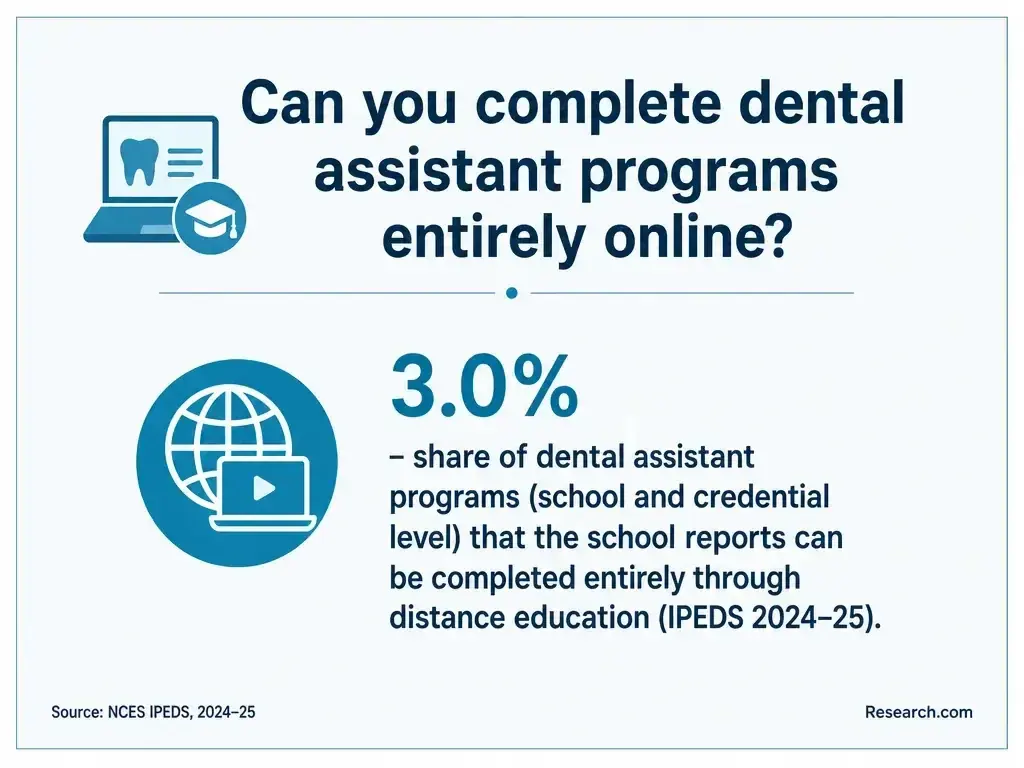
Online lessons can cover terminology, anatomy, records, and some infection-control theory. They cannot replace supervised practice in instrument handling, chairside positioning, patient interaction, or other physical competencies. A hybrid option is useful if its required labs and clinical placement are accessible from York; an entirely remote course should not be assumed to prepare you for every duty or certification route.
Ask where hands-on sessions take place, who secures a clinical site, and whether travel is required outside your normal commute. Verify certification eligibility directly rather than treating an online school's general accreditation - or its appearance among no application fee accredited online colleges - as proof that a dental-assisting course meets clinical requirements.
A defensible York-wide average is not available here: providers can differ in credential, included supplies, and clinical arrangements. Obtain a written, itemized estimate from each school instead of comparing advertised tuition alone. Include mandatory fees, books, uniforms and protective equipment, required health checks, travel to labs or externships, certification examinations, and earnings you may give up while training.
Ask each school whether its specific program qualifies for federal aid, grants, scholarships, or workforce-training support; eligibility is not automatic. Compare the resulting out-of-pocket cost and likely debt with a paid office-training offer. A low advertised price may be poor value if essential hands-on training costs extra. Similarly, a fast track bachelor degree online is a different educational investment, not a useful price benchmark for becoming a dental assistant.
A trade school may award a certificate or diploma documenting completion. That school-issued credential is distinct from institutional accreditation, CODA programmatic accreditation, and professional certification through the Dental Assisting National Board. None of those labels, by itself, authorizes every clinical task in Pennsylvania (Commission on Dental Accreditation; Dental Assisting National Board; Pennsylvania State Board of Dentistry).
Ask for the exact credential name and whether the particular dental-assisting program is CODA-accredited. Then check the Dental Assisting National Board's current eligibility routes for any exam you intend to take. If a school offers credit for prior experience or a route to further occupational training, request its written policy; do not assume credit will transfer. Broader comparisons such as best double degrees do not answer whether this certificate prepares you for your intended dental-office duties.
Entry requirements are provider-specific. Ask whether applicants need proof of prior schooling, an assessment, immunization records, a background check, or other documentation before classes or a clinical placement. A school may admit a student who later cannot meet a placement site's requirements, so confirm both sets of rules before paying a nonrefundable charge.
For the two institutions considered in this York comparison - YTI Career Institute-York and York County School of Technology-Adult & Continuing Education - request the current dental-assisting offering, admission checklist, start dates, and clinical-placement conditions directly. Do not rely on an older catalog to establish that a cohort is currently accepting students.
Core skills include preparing treatment areas, maintaining infection-control procedures, assisting during examinations and procedures, taking and organizing records, and communicating clearly with patients and the dental team (U.S. Bureau of Labor Statistics). Programs may also introduce dental materials, radiography concepts, scheduling, and insurance workflow. The depth of practice matters more than a long course list.
Before enrolling, ask to see the lab competencies and how performance is assessed. In particular, find out whether students practice with equipment under supervision, receive feedback on chairside technique, and complete a clinical experience. Instruction about radiographs is not the same as authorization to take them in a Pennsylvania practice.
For basic dental-assisting work in Pennsylvania, do not assume that graduation creates a separate dental assistant license. The rules change when duties expand: Pennsylvania regulates expanded-function dental assistants, and radiographic duties have separate requirements. Confirm the duties of the job you want against current Pennsylvania State Board of Dentistry rules before choosing training (Pennsylvania State Board of Dentistry).
Professional certification, such as the Dental Assisting National Board's Certified Dental Assistant credential, is a separate question from state authorization. Ask the board what education, examination, application, and supervision requirements apply to your intended duties; ask the certifying organization whether your specific program meets its exam-eligibility route. School authorization and accreditation do not substitute for either determination.
Start with the job you want, then compare programs against that goal. A ranking can narrow your search, but your best choice depends on whether you can finish the training, reach the clinical site, and qualify for the duties local employers expect. Use this sequence before enrolling:
The common mistakes are choosing by tuition alone, assuming online lessons replace clinical practice, or treating similarly named certificates as equivalent. For a fuller return-on-investment judgment, consider completion probability, current earnings, expected pay after training, lost wages, financing costs, and how long you expect to work in the field.
A common starting point is supervised chairside or sterilization work, with experience leading to broader responsibilities in patient coordination, office operations, or a specialty practice. Some assistants pursue national certification or Pennsylvania expanded-function authorization when their career goals and eligibility support it. Those are additional steps, not automatic outcomes of an entry-level certificate (Dental Assisting National Board; Pennsylvania State Board of Dentistry).
If you prefer patient care and office-based work, dental assisting may be a good fit. If you want a role centered mainly on independent treatment or a guaranteed immediate pay increase, this training alone is unlikely to meet that goal. Ask employers which advancement duties are actually available in their practices before buying an additional credential.
The U.S. Bureau of Labor Statistics projects 7.4% growth nationally from 2025 to 2035 for dental assistants. This indicates projected occupation-wide demand, not the number of openings in York or a guarantee of work after graduation. Replacement hiring and local practice staffing will affect the positions a new applicant can pursue.
Use current York-area postings to test the projection against your plans: note requested experience, radiography or other credentials, schedule, and commuting distance. If most suitable openings require skills your proposed program does not teach, seek a stronger clinical component or an employer willing to train you.
Investing in training is a consequential decision, so Research.com evaluates programs against others in the same occupation and location rather than treating a national list as a substitute for local choices. Only programs with completions reported to IPEDS are eligible; that limit does not mean an unlisted employer-training route or provider is unavailable or inferior.
For its best-programs ranking, the team assesses student outcomes; earnings and return on investment; costs and debt; and quality and recognition. Occupation-relevant programmatic accreditation or industry recognition accounts for 20% of the score, institutional accreditation for 10%, and student support for 10%. The remaining 60% covers outcomes, earnings, and costs, with entropy-based weights that give more weight to indicators that vary more across programs. The separate most-affordable methodology scores only tuition, attendance cost, debt, and federal loan default rates; it does not score accreditation or other quality indicators.
The team uses the following sources to check program, institution, outcome, recognition, and training information. Some cover a broader range of trades and should not be mistaken for dental-assisting accreditors.
These checks make the ranking a starting point, not a promise of employment or eligibility for every clinical duty. Readers can review Research.com's methodology, then confirm current program details and Pennsylvania requirements before enrolling.
# 1 position
# 2 position

It can be if the program provides supervised practical training you cannot readily obtain through a paid office role and its full cost fits your likely employment options. Compare both routes before committing.
Basic duties may be learned in a dental office under supervision. Confirm the employer's training plan and check Pennsylvania's separate rules before performing radiographic or expanded-function duties (Pennsylvania State Board of Dentistry).
Do not assume so. Ask how it provides assessed hands-on practice and whether it supports the specific certification or regulated duties you want.
No. A school completion credential and Dental Assisting National Board certification are different; exam eligibility and certification requirements must be checked separately (Dental Assisting National Board).
Request current tuition and required extras, the training schedule, lab and clinical hours, placement arrangements, accreditation status, and the exact credential awarded.