# 1 position


Audited and Verified:
Our Editorial and Data Verification Process
Research.com uses government datasets, official education statistics and primary institutional information to support its career and degree guides. Our review process checks factual accuracy, occupational definitions, source dates and the requirements associated with the credentials discussed.
How This Article Was Fact-Checked
Our editorial team verifies salary estimates, employment projections, education requirements and program information against original data providers and official organizations. Salary figures are checked against the relevant occupational definitions and reporting periods. Information about licensure, accreditation and required in-person training is reviewed separately.
Fact-checked and verified on:

Co-Founder and Chief Data Scientist

Reviewed by Karolina Broda
Fact-Checker and Data Verification
Choosing dental assistant training in North Platte means weighing hands-on preparation against cost, travel, and the duties Nebraska allows you to perform. The U.S. Bureau of Labor Statistics projects 7.4% national growth in dental assistant employment from 2025 to 2035, but that does not guarantee local openings. This guide explains training routes, credentials, costs, and career prospects. It also features a Best Dental Assistant Trade Schools in North Platte for 2027 ranking created by the Research.com team of data scientists to help students identify programs worth considering.
Dental assistant training prepares students to support dentists during procedures, prepare treatment rooms, follow infection-control procedures, handle instruments, and communicate with patients. Programs may also teach radiography and other functions, but instruction alone does not establish permission to perform every duty in Nebraska. According to the U.S. Bureau of Labor Statistics, some assistants enter through postsecondary training while others learn on the job.
The routes below differ most in their structure and the evidence of practical skills a prospective employer can assess. Confirm what is currently offered and where supervised practice takes place before treating two similarly named credentials as equivalent.
| Pathway | What it typically offers | Best fit and key check |
| Certificate or diploma program | Focused coursework, skills practice, and possibly a clinical placement | Students seeking structured entry preparation; verify actual chairside hours and the credential awarded. |
| Associate degree program | Dental assisting instruction plus additional academic coursework | Students who value the broader credential; compare extra time and cost against their specific job goal. |
| Employer-sponsored, on-the-job training | Workplace instruction under a dentist, with duties developing through practice | Applicants who can secure a training position; ask about pay, supervision, and preparation for additional functions. |
For a North Platte student, access to a dental office for practice can matter as much as classroom location. Ask Mid-Plains Community College which dental assistant training options, if any, are available for your intended start date, and compare those details with local employers offering supervised entry training. Do not assume an employer position is a registered apprenticeship: verify registration with Apprenticeship.gov if that distinction matters to you.
General dental offices are the most direct employment target; specialty practices may offer opportunities with different instruments, procedures, and patient needs. The U.S. Bureau of Labor Statistics identifies dentists' offices as the principal national employer of dental assistants. In a smaller labor market such as North Platte, a search limited to one specialty could mean fewer openings, so ask prospective clinical sites whether they interview trainees and consider nearby communities if commuting is realistic.
Training also supports work involving sterilization, patient scheduling, or treatment coordination within a dental practice. Those responsibilities may be combined in a small office rather than advertised as separate entry-level jobs. Match a program's clinical exposure to the setting you actually want - not just its course title.
A dependable North Platte-specific dental assistant wage figure is not established here. For context, the U.S. Bureau of Labor Statistics reports a $48,070 national median annual wage for dental assistants in May 2025. That is the midpoint for workers across experience levels and locations, not a forecast of a new graduate's pay in North Platte.
When comparing training costs with potential earnings, request current starting-pay ranges from local employers and ask whether pay changes after demonstrated proficiency or an additional credential. Compare offers on hours, benefits, and travel costs as well as the hourly rate; part-time work can materially change annual income.
There is no single required program length for entry-level dental assisting. A focused certificate may take less time than an associate degree, while employer-based training depends on the office's supervision and the skills being learned. Published durations can exclude prerequisite work, clinical scheduling, or time spent preparing for a separate credential. The U.S. Bureau of Labor Statistics describes both postsecondary education and on-the-job training as entry routes.
Request a calendar showing the first class, required lab sessions, clinical placement, and expected completion date. Also ask for documented classroom, lab, and supervised clinical hours; do not infer them from the number of months advertised. If speed is your priority, a guide to a 6 month course with high salary can provide broader context, but compare dental programs by their practical preparation rather than duration alone.
Online lessons can cover terminology, anatomy, records, and infection-control concepts. They cannot replace supervised practice positioning patients, transferring instruments, maintaining a treatment field, or performing any permitted radiography task. A hybrid program can be useful for someone balancing work and study if its in-person labs and clinical site are accessible from North Platte.
Before enrolling, get the locations and schedules for every required hands-on session in writing. An inexpensive online course that leaves you to arrange your own practice site may cost more in travel or delay your entry into work. Likewise, a campus-based program is not automatically stronger: compare supervised chairside experience and employer feedback, not format alone.
A verified North Platte program-cost average is not available here, and quoting one would obscure substantial differences between college training and learning while employed. Ask each provider for a current, itemized total cost to become job-ready, not just a tuition figure. The Federal Student Aid office notes that eligibility for federal aid depends on both the student and the eligible school and program; do not assume every short course qualifies.
Your comparison should account for tuition and mandatory fees, books and supplies, scrubs and protective equipment, any required health screening or background check, exam or application charges, and travel to labs or clinical sites. Then subtract grants or employer-paid training and consider wages you would forgo while attending. A lower sticker price may not be the better investment if clinical travel is extensive or completing the program requires leaving paid work.
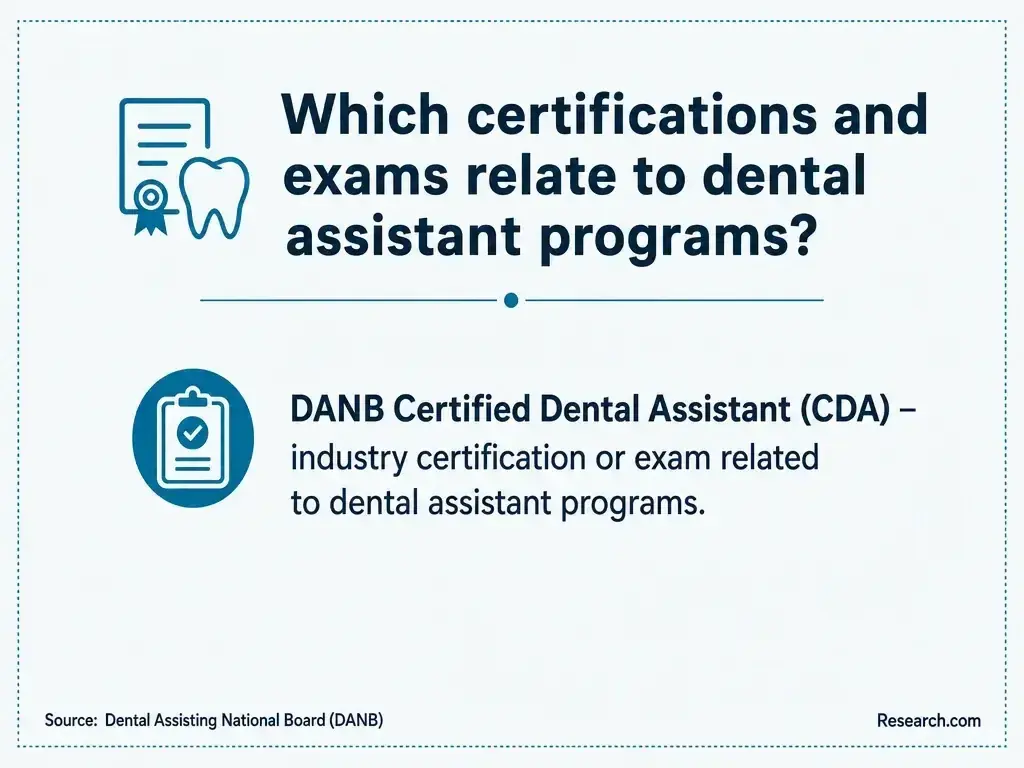
That depends on the program: it may award a certificate, diploma, or associate degree. A school-issued credential documents completion; it is not the same as national certification, programmatic accreditation, or state permission to perform a regulated function. The Dental Assisting National Board administers dental assisting certifications, including the Certified Dental Assistant credential, with eligibility requirements that must be checked against your own education and experience.
Ask for the exact award name on the completion document. If certification is your goal, check current Dental Assisting National Board eligibility rules and whether the program holds Commission on Dental Accreditation recognition where that matters to your chosen eligibility route. Institutional accreditation, state authorization, and dental program accreditation answer different questions; none should be assumed from the school's name.
Entry requirements vary by provider. Ask whether applicants need a high school credential, placement assessment, immunization records, background screening, or prerequisites before beginning clinical work; also ask when each requirement must be completed. Employer-trained positions have hiring requirements rather than school admissions requirements, and a dental office may expect availability during its patient-care hours.
For local planning, confirm that your schedule allows travel to any off-campus practice site before paying a deposit. If you have prior healthcare or dental-office experience, ask whether the provider awards documented prior-learning credit or advanced standing; do not assume that experience shortens required hands-on preparation.
Core training commonly addresses dental anatomy and terminology, chairside instrument handling, patient preparation, infection prevention, sterilization, records, and communication. The U.S. Bureau of Labor Statistics describes these as central dental assistant duties. Programs may also teach radiographic concepts and practice-specific digital workflows; check which skills students actually perform under supervision rather than relying on a course description.
Look closely at lab and clinical assessment. Students need feedback on safe instrument transfer, cleaning and reprocessing, and communicating with patients during care. If a program advertises an additional dental function, ask it to identify the applicable Nebraska rule and explain how its training documents eligibility. A lesson on a procedure is not necessarily authorization to perform it at work.
Nebraska distinguishes basic dental assisting from additional functions governed by state requirements. A separate occupational license is generally not the starting point for basic assisting, but the duties an assistant may perform depend on Nebraska law, the training or credentials required for a particular function, and dentist supervision. Verify the current rules with the Nebraska Department of Health and Human Services and Board of Dentistry before choosing a program to pursue radiography, coronal polishing, or expanded functions.
National certification from the Dental Assisting National Board is distinct from Nebraska authorization. Likewise, a school's institutional accreditation establishes neither certification eligibility nor permission to perform a particular procedure. Ask the provider to show the exact route from its credential and documented practical training to the duties you intend to perform; confirm examination, application, or experience requirements with the relevant authority.
Start with your target job duties, then compare programs on evidence that they can prepare you for those duties at a cost and schedule you can manage. A ranking is useful for narrowing options, but it cannot verify a future class schedule, an available clinical seat, or an individual student's financial aid.
Use these checks when speaking with an admissions representative and a prospective dental-office employer:
A warning sign is a claim that an online certificate alone qualifies you for every dental duty, or a refusal to specify clinical hours and placement responsibility. If a program's added time and cost do not support your intended role, direct employer training may be the better starting route. Readers comparing short occupational pathways can also review quick college degrees that pay well, while checking each option's actual credential and entry requirements.
The most direct path is entry-level chairside assisting, followed by greater responsibility as skills and permitted duties develop. An assistant may become particularly experienced in a practice's patient coordination, sterilization processes, or specialty procedures. Additional certification or state-recognized qualifications can support a broader scope of work where Nebraska rules allow it, but they are not substitutes for the required training and supervision.
In a smaller market, a role combining clinical and administrative work may be more attainable than a narrowly specialized position. Ask employers which duties offer progression in their offices and whether they support further training. Treat supervisory responsibilities and higher pay as possibilities tied to experience and available positions, not automatic outcomes of completing a program.
The U.S. Bureau of Labor Statistics projects 7.4% growth in U.S. dental assistant employment from 2025 to 2035. That national projection suggests continuing demand for the occupation, but it cannot tell a prospective student how many openings will arise in North Platte or when a particular office will hire.
Use the projection as background, then test local demand directly: review current dental-office postings, ask about anticipated vacancies when arranging clinical experience, and determine whether commuting to another community is feasible. A program with strong practical placement support may be more valuable locally than one whose principal selling point is the national growth rate.
Investing in training is a consequential decision. Research.com's ranking is designed to help readers compare dental assistant programs with other options serving the same occupation and location, rather than with unrelated trades. The team evaluates reported outcomes, costs, recognition, and support; it checks multiple sources to improve the ranking's credibility and accuracy. Only programs with completions reported to IPEDS are eligible, so the ranking is not an inventory of every employer-training or non-IPEDS option.
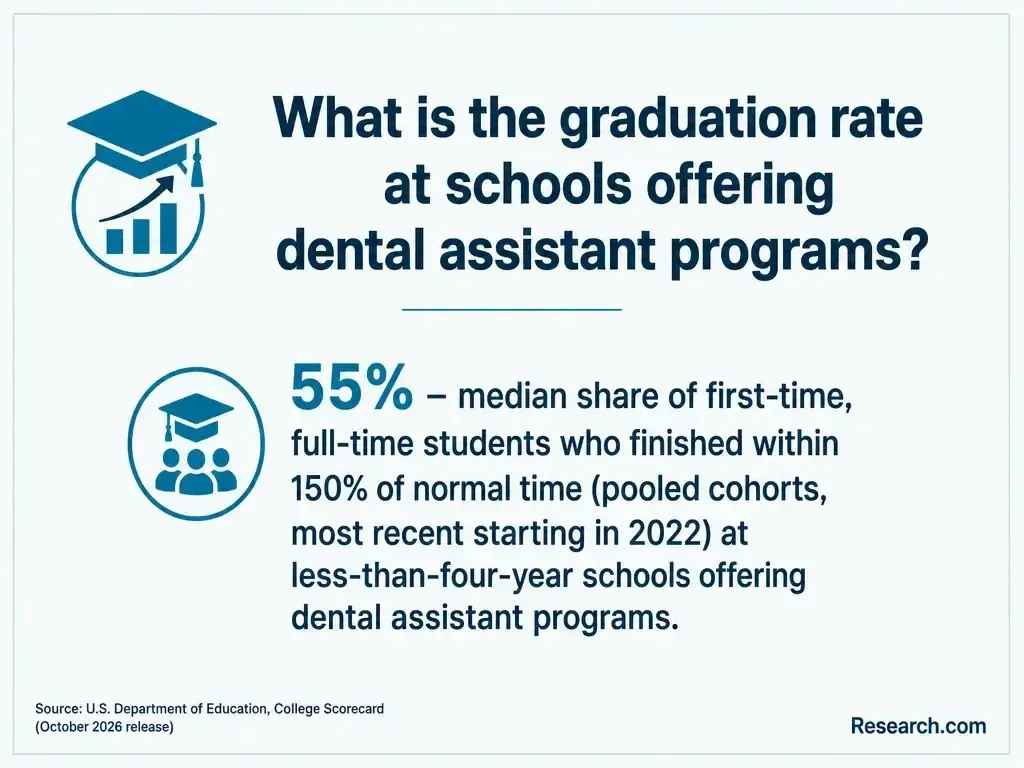
Best-program scores cover student completion and full-time and part-time retention; earnings one year after completion and earnings relative to annual attendance cost; tuition, attendance cost, debt - including debt for students who withdrew - and federal loan default rates; and accreditation, relevant industry recognition, and student support. Programmatic accreditation or industry recognition accounts for 20% of the score, institutional accreditation for 10%, and student support for 10%. An entropy-based method distributes the remaining 60% across outcomes, earnings, and costs, giving more weight to indicators that vary more across programs. Most-affordable rankings instead score only tuition, attendance cost, debt, and loan default rates using entropy-based weights; accreditation and other quality indicators are not part of that score.
The ranking draws on the following databases and organizations. Some cover broader allied-health or trade training rather than dental assisting specifically; their inclusion as sources does not make them dental program accreditors.
Use the ranking as a shortlist, then verify the current program, clinical opportunities, Nebraska duty eligibility, and your own net cost. More detail on how Research.com builds rankings appears on its methodology page.
# 1 position
# 2 position
Not necessarily. The U.S. Bureau of Labor Statistics recognizes both postsecondary training and on-the-job learning as entry routes. Compare available employer training with a program's structured labs and clinical experience.
Some theory can be studied online, but chairside skills require in-person practice. Confirm where and when labs or clinical work occur before enrolling.
Do not assume so. Ask the Nebraska Department of Health and Human Services and Board of Dentistry about current requirements for radiography, then verify that the program documents the required preparation.
National certification and Nebraska rules for specific duties are separate matters. Check the intended job's expectations and Dental Assisting National Board eligibility requirements before paying for certification preparation.
Get the total cost, exact credential, practical-training hours, clinical-site location, and a written explanation of how the program supports your intended Nebraska dental assistant duties.