# 1 position

Audited and Verified:
Our Editorial and Data Verification Process
Research.com uses government datasets, official education statistics and primary institutional information to support its career and degree guides. Our review process checks factual accuracy, occupational definitions, source dates and the requirements associated with the credentials discussed.
How This Article Was Fact-Checked
Our editorial team verifies salary estimates, employment projections, education requirements and program information against original data providers and official organizations. Salary figures are checked against the relevant occupational definitions and reporting periods. Information about licensure, accreditation and required in-person training is reviewed separately.
Fact-checked and verified on:

Co-Founder and Chief Data Scientist

Reviewed by Karolina Broda
Fact-Checker and Data Verification
Choosing dental assistant training in Los Altos Hills means looking beyond the lowest tuition: the program must also fit California's rules for the work you want to do. The Research.com team of data scientists created a Most Affordable Dental Assistant Trade Schools in Los Altos Hills for 2027 ranking to help students identify programs worth considering. With national dental assistant employment projected to grow 7.4% from 2025 to 2035, the decision is timely (U.S. Bureau of Labor Statistics). This guide compares costs, practical training, credentials, and career-entry routes so you can choose more confidently.
Expect instruction in chairside assistance, infection prevention, dental materials, patient communication, and office workflow, followed by supervised practice. Radiography and other expanded duties need particular attention because California restricts who may perform them (Dental Board of California). A program's name alone does not establish which duties its graduates can perform.
The main routes differ in both what you pay for and what you receive. This comparison helps identify the route that fits your intended first job:
| Route | Typical training and credential | Best fit and main limitation |
| Community college program | Structured classes, labs, and potentially clinical experience; a certificate or, where offered, an associate degree | Students seeking an organized path and a college credential; confirm the exact program's California RDA alignment. |
| Private career-school program | Often a focused certificate with scheduled practical training | Students who need a particular schedule; compare the complete price and clinical placement terms. |
| Employer-based entry | Practice-specific, supervised training; a school credential may not be awarded | Students seeking an entry-level role sooner; training may not cover every requirement for registration or expanded duties. |
Foothill College is the local school to investigate first, but compare its current dental assisting offering, not the college as a whole, with your intended job duties. Ask where practice occurs, who arranges clinical placements, and which California requirements are included rather than assuming that every certificate provides the same experience (Foothill College; Dental Board of California).
Dental assistants work primarily in dental offices, supporting dentists and patients during procedures; specialty practices may emphasize different instruments, scheduling, and patient needs (U.S. Bureau of Labor Statistics). Los Altos Hills students should search across the surrounding Peninsula and South Bay rather than assume jobs will be located within the town. That broader commute can make clinical-placement location and transportation costs as important as classroom location.
Before accepting an office-based training offer, ask which tasks you may perform immediately, who supervises you, and whether the employer supports the courses or experience needed for your next California credential. A job that offers paid learning may be attractive, but it is not automatically equivalent to a structured program or a registered apprenticeship (Dental Board of California; U.S. Department of Labor).
The national median annual wage for dental assistants was $48,070 in May 2025 (U.S. Bureau of Labor Statistics). That is the midpoint for employed assistants nationwide, not an entry-level offer in Los Altos Hills. The federal occupational series does not publish a wage specifically for the town, so compare actual Peninsula and South Bay job postings by duties, experience requirements, schedule, and benefits before estimating your own pay.
Use a conservative starting-pay estimate when judging whether training will pay off. Experience, radiography qualifications, registered duties, and practice setting can change the jobs you can pursue, but a credential does not guarantee a raise. Compare any expected increase with tuition, debt payments, commuting expenses, and earnings you would forgo while studying.
There is no single program length or universal clock-hour requirement for every California dental assistant route. Entry-level employer training, a school certificate, and an associate-degree pathway have different schedules; California RDA eligibility is a separate question governed by the Dental Board of California. Get the current catalog's total units or hours, weekly lab schedule, and clinical requirements before comparing advertised completion times.
An accelerated certificate may get you into an office sooner, but it can compress hands-on practice or make paid work harder to maintain. An associate-degree option takes longer and can make sense if you want its broader coursework; ask whether relevant prior learning or completed coursework can reduce the time without omitting required clinical training. If speed is your priority, guidance on the fastest way to get an associate's degree can help frame the trade-off, but confirm the dental program's actual sequence with the school.
Online coursework can help with terminology, anatomy, records, and some administrative content. Chairside technique, instrument handling, infection-control practice, and supervised patient care require suitable in-person instruction or an employer site. A fully online certificate should not be treated as proof of California RDA or radiography eligibility (Dental Board of California).
For a Los Altos Hills student balancing work and travel, a hybrid schedule may reduce classroom commutes without removing trips to labs or clinical sites. When comparing online trades schools, obtain the dental program's site schedule in writing: who secures placement, where it is located, and which competencies are assessed face to face. On-campus training may be simpler if reliable local placement is the deciding factor.
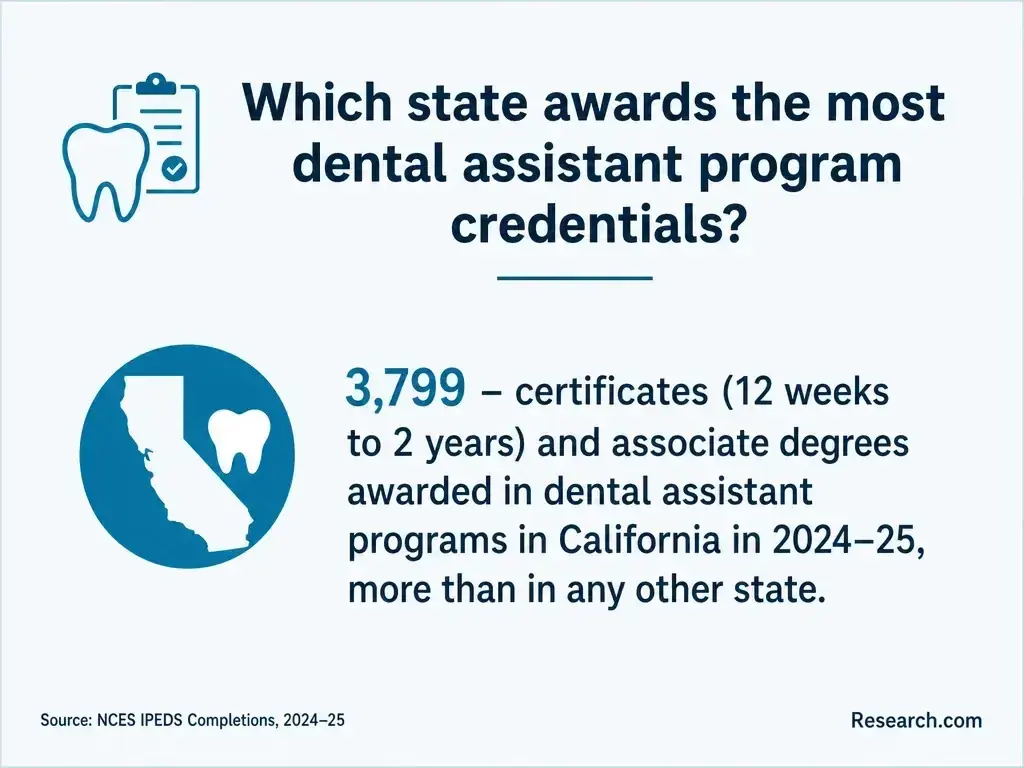
A reliable Los Altos Hills average program price is not available from the information used here. Do not substitute one school's tuition for a local average or assume that a low-cost ranking captures every expense. Request a current, itemized quote from each program and compare the cost of reaching the same job-ready goal.
The following cost categories belong in that comparison because a shorter or cheaper-looking program can shift expenses outside tuition:
| Cost category | What to confirm |
| School charges | Tuition, mandatory fees, books, supplies, lab materials, and any charge for clinical placement |
| Career-entry charges | Uniforms and protective equipment, required screenings, qualifying courses, examinations, and applications |
| Time and travel | Commutes to campus and clinical sites, parking, and wages lost while attending |
| Potential offsets | Grants, scholarships, eligible federal or state aid, employer assistance, and paid training |
Federal aid depends on the student and the specific eligible institution and program, not simply on whether a course is online (Federal Student Aid). If flexibility is essential, information about online fafsa schools can help you formulate aid questions; verify the dental program's eligibility directly. Also ask Foothill College about current California residency-based charges and available aid rather than relying on an older advertised price (Foothill College).
The answer depends on the specific offering: it may award a school certificate or, where available, an associate degree. A school credential documents completion; it is not the same thing as Registered Dental Assistant (RDA) status issued under California's rules. Nor is institutional accreditation identical to Commission on Dental Accreditation programmatic accreditation, state authorization, or an individual professional certification (Dental Board of California; Commission on Dental Accreditation).
The Dental Assisting National Board offers professional certification with its own eligibility and examination requirements. That certification and California registration serve different purposes; check both sets of rules if you want both credentials (Dental Assisting National Board; Dental Board of California). Lists of online certification courses that pay well can provide broader career comparisons, but they cannot establish that a dental course satisfies California's hands-on or regulatory requirements.
Admissions rules vary by program. Ask for the current requirements for educational preparation, placement or prerequisite coursework, health documentation, immunizations, and any screening needed before clinical participation. Separate those school entry rules from employer hiring standards and from the Dental Board of California's requirements for registration or specific duties; meeting one does not automatically satisfy the others (Foothill College; Dental Board of California).
If you already work in a dental office, ask whether documented experience or prior coursework changes placement or program length. Get any advanced-standing decision in writing, and check whether it also preserves the practical instruction and eligibility you need.
Relevant training covers dental terminology, anatomy, infection control, chairside workflow, instrument processing, materials, records, and patient communication (U.S. Bureau of Labor Statistics). Strong practical instruction lets students demonstrate these tasks under supervision rather than merely recognize them in an online lesson.
Compare syllabi for radiography instruction, California-specific safety and practice content, and supervised clinical experience. Ask which skills are taught in a lab, which are assessed with patients, and whether the program documents competency. Those distinctions matter more than a similar-sounding course title when you apply for a job with defined duties (Dental Board of California).
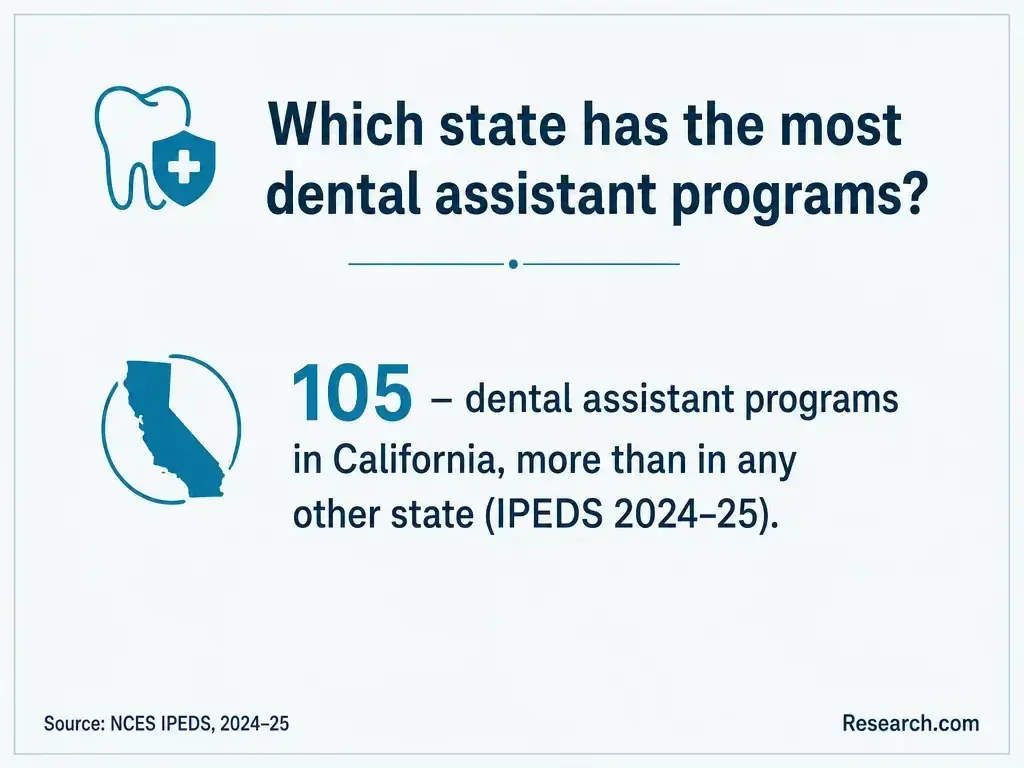
Not for every entry-level dental assisting task. California distinguishes unlicensed dental assistants from RDAs and restricts particular duties, including radiography, according to its rules. RDA registration requires an eligible pathway and additional board requirements; completing a school program alone does not grant the credential (Dental Board of California).
Before paying a deposit, tell the program which duties you want to perform and ask it to identify the exact California pathway its training supports. Confirm the answer against the Dental Board of California's current RDA, radiation-safety, and duty requirements. Optional national certification from the Dental Assisting National Board is a separate decision, not a substitute for state authorization to perform restricted duties.
Start with the job you want, then compare programs on eligibility, practice, and total cost - not rank alone. An inexpensive program is poor value if you must later buy missing instruction or cannot reach its clinical site. These checks help turn a shortlist into a decision:
Two common mistakes are treating an online certificate as automatic permission to perform restricted duties and treating a national median wage as a first-job offer. Verify the former with the state board and the latter with local employers. The right investment is the route whose cost and time are justified by the credential, practical experience, and work you actually intend to pursue.
An entry-level assistant may build chairside and office experience, then pursue the education and requirements for California RDA registration or qualifying duties. With experience, assistants may move toward specialty-practice support, patient coordination, or office supervision; each employer can set different experience expectations (Dental Board of California; U.S. Bureau of Labor Statistics). These are possible progressions, not automatic promotions from a certificate.
If your main goal is the broadest possible salary increase rather than dental patient care, compare this pathway with other high paying certification programs before enrolling. If you prefer hands-on work in a dental practice, prioritize a route that builds demonstrable clinical skills and keeps the California duties you want within reach.
U.S. Bureau of Labor Statistics projections show 7.4% national growth from 2025 to 2035 for dental assistants. That supports a positive national outlook but does not measure vacancies in Los Altos Hills or guarantee work after completion. Because a practical job search will likely extend into surrounding communities, compare current openings across the Peninsula and South Bay for required duties, schedules, and commute time.
Employers may differ in how much training they provide after hire. To improve your fit, seek supervised experience and clear documentation of the procedures you can legally perform. Recheck job postings near graduation: their requirements are a more direct guide to local demand than a national growth projection.
Education is a significant investment, so Research.com designed this ranking to help readers compare relevant options rather than rely on advertised tuition alone. Programs are compared with others in the same occupation and location; only programs with completions reported to IPEDS qualify. For this most affordable ranking, the score uses tuition, cost of attendance, median student debt, and federal loan default rate. An entropy-based method assigns more weight to measures that vary more across eligible programs. Accreditation and other quality indicators do not enter this affordability score, so readers should check them separately.
The Research.com team draws on the following sources to check costs, outcomes, and program context. Some sources provide occupational or quality context rather than a scored affordability measure:
IPEDS coverage does not include every private training, employer-sponsored, or other noncollege route. A missing provider is not necessarily unapproved or poor quality. The ranking is a cost-and-debt starting point, not a finding that every listed program meets a particular California career goal. Readers can review Research.com's methodology for more about how the ranking was created.
# 1 position
# 2 position
Foothill College is a local school to check. Confirm its current dental assisting offering, credential, schedule, and clinical arrangements directly with the college before applying (Foothill College).
California allows certain unlicensed dental assisting work, making supervised employer training a possible entry route. Restricted duties and RDA registration have separate requirements (Dental Board of California).
Do not assume so. Ask how the program provides required practical training and whether its specific pathway meets current Dental Board of California rules.
Only if its total cost, practical training, and credential fit your goal. Include fees, travel, lost earnings, aid, and any additional training you would need.
No. A school award, Dental Assisting National Board certification, and California RDA registration are distinct; check each credential's eligibility requirements separately.