# 1 position
Portland Community College - Dental Assisting/Assistant.
certificate or diploma

Audited and Verified:
Our Editorial and Data Verification Process
Research.com uses government datasets, official education statistics and primary institutional information to support its career and degree guides. Our review process checks factual accuracy, occupational definitions, source dates and the requirements associated with the credentials discussed.
How This Article Was Fact-Checked
Our editorial team verifies salary estimates, employment projections, education requirements and program information against original data providers and official organizations. Salary figures are checked against the relevant occupational definitions and reporting periods. Information about licensure, accreditation and required in-person training is reviewed separately.
Fact-checked and verified on:

Co-Founder and Chief Data Scientist

Reviewed by Karolina Broda
Fact-Checker and Data Verification
Choosing dental assistant training in Portland means comparing more than tuition: the program must provide hands-on practice and align with Oregon's rules for the duties you want to perform. The U.S. Bureau of Labor Statistics projects dental assistant employment to grow 7.4% nationally from 2025 to 2035. For career starters and changers, this guide explains training routes, costs, credentials, pay, and entry requirements. It also accompanies the Best Dental Assistant Trade Schools in Portland for 2027 ranking, created by the Research.com team of data scientists to help students identify programs worth considering.
Expect instruction in patient preparation, chairside assistance, infection prevention, dental materials, records, and communication, followed by practice with equipment and patients. A useful program makes clear which skills students rehearse in a lab and which they perform under supervision in a clinical placement. Dental assisting is a hands-on occupation; a course that teaches terminology but offers no credible route to clinical practice is not equivalent to one with substantial supervised experience.
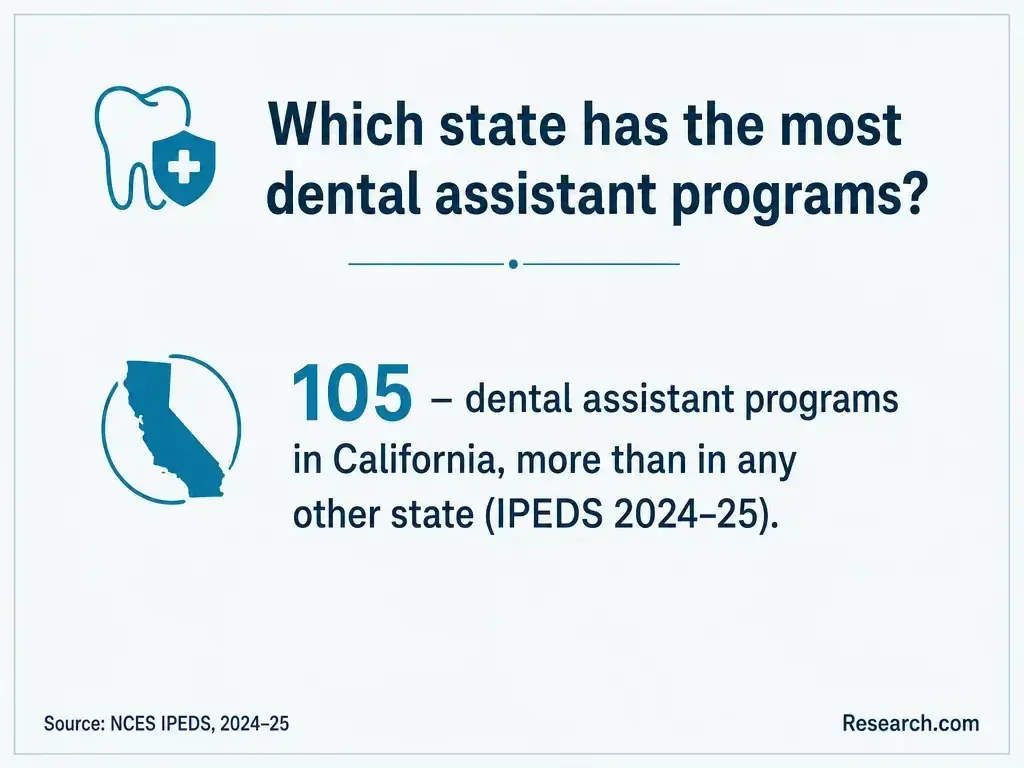
Portland-area applicants can compare offerings at Portland Community College, Carrington College-Portland, and Concorde Career College-Portland, subject to current availability. A public-college certificate may suit someone who can follow its academic calendar; a career-school schedule may suit someone who needs another start date. Neither provider type, nor a similarly named certificate, establishes identical clinical training or eligibility for Oregon credentials. Ask each program for its current curriculum, placement arrangements, and written explanation of which Oregon-recognized requirements its training satisfies.
An alternative is to enter a dental office in an allowed basic role and receive employer-directed training. That can reduce upfront school costs and bring income sooner, but the training may depend heavily on the office and may not provide the structured coursework or documentation needed for additional duties. Do not assume a dental office position is a registered apprenticeship; confirm registration with the sponsor or state apprenticeship agency if that designation matters to you (Apprenticeship.gov).
Most dental assistants work in dentists' offices, including general and specialty practices (U.S. Bureau of Labor Statistics). In the Portland area, that can mean chairside work in a neighborhood practice or a larger multi-provider office. Specialty settings may emphasize different workflows - for example, surgical setup in oral surgery or recurring adjustments and patient education in orthodontics.
Location affects the practical value of a program: a clinical placement across the metro area can change commuting costs and hours available for paid work. Before enrolling, ask whether students arrange their own placements, whether sites are accessible without a car, and whether the program helps them document the skills local employers request.
A verified, current Portland-specific wage figure is not established here, so the national figure is a benchmark rather than a local pay quote. The median annual wage for U.S. dental assistants was $48,070 in May 2025: half earned more and half earned less (U.S. Bureau of Labor Statistics, Occupational Outlook Handbook). It describes workers across experience levels, not what a newly trained Portland applicant should expect to receive.
For a local decision, compare advertised pay for entry-level openings with pay for positions requiring Oregon-recognized radiography or expanded-functions credentials. Ask employers whether training time is paid, which credentials they require at hiring, and whether they reimburse examination fees. When judging a program's value, compare plausible post-training earnings with what you could earn without enrolling; a higher occupational median alone does not establish a return on tuition.
Program length depends on the credential, calendar, clinical schedule, and whether a student attends full time. A certificate commonly takes less time than an associate degree, while office-based training follows an employer's schedule rather than a school term. Do not treat a short advertised completion time as the date you can perform every dental assisting function in Oregon.
Request the published clock or contact hours for classroom instruction, lab practice, and supervised clinical work separately. Also ask whether placement waiting time, required examinations, and Oregon credential applications extend the period between enrollment and your intended job duties. These details make a short program meaningfully comparable with a longer one.
Online coursework can cover topics such as terminology, anatomy, and records. Campus labs and dental offices are where students practice chairside positioning, infection-control routines, materials handling, and patient-facing tasks. A hybrid format can reduce classroom commuting, but its in-person requirements still need to fit your work and transportation schedule. An entirely online curriculum should not be assumed to establish practical competence or eligibility for an Oregon credential (Oregon Board of Dentistry; Dental Assisting National Board).
Compare formats by the location and supervision of practical work, not by the number of online lessons. Guides to most affordable online colleges for working adults can help frame general scheduling and cost questions, but dental assisting applicants must separately verify access to hands-on training.
There is no single defensible Portland average across public-college, career-school, and employer-training routes: they charge for different things and may include different amounts of clinical preparation. Get a current, itemized quote from each program rather than relying on an advertised tuition figure. The comparison below identifies costs that can change the amount needed to reach employment.
| Cost component | What to confirm | Why it matters |
| Tuition and mandatory fees | Full-program charge, residency rate if applicable, and refund policy | Sticker prices may cover different numbers of terms or hours. |
| Training supplies | Books, uniforms, protective equipment, and required instruments | Items excluded from tuition still affect upfront cash needs. |
| Career-entry expenses | Exams, credential applications, health requirements, and background checks where required | Finishing classes may not be the final expense. |
| Time and travel | Clinical-site commute and hours away from paid work | A faster or cheaper course may impose a larger opportunity cost. |
Ask the financial aid office whether the specific program qualifies for federal aid; institutional accreditation alone does not answer that question (Federal Student Aid). Compare grants, scholarships, and eligible workforce assistance before borrowing. Resources on schools with low tuition programs that accept fafsa may help explain aid terminology, but they are not a substitute for a dental assisting program's written aid and cost estimate.
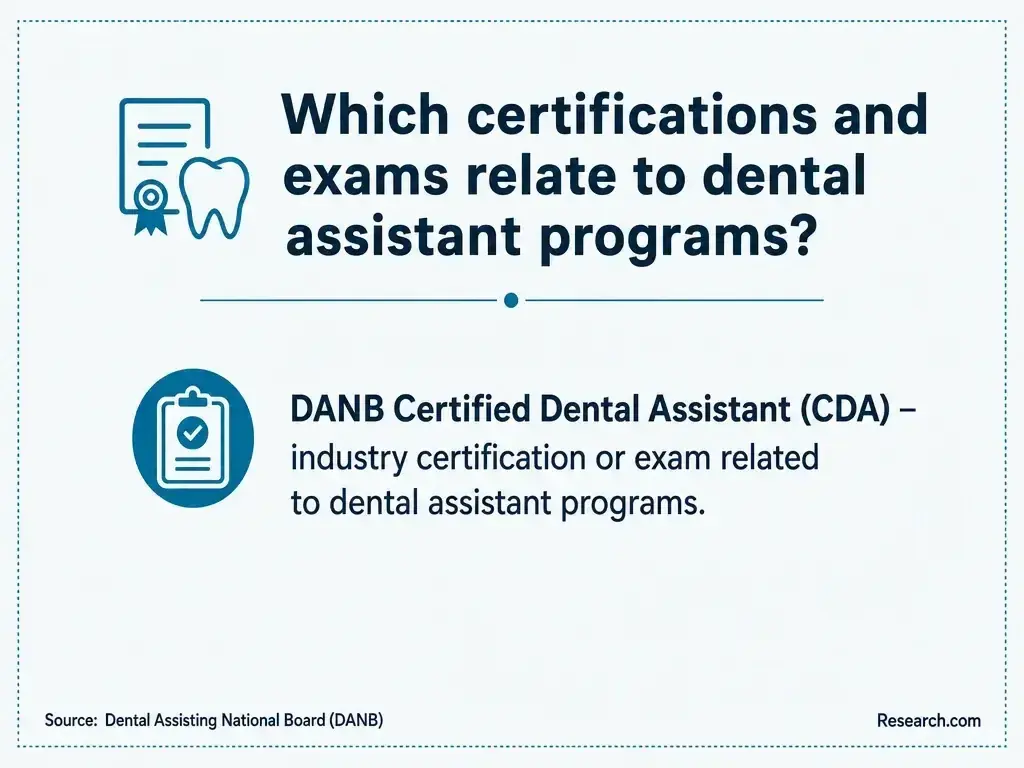
A school may award a certificate or diploma; an associate-degree program, where offered, awards an academic degree. These are educational credentials, not interchangeable with professional certification or permission to perform a regulated duty. The Dental Assisting National Board administers professional certifications and examinations, while the Oregon Board of Dentistry determines state requirements for dental assisting functions (Dental Assisting National Board; Oregon Board of Dentistry).
Commission on Dental Accreditation (CODA) accreditation is programmatic recognition specific to dental education. Institutional accreditation evaluates a school, and state school authorization concerns permission to operate; neither automatically grants certification or Oregon expanded-duty eligibility. If you may later seek another credential, ask whether completed coursework can transfer or receive advanced standing - but obtain that policy from the receiving provider in writing.
Admissions criteria vary by provider. Applicants should check the current requirements for prior schooling, placement assessments, application dates, and any health or background documentation needed before clinical work. A school may admit a student who cannot yet attend a particular clinical site, so ask when site-specific clearance is checked and what happens if placement cannot be secured.
Entry to a basic office role and entry to a training program are separate decisions. Someone with a willing employer may prefer supervised on-the-job learning; someone who wants structured practice and documented preparation for further credentials may prefer a school program. Neither route should be purchased or accepted on the assumption that Oregon will recognize every skill learned.
Core learning covers tooth and oral anatomy, dental terminology, instrument transfer, patient preparation, infection control, dental materials, documentation, and communication. Programs may also teach radiography concepts and procedures connected to expanded duties, but the curriculum's presence does not itself authorize a graduate to perform those duties in Oregon (Oregon Board of Dentistry; U.S. Bureau of Labor Statistics).
Look for repeated supervised practice rather than a course list alone. Ask how instructors assess infection-control technique, whether students work with actual patients during clinical training, and how deficiencies are corrected before completion. Those answers are more useful to an employer - and to a prospective student - than a broad promise of "hands-on" learning.
Oregon distinguishes basic dental assisting from functions that require additional state-recognized qualifications. A general dental assistant school certificate is not, by itself, a license or authorization for radiographic or expanded functions. Requirements depend on the exact task and credential sought; check the Oregon Board of Dentistry's current dental assistant rules before selecting a course or accepting duties beyond basic assisting (Oregon Board of Dentistry).
Professional certification from the Dental Assisting National Board and Oregon authorization serve different purposes. A program can prepare students for an exam without making every graduate exam-eligible, and passing an exam does not automatically replace a state application or other required steps. Ask a prospective program to identify, in writing, the specific Oregon credential and the education, practical experience, examinations, and application steps it supports (Dental Assisting National Board; Oregon Board of Dentistry).
Start with the duties you want to perform, then compare programs on evidence that connects training to those duties. A ranking can narrow the field, but it cannot tell you whether a clinical timetable fits your job or whether a particular course meets your intended Oregon credential pathway. Use these questions when speaking with admissions and program staff:
A warning sign is a claim that "accredited" means automatic Oregon approval for every duty, or that a quick online course replaces clinical practice. Another is an earnings promise based on experienced workers' pay. Calculate value using the full price, aid, likely debt, completion probability, lost earnings during training, plausible earnings afterward, and the time over which you expect the investment to pay back. If you are comparing trade training with a different educational goal, an accelerated bachelor's degree online guide addresses a separate pathway; it should not be treated as dental assistant entry preparation.
The immediate path is basic chairside assistance. With the relevant Oregon-recognized qualifications, an assistant may pursue additional duties; with experience, some workers move toward office coordination, specialty-practice responsibilities, or training new staff. These are possible progressions, not automatic promotions or permissions to perform regulated tasks (Oregon Board of Dentistry; U.S. Bureau of Labor Statistics).
Choose a program for the role you want first. If the goal is rapid entry into chairside work, weigh a short, clinically credible certificate against employer training. If the goal requires specific expanded functions, compare each program's documented eligibility pathway before considering its speed. A broader question such as which major makes the most money concerns a different educational decision and does not predict dental assistant earnings.
The U.S. Bureau of Labor Statistics projects 7.4% national employment growth for dental assistants from 2025 to 2035. This supports considering the occupation, but a national projection cannot show how many entry-level openings will be available near a particular Portland clinical site or when you graduate. Review current local postings for required experience, schedules, and Oregon credentials before paying for a program.
For working adults, the decision is whether the training route improves access to those openings enough to justify its cost and time. Employers may value dependable chairside skills and documented eligibility for the duties they need; a credential with little practical training may be a poor match even in a growing occupation. An easy masters degrees online comparison addresses a different career pathway, not a substitute for dental assisting preparation.
Education is a significant investment, so the Research.com team designed the ranking to compare dental assistant programs with other programs in the same occupation and location - not with unrelated trades. Only programs reporting completions to the Integrated Postsecondary Education Data System (IPEDS) are eligible. That makes the comparison more consistent, but it also means an employer-training route or a provider absent from IPEDS may not appear; omission is not a judgment of quality.
Best-program scores cover student outcomes; earnings and return on investment; costs and debt; and quality and recognition. Relevant programmatic accreditation or industry recognition accounts for 20% of the score, institutional accreditation for 10%, and student support for 10%. The remaining 60% covers completion, full- and part-time retention, earnings one year after completion, earnings relative to annual attendance cost, tuition, attendance cost, debt - including debt held by students who withdrew - and federal loan default rates. An entropy-based method gives more weight to indicators that vary more across programs. Separate most-affordable rankings score only costs and debt, using entropy-based weights; accreditation and other quality measures do not contribute to that score.
The team uses the following sources to check institutional data, outcomes, and recognition. Some cover other trades as well as dental assisting; their inclusion does not mean they accredit dental assistant programs.
The ranking is a starting point for a shortlist, not proof that a particular program meets Oregon requirements for every dental assisting duty. Readers should compare current program documents and verify eligibility directly with the Oregon Board of Dentistry. More detail on the ranking approach is available in Research.com's methodology.
# 1 position
# 2 position
# 3 position
Basic dental assisting may be learned through supervised employer training, depending on the duties. For radiography or expanded functions, check the Oregon Board of Dentistry's separate qualification requirements before relying on that route.
No. A school certificate documents completion of its program. Dental Assisting National Board certification is a separate professional credential with its own eligibility and examination rules.
Some theory can be taught online, but chairside and clinical skills need in-person practice. Verify how a program arranges that practice and whether its training supports your intended Oregon duties.
No. Accreditation and state eligibility are different. Match the program's documented coursework, practical training, and exam preparation to the Oregon Board of Dentistry's current requirements for the specific function.
Neither is automatically better. Compare total costs, lost earnings, clinical experience, completion prospects, and the time needed to meet your intended job requirements - not tuition or advertised duration alone.