# 1 position

Audited and Verified:
Our Editorial and Data Verification Process
Research.com uses government datasets, official education statistics and primary institutional information to support its career and degree guides. Our review process checks factual accuracy, occupational definitions, source dates and the requirements associated with the credentials discussed.
How This Article Was Fact-Checked
Our editorial team verifies salary estimates, employment projections, education requirements and program information against original data providers and official organizations. Salary figures are checked against the relevant occupational definitions and reporting periods. Information about licensure, accreditation and required in-person training is reviewed separately.
Fact-checked and verified on:

Co-Founder and Chief Data Scientist

Reviewed by Karolina Broda
Fact-Checker and Data Verification
Choosing dental assistant training in Lakewood, Washington, means looking beyond a school's name: will its hands-on instruction prepare you for work in a dental office, and what will it cost to get there? The U.S. Bureau of Labor Statistics projects 7.4% national growth in dental assistant employment from 2025 to 2035. This guide explains local training routes, Washington requirements, costs, and career prospects. It also accompanies the Best Dental Assistant Trade Schools in Lakewood for 2027 ranking, created by the Research.com team of data scientists to help students identify programs worth considering.
Expect instruction in chairside assistance, infection prevention, instrument handling, dental materials, patient communication, and office procedures, followed by supervised practice. The important distinction is between learning a procedure in a classroom and performing it safely with patients under the supervision required by a dental practice.
Lakewood applicants can investigate Clover Park Technical College's dental assisting training and compare its current catalog with any employer-led opportunity available to them. A structured school program may suit someone who wants scheduled labs and a defined credential. Paid, supervised training in a dental office may suit someone who can secure an employer willing to teach entry-level duties; it is not automatically a registered apprenticeship or a substitute for any training required for a particular duty. Confirm current program details directly with Clover Park Technical College and any prospective employer.
Focus on the dental assisting curriculum rather than the appeal of a broadly advertised credential. Even searches for online phd programs no dissertation cannot answer the occupation-specific question that matters here: where will you practice chairside skills, and under whose supervision?
Dental offices are the primary workplace for dental assistants, according to the U.S. Bureau of Labor Statistics. Around Lakewood, that makes general dentistry and specialty practices in the wider Tacoma-Lakewood area more relevant to a job search than the number of training providers inside city limits. Practices may divide work differently: one position can emphasize chairside support, another instrument processing, scheduling, or patient intake.
Ask a prospective clinical site or employer which duties a new assistant will perform, who supervises them, and whether the office trains staff on its equipment and infection-control workflow. A commute to a clinical placement is part of the real cost of a program, even when classroom instruction is close to home.
The U.S. Bureau of Labor Statistics reports a May 2025 national median annual wage of $48,070 for dental assistants. That is the midpoint for employed assistants nationwide, not a Lakewood wage or an entry-level offer. Use it as occupational context, then check current Tacoma-Lakewood-area job postings and comparable official local wage data before estimating what a first job might pay.
When judging whether training is worth its cost, compare likely starting offers - not the national median - with your current earnings. Account for time spent training, any debt, and whether an employer offers paid training. The calculation changes substantially if you can keep working while learning.
There is no single Washington clock-hour requirement that defines every route into entry-level dental assisting. Program calendars, lab schedules, and any clinical placement determine how long school-based training takes; supervised employer training follows the employer's training plan. Obtain the current catalog before comparing advertised completion dates.
Ask for the total scheduled hours, hours spent practicing in person, placement expectations, and whether a part-time schedule delays completion. An accelerated calendar may reduce time away from work but leave less flexibility for a job or caregiving. Generic searches for 1 year doctorate programs online address a different training question; for dental assisting, the useful measure is the time needed to build and demonstrate chairside competence.
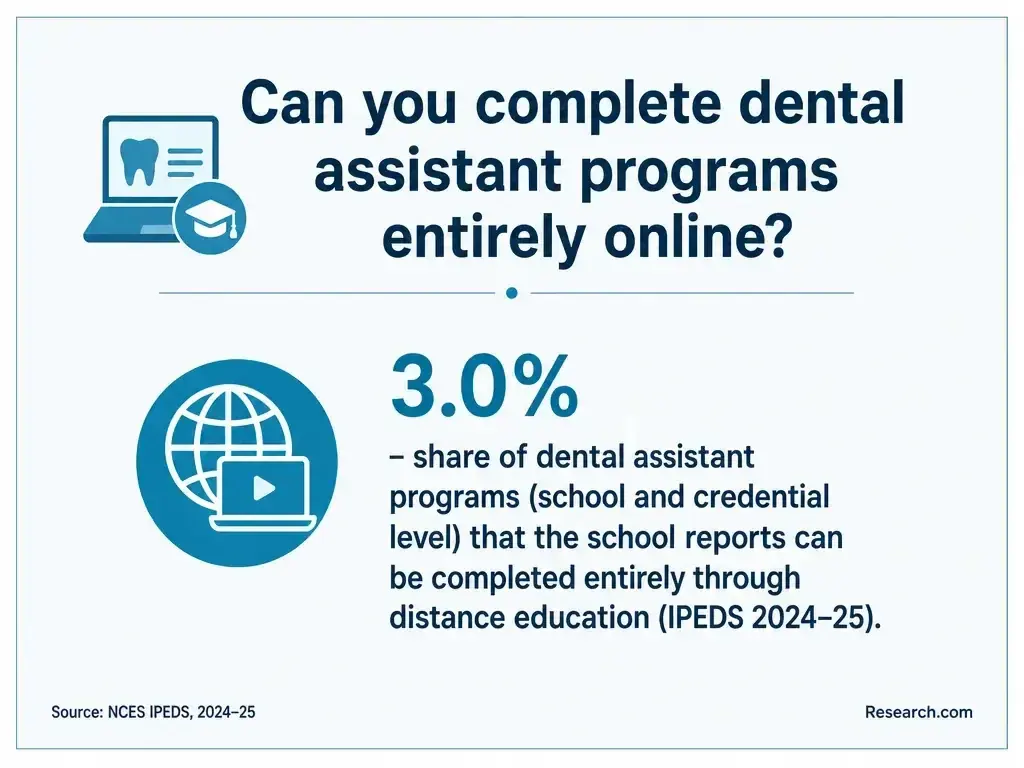
Online coursework can cover topics such as dental terminology and office procedures. It cannot, by itself, demonstrate instrument transfer, infection-control technique, or chairside communication with a patient. A hybrid program can be practical if its required labs and clinical activities are accessible from Lakewood; a campus-based program may make those sessions easier to schedule.
The format comparison below matters because "online" describes delivery, not whether training is sufficient for a job or a credential.
| Format | Potential advantage | What to verify |
| Campus-based | Regular access to supervised practice | Lab time, clinical placement, and commuting schedule |
| Hybrid | Less travel for coursework | Location and frequency of required in-person sessions |
| Fully online coursework | Flexible study of theory | How - and whether - separate hands-on training is arranged |
Use a guide to the best online school for trade skills to compare delivery options, but ask each dental assisting provider exactly where practical skills are taught and assessed. Never assume an online completion certificate establishes eligibility for Washington duties or national certification.
A defensible Lakewood-wide average is not available here: school-based programs and employer training do not share a single price or cost structure. Request a written, current cost sheet for each option rather than treating an advertised tuition figure as the price of becoming job-ready.
For a fair comparison, include mandatory fees, textbooks and supplies, uniforms or protective equipment, immunizations or background checks if required for a placement, transportation, and any certification examination fee you intend to pay. Add foregone earnings if the schedule limits work. Then subtract confirmed grants, scholarships, employer payments, or wages earned during training - not aid you merely hope to receive.
Federal aid depends on the eligibility of both the school and program, as well as the student; Washington College Grant eligibility also has its own requirements (Federal Student Aid; Washington Student Achievement Council). Ask the financial aid office about applicable aid and workforce-training support before borrowing. A lower-priced option is not necessarily cheaper if it lacks accessible clinical training or extends your time out of work.
A school-based route may award a certificate or another program completion credential; confirm the exact award in the current catalog. Employer training may document skills without awarding a school credential. Neither should be confused with Certified Dental Assistant (CDA), a national certification administered by the Dental Assisting National Board, or with a credential issued by the Washington Department of Health (Dental Assisting National Board; Washington Department of Health).
Before enrolling, ask whether the program's accreditation and coursework satisfy the particular CDA eligibility route you intend to use. Institutional accreditation, Commission on Dental Accreditation programmatic accreditation, national certification, and Washington registration each serve different purposes; one does not automatically confer another. Search terms such as certificate careers that pay well can help frame a career comparison, but verify the dental assisting credential - not just its title - against your intended job.
Admission requirements vary by provider. Check the current application for education prerequisites, placement assessments, health or immunization documentation, and any background check required for clinical participation. Being admitted does not necessarily mean a student has met every condition for a clinical placement or a later credential.
Online colleges with open admission may be useful for understanding access policies generally, but "open admission" does not establish that a dental assisting program has an available seat or that its clinical requirements can be completed remotely. Ask admissions staff to identify every condition that must be met before you can start hands-on work.
Dental assisting training should connect knowledge to repeatable practice: preparing treatment areas, processing instruments, supporting a dentist during procedures, documenting care, and communicating with patients. Instruction may also address dental anatomy, materials, radiography, and administrative tasks. The U.S. Bureau of Labor Statistics describes these as common occupational duties, but the procedures an individual assistant may perform depend on applicable Washington rules and supervision.
Compare programs by what students actually do, not by course names alone. Ask to see the current skills checklist and how often students practice each task before assessment. If a program advertises radiography or advanced procedures, have it explain how that training relates to Washington's rules for the specific duty (Washington Department of Health).
Washington regulates dental assisting through the Washington Department of Health. Dental assistant registration and expanded function dental auxiliary licensure are distinct credentials with different scopes and requirements. The nationally administered CDA certification is another distinct credential; do not assume it replaces state registration or grants authority to perform expanded functions (Washington Department of Health; Dental Assisting National Board).
Choose the duties you want to perform first, then check the Department of Health's current credential and scope-of-practice instructions before selecting training. Ask a school to show which requirements its program meets and which steps remain yours to complete. Graduation alone should not be treated as state authorization to perform a procedure.
The best fit is the route that gets you adequately trained for your intended duties at a manageable total cost. A structured program may be worth paying for if its supervised practice, schedule, and credential alignment solve needs an employer cannot meet. If you already have an offer of well-supported, paid office training, compare that option before taking on tuition or debt.
Use these questions when speaking with Clover Park Technical College or any prospective training employer; they expose gaps that a ranking or short program description cannot.
Verify institutional accreditation with the accreditor, any claimed dental assisting programmatic accreditation with the Commission on Dental Accreditation, and state credential rules with the Washington Department of Health. A common mistake is choosing the shortest or cheapest advertised option without confirming clinical access. Search results for online phd programs no dissertation illustrate why a broad "online program" label is no substitute for occupation-specific verification.
Entry-level work commonly involves chairside and office-support duties. With experience and additional employer training, an assistant may take on more specialized responsibilities or move toward practice coordination. An assistant interested in expanded functions must separately examine Washington's expanded function dental auxiliary requirements; experience or a basic school certificate alone does not grant that license (Washington Department of Health).
Dental hygiene is a different occupation with its own education and licensing requirements, not an automatic promotion from dental assisting. If your main goal is a different scope of clinical practice, compare that goal's requirements before investing in an entry-level dental assisting program.
The U.S. Bureau of Labor Statistics projects 7.4% growth in U.S. dental assistant employment from 2025 to 2035. That national projection indicates occupational demand but does not forecast how many jobs a Lakewood graduate will find. For a local decision, compare current openings across the wider Tacoma-Lakewood commuting area and note which duties, schedules, and credentials employers request.
Training is a more compelling investment when those postings match the skills and availability you can offer. It is less compelling to borrow heavily on the assumption that national growth will guarantee a nearby job or a particular wage.
Education is a consequential investment, so the Research.com team evaluates trade-school programs against other programs in the same occupation and location - not unrelated schools elsewhere. The ranking includes only programs with completions reported to IPEDS. That makes the comparison more consistent, but it also means an employer training route or a provider absent from IPEDS may not appear; absence is not a judgment of quality or legitimacy.
Best-program rankings consider student outcomes; earnings and return on investment; costs and debt; and quality and recognition. Occupation-relevant programmatic accreditation or industry recognition carries 20% of the score, institutional accreditation 10%, and student support services 10%. The remaining 60% covers completion and full- and part-time retention, earnings one year after completion and relative to annual attendance cost, tuition, attendance cost, debt - including debt held by students who withdrew - and federal loan default rates. Those indicators receive entropy-based weights, giving more weight to measures that differ more across programs. Most-affordable rankings instead score only tuition, attendance cost, median debt, and federal loan default rate using entropy-based weights; accreditation and other quality measures do not enter that score.
The team uses the following sources to check education, outcomes, recognition, and occupational context. A source's inclusion does not mean every organization it covers accredits dental assisting programs.
This approach helps readers compare measurable outcomes while still checking whether a particular program provides the clinical experience and Washington credential eligibility they need. More detail is available in Research.com's methodology.
# 1 position
# 2 position
Do not assume a school credential is the only entry route. Compare structured training with supervised employer training, then verify Washington registration and the rules for the duties you expect to perform (Washington Department of Health).
Theory may be available online, but chairside skills require in-person practice and assessment. Ask where labs or clinical activities take place before enrolling.
No. CDA is a separate national certification with eligibility and examination requirements set by the Dental Assisting National Board.
Request the full price for tuition, fees, supplies, required placement expenses, and travel. Compare it with confirmed aid or paid-training wages and the income you may give up while training.
Not necessarily. The $48,070 May 2025 U.S. median covers employed dental assistants across experience levels; check current local offers when planning your budget (U.S. Bureau of Labor Statistics).