# 1 position


Audited and Verified:
Our Editorial and Data Verification Process
Research.com uses government datasets, official education statistics and primary institutional information to support its career and degree guides. Our review process checks factual accuracy, occupational definitions, source dates and the requirements associated with the credentials discussed.
How This Article Was Fact-Checked
Our editorial team verifies salary estimates, employment projections, education requirements and program information against original data providers and official organizations. Salary figures are checked against the relevant occupational definitions and reporting periods. Information about licensure, accreditation and required in-person training is reviewed separately.
Fact-checked and verified on:

Co-Founder and Chief Data Scientist

Reviewed by Karolina Broda
Fact-Checker and Data Verification
Choosing dental assistant training near Kirkland means weighing more than tuition: you need a workable commute, substantial chairside practice, and a clear route to Washington registration. The U.S. Bureau of Labor Statistics reports a $48,070 national median annual wage for dental assistants in May 2025, but that is not a starting-pay estimate. This guide compares training routes, costs, credentials, and career prospects. It also features the Best Dental Assistant Trade Schools in Kirkland for 2027 ranking, created by the Research.com team of data scientists to help students identify programs worth considering.
Expect a combination of classroom instruction, simulated practice, and supervised patient-care experience. Dental assistants prepare treatment rooms, support dentists during procedures, maintain infection controls, and handle records; the exact duties permitted depend on Washington rules, supervision, and demonstrated competence (U.S. Bureau of Labor Statistics; Washington State Department of Health). Ask where students practice instrument transfer, sterilization, patient communication, and radiography-related procedures - not merely whether a catalog says "hands-on."
The main routes differ in what you pay for and how quickly you enter a workplace. Published hours and externship arrangements vary by provider, so obtain the current catalog rather than assuming that similarly named credentials involve equivalent clinical time.
This comparison shows which route may fit your circumstances; it does not imply that every route offers the same credential or certification eligibility.
| Route | What it offers | Best fit and main trade-off |
| Career-school or technical-college certificate | Structured coursework, skills labs, and potentially an externship | Fits students seeking guided practice; compare total price and clinical access. |
| Associate-degree program, where offered | Dental-assisting preparation plus additional college coursework | Fits students who value that credential; usually means more time and expense. |
| Dental-office training | Employer-directed learning alongside paid or entry-level work | Fits students with a suitable hiring opportunity; instruction and future credential options may be less predictable. |
A dental-office job can be a realistic alternative to school because Washington registration is not itself a requirement to complete a particular trade-school program (Washington State Department of Health). Before choosing that route, ask the employer who supervises training and which duties a beginner may perform. Unlike trades with a standard journeyman progression, dental assisting should not be presumed to follow a registered-apprenticeship ladder.
Dental offices are the principal workplace for dental assistants nationally, according to the U.S. Bureau of Labor Statistics. Around Kirkland, that makes general dentistry and specialty practices - such as orthodontics, oral surgery, and pediatric dentistry - relevant places to investigate. A position's duties can differ substantially: a specialty practice may prize procedure-specific setup, while another office may combine chairside work with scheduling and insurance tasks.
When assessing an externship, ask whether it is at an accessible office and whether students rotate through the duties they hope to perform. A placement across the Seattle-area commute may add travel expense and limit paid-work hours, even when the program's tuition looks attractive.
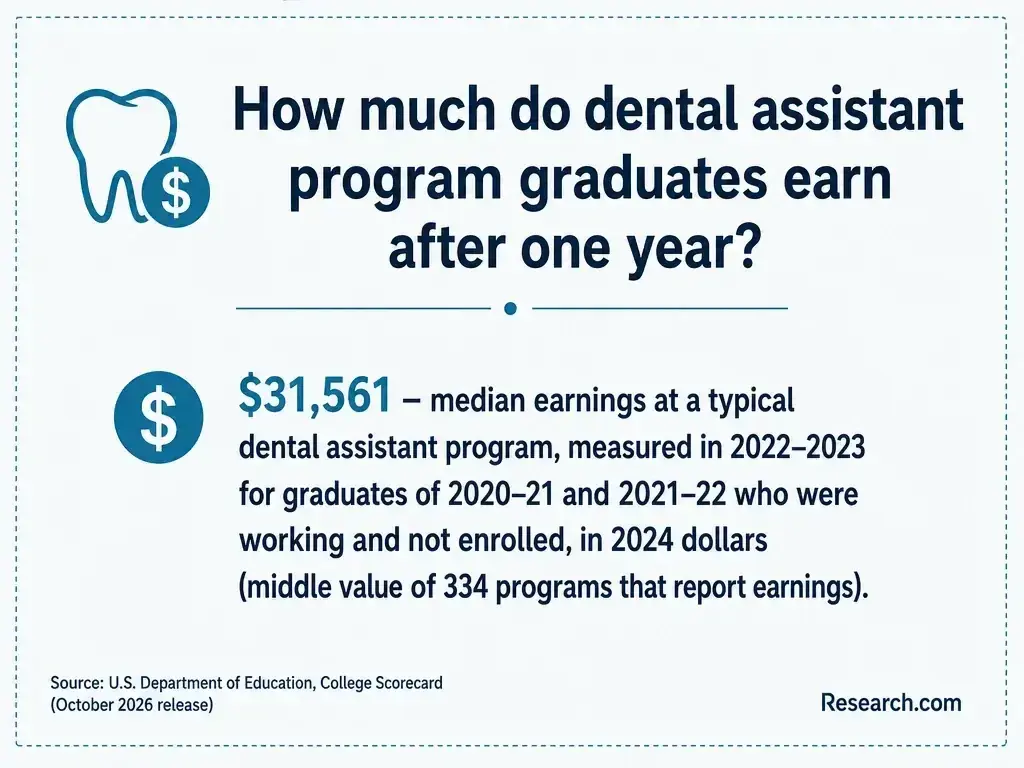
A verified Kirkland-specific wage figure is not established here. For a national reference, the median annual wage for dental assistants was $48,070 in May 2025 (U.S. Bureau of Labor Statistics, Occupational Outlook Handbook). That figure covers experienced and new workers across the country; it is not an entry-level wage or a Seattle-area estimate.
For a useful local comparison, ask prospective employers for the offered hourly rate, paid hours, benefits, and any pay progression after registration or added responsibilities. Convert offers to an annual equivalent only when the expected schedule is clear. Compare that likely take-home improvement with training costs and earnings you would forgo while studying - not with the national median alone.
A certificate route is generally shorter than an associate-degree route, while employer training may begin with a job and continue as skills develop. There is no single Washington-required classroom-hour total that every prospective registered dental assistant must complete before applying for registration (Washington State Department of Health). That does not make clinical hours unimportant: programs set their own lab and externship schedules, and certification pathways have separate eligibility rules.
Request the exact clock or credit hours, weekly timetable, and required days at an externship site from each provider. If you work, compare your realistic completion date - not the advertised fastest date - with the income you would lose by reducing shifts. Resources about accelerated online undergraduate degrees for working adults address a different educational choice; speed alone does not replace dental-assisting practice.
Online delivery can help with terminology, anatomy, records, and other classroom material. Chairside assisting, instrument handling, infection-control technique, and supervised patient care require in-person practice and assessment. A hybrid program may reduce trips for lectures, but a Kirkland student still needs a workable route to its lab and clinical sites (U.S. Bureau of Labor Statistics).
Ask a hybrid provider to identify every required campus day, who arranges externships, and what happens if a placement falls through. Treat a fully online claim as a red flag until the provider explains how practical competence is assessed and how its training supports your intended Washington duties. Lists of easy online certifications that pay well should not be mistaken for proof that an online dental-assisting course provides clinical training or state registration.
A defensible Kirkland program-cost average is not available from the information presented here. Instead of treating an advertised tuition figure as the price of entry, request an itemized, current cost-of-attendance estimate from every provider. Include mandatory fees, books, scrubs and protective equipment, supplies, any required screening, transportation to labs and externships, and applicable registration or optional certification expenses.
The comparison should also account for aid and income. Ask whether the specific program qualifies for federal aid or Washington College Grant assistance; eligibility depends on the student and program, not simply on the school's name (Federal Student Aid; Washington Student Achievement Council). Employer training may reduce tuition and provide wages, but assess whether it offers enough supervised practice for your goal. Comparisons with affordable online universities can obscure dental assisting's required in-person costs.
The school may award a certificate, diploma, or - if the specific program is designed to do so - an associate degree. That school award is not Washington dental-assistant registration. Nor is it automatically the Dental Assisting National Board's Certified Dental Assistant (CDA) credential; DANB sets its own examination and eligibility requirements (Washington State Department of Health; Dental Assisting National Board).
Ask whether the program holds Commission on Dental Accreditation accreditation if national certification is a goal, and verify the applicable DANB pathway before enrolling (Commission on Dental Accreditation; Dental Assisting National Board). Also distinguish institutional accreditation, state authorization to operate, and programmatic accreditation: each answers a different question, and none independently grants state registration. Even an affordable online associates degree comparison is useful only if the particular dental-assisting program supplies the required practical preparation.
School admissions and permission to work are separate steps. A provider may require an application, evidence of secondary-school completion, placement assessment, immunization documentation, or screening before clinical placement; request its current written requirements and deadlines rather than assuming all schools use the same rules. An employer-training position instead requires meeting that employer's hiring standards.
Before paying a deposit, confirm whether you can attend the required daytime labs and reach the externship site. Then check Washington Department of Health dental-assistant registration instructions separately from school admissions. A school's acceptance letter does not serve as occupational registration (Washington State Department of Health).
Relevant instruction covers dental terminology and anatomy, chairside procedures, instruments, sterilization and infection prevention, patient communication, records, and practice workflow. Programs may also teach dental imaging and specialty-office procedures; ask how each skill is practiced and assessed rather than relying on a course title (U.S. Bureau of Labor Statistics).
A useful question for a lab tour is: "What can a student do independently in a simulation, and what must be demonstrated under supervision with patients?" Clear answers help distinguish a course that introduces concepts from one that develops workplace-ready technique. Digital records and imaging make technology familiarity useful, but software exposure cannot substitute for safe chairside practice.
Washington requires dental assistants to register with the state Department of Health. Registration is distinct from completing a trade-school program and from earning DANB's optional national CDA certification. Scope of duties and supervision are governed by Washington rules; do not assume that an out-of-state course or certificate authorizes a particular procedure here (Washington State Department of Health; Dental Assisting National Board).
Washington's expanded function dental auxiliary is a separate, more advanced credential with its own requirements. If that is your eventual goal, compare programs against the Department of Health's current eligibility rules before enrolling; a basic dental-assisting certificate should not be sold as automatic eligibility. Confirm registration and scope requirements directly with the Department of Health when you are ready to apply.
The best choice is the program that can get you from training to your intended Washington workplace at a manageable total cost. Lake Washington Institute of Technology is one provider to investigate, but check its current dental-assisting offering, schedule, credential, and clinical arrangements rather than relying on an older catalog. Rankings can narrow options; they cannot tell you whether a particular commute or externship fits your life.
Use these checks when speaking with admissions staff. Each addresses a common mistake that can be expensive to discover after enrollment:
If you primarily need flexible remote study, resources on the most affordable online universities for working adults address another comparison. They cannot establish whether a dental-assisting program gives you accessible labs, clinical practice, and a viable route into local work.
Most students are preparing for an entry-level dental-assistant role. With experience, an assistant may seek a specialty-practice position, take on scheduling or team-coordination duties, or pursue national certification where eligible. Washington's expanded function dental auxiliary route is a distinct advancement option, not an automatic promotion following basic training (U.S. Bureau of Labor Statistics; Washington State Department of Health; Dental Assisting National Board).
Choose training around the first job you actually want. If you prefer chairside care, prioritize repeated supervised practice; if you hope to work in a particular specialty, ask whether the externship exposes students to it. Further credentials may broaden options, but verify their separate requirements and costs before counting them in a return-on-investment calculation.
U.S. dental-assistant employment is projected to grow 7.4% from 2025 to 2035 (U.S. Bureau of Labor Statistics, Employment Projections). This signals national demand, not a forecast of Kirkland vacancies or a guarantee of a job after graduation. A local search should cover reachable practices across the Eastside and consider whether your training schedule permits interviews or work during school.
Ask prospective employers which beginner skills they expect and whether they train new assistants. Their answers can reveal whether a shorter, lower-cost route is adequate or whether structured labs and an externship would make the investment more useful for your intended role.
Investing in training is an important decision, particularly when two programs with similar names may offer different clinical experiences. Research.com evaluates programs against others in the same occupation and location to make the ranking useful for comparing realistic options. Only programs with completions reported to IPEDS are included; an unlisted employer-training route or provider is not necessarily unavailable or low quality.
The best-programs ranking considers student outcomes; earnings and return on investment; costs and debt; and quality and recognition. Programmatic accreditation or relevant industry recognition receives 20% of the score, institutional accreditation 10%, and student support services 10%. The remaining 60% covers outcomes, earnings, and costs, with weights distributed through an entropy-based method that assigns more weight to indicators that vary more across programs. An affordability ranking, by contrast, scores only tuition, attendance cost, debt, and federal loan default rate using that method; it does not score accreditation or other quality indicators. These measures support comparison but cannot establish that a graduate will qualify for every dental-assisting duty in Washington.
To check the ranking's quality, credibility, and accuracy, the Research.com team used the following education, accreditation, credential, and training data sources:
Use the ranking to narrow your shortlist, then verify each program's current clinical arrangements, costs, and fit with Washington requirements. More detail on the approach appears in Research.com's methodology.
# 1 position
# 2 position
Potentially. Washington registration does not require completion of one particular trade-school route, and some dental offices train beginners. Confirm the employer's supervision and training plan, then follow the Washington Department of Health's registration requirements.
No. A certificate is an award from a school; CDA is a national credential administered by DANB under separate eligibility and examination rules. Neither is Washington state registration.
Coursework may be online, but practical chairside skills need in-person instruction or supervised assessment. Ask exactly where and when a program's labs and clinical experience occur.
No. Institutional accreditation, dental-assisting program accreditation, school authorization, national certification, and state registration are different. Check the Department of Health's current registration instructions separately.
It depends on the job offer and the training. Compare wages during training, total school cost, supervised practice, your completion prospects, and whether either route supports your longer-term credential goals.