# 1 position


Audited and Verified:
Our Editorial and Data Verification Process
Research.com uses government datasets, official education statistics and primary institutional information to support its career and degree guides. Our review process checks factual accuracy, occupational definitions, source dates and the requirements associated with the credentials discussed.
How This Article Was Fact-Checked
Our editorial team verifies salary estimates, employment projections, education requirements and program information against original data providers and official organizations. Salary figures are checked against the relevant occupational definitions and reporting periods. Information about licensure, accreditation and required in-person training is reviewed separately.
Fact-checked and verified on:

Co-Founder and Chief Data Scientist

Reviewed by Karolina Broda
Fact-Checker and Data Verification
Choosing an affordable dental assistant program in Rochester means comparing more than tuition: hands-on training, Minnesota credential rules, and time away from work can change the value of a program. The U.S. Bureau of Labor Statistics projects 7.4% national employment growth for dental assistants from 2025 to 2035. This guide is for prospective students and career changers weighing those trade-offs. It accompanies the Most Affordable Dental Assistant Trade Schools in Rochester for 2027 ranking, created by the Research.com team of data scientists to help students identify programs worth considering.
Expect instruction in chairside assistance, infection control, dental materials, patient communication, and office procedures, followed by supervised practice. The decisive question is whether a program provides the clinical experience and credential preparation needed for your intended Minnesota duties - not simply whether it awards a certificate or diploma.
Rochester Community and Technical College is a local public-college option to investigate. Compare its current dental-assisting curriculum, clinical placement arrangements, and stated credential outcomes with any shorter career-school or employer-sponsored route you consider. A short route may help someone enter a dental office sooner, while a program aligned with licensed dental assistant requirements may better fit someone seeking a broader permitted scope of work. Ask each provider which procedures students practice, where they practice them, and which costs or scheduling obligations accompany placement.
An associate credential can be useful if its additional coursework serves your goals, but speed alone is not evidence of Minnesota licensing eligibility. Even a fastest associates degree comparison cannot replace a review of the specific dental-assisting curriculum and clinical requirements.
Dental assistants work primarily in dentists' offices, with some positions in specialty practices and other dental-care settings (U.S. Bureau of Labor Statistics). In Rochester, compare general dentistry openings with specialty-office openings: the mix of procedures can affect the skills an employer expects and the supervision available to a new assistant.
A supervised, entry-level office role may suit someone who wants to earn while learning. Ask prospective employers whether they train unlicensed assistants, what duties the position permits under Minnesota rules, and whether they support later certification or licensure. Employer training can reduce upfront school costs, but it is not interchangeable with a qualifying program if your goal is licensed dental assistant status (Minnesota Board of Dentistry).
The U.S. Bureau of Labor Statistics reports a $48,070 national median annual wage for dental assistants in May 2025. That is the midpoint for workers nationwide, across experience levels - not a Rochester wage or a likely first-job offer. Use it as context, then compare current local postings by required credential, schedule, benefits, and duties before estimating what training could return.
For an investment decision, compare expected earnings after training with what you could earn without it. Include completion probability, aid, borrowing, time out of work, and how long you expect to remain in the occupation; a higher-priced program is not automatically a worse investment if it supports the credential and work you actually want.
There is no single duration for every dental-assisting route. An employer may teach limited office duties on the job, while a formal certificate, diploma, or associate program has scheduled coursework, labs, and possibly clinical experience. Full-time versus part-time enrollment and the timing of clinical placements can change your finish date substantially.
Before choosing an accelerated option, request its total clock or contact hours, supervised clinical hours, start dates, and expected completion date in writing. Check those details against current Minnesota Board of Dentistry requirements for the credential you intend to pursue. A shorter advertised calendar is not useful if it omits training you later need to obtain separately.
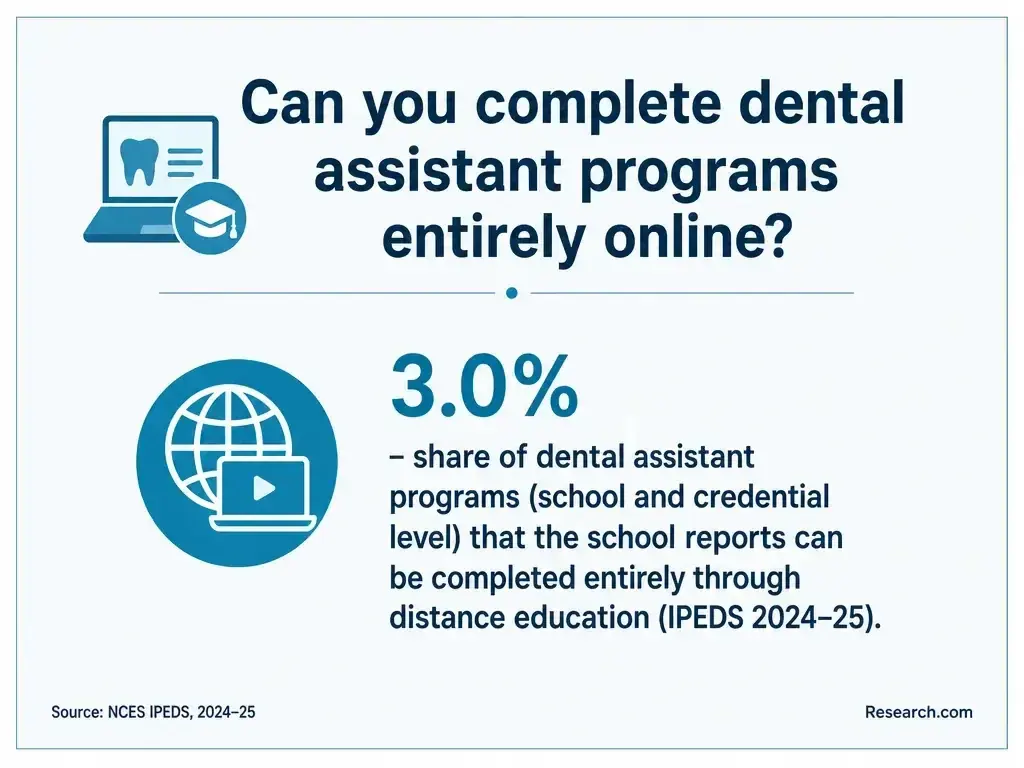
Online coursework can cover terminology, records, and some theory. Chairside procedures, instrument handling, infection-control practice, and clinical work require supervised in-person learning. A hybrid program may reduce trips to class, but it does not eliminate travel to labs or a dental office.
The comparison below shows what format descriptions do - and do not - tell you about becoming job-ready.
| Format | Potential advantage | Critical limitation to check |
| On-campus | Scheduled access to equipment and instructors | Lab and clinical schedules may conflict with work |
| Hybrid | Some theory completed remotely | In-person labs and clinical placement still require travel |
| Online coursework only | Flexible study of classroom material | May not provide practical training or support the intended credential |
Search results for online community colleges with open enrollment can help you explore access to coursework, but open enrollment says nothing about dental-assisting clinical capacity or Minnesota eligibility. Ask where every hands-on requirement occurs before paying a deposit.
A defensible Rochester-wide average is not available here. Providers publish prices for different credentials and may include different items, so a tuition-only comparison could mislead you. Request a current, itemized cost for the complete pathway you plan to take.
These are the cost categories most likely to change which option is actually affordable:
Ask the financial-aid office which aid applies to the specific program, not just the institution. Federal aid eligibility depends on program and student requirements (Federal Student Aid). Minnesota workforce services may also identify eligible training assistance; employer-paid training may offset costs but can cover a narrower set of duties. Listings for free to apply accredited online colleges address an application expense, not the full cost of becoming a dental assistant.
Depending on the provider, formal training may award a certificate, diploma, or associate degree. Those are educational awards. Certified Dental Assistant (CDA) is a professional certification administered by the Dental Assisting National Board; licensed dental assistant refers to a Minnesota state credential. Neither follows automatically from receiving a school award (Dental Assisting National Board; Minnesota Board of Dentistry).
Ask for the exact award name and a written explanation of which certification-exam eligibility route and Minnesota licensing requirements the curriculum supports. The Commission on Dental Accreditation's programmatic accreditation is different from a school's institutional accreditation or authorization to operate. Verify each claim separately rather than assuming one status substitutes for another (Commission on Dental Accreditation; Minnesota Board of Dentistry).
Requirements vary by provider and by clinical site. Ask admissions whether you need a high school credential, placement assessment, health documentation, background check, or other clearance, and when each item is due. A school's admission decision is separate from a clinical site's placement decision and from the state's later licensing decision.
If you already have dental-office experience, ask whether the program evaluates prior learning or offers advanced standing - and whether any credit changes required lab or clinical participation. A low-friction application, like those highlighted in guides to cheap bachelor degree options, is not a substitute for confirming entry, placement, and credential requirements in this trade.
Training typically connects classroom knowledge to chairside tasks: preparing treatment areas, handling instruments, following infection-control protocols, communicating with patients, maintaining records, and supporting dental procedures (U.S. Bureau of Labor Statistics). Depending on the program and intended scope of practice, instruction may also address dental radiography, impressions, and other supervised procedures.
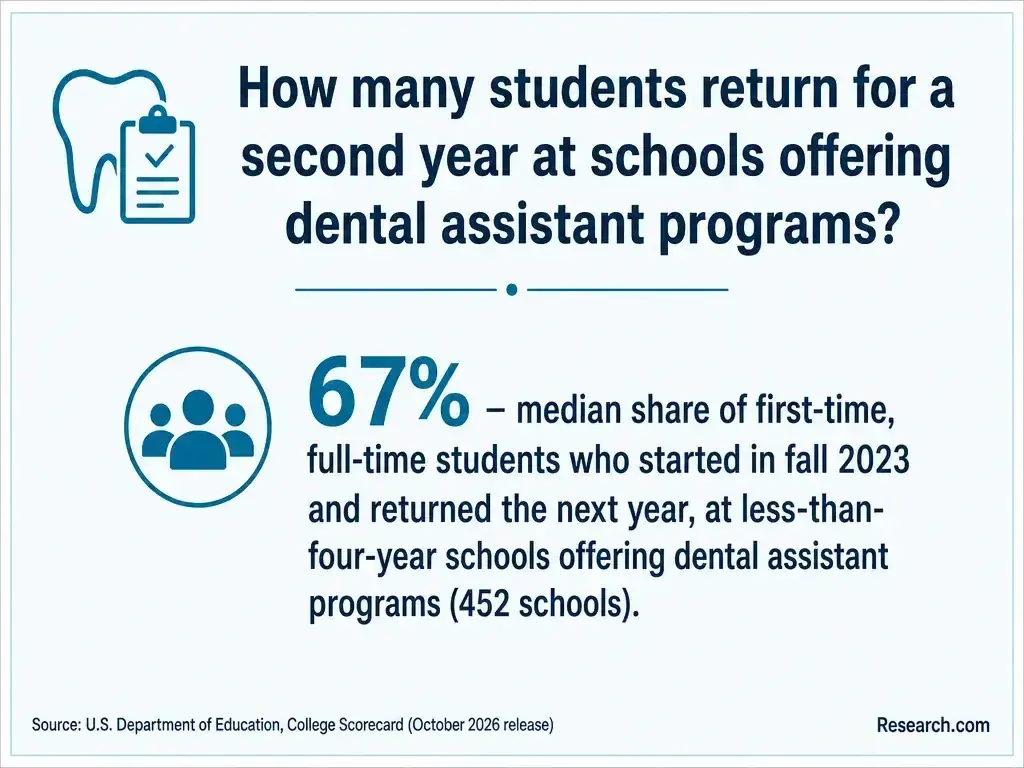
Compare actual practice opportunities, not course titles alone. Ask to see the lab skill list and clinical evaluation criteria, including who observes students and how missed competencies are made up. Digital imaging and electronic records make comfort with dental technology valuable, but no online simulation replaces supervised practice with equipment and patients.
Not for every dental-assisting role. Minnesota permits unlicensed dental assistants to perform certain duties under the applicable supervision rules, while licensed dental assistants have a distinct regulated scope of practice. Requirements for particular functions, including radiography, must be checked against current Minnesota Board of Dentistry rules before accepting an assignment.
If licensed dental assistant status is your goal, verify the Board's current education, examination, and application routes before enrolling. The Dental Assisting National Board administers national certification, but national certification and Minnesota licensure are distinct; completing a program alone does not grant either credential (Minnesota Board of Dentistry; Dental Assisting National Board). Ask the school to identify the precise route its graduates are prepared to pursue.
Start with the job you want, then compare programs that prepare you for that job's permitted duties. The affordability ranking is a useful shortlist, not a replacement for checking clinical training and regulatory fit.
Use these questions when speaking with a program representative:
A common mistake is choosing the cheapest advertised tuition or an entirely online option before checking the duties its training supports. Another is treating a national median wage as expected starting pay. If a provider cannot clearly document its curriculum, clinical arrangements, costs, and credential claims, pause before committing. Comparisons with unrelated searches such as online phd cheap will not answer whether a dental-assisting program makes financial sense.
A common starting path is supervised chairside work in a general dental office. With the appropriate Minnesota credentials and experience, an assistant may pursue duties available to licensed dental assistants or seek work in a specialty practice. Experienced assistants may also take on scheduling, patient coordination, inventory, or team-lead responsibilities, depending on the employer (Minnesota Board of Dentistry; U.S. Bureau of Labor Statistics).
These are different employment paths, not automatic promotions. Before paying for additional training, check whether local openings require the credential it offers and whether the resulting duties or schedule would justify its cost for you.
The U.S. Bureau of Labor Statistics projects 7.4% growth nationally from 2025 to 2035 for dental assistants. That points to a growing occupation overall, but it does not predict how many openings an individual Rochester applicant will find or guarantee a job after training.
For a local reality check, review current dental-office postings over several weeks. Note how many seek unlicensed versus licensed assistants, which procedures they mention, and whether schedules fit yours. That evidence can help you decide whether to enter through employer training or invest in a formal program aimed at a broader scope of practice.
Investing in training is an important decision. To make the ranking useful and credible, the Research.com team compares dental assistant programs with other programs in the same occupation and location, rather than with unrelated trades. Only programs with completions reported to IPEDS are included; an employer training route or other provider absent from IPEDS is not necessarily a poor option.
The most affordable ranking scores tuition, cost of attendance, median student debt, and federal loan default rates. An entropy-based method gives more weight to measures that vary more among the programs compared. Accreditation and other quality indicators do not enter this affordability score. Research.com's separate best programs rankings also consider completion, retention, earnings, student support, and relevant recognition. Affordability therefore should not be read as a finding that a program meets Minnesota licensing requirements.
The team used the following sources to assemble and check the ranking. Some cover institutions broadly, while others help identify occupation-specific recognition or alternative training pathways:
This approach helps readers narrow their cost comparison, then investigate practical training and eligibility before enrolling. See Research.com's methodology for more about how the ranking was created.
# 1 position
# 2 position
Employer-sponsored training may minimize upfront tuition for an unlicensed entry-level role. If you want Minnesota licensed dental assistant status, compare the full cost of programs that support the relevant eligibility route; the lowest tuition may not be the lowest job-ready cost.
Online classes can cover theory, but practical dental-assisting skills require in-person instruction or supervised work. Confirm the clinical arrangements and Minnesota credential implications of any online offer.
No. A school certificate records completion of training; Minnesota licensure is a separate state credential with its own requirements (Minnesota Board of Dentistry).
It depends on your intended credential route. CODA accreditation is programmatic recognition, not institutional accreditation or a license. Check the Minnesota Board of Dentistry's current requirements and the program's verified CODA status before enrolling.
Possibly. Eligibility depends on the specific program and your circumstances. Request a program-level aid assessment and compare the amount you would still need to pay or borrow (Federal Student Aid).