# 1 position

Audited and Verified:
Our Editorial and Data Verification Process
Research.com uses government datasets, official education statistics and primary institutional information to support its career and degree guides. Our review process checks factual accuracy, occupational definitions, source dates and the requirements associated with the credentials discussed.
How This Article Was Fact-Checked
Our editorial team verifies salary estimates, employment projections, education requirements and program information against original data providers and official organizations. Salary figures are checked against the relevant occupational definitions and reporting periods. Information about licensure, accreditation and required in-person training is reviewed separately.
Fact-checked and verified on:

Co-Founder and Chief Data Scientist

Reviewed by Karolina Broda
Fact-Checker and Data Verification
Choosing the cheapest dental assistant program near Tanner means looking beyond tuition: clinical practice, commuting, fees, and Alabama's rules can change which option is worth paying for. The U.S. Bureau of Labor Statistics projects 7.4% national growth in dental assistant employment from 2025 to 2035, making training quality as important as price. This guide compares pathways, costs, credentials, and career prospects. It also features a Most Affordable Dental Assistant Trade Schools in Tanner for 2027 ranking created by the Research.com team of data scientists to help students choose programs worth considering.
Expect instruction in chairside procedures, infection control, dental terminology, records, and patient communication, followed by practice using instruments and equipment. A credible comparison asks not just what topics appear in the catalog, but which skills students perform in a lab and in a supervised dental setting. The U.S. Bureau of Labor Statistics describes these as core dental assistant duties.
For a Tanner resident, the practical training site matters: a course advertised as nearby may hold labs or externships elsewhere in the Decatur-Huntsville area. John C Calhoun State Community College is a local public-college option to investigate, but confirm its current dental assisting offering, campus, clinical arrangements, and credential directly before comparing it with private career training. Employers may also train assistants on the job; that route can reduce upfront tuition but may offer less structured instruction or fewer transferable credentials. The U.S. Bureau of Labor Statistics recognizes both postsecondary education and on-the-job training as entry routes, depending on the state and employer.
Dental offices are the principal workplace for dental assistants, according to the U.S. Bureau of Labor Statistics. A Tanner applicant can consider practices across nearby communities rather than restricting a job search to the town itself. General practices offer broad chairside exposure; specialty practices may seek experience with particular procedures and patient groups.
Ask a prospective externship coordinator which offices accept students, whether placements are arranged or student-sourced, and how far graduates typically travel for work. A placement across the surrounding area could be valuable, but transportation and schedule reliability become part of the real training cost.
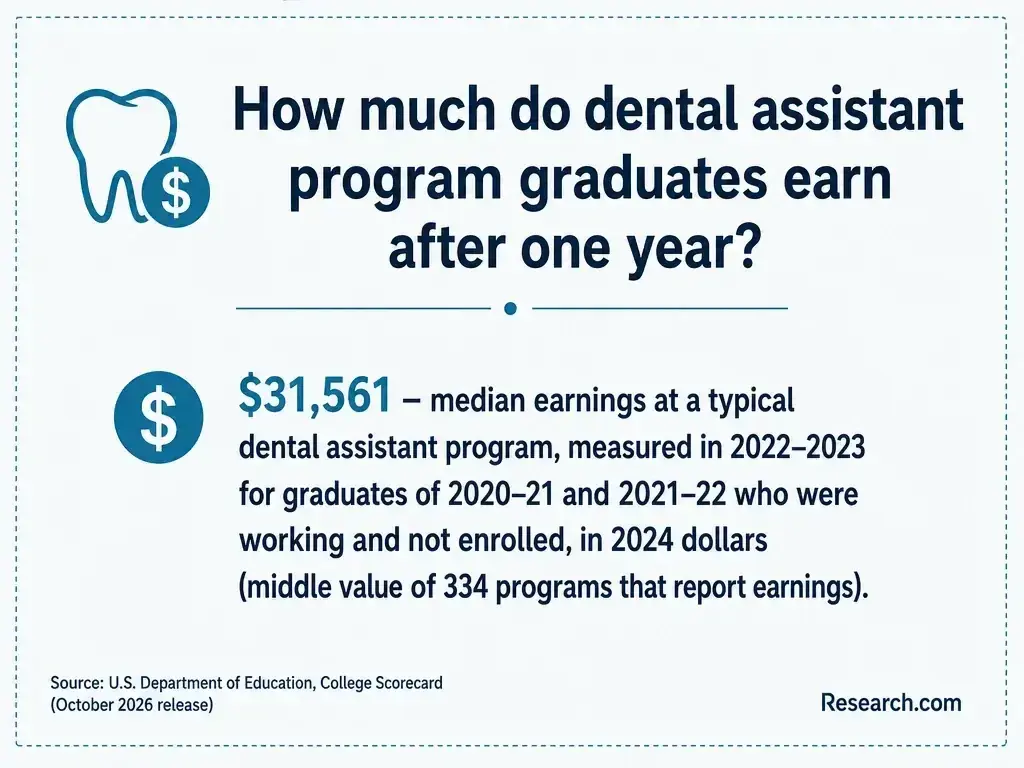
The national median annual wage for dental assistants was $48,070 in May 2025 (U.S. Bureau of Labor Statistics, Occupational Outlook Handbook). That figure describes workers across experience levels nationwide; it is not a Tanner wage estimate or a promise to a new graduate. Without a comparable Tanner-specific published wage series, use current offers from reachable employers to test whether training costs fit your expected pay.
When comparing offers, ask about paid hours, benefits, travel, and whether the employer pays for further training. A higher hourly offer with a difficult commute or fewer scheduled hours may have a lower practical return than a closer position.
Dental assisting certificates and diplomas are generally shorter than associate degree programs, but an advertised completion date may exclude prerequisite work, a waiting period, or an externship. Alabama does not impose one universal school-program length for every entry-level dental assistant role; compare each program's published calendar, clock or credit hours, lab hours, and supervised practice requirements against your intended duties and any certification goal (Alabama Board of Dental Examiners; Dental Assisting National Board).
If speed is your priority, compare the date you could start working, not just the final online class date. Some accelerated online associate degree programs illustrate why a compressed academic schedule is different from completing required in-person dental skills practice. Ask whether part-time attendance changes clinical placement availability or the total time to finish.
Online instruction can cover terminology, anatomy, scheduling, and some infection-control concepts. It cannot substitute for hands-on chairside practice, instrument processing, or supervised work with patients. A hybrid program may suit a Tanner student balancing employment and travel, provided it specifies where and when labs and clinical experience occur.
Campus-based training makes it easier to inspect equipment and practice with instructors, but can require more frequent commuting. An online provider's institutional status does not, by itself, establish that its dental assisting training meets an employer's expectations or a certifying body's eligibility rules. If considering accredited online colleges non profit, separately verify the dental program's practical component and credential eligibility; "nonprofit" and "private" are not opposite categories. Confirm the precise rules with the Dental Assisting National Board and Alabama Board of Dental Examiners before enrolling.
There is no reliable published Tanner-wide average that includes every dental assisting school, employer-run route, and required expense. Quoting one would give false precision. Instead, request an itemized, written cost to become job-ready from each provider. Published college tuition is a starting point, not a complete budget (National Center for Education Statistics; Federal Student Aid).
Use the same cost categories for every option so a shorter private course and a public-college program can be compared fairly:
Federal aid eligibility depends on the student and program, not merely the school's advertising (Federal Student Aid). Compare the amount you may need to borrow with a realistic starting-pay offer and your likelihood of finishing; a lower tuition bill is not automatically the better return if it leaves you without needed clinical experience.
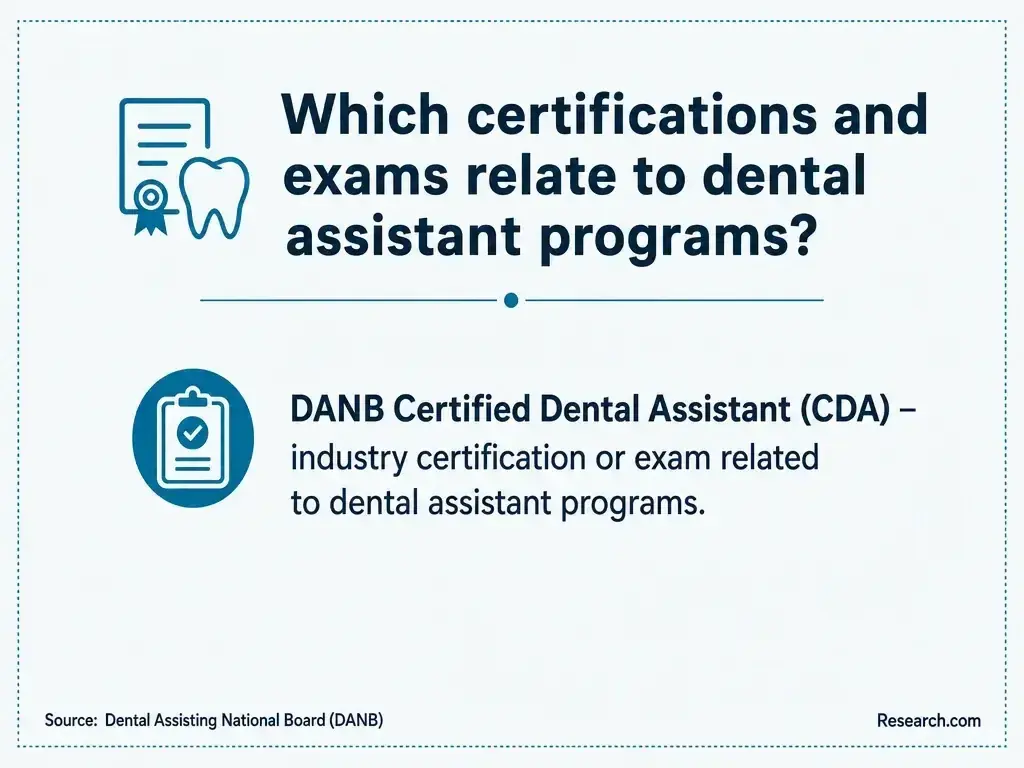
A training provider may award a certificate, diploma, or associate degree; an employer-run course may document completed training without awarding an academic credential. These are school or employer credentials. The Certified Dental Assistant designation is a separate professional certification administered by the Dental Assisting National Board, with its own eligibility and examination requirements (Dental Assisting National Board).
Programmatic accreditation is another distinct question. The Commission on Dental Accreditation accredits eligible dental assisting programs, while institutional accreditation applies to the school; neither automatically grants certification or permission to perform every Alabama dental function. Request the exact credential name in writing and check the Dental Assisting National Board's current route to any certification you intend to pursue (Commission on Dental Accreditation; Dental Assisting National Board).
Entry requirements vary by provider and clinical site. Ask whether you need a high school diploma or equivalent, placement testing, immunization documentation, a background check, or a health screening, and whether these have separate fees. Do not assume that a program's open admissions policy means automatic access to limited lab or externship places.
If you are considering an online college open enrollment option, distinguish admission to the school from admission to its dental assisting training and eligibility for in-person practice. An employer-sponsored route has different entry criteria: the practice may hire first and teach its procedures on the job, so ask what supervision and instruction it will actually provide.
Dental assisting training should connect classroom knowledge to the flow of an appointment: preparing the operatory, maintaining infection-control procedures, assisting the dentist, documenting care, and explaining instructions to patients. Depending on the program and applicable rules, students may also study dental imaging and practice related procedures under supervision (U.S. Bureau of Labor Statistics; Alabama Board of Dental Examiners).
To judge depth, request the course outline and a breakdown of instructor-supervised lab and clinical hours. Two similarly named certificates may offer very different opportunities to handle instruments, practice patient communication, and receive feedback. If a program describes imaging or expanded functions, ask exactly which activities students practice and what Alabama permits graduates to do afterward.
Do not confuse entry-level employment with authorization for every task. Alabama's dental board regulates dental practice and the functions assistants may perform; national certification through the Dental Assisting National Board is a separate credential. Before paying for training, check the Alabama Board of Dental Examiners' current requirements for your intended duties, including any applicable conditions for radiography or expanded functions (Alabama Board of Dental Examiners; Dental Assisting National Board).
Ask the school to identify, in writing, the Alabama rules and certification eligibility routes its curriculum supports. A school's state authorization, institutional accreditation, and CODA programmatic accreditation answer different questions; none should be treated as an occupational license or a blanket approval to perform restricted duties (Alabama Board of Dental Examiners; Commission on Dental Accreditation).
Start with the job you want, then work backward to the training and duties an employer expects. The affordability ranking is a useful shortlist, not a substitute for checking clinical access, completion prospects, or the full cost of attendance. A broader best college degree for future comparison can frame opportunity cost, but it cannot answer whether a particular dental assisting course prepares you for Alabama practice.
Before enrolling, put these questions to each provider and record the answers for comparison:
A warning sign is a promise that an entirely online certificate alone qualifies you for every dental assistant duty. Another is a low tuition quote without an itemized account of clinical placement and mandatory costs. For a Tanner commuter, confirm the actual lab and externship addresses before treating any program as affordable.
An entry-level assistant may build experience in general dentistry and later seek work in a specialty practice, take on administrative responsibilities, or pursue additional training and voluntary certification. Progression depends on employer needs and Alabama's rules for specific functions; a school credential alone does not confer an expanded scope of practice (Alabama Board of Dental Examiners; Dental Assisting National Board).
Dental assisting fits someone who wants patient-facing, hands-on work in an office and can reliably travel to training and jobs around Tanner. Someone seeking a paid entry route may prefer an employer willing to train, while someone seeking structured lab work and a documented credential may prefer a school program. When comparing careers you can purse via trade schools, assess the actual work setting as well as the credential and price.
U.S. dental assistant employment is projected to grow 7.4% from 2025 to 2035 (U.S. Bureau of Labor Statistics, Employment Projections). This is a national occupation-wide projection, not a forecast of vacancies in Tanner. It supports considering the field, but cannot tell an individual student whether a particular nearby practice will be hiring after graduation.
For a local reality check, review current openings within a commute you would accept and note whether employers request chairside experience, particular skills, or certification. Ask training providers which area practices host their students. Those answers are more useful for planning a Tanner job search than applying a national growth rate to one town.
Investing in training is an important decision, especially when a low advertised price may leave out expenses or practical experience. Research.com's team built the affordability ranking to help readers compare dental assisting programs against relevant local options, using reported costs and debt rather than treating price as a measure of training quality.
Only programs with completions reported to IPEDS are eligible. For the most affordable ranking, the score uses tuition, cost of attendance, median student debt, and federal loan default rate; an entropy-based method assigns more weight to measures that differ more among eligible programs. Accreditation, support services, completion, and earnings are not part of this affordability score. A separate best-programs methodology considers those broader indicators. Readers should therefore verify clinical training and credential fit independently. More detail is available in Research.com's ranking methodology.
The team used the following data and reference sources to check education records, costs, and occupation-specific context:
IPEDS and college-oriented databases do not capture every private training provider or employer-run course. A provider's absence from the ranking does not establish that it lacks authorization or quality; it means readers must investigate that option separately.
# 1 position
# 2 position
Compare an employer-trained position with itemized school quotes. Employer training may reduce upfront tuition, but check what instruction and transferable documentation it provides. For school programs, include supplies, clinical travel, aid, and borrowing costs - not tuition alone.
You can study some subjects online, but chairside and infection-control skills require in-person practice. Verify where a hybrid program conducts labs and supervised clinical training before paying.
No. A school certificate records program completion; Certified Dental Assistant is a separate Dental Assisting National Board credential with its own eligibility and exams (Dental Assisting National Board).
Choose based on the training, cost, schedule, and credential your target employers value. A longer program is worthwhile only if its additional instruction and opportunities justify the extra expense and time for your goal.
No. CODA accreditation evaluates an eligible program; Alabama's dental board sets rules affecting practice and particular assistant functions. Verify both questions separately (Commission on Dental Accreditation; Alabama Board of Dental Examiners).