2027 Environmental Science Degree Specialization Pay Report: Which Academic Tracks Lead to the Highest Earnings

Co-Founder and Chief Data Scientist
Choosing an environmental science specialization is really a career-positioning decision. BLS May 2024 wage data shows environmental engineers had a median annual wage of $104,170, while environmental scientists and specialists had a median of $80,060, highlighting how technical track, degree level, and employer type can change pay prospects.
This guide is for students comparing concentrations such as environmental engineering, GIS, climate science, conservation, policy, hydrology, and compliance. You will learn which tracks tend to pay more, why those differences exist, and how to weigh earning potential against program cost, skills, credentials, and long-term fit.
Key Things You Should Know
- Environmental engineering, geoscience, hydrology, climate analytics, and environmental health and safety usually show the strongest salary signals because they connect environmental knowledge with engineering, quantitative modeling, regulation, or risk management.
- BLS May 2024 occupational medians are useful benchmarks but not guarantees: environmental engineers were at $104,170, geoscientists were near the upper end of environmental career pay, and environmental scientists and specialists were at $80,060.
- The best-paying specialization is not always the best ROI choice; degree level, math prerequisites, licensing needs, internship access, regional employers, and graduate school costs can matter as much as the concentration name.
- Which Environmental Science Degree Specializations Lead to the Highest Earnings?
- How Does Environmental Science Specialization Pay Vary by Degree Level?
Which Environmental Science Degree Specializations Lead to the Highest Earnings?
The environmental science specializations that most often lead to the highest earning potential are environmental engineering, geoscience, hydrology and water resources, climate and atmospheric science, environmental health and safety, and GIS/data analytics.
These tracks tend to pay more because employers can tie them to infrastructure, energy, remediation, regulatory compliance, risk reduction, and technical decision-making.
Salary data for environmental science concentrations is imperfect because federal wage datasets track occupations, not college majors. The table below uses BLS May 2024 occupational medians as practical proxies for common specialization-to-career pathways, so students should treat the figures as labor-market signals rather than promised outcomes:
| Environmental Science Specialization | Common Career Path | 2024 U.S. Pay Signal | Why It Often Pays More | Best Fit |
| Environmental engineering | Environmental engineer, remediation engineer, water systems engineer | BLS May 2024 median for environmental engineers: $104,170 | Requires engineering math, design, permitting, and infrastructure problem-solving | Students strong in calculus, physics, chemistry, and applied design |
| Geoscience or environmental geology | Geoscientist, hydrogeologist, energy or remediation consultant | BLS May 2024 median for geoscientists, except hydrologists and geographers: $95,200 | Connects environmental work with subsurface risk, energy, minerals, groundwater, and site assessment | Students interested in fieldwork, earth systems, mapping, and consulting |
| Hydrology and water resources | Hydrologist, watershed analyst, water quality specialist | BLS May 2024 median for hydrologists: $90,150 | Water scarcity, stormwater, flooding, and contamination create demand for technical analysis | Students who like quantitative science, modeling, and public infrastructure |
| Climate science or atmospheric science | Climate analyst, atmospheric scientist, climate risk specialist | Strongest pay signals appear in technical modeling, energy, insurance, and government research roles | Climate risk is increasingly tied to finance, infrastructure, agriculture, and emergency planning | Students comfortable with statistics, programming, and large datasets |
| Environmental health and safety | EHS specialist, safety manager, compliance analyst | BLS May 2024 median for occupational health and safety specialists: $81,140 | Employers pay for reduced workplace risk, regulatory compliance, and operational continuity | Students who want applied, employer-facing roles in industry |
| GIS and environmental data analytics | GIS analyst, spatial data analyst, environmental data specialist | Pay varies widely by sector and software depth | Technical mapping and analytics skills can transfer across environmental consulting, utilities, transportation, and government | Students who like coding, visualization, remote sensing, and spatial analysis |
| Conservation biology or ecology | Conservation scientist, wildlife specialist, restoration ecologist | BLS May 2024 median for conservation scientists: $72,320 | Mission-driven work is strong, but many roles depend on public budgets, grants, and nonprofits | Students prioritizing ecosystems, biodiversity, and field research over maximum pay |
| Environmental policy or sustainability | Policy analyst, sustainability coordinator, ESG associate | Pay depends heavily on employer, graduate training, and business skills | Advancement improves when policy knowledge is paired with economics, data, law, or management | Students interested in regulation, corporate strategy, public affairs, or advocacy |
The main takeaway is that technical depth generally improves earning potential. A broad environmental science degree can still be valuable, but students aiming for higher pay should add a marketable technical layer rather than relying on the major title alone.
How Does Environmental Science Specialization Pay Vary by Degree Level?
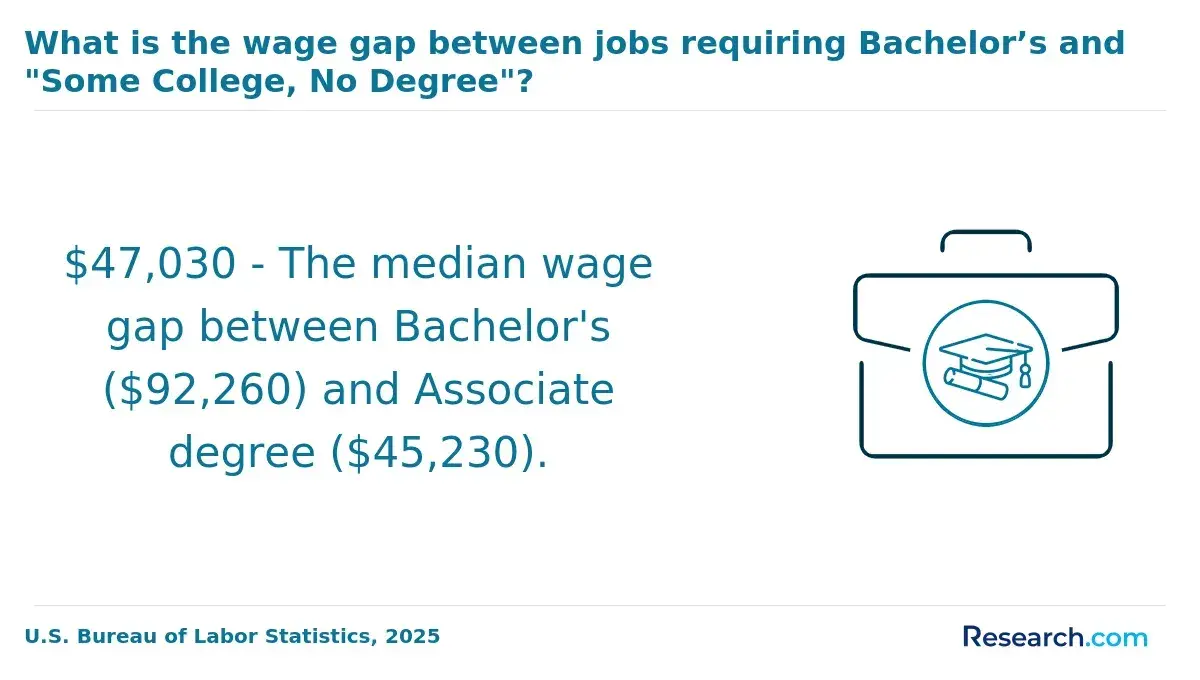
Environmental science pay varies strongly by degree level because many higher-paying roles require specialized technical competence, supervised project experience, or eligibility for professional credentials. An associate degree may support technician work, while a bachelor's degree is the common entry point for environmental scientists, EHS specialists, GIS analysts, and consulting roles.
The table below compares how degree level usually changes the kinds of roles available to environmental science students. It is most useful for understanding career ceiling, not for predicting an individual salary:
| Degree Level | Typical Environmental Science Roles | Specializations With Stronger Pay Signals | Important Limitations |
| Associate degree or certificate | Environmental technician, field sampling assistant, lab aide, water quality technician | Water quality, hazardous materials, GIS support, lab methods | Advancement may require a bachelor's degree or years of field experience |
| Bachelor's degree | Environmental scientist, EHS specialist, GIS analyst, sustainability analyst, compliance associate | Environmental engineering-adjacent coursework, GIS, hydrology, EHS, environmental chemistry | Research-heavy or engineering roles may require additional credentials or graduate study |
| Master's degree | Hydrologist, climate analyst, senior consultant, policy analyst, project scientist | Climate analytics, hydrology, geospatial data, environmental policy, environmental management | ROI depends on employer demand, assistantships, tuition, and whether the degree adds technical skills |
| Doctorate | Research scientist, professor, senior technical specialist, federal researcher | Atmospheric science, ecology, toxicology, geochemistry, climate modeling | Best for research-intensive goals; not always necessary for industry advancement |
Students should think of degree level as a gatekeeper and a multiplier. A bachelor's degree can open the door, but the pay premium often comes from combining that degree with a specialization employers can use immediately, such as data analysis, remediation, environmental chemistry, or water systems.
Before choosing a graduate degree, compare the academic track with the actual roles you want. For example, a master's in environmental management may be valuable for consulting leadership, while a master's in hydrology may be better for technical water-resource roles.
The same environmental science specialization can lead to very different pay depending on industry. Private consulting, energy, utilities, manufacturing, insurance, construction, and technology-adjacent employers often pay differently from nonprofits, parks agencies, and grant-funded conservation organizations because revenue models and risk exposure differ.
The table below summarizes where common academic tracks often have the strongest industry demand. It helps students identify not only which specialization pays more, but also which employers are most likely to value that specialization:
| Academic Track | Industries That Often Pay More | Why Employers Pay for It | Career Trade-Off |
| Environmental engineering | Utilities, infrastructure, remediation, manufacturing, engineering consulting | Permitting, system design, pollution control, and compliance can affect major project costs | Higher math and engineering prerequisites; some roles require engineering licensure |
| Geoscience and hydrogeology | Environmental consulting, energy, mining, water resources, construction | Subsurface risk assessment is central to remediation, groundwater, and site development | Fieldwork and travel may be common early in the career |
| GIS and remote sensing | Utilities, transportation, environmental consulting, government contractors, insurance | Spatial data supports planning, climate risk, asset management, and emergency response | Pay improves when GIS is paired with Python, databases, or domain expertise |
| EHS and compliance | Manufacturing, logistics, construction, healthcare facilities, energy | Regulatory mistakes can create fines, shutdowns, injuries, and reputational risk | Work may be operational, audit-heavy, and deadline-driven |
| Climate and sustainability | Finance, insurance, real estate, consulting, corporate sustainability | Organizations need climate risk, emissions, disclosure, and adaptation planning | Entry-level roles can be competitive without analytics or accounting knowledge |
| Ecology and conservation | Public agencies, environmental nonprofits, restoration contractors, land management | Employers need field surveys, habitat restoration, and biodiversity compliance | Mission alignment is strong, but pay may be constrained by grants or public budgets |
One practical way to compare industries is to look at job postings before choosing electives. If postings repeatedly ask for ArcGIS Pro, SQL, stormwater permitting, NEPA documentation, Phase I environmental site assessments, HAZWOPER, or emissions reporting, those are signs that the specialization has employer demand beyond the classroom.
Long-term advancement in environmental science often depends less on the concentration name and more on whether the specialization builds a path into project leadership, technical authority, regulatory strategy, or business decision-making.
Tracks with the strongest advancement potential usually allow professionals to move from task execution to managing budgets, clients, teams, permits, risk, or models.
The best long-term tracks tend to combine environmental knowledge with one of three advancement engines: engineering authority, data expertise, or management responsibility. Students should compare tracks using the following lens:
- Technical authority: Environmental engineering, hydrology, geoscience, toxicology, and climate modeling can support senior specialist roles because employers need defensible expertise for high-stakes decisions.
- Project and client leadership: Consulting-focused tracks can advance into project manager, program manager, or principal consultant roles when professionals learn budgeting, proposals, supervision, and client communication.
- Regulatory and risk leadership: EHS, compliance, environmental law-adjacent coursework, and sustainability reporting can lead to management roles because organizations must meet legal and investor expectations.
- Data and technology leadership: GIS, remote sensing, environmental informatics, and climate analytics can grow into technical lead roles as employers use automation, sensors, dashboards, and AI-assisted analysis.
Students who eventually want management roles may benefit from business coursework after gaining technical experience. Some environmental professionals compare environmental management degrees with flexible business options such as the easiest online MBA programs, but the right choice depends on whether the target role values environmental specialization, general leadership training, or both.
AI and automation are changing advancement paths, but they are not replacing environmental judgment. The professionals most likely to benefit are those who can validate data quality, interpret models, understand regulations, communicate uncertainty, and explain why a recommendation is scientifically and legally sound.
Location can significantly change environmental science pay because environmental work is tied to local industries, regulations, infrastructure needs, climate risks, and public funding. A hydrology track may be especially valuable in water-stressed regions, while air quality and industrial compliance may be stronger near manufacturing, ports, energy facilities, or large metro areas.
Remote work has expanded options for some environmental science roles, especially GIS, climate analytics, sustainability reporting, environmental data management, and policy research. However, field sampling, construction monitoring, wetland delineation, lab work, and site remediation still usually require in-person work.
Use these location and work-format factors before choosing a specialization or school:
- Regional employer base: Check whether the area has consulting firms, utilities, federal agencies, state environmental departments, energy companies, restoration contractors, or manufacturing employers that hire your track.
- Fieldwork requirements: If you want remote flexibility, avoid assuming all environmental roles can be remote; many entry-level jobs require site visits, sampling, or inspections.
- Cost of living: A higher salary in a high-cost metro area may not produce better financial outcomes than moderate pay in a lower-cost region.
- State regulations: States with active environmental permitting, water management, coastal planning, wildfire risk, or air quality programs may create different demand patterns.
- Internship access: A lower-ranked program near strong employers may produce better early-career outcomes than a more expensive program with fewer local placements.
The smart move is to compare specialization pay and job postings in the region where you actually plan to work. National medians are helpful, but regional demand can determine which concentration produces the best practical return.
Environmental science specializations become more marketable when they produce job-ready skills, not just topic familiarity. Employers often want graduates who can work with data, write clearly, understand regulations, use field and lab methods, and communicate risk to nontechnical audiences.
The most valuable courses and skills vary by track, but the following combinations repeatedly appear in stronger environmental career pathways:
| Specialization | High-Value Courses | Marketable Skills | Portfolio or Experience to Build |
| GIS and environmental analytics | GIS, remote sensing, statistics, Python, database management | Spatial analysis, dashboards, data cleaning, geoprocessing, map communication | Public map portfolio, environmental dataset project, internship with GIS deliverables |
| Hydrology and water resources | Hydrology, groundwater, water chemistry, fluid mechanics, watershed modeling | Sampling plans, flow analysis, stormwater concepts, contaminant transport | Water quality project, field sampling experience, modeling assignment |
| EHS and compliance | Environmental law, industrial hygiene, hazardous materials, risk assessment | Audits, incident reporting, regulatory tracking, safety training support | Compliance checklist, mock audit, internship in manufacturing or facilities |
| Environmental engineering | Calculus, physics, engineering design, wastewater, air pollution control | Design thinking, permitting support, technical calculations, systems analysis | ABET-aligned projects, design capstone, engineering internship |
| Climate and sustainability | Climate science, statistics, emissions accounting, economics, policy | Scenario analysis, carbon accounting, risk communication, reporting frameworks | Climate risk brief, emissions inventory, sustainability dashboard |
| Ecology and conservation | Ecology, botany, wildlife biology, restoration, field methods | Species identification, habitat assessment, survey methods, technical field notes | Field season work, restoration plan, agency or nonprofit internship |
Communication can also affect earning potential because many environmental roles involve reports, proposals, public meetings, or executive briefings. Students who enjoy the environmental field but want stronger writing, media, or stakeholder communication skills sometimes compare specialized environmental training with an affordable online master's degree in communications to prepare for sustainability communication, policy, or public affairs roles.
A strong course plan should answer one question: what can you do for an employer on day one? If the answer is vague, add a technical elective, internship, capstone, certification, or portfolio project before graduation.
Pay only matters in context. A high-earning environmental science specialization may be a weak financial choice if it requires expensive prerequisites, unpaid field experience, relocation, or graduate school that does not improve access to target roles.
College Board data for the 2024-25 academic year reported average published tuition and fees of $11,610 for in-state students at public four-year colleges and $43,350 at private nonprofit four-year colleges. That gap matters because students in the same environmental science specialization may enter similar labor markets while carrying very different education costs.
Use the following process to compare specialization pay against program cost before committing:
- Start with target roles, not the major name: Identify three to five job titles you would realistically pursue, then check whether they require a bachelor's degree, master's degree, engineering licensure, GIS skill, fieldwork, or certifications.
- Compare total cost, not tuition alone: Include fees, housing, transportation, field course costs, lab fees, software, unpaid internship risk, and the interest rate on any loans.
- Ask for outcomes by concentration: Career services should be able to discuss internships, employer partners, graduate school placements, and job titles connected to each track.
- Value paid experience highly: A lower-cost program with strong internships, co-ops, or local consulting connections may beat a more expensive option with weak employer access.
- Check whether graduate school is likely: If the track commonly requires a master's degree for your goal, evaluate undergraduate cost and graduate funding together.
- Stress-test your plan: Ask whether the specialization still makes sense if you start in a lower-paid field role, take longer to find a job, or decide not to attend graduate school.
Students comparing multiple career paths should also remember that every field has its own cost-and-credential structure. For example, a marriage and family therapist degree is evaluated very differently because it is tied to clinical licensure, supervised hours, and state rules, while environmental science ROI often depends more on technical skills, employer sector, and project experience.
Common red flags include choosing a school based only on a salary ranking, ignoring whether the program has modern GIS or lab facilities, assuming all sustainability degrees have the same employer value, and taking on high debt for a track that usually requires additional graduate study.
Certifications, licensure, and graduate study can change environmental science earning potential, but their value depends on the specialization. Some credentials are essential for certain roles, while others are useful only when combined with experience.
The table below summarizes credentials students commonly encounter. Requirements vary by state, employer, and job function, so students should verify expectations for their target roles before paying for exams or graduate credits:
| Credential or Study Path | Most Relevant Track | How It May Affect Earnings | Important Caution |
| Professional Engineer licensure | Environmental engineering | Can support higher-responsibility engineering roles, sign-off authority, and project leadership | Typically requires an engineering degree path, exams, and supervised experience |
| GIS certificates | GIS, remote sensing, environmental analytics | Can strengthen entry-level applications and demonstrate software competence | Portfolio quality often matters more than the certificate name alone |
| HAZWOPER training | Remediation, hazardous waste, consulting, field science | Can make graduates more employable for site work and hazardous-materials projects | Training must match the job's safety requirements and may need refreshers |
| Certified Safety Professional path | EHS and occupational safety | Can support advancement into safety and compliance leadership after experience | Eligibility usually depends on education, experience, and exam requirements |
| Master's degree | Hydrology, climate science, policy, environmental management, toxicology | May open specialized analyst, research, or senior consulting roles | ROI is strongest when the program adds technical skills or required specialization |
| Doctorate | Research, academia, advanced modeling, toxicology, climate science | Can be necessary for research leadership or faculty careers | It is not the fastest path for many applied industry roles |
Environmental science is less uniformly license-driven than fields such as speech-language pathology, where licensure and clinical preparation are central; students comparing credential-heavy healthcare paths can review SLP online programs to see how different the ROI questions can be. In environmental careers, the best credential is usually the one that helps you qualify for a specific job posting or promotion, not the one that simply looks impressive.
Before enrolling in graduate school, ask whether the role you want truly requires it. If job postings say "master's preferred" but emphasize Python, ArcGIS, NEPA, stormwater permitting, or EHS audits, a targeted certificate or internship may produce better short-term value than a full degree.
The best environmental science specialization is the one that balances earning potential, academic fit, labor-market demand, and the kind of work you actually want to do. A high-paying track can be a poor choice if you dislike the daily work, struggle with required prerequisites, or need a graduate degree you cannot afford.
Use this decision framework to compare tracks without overvaluing salary headlines:
- Define your preferred work environment: Decide whether you want fieldwork, lab work, office analysis, policy, consulting, engineering design, public service, or corporate sustainability.
- Match the track to real job titles: Search current postings for the specialization and list the skills, software, credentials, and degree levels employers request most often.
- Separate entry-level pay from career ceiling: GIS or EHS may produce faster early opportunities, while engineering, hydrology, geoscience, and climate analytics may offer stronger technical advancement with the right preparation.
- Evaluate program strength: Look for faculty expertise, field equipment, lab access, GIS software, internship pipelines, capstone projects, employer partnerships, and alumni outcomes.
- Estimate ROI conservatively: Use median occupational wages as benchmarks, not promises, and compare them with total program cost and likely debt.
- Build flexibility: Choose electives that keep multiple doors open, such as statistics, environmental law, chemistry, GIS, programming, technical writing, or project management.
If your goal is maximum earning potential, start by comparing environmental engineering, geoscience, hydrology, climate analytics, EHS, and GIS. If your goal is mission-driven ecological work, conservation or restoration can be a better fit even if salary signals are lower.
If your goal is policy or sustainability leadership, strengthen the degree with data, economics, reporting, or management skills so the specialization connects to employer needs.
The safest choice is not always the broadest degree or the highest-paid track on paper. It is the specialization that gives you a credible first job, room to advance, manageable education cost, and enough interest to stay engaged through the technical learning curve.
For entry-level earnings, the strongest environmental science tracks are usually those that lead directly to billable, regulated, or technical work. Employers tend to pay more for new graduates who can collect defensible field data, analyze datasets, support permits, maintain compliance documentation, or use industry software without extensive retraining.
Students comparing first jobs should focus on the connection between coursework and entry-level tasks. The following tracks often translate well into early-career roles because they produce concrete skills employers can test during interviews:
- GIS and environmental data analytics: Good for entry-level GIS analyst, mapping technician, environmental data analyst, and consulting support roles when students build a portfolio using ArcGIS, QGIS, Python, or remote sensing tools.
- Environmental health and safety: Strong for compliance coordinator, EHS technician, safety specialist, and industrial environmental roles, especially when paired with OSHA knowledge, auditing, and incident documentation.
- Water quality and hydrology: Useful for field scientist, water quality technician, stormwater associate, and watershed analyst roles because employers need sampling, monitoring, and reporting support.
- Environmental chemistry or toxicology: Helpful for lab, remediation, hazardous waste, and contamination assessment roles where scientific accuracy and chain-of-custody procedures matter.
- Environmental consulting or compliance: Practical for graduates who want to enter consulting firms, support environmental site assessments, and learn permitting or regulatory documentation on the job.
A common mistake is assuming conservation, sustainability, or climate policy tracks automatically produce high entry-level pay because the topics are popular. They can lead to strong careers, but early roles often become more competitive unless the student also has analytics, reporting, finance, GIS, or regulatory skills.
Other Things You Should Know About Environmental Science
Environmental engineering usually shows the strongest pay signal among environmental science-related tracks, especially when it leads to engineering roles. Geoscience, hydrology, climate analytics, EHS, and GIS/data analytics can also lead to strong earnings depending on industry, credentials, and experience.
It can be, especially for field science, compliance, consulting support, and public agency roles. However, students often improve their prospects by adding a technical concentration such as GIS, water resources, environmental chemistry, EHS, statistics, or regulatory compliance.
Not always. A master's degree can help in hydrology, climate science, policy, toxicology, research, and senior consulting pathways, but some students may get better ROI from paid experience, GIS skills, certifications, or employer-sponsored training.
The biggest mistake is choosing based only on advertised salary potential. Students should also check job postings, program cost, internship access, regional demand, required credentials, and whether they actually want the day-to-day work connected to that track.
- Data show today's environmental science grads have more diverse job prospects https://www.onlineu.com/magazine/environmental-science-majors-career-outcomes
- 20 Highest-Paying Environmental Science Jobs in 2025 https://internshala.com/blog/highest-paying-environmental-science-jobs/
- A Degree in Earth and Climate Sciences: Jobs, Salaries and Projected Job Growth https://www.bates.edu/earth-climate-sciences/about/eacs-jobs/
- Exploring the Demand for Environmental Science Professionals https://www.webuildstaffing.com/exploring-the-demand-for-environmental-science-professionals/
- Agriculture and Environmental Science Degree Careers and Salary in Europe - StudyinEurope.eu https://www.studyineurope.eu/agriculture-environment/agriculture-environment-degree-careers-salary-europe/
- What Certifications are most Valuable for Environmental Science Graduates? https://www.nrep.org/blog/certifications-environmental-science-graduate
- Majors related to the environment with good job prospects? https://talk.collegeconfidential.com/t/majors-related-to-the-environment-with-good-job-prospects/2083576
- Environmental Science Jobs https://unity.edu/careers/environmental-science-jobs/