2027 Environmental Science Degree Underemployment Report: Which Graduates Are Most Likely to Work Below Their Education Level

Co-Founder and Chief Data Scientist
Environmental Science graduates often face a difficult first-job choice: take a field, lab, retail, or administrative role quickly, or keep pushing for work that fully uses the degree. The risk is real: New York Fed 2024 labor market data put recent college graduate underemployment at roughly 40%.
For Environmental Science majors, the issue is sharper because many degree-level roles expect GIS, permitting, data, field, and regulatory experience before hiring. This guide is for students and recent graduates who want to understand their risk, compare job paths, and avoid getting stuck in low-credential work.
Key Things to Know About Underemployment in Environmental Science Industry
- Environmental Science underemployment is most likely when graduates leave school with broad coursework but little proof of job-ready skills such as GIS, environmental sampling, NEPA documentation, wetland delineation, R/Python, OSHA safety, or permitting support.
- The wage trade-off can be large: BLS May 2024 data show a median annual wage of $80,060 for environmental scientists and specialists, compared with $50,660 for environmental science and protection technicians, a gap of about $29,400.
- Underemployment can persist: a 2024 Strada Institute and Burning Glass Institute analysis found that 52% of bachelor's graduates were underemployed one year after graduation, making the first post-college job a high-stakes decision.
- How likely is it for Environmental Science graduates to become underemployed?
- Is the college curricula for Environmental Science keeping up with employer expectations?
How likely is it for Environmental Science graduates to become underemployed?
Environmental Science graduates face a moderate to high underemployment risk compared with majors that feed directly into licensed or tightly defined occupations. Underemployment means a graduate is working in a job that does not typically require a bachelor's degree, even if the job is related to the environment. Educational mismatch is broader: it includes jobs that require a degree but do not use the graduate's specific training.
The risk is not because Environmental Science is useless. It is because many entry-level employers separate "interested in sustainability" from "ready to prepare permits, manage data, follow sampling protocols, write technical reports, and work safely in the field."
BLS 2024 projections show environmental scientists and specialists are expected to grow 7% from 2023 to 2033, faster than the average for all occupations, but that demand is still selective. Graduates with internships, technical software, and regulatory exposure compete much better than those with classroom-only experience.
The table below shows how different first-job outcomes usually affect degree utilization. It is not a guarantee of any individual outcome, but it helps students identify whether a role is likely to build toward a degree-level Environmental Science career or become a low-credential detour:
| First-job type | Typical education match | Common duties | Underemployment risk |
| Environmental scientist or specialist assistant role | Bachelor's-level or near bachelor's-level | Sampling plans, site assessments, compliance research, data interpretation, technical reports | Lower if the role includes analysis and documentation |
| Environmental technician or field sampling role | Often associate-level or experience-based, but can be a gateway | Collecting samples, maintaining equipment, logging field data, following safety procedures | Moderate if there is no path to reporting, GIS, or permitting work |
| General sustainability coordinator role | Varies widely by employer | Waste audits, outreach, recycling programs, reporting metrics | Moderate when the job lacks technical or regulatory responsibilities |
| Administrative, retail, warehouse, or unrelated customer service role | Usually below bachelor's level | Scheduling, sales, clerical tasks, general operations | High unless used briefly while building a targeted job pipeline |
The students most at risk are those who apply broadly to "green jobs" without matching job descriptions to skills. The best-positioned graduates usually have a defined target, such as environmental consulting, water quality, restoration ecology, GIS analysis, EHS compliance, or sustainability reporting, and can show relevant work samples before graduation.
Is the college curricula for Environmental Science keeping up with employer expectations?
Environmental Science curricula are improving, but many programs still lean heavily on broad science foundations while employers increasingly screen for applied, documented skills. A strong curriculum should not only teach ecology, chemistry, geology, climate systems, and policy; it should also help students produce evidence that they can work in regulated, data-heavy environments.
The curriculum mismatch is especially important because many entry-level postings are written for candidates who can contribute on day one. AI-enabled mapping tools, remote sensors, automated monitoring systems, and environmental data platforms are reducing demand for purely manual entry-level tasks. That does not eliminate junior roles, but it raises the value of graduates who can clean data, interpret outputs, validate field results, and write defensible reports.
The table below summarizes common gaps between traditional coursework and employer expectations. Use it as a program audit tool when comparing majors, concentrations, minors, electives, and internship options:
| Curriculum area | What many programs cover | What employers often expect | Why it matters |
| GIS and spatial analysis | Introductory mapping concepts | ArcGIS Pro, QGIS, geodatabases, map layouts, field data integration | GIS is used in permitting, site selection, environmental justice analysis, habitat work, and consulting deliverables |
| Environmental regulations | Policy overview and case studies | Applied familiarity with NEPA, Clean Water Act, stormwater rules, Phase I ESA workflows, or state permitting processes | Regulatory literacy helps graduates move beyond general assistant work |
| Data analysis | Statistics lecture or spreadsheet assignments | Excel modeling, R, Python, QA/QC, visualization, reproducible analysis | Employers increasingly expect graduates to handle monitoring data, not just collect it |
| Field methods | Labs and field trips | Sampling protocols, chain of custody, PPE, safety plans, field notes, equipment calibration | Field credibility is a major hiring signal for consulting, water, soil, and remediation roles |
| Technical communication | Research papers | Client-ready memos, compliance summaries, executive summaries, figures, and concise recommendations | Reports are often the final product in environmental work |
Students who discover a curriculum gap do not always need to change majors. They can add a GIS certificate, statistics minor, environmental engineering elective, internship, undergraduate research project, or applied capstone. For students drawn to climate communication, public engagement, or environmental policy messaging, an affordable online master's degree in communications may also be worth comparing with a technical graduate degree, depending on the target role.
Environmental Science sits in the middle of the underemployment spectrum. It is usually riskier than majors with direct licensure pipelines, such as nursing or accounting, but it can be safer than very general majors when students build technical, regulatory, and field experience.
The key difference is occupational clarity: employers know exactly what a licensed nurse or accountant is prepared to do, while "Environmental Science graduate" can signal many possible skill sets.
The New York Fed's 2024 data show recent college graduate underemployment at roughly 40% across majors. Environmental Science students should use that as a benchmark, not a prediction. Their personal risk depends heavily on specialization, geography, internships, and whether they target degree-level roles instead of generic sustainability or assistant jobs.
The table below compares Environmental Science with other broad major groups in practical terms. It focuses on how clearly each major connects to bachelor's-level roles, which is one of the biggest drivers of underemployment risk:
| Major or pathway type | Typical underemployment pressure | Reason | How Environmental Science students should interpret it |
| Licensed health and therapy pathways | Often lower after required credentialing | Jobs are tied to state licensure, clinical hours, or specific graduate credentials | Environmental Science has fewer universal licensing gates, so students must prove readiness through skills and experience |
| Engineering, computer science, and data-heavy majors | Often lower for technically prepared graduates | Technical screening is clearer and portfolios can show direct ability | Adding GIS, data analysis, modeling, or coding can make Environmental Science more competitive |
| Business, communications, and social science majors | Varies widely | Outcomes depend on internships, networks, and role targeting | Environmental Science graduates competing for policy or sustainability jobs need equally strong communication and business evidence |
| Humanities and very broad liberal arts majors | Often higher without a career bridge | Skills may be valuable but less directly mapped to entry-level postings | Environmental Science students should avoid becoming equally broad by graduating without a technical concentration |
A useful comparison is credential clarity. Fields such as speech-language pathology have more defined licensure and graduate-training expectations, so students exploring regulated helping professions may compare SLP online programs with Environmental Science to understand how structured career pipelines differ. Environmental Science can still lead to strong degree-level work, but students must build the bridge more deliberately.
Low-credential work can affect career growth if it delays the development of technical judgment, professional networks, and project experience. Environmental Science careers often advance through accumulated evidence: field reliability, regulatory knowledge, report writing, client communication, data interpretation, and eventually project management. If the first job does not build those signals, the graduate may look less competitive even after gaining general work experience.
The main career-growth risk is not one short-term mismatch. It is a pattern of roles that do not compound. A graduate who spends a year in retail while earning GIS certification and volunteering on watershed monitoring may still reposition effectively. A graduate who spends several years in unrelated work without new technical evidence may face a harder transition into degree-level environmental positions.
The table below compares how different early-career choices can affect long-term growth. Use it to judge whether a job adds career capital or simply fills time:
| Early-career path | Career capital gained | Growth risk | Best use case |
| Environmental consulting field role | Sampling, site documentation, client exposure, safety practices | Can become repetitive if it never expands into analysis or reporting | Good bridge if paired with GIS, permitting, or report-writing opportunities |
| Government or utility internship | Regulatory context, public-sector workflow, water or waste systems exposure | May be slow-moving or seasonal | Strong option for students targeting public agencies or municipal roles |
| Unrelated full-time job | General professionalism and income | Weak environmental signal unless combined with active upskilling | Reasonable only with a defined transition plan |
| Immediate graduate school | Advanced coursework and research depth | Can increase debt without solving experience gaps | Best when the target role truly requires a master's or specialized research training |
Some Environmental Science professionals later move into operations, sustainability strategy, compliance leadership, or consulting management. In those cases, business training can become useful after technical credibility is established.
Graduates considering a management pivot can compare options such as the easiest online MBA programs, but an MBA is usually not the fastest fix for initial underemployment if the missing piece is field, GIS, or regulatory experience.
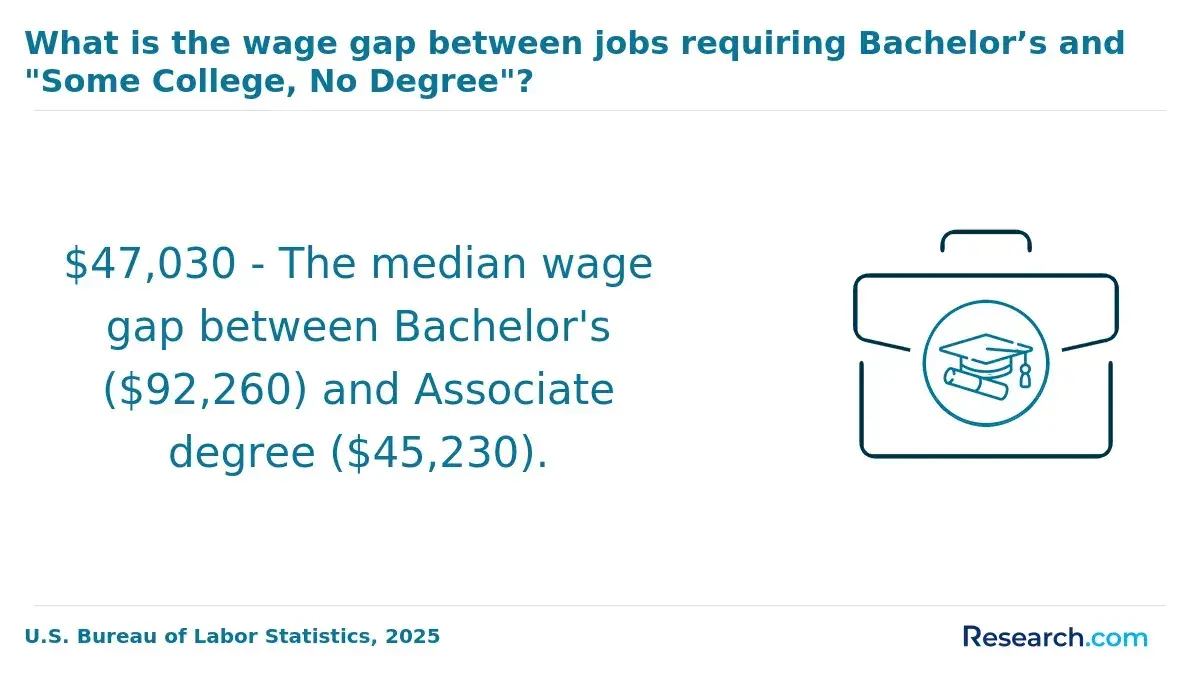
The salary gap between degree-level Environmental Science work and lower-credential environmental support roles can be substantial. BLS May 2024 wage data show a median annual wage of $80,060 for environmental scientists and specialists and $50,660 for environmental science and protection technicians.
That difference, about $29,400 per year, illustrates why underemployment is not just a title issue; it can affect loan repayment, savings, housing choices, and the ability to invest in further training.
The table below compares common role categories using national wage data where a clear BLS occupational match exists. Local salaries vary by state, employer, industry, overtime rules, union coverage, and cost of living, so students should use these figures as national benchmarks rather than promises:
| Role category | Typical degree utilization | Relevant BLS May 2024 median annual wage | What the gap means |
| Environmental scientists and specialists | High; commonly bachelor's-level | $80,060 | Better fit for graduates doing analysis, compliance, site assessment, reporting, or research support |
| Environmental science and protection technicians | Partial; often technical support | $50,660 | Can be a bridge, but graduates should seek advancement into analysis or project roles |
| General administrative or customer service fallback work | Low if unrelated to environmental work | Varies by occupation | May reduce short-term financial pressure but often does not build environmental career capital |
The student loan impact depends on debt level, repayment plan, interest rate, and household income. The practical point is that a lower-credential role can make even manageable debt feel heavier because the graduate has less room for certification fees, relocation, unpaid networking, or a delayed job search. Graduates with loans should avoid assuming that "any job is fine for now" unless they have a clear plan to move toward degree-level earnings.
Environmental Science graduates are pushed into low-credential roles by a mix of market structure, preparation gaps, and job-search timing. The field has real demand, but entry-level openings can be geographically uneven and employer expectations are often specific. Consulting firms, utilities, labs, government agencies, renewable energy companies, conservation organizations, and industrial employers may all hire Environmental Science graduates, but they do not screen for the same skills.
BLS 2024 projections estimate about 8,500 openings per year for environmental scientists and specialists over the 2023 to 2033 period. That shows opportunity, but not unlimited capacity. Graduates who treat the major as a general "green career" credential may lose out to applicants who can match a narrower hiring need.
The most common barriers fall into a few predictable categories. Identifying them early helps students fix the problem before graduation rather than after months of rejected applications:
- No specialized technical signal: Employers may pass over resumes that list Environmental Science coursework but show no GIS, data analysis, field methods, permitting, or safety training.
- Weak internship history: Students who wait until senior year to seek experience often compete against graduates who already completed agency, consulting, lab, utility, or nonprofit internships.
- Unfocused job targeting: Applying to every "sustainability" or "environmental" title can produce poor results because the same major may lead to compliance, restoration, water, waste, GIS, EHS, or policy roles.
- Geographic mismatch: Some regions have more environmental consulting, energy, water, coastal, wildfire, agriculture, or public-sector demand than others.
- Limited professional network: Alumni referrals, faculty contacts, conference conversations, and internship supervisors often matter because many entry-level roles are small-team hires.
- Assuming the degree is self-explanatory: Environmental Science programs vary widely, so the resume must translate coursework into employer language.
Red flags include job descriptions that require a bachelor's degree but list only clerical duties, unpaid "experience" with no supervision or skill development, sustainability roles focused mainly on sales quotas, and technician roles with no path to reporting or analysis. These roles may still be acceptable for income, but they should not be mistaken for automatic career progression.
A strong Environmental Science resume should make the employer's screening decision easy. Instead of presenting the degree as a broad academic credential, it should show a match between the job description and the candidate's tools, field exposure, regulatory knowledge, and work products.
This is especially important because applicant tracking systems and recruiters often search for specific terms such as GIS, Phase I ESA, stormwater, NEPA, wetlands, HAZWOPER, R, Python, water quality, or compliance.
The most effective approach is to build a resume around the target role, not around the major. A consulting resume should look different from a conservation, GIS, EHS, laboratory, or public policy resume.
- Choose one primary target role family, such as environmental consulting, GIS analyst, water quality specialist, EHS coordinator, sustainability analyst, restoration technician, or regulatory compliance assistant.
- Copy 10 to 15 entry-level job descriptions into a document and highlight repeated tools, regulations, field methods, and deliverables.
- Create a skills section that mirrors real employer language, but only include tools and methods you can discuss in an interview.
- Convert coursework into applied evidence by naming projects, datasets, field sites, lab methods, maps, reports, or presentations.
- Add a small portfolio if possible, such as GIS maps, a water-quality analysis, a mock compliance memo, a species survey summary, or a data visualization.
- Quantify work when accurate, using details such as number of samples processed, acres mapped, reports drafted, datasets cleaned, or monitoring events supported.
- Place internships, fieldwork, research, and certifications above unrelated jobs unless the unrelated job shows leadership, safety, logistics, or client communication.
Common resume mistakes include listing every environmental topic studied, using vague phrases such as "passionate about sustainability," burying GIS or fieldwork under general coursework, and applying with the same resume to every role. A better resume tells the employer, "This graduate can do the first 90 days of the job with supervision."
Certifications can help Environmental Science graduates reduce underemployment risk when they match a specific job family. They are not magic credentials, and some advanced certifications require work experience. The fastest return usually comes from credentials that remove a hiring barrier for entry-level work, especially safety, GIS, stormwater, wetlands, data, or industry-specific compliance training.
The table below summarizes certifications and training options that commonly strengthen Environmental Science applications. Requirements change by provider, state, and employer, so students should verify eligibility before paying fees:
| Credential or training | Best-fit roles | How it can help | Important limitation |
| OSHA 40-hour HAZWOPER | Environmental consulting, remediation, hazardous materials, field technician roles | Signals safety readiness for contaminated-site and field work | May require employer-specific refreshers or medical clearance depending on duties |
| GIS certificate or documented ArcGIS Pro/QGIS training | GIS technician, environmental analyst, conservation planning, consulting support | Shows ability to produce maps and manage spatial data | A portfolio often matters as much as the certificate name |
| Wetland delineation training | Ecological consulting, permitting, restoration, transportation projects | Builds applied field credibility for Clean Water Act-related work | Regional plant, soil, and hydrology knowledge still matters |
| Stormwater inspection or erosion control credential | Construction compliance, municipal stormwater, environmental inspection | Connects the degree to regulated site work | Credential names and requirements vary by state and program |
| LEED Green Associate | Sustainability, green building, facilities, ESG-adjacent roles | Useful for built-environment sustainability pathways | Less valuable for ecology, remediation, or water-quality roles |
| FAA Part 107 remote pilot certificate | Remote sensing, environmental mapping, restoration monitoring, consulting support | Can support drone-based data collection where employers use unmanned aircraft | Employers still need evidence of mapping, safety, and data interpretation skills |
Environmental credentials are different from state-licensed clinical pathways. For example, students comparing regulated human-services careers can review a marriage and family therapist degree to see how licensure-heavy fields structure education, supervised hours, and state approval. Environmental Science has fewer universal licensure rules, so students must choose credentials based on target jobs rather than assuming one certificate fits all paths.
Environmental Science students can sharply improve their odds of landing degree-level work by treating career preparation as a four-year project, not a final-semester scramble. The strongest strategy is to combine a clear role target with applied experience, technical tools, and evidence that employers can understand quickly.
The following steps are practical because they create proof, not just interest. Students should start as early as possible, but recent graduates can still use the same sequence to reposition themselves.
- Pick a target lane by sophomore or junior year, such as consulting, water resources, GIS, EHS, sustainability analytics, conservation, environmental health, or regulatory compliance.
- Audit your transcript against real job postings and identify missing tools, regulations, software, or field methods.
- Complete at least one internship, co-op, research placement, agency volunteer role, or supervised field project before graduation.
- Build a portfolio with 3 to 5 work samples, such as a GIS map, monitoring report, environmental data analysis, literature review, compliance memo, or restoration plan.
- Use electives strategically, prioritizing GIS, statistics, hydrology, soil science, toxicology, environmental law, data analysis, technical writing, or environmental engineering fundamentals when relevant.
- Network before you need a job by contacting alumni, attending local environmental professional association events, asking faculty for employer introductions, and following up after internships.
- Apply by role family, not by keyword alone, and tailor each resume to the employer's tools, regulations, and deliverables.
- Evaluate first offers for learning value, not just title, by asking whether the role leads to analysis, reporting, client work, permitting, or project responsibility.
Internships usually carry more weight than class projects because they show workplace reliability, but projects still matter when they are concrete and relevant. A strong academic GIS project can outperform a weak internship if it directly matches the job. Likewise, a master's degree can be valuable for research, policy, planning, or specialized science roles, but it should not be used to postpone skill-building.
Students interested in environmental outreach, climate messaging, or public-facing sustainability work may also compare communication-focused graduate options with technical programs before committing to additional debt.
Some Environmental Science graduates use lower-credential roles as stepping stones, especially when the job involves field sampling, data logging, safety procedures, or environmental compliance support. The risk rises when the job is unrelated, repetitive, or disconnected from technical advancement. A field technician job with exposure to GIS and reporting can be a launchpad; a general office job with no environmental responsibilities usually is not.
The persistence risk is significant. A 2024 Strada Institute and Burning Glass Institute analysis found that 52% of bachelor's graduates were underemployed one year after graduation, and many remained underemployed several years later. For Environmental Science graduates, this means the first role should be evaluated not only by pay but by whether it creates evidence for the next job.
Before accepting a low-credential role, graduates should ask whether it has a realistic exit path. The following checks help separate a temporary bridge job from a long-term mismatch:
- Confirm whether the role includes technical tasks such as sample documentation, GIS updates, compliance tracking, environmental reporting, or data quality checks.
- Ask what employees in the role typically move into after 6 to 18 months, and look for actual titles such as environmental scientist, compliance analyst, GIS technician, EHS coordinator, or project assistant.
- Check whether the supervisor can assign work samples that are safe to describe on a resume, such as monitoring summaries, site visit documentation, permit support, or dashboard updates.
- Avoid roles that advertise "environmental" work but mostly involve sales, canvassing, general labor, or administrative coverage with no technical progression.
If a graduate needs immediate income, taking a lower-credential job can make sense. The mistake is accepting it without a deadline, skill plan, and application schedule. A better strategy is to treat the job as a 90-day to 180-day bridge while completing one targeted credential, building a portfolio, and applying to degree-level openings every week.
Other Things You Should Know About Environmental Science
Yes, but employers will look closely for lab access, field experience, GIS training, internships, and applied projects. Online students should be especially intentional about local fieldwork, agency volunteering, and portfolio samples.
Not always. Graduate school helps when the target role requires advanced research, specialized technical training, or a public-sector credential preference. If the problem is lack of internships, GIS, field methods, or regulatory exposure, targeted experience may offer a faster return.
Concentrations tied to specific employer needs tend to be safer, such as GIS, water resources, environmental health and safety, hydrology, remediation, data analysis, or regulatory compliance. Outcomes still depend on location, experience, and the quality of the student's work samples.
Relocation can help if the local market has few consulting firms, agencies, utilities, labs, energy employers, or conservation organizations. Before moving, compare job density, salary, cost of living, state regulations, and whether the region's environmental issues match your specialization.
- Room for Progress in College Graduates’ Transition to the Labor Market - Public Policy Institute of California https://www.ppic.org/blog/room-for-progress-in-college-graduates-transition-to-the-labor-market/
- So much for saving the planet. Climate careers, and many others, evaporate for class of 2025 https://hechingerreport.org/so-much-for-saving-the-planet-climate-careers-and-many-others-evaporate-for-class-of-2025/
- Environmental Science Jobs https://unity.edu/careers/environmental-science-jobs/
- Under Trump, job prospects look 'bleak' for Mass. grads in environmental science https://www.wbur.org/news/2025/05/08/environmental-science-college-students-job-market-trump-climate
- The Labor Market for Recent College Graduates https://www.newyorkfed.org/research/college-labor-market
- Data show today's environmental science grads have more diverse job prospects https://www.onlineu.com/magazine/environmental-science-majors-career-outcomes