2027 Environmental Science Degree Automation Exposure Report: Which Career Paths Face the Most AI and Technology Disruption

Co-Founder and Chief Data Scientist
Environmental science students are choosing careers while AI is changing how employers collect data, model climate risk, review permits, and monitor pollution. The U.S. Bureau of Labor Statistics reported a May 2024 median wage of $80,060 for environmental scientists and specialists, while projecting faster-than-average job growth for the occupation through 2033.
This guide is for students, career changers, and graduates who want to know which paths are most exposed to automation, which remain resilient, and how to build a degree plan that supports long-term employability.
Key Things You Should Know
- Highest automation exposure is concentrated in routine data-heavy roles, including environmental sampling technicians, compliance documentation assistants, GIS production roles, and entry-level reporting jobs where AI can standardize monitoring, mapping, and draft-writing tasks.
- Lower-risk paths combine science with judgment, regulation, field investigation, stakeholder communication, engineering accountability, emergency response, or licensed decision-making; BLS May 2024 wage data places environmental scientists and specialists at a $80,060 median salary.
- The best long-term strategy is not avoiding AI; it is pairing environmental science knowledge with GIS, remote sensing, statistics, coding, regulatory literacy, risk communication, and project leadership so technology increases your value rather than replaces your tasks.
- Which Environmental Science Career Paths Face the Greatest Risk of AI and Automation?
- Which Job Tasks Are Most Likely to Be Automated in Environmental Science Careers?
Which Environmental Science Career Paths Face the Greatest Risk of AI and Automation?
AI and automation exposure in environmental science depends less on the job title and more on the task mix. A career is more exposed when the work is repetitive, rules-based, screen-based, or built around producing standard reports from structured data. A career is more resilient when it requires field judgment, legal accountability, public trust, interdisciplinary interpretation, or decisions under uncertainty.
The table below ranks common environmental science career paths by likely automation exposure. The salary column is included only where the occupation closely matches a BLS category; automation risk is a practical career-planning assessment, not a prediction that the occupation will disappear.
| Career path | Typical environmental science role | Automation exposure | Why AI may disrupt the work | What remains harder to automate | Salary context |
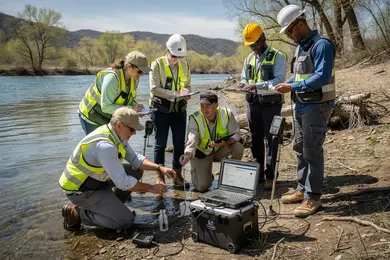
| Environmental sampling technician | Collects water, soil, air, and waste samples; prepares chain-of-custody records; supports lab and field teams | High | Automated sensors, drones, digital forms, and lab information systems can reduce manual collection and documentation work | Site access judgment, safety awareness, troubleshooting equipment, and responding to irregular field conditions | Generally lower than scientist, engineering, and management tracks in federal wage data |
| GIS mapping technician | Builds maps, cleans spatial data, updates layers, and produces routine geospatial outputs | High | AI-assisted geocoding, image classification, map production, and quality checks can compress routine production time | Spatial reasoning, project scoping, field validation, cartographic judgment, and explaining uncertainty | Varies widely by employer and software depth |
| Environmental compliance reporting assistant | Prepares standard permit documents, inspection summaries, and regulatory tracking files | High to medium | Generative AI can draft summaries, compare records, extract requirements, and flag missing documentation | Interpreting regulations, defending conclusions, communicating with agencies, and handling nonstandard compliance issues | Often entry-level unless paired with regulatory expertise |
| Environmental data analyst | Analyzes monitoring data, builds dashboards, identifies trends, and supports risk decisions | Medium | AI can automate anomaly detection, visualization, and first-draft interpretations | Choosing valid methods, checking bias, connecting data to environmental processes, and advising decision-makers | Higher potential when paired with programming, statistics, and domain specialization |
| Environmental scientist or specialist | Studies contamination, conducts assessments, prepares technical findings, and advises clients or agencies | Medium | AI can accelerate literature review, modeling, report drafting, and monitoring workflows | Professional judgment, field interpretation, regulatory strategy, client communication, and defensible conclusions | BLS reported a May 2024 median wage of $80,060 |
| Environmental consultant or project manager | Manages assessments, remediation projects, permitting work, and client deliverables | Medium to low | AI can streamline scheduling, document review, and data synthesis | Client trust, negotiation, liability management, scope control, and decision-making across technical and business constraints | Often improves with experience, credentials, and management responsibility |
| Environmental engineer | Designs systems for pollution control, water treatment, waste management, and environmental protection | Low to medium | AI can support design alternatives, simulation, monitoring, and documentation | Engineering responsibility, safety, licensure, design accountability, and interdisciplinary problem-solving | BLS May 2024 wage data places environmental engineers above many environmental science roles |
| Environmental policy analyst or planner | Evaluates policy, climate resilience, land use, public impacts, and stakeholder trade-offs | Low to medium | AI can summarize policy, model scenarios, and draft memos | Public engagement, ethics, political judgment, equity analysis, and balancing competing interests | Varies by government level, nonprofit, consulting, or private-sector employer |
| Emergency management or environmental health specialist | Responds to hazards, inspections, contamination events, public health risks, or disaster impacts | Low | AI can improve alerts, mapping, records, and decision support | On-site judgment, public communication, crisis leadership, and legally sensitive decisions | Strongest where credentials, local regulations, and field experience are valued |
The main takeaway is that environmental science careers are more likely to be transformed than eliminated. Entry-level roles with repetitive reporting may shrink or require stronger technical skills, while roles involving interpretation, accountability, and field judgment should remain more durable.
Students comparing environmental science with other people-centered fields should also consider how automation risk differs by profession. For example, healthcare communication and clinical interaction remain central in fields such as SLP online programs, while environmental roles often require a different mix of technical data skills and regulatory knowledge.
Which Job Tasks Are Most Likely to Be Automated in Environmental Science Careers?
The most automatable tasks in environmental science are the tasks that follow predictable rules or rely on structured digital data. This matters because students should not ask only, "Will this job exist?" A better question is, "Which parts of this job will employers expect me to do faster with technology?"
The table below separates tasks that are more exposed from tasks that remain more dependent on human expertise. Use it to choose electives, internships, and certifications that move you toward higher-value responsibilities.
| Task area | Automation exposure | How AI or technology changes the task | Career-planning implication |
| Routine sample logging | High | Digital chain-of-custody systems, barcodes, sensors, and automated lab systems reduce manual recordkeeping | Learn quality assurance and field troubleshooting rather than only form completion |
| Standard compliance summaries | High | Generative AI can draft reports from templates and compare documentation against regulatory checklists | Develop regulatory interpretation and review skills so you can validate AI-assisted drafts |
| Basic GIS layer updates | High | AI-assisted mapping tools can classify imagery, clean spatial datasets, and produce standard maps | Move beyond map production into spatial analysis, remote sensing validation, and decision support |
| Literature review and technical search | Medium to high | AI search tools can summarize studies and extract key findings quickly | Learn how to verify sources, evaluate methods, and identify whether evidence applies to a site-specific problem |
| Environmental modeling | Medium | AI can speed scenario testing, pattern recognition, and model calibration | Understand model assumptions, uncertainty, and environmental mechanisms, not just software operation |
| Field investigation | Medium to low | Drones, sensors, and mobile apps improve data collection but do not remove the need for site judgment | Build field safety, sampling design, and observational skills |
| Public meetings and stakeholder communication | Low | AI can prepare talking points and summarize comments | Practice explaining technical risk clearly, listening to community concerns, and managing conflict |
| Regulatory decision-making and professional sign-off | Low | AI can organize evidence but cannot take legal or ethical responsibility for professional conclusions | Pursue credentials, mentorship, and experience that lead to accountable decision-making roles |
Common mistake: treating AI as a threat only to "tech jobs." In environmental science, AI affects fieldwork, compliance, consulting, planning, and research because nearly every environmental decision depends on data. The safest path is to become the person who can question, validate, and apply AI outputs in real environmental contexts.
AI adoption is uneven across environmental science employers. A federal agency, an engineering firm, a utility, a climate-tech startup, and a small conservation nonprofit may all hire environmental science graduates, but they may use AI at very different speeds and for different reasons.
The U.S. Census Bureau's Business Trends and Outlook Survey has shown that only a minority of U.S. firms report using AI to produce goods or services, but adoption is rising and is concentrated in information-rich business functions. For environmental science graduates, the practical impact is that data-intensive employers may change entry-level expectations faster than traditional field employers.
The table below compares major hiring industries by likely AI adoption pattern and career impact. This is useful when deciding whether to target a high-tech, high-change environment or a slower-moving but more regulation-driven employer.
| Industry or employer type | AI adoption pattern | Environmental science jobs most affected | What students should watch |
| Environmental consulting and engineering firms | Fast adoption for reporting, modeling, GIS, project management, and proposal writing | Compliance analysts, GIS technicians, junior consultants, environmental data analysts | Employers may expect graduates to produce higher-quality drafts and analyses with fewer hours of manual work |
| Energy, utilities, and infrastructure | Fast adoption for sensors, asset monitoring, climate risk, water systems, emissions tracking, and predictive maintenance | Environmental compliance staff, water quality analysts, sustainability analysts, field monitoring teams | Skills in SCADA-adjacent data, remote sensing, environmental monitoring, and risk analytics become valuable |
| Government environmental agencies | Moderate adoption, often shaped by procurement rules, public accountability, privacy, and records requirements | Permit reviewers, inspectors, program analysts, environmental planners | Regulatory judgment and defensible documentation matter more than tool speed alone |
| Climate-tech and sustainability software companies | Very fast adoption for carbon accounting, satellite analytics, risk modeling, and automated reporting | Climate data analysts, ESG analysts, product specialists, environmental data scientists | Graduates need stronger coding, statistics, and communication skills than in many traditional entry-level roles |
| Manufacturing, construction, and real estate development | Moderate to fast adoption where compliance cost, permitting timelines, and reporting burdens are high | Environmental health and safety coordinators, permitting assistants, site assessment staff | Knowledge of regulations, audits, and site-specific risk can protect against pure automation |
| Conservation nonprofits and land management organizations | Selective adoption, especially for drones, species monitoring, GIS, and grant reporting | Conservation technicians, GIS assistants, field researchers | Funding constraints may slow adoption, but remote sensing and citizen-science data are changing workflows |
If you want faster salary growth and technical advancement, AI-heavy employers can be attractive. If you prefer slower technology change and more public-service work, government, field-based conservation, or regulatory roles may fit better, though they still increasingly require digital competence.
Employer Confidence in Online vs. In-Person Degree Skills, Global 2024

The most resilient environmental science graduates build a "T-shaped" skill profile: deep environmental knowledge in one area, supported by broad technical, communication, and management skills. This makes it easier to shift between consulting, government, energy, infrastructure, conservation, and climate-risk roles as technology changes.
The skills below are especially valuable because they complement AI rather than compete directly with it:
- Regulatory interpretation: Understanding the Clean Water Act, Clean Air Act, NEPA processes, hazardous waste rules, state permitting systems, and local land-use requirements helps you turn data into defensible decisions.
- GIS and remote sensing: Spatial analysis, image interpretation, GPS field validation, and map-based storytelling remain central to environmental work, especially in climate risk, conservation, and infrastructure planning.
- Statistics and data quality: Sampling design, uncertainty, bias detection, reproducibility, and basic coding help you evaluate whether an AI-assisted result is scientifically sound.
- Field methods and safety: Employers still need people who can observe site conditions, handle equipment, maintain chain of custody, and make safe decisions when conditions change.
- Technical writing: AI can draft text, but professionals must produce accurate, concise, review-ready reports that clients, agencies, and courts can trust.
- Stakeholder communication: Explaining risk to communities, clients, or regulators requires empathy, clarity, listening, and credibility.
- Project management: Budgeting, scheduling, scoping, quality control, and team coordination become more valuable as automation reduces routine production work.
Students should also consider credentials that match their target path. Examples include HAZWOPER training for hazardous-site work, GIS certificates for spatial roles, LEED or Envision credentials for sustainability and infrastructure, and Engineer in Training or Professional Engineer pathways for students in ABET-accredited environmental engineering programs. Requirements vary by employer and state, so verify before investing time or money.
The most stable environmental science specializations are not necessarily the ones with the least technology. Often, the best long-term options are the areas where AI improves productivity but human accountability remains essential. The strongest specializations tend to connect environmental science to regulation, infrastructure, public health, climate adaptation, or resource management.
The table below compares specializations by long-term stability, AI exposure, and best-fit student profile. Use it to decide whether to deepen your technical specialization, pursue graduate study, or enter the workforce and build experience.
| Specialization | Long-term stability | AI exposure | Best fit for students who enjoy | Why it may remain resilient |
| Water resources and water quality | High | Medium | Hydrology, chemistry, infrastructure, field sampling, public health | Water compliance, treatment, drought planning, and contamination response require site-specific judgment and public accountability |
| Environmental health and safety | High | Medium to low | Inspections, workplace safety, compliance, training, risk prevention | Organizations need accountable professionals to manage hazards, audits, incidents, and regulatory obligations |
| Climate adaptation and resilience planning | High | Medium | Climate data, planning, infrastructure, community engagement | AI can model scenarios, but humans must weigh trade-offs, equity, budgets, and implementation constraints |
| Environmental remediation and site assessment | High | Medium | Contaminated sites, field investigation, geology, chemistry, consulting | Liability, sampling design, field conditions, and cleanup strategy limit full automation |
| Environmental data science | High but fast-changing | Medium | Coding, modeling, dashboards, remote sensing, statistics | Demand grows for professionals who can connect data tools with real environmental questions |
| Conservation biology and habitat management | Medium to high | Medium | Ecology, fieldwork, species monitoring, land stewardship | Drones and sensors help monitoring, but habitat decisions require ecological interpretation and local knowledge |
| Routine sustainability reporting | Medium | High to medium | Corporate reporting, metrics, disclosures, supply chains | Automation is strong in data collection and reporting, but assurance, strategy, and stakeholder trust add value |
| Basic environmental lab support | Medium to low | High | Lab procedures, sample processing, quality control | Automation can reduce repetitive tasks unless the role grows into QA, method development, or lab management |
For students choosing a concentration, the most balanced options are usually water resources, environmental health and safety, remediation, climate resilience, and environmental data science. These areas combine labor demand with technical complexity and decision-making that is difficult to automate completely.
AI can affect environmental science salaries in two opposite ways. It may reduce the value of routine production tasks, but it can increase the value of professionals who use automation to manage larger projects, analyze more complex data, or advise decision-makers.
The BLS May 2024 median wage of $80,060 for environmental scientists and specialists is a useful benchmark, but it should not be treated as a guaranteed outcome for any graduate. Pay depends on experience, region, employer type, degree level, specialization, clearance requirements, travel demands, and whether the role carries regulatory, engineering, or management responsibility.
AI may support faster advancement when it helps a graduate move from task execution to higher-value work. The salary upside is usually strongest when a worker can do the following:
- Review and defend AI-assisted reports instead of merely generating drafts.
- Use GIS, remote sensing, and statistical tools to identify risks that affect permitting, cleanup, infrastructure, or compliance costs.
- Manage projects, budgets, subcontractors, and client communication while using automation to reduce administrative friction.
- Translate environmental data into decisions for executives, regulators, community members, or legal teams.
- Build specialized expertise in water, remediation, climate resilience, environmental health and safety, or regulatory compliance.
Graduate education can help, but only if it is targeted. A master's degree may improve access to research, policy, data science, or leadership roles, while an engineering route may require different accreditation and licensure planning.
Students aiming for environmental management, consulting leadership, or sustainability strategy sometimes compare technical master's programs with business options such as the easiest online MBA programs, but the better choice depends on whether the target role values scientific depth, management training, or both.
A common mistake is choosing the highest starting salary without considering how the job's tasks may change. A higher-paying but routine reporting role can be less durable than a moderately paid role that builds regulatory judgment, field experience, and client-facing responsibility.
AI is not only disrupting environmental science work; it is also creating new roles. Many employers need professionals who understand both environmental systems and the limitations of automated tools. That combination is still relatively uncommon, which can create opportunities for graduates who build the right portfolio early.
The table below highlights emerging or expanding roles where AI and environmental science intersect. These roles may not always use the exact titles shown, so students should search for related keywords such as climate analytics, geospatial intelligence, environmental data, sustainability technology, and risk modeling.
| Emerging opportunity | What the role involves | Skills that improve competitiveness | Good entry point |
| Climate risk analyst | Uses climate, hazard, asset, and demographic data to evaluate risk for infrastructure, insurance, real estate, or public planning | GIS, statistics, climate data interpretation, scenario analysis, communication | Internship in resilience planning, utilities, consulting, or local government |
| Environmental data quality specialist | Checks data pipelines, monitoring systems, AI outputs, and reporting workflows for accuracy and defensibility | QA/QC, sampling design, databases, statistics, documentation | Lab, monitoring, or compliance role with strong data responsibilities |
| Remote sensing analyst | Uses satellite, drone, and aerial imagery to monitor land cover, vegetation, water, heat, fires, or development impacts | GIS, Python or R, image classification, field validation | GIS certificate, research assistantship, conservation internship, or planning agency role |
| Environmental AI implementation specialist | Helps organizations adopt AI tools for reporting, monitoring, compliance, or risk analysis while managing accuracy and governance | Environmental workflows, project management, prompt evaluation, data governance, change management | Consulting, sustainability software, or environmental operations role |
| Carbon and sustainability data analyst | Collects, audits, and interprets emissions, energy, waste, water, and supply-chain data for organizational reporting | Accounting logic, ESG data systems, spreadsheets, databases, communication | Sustainability office, corporate EHS team, or consulting internship |
| Smart water or environmental sensor analyst | Interprets real-time monitoring data from utilities, watersheds, industrial systems, or field sensor networks | Water science, sensors, data visualization, anomaly detection, operations awareness | Water utility, environmental monitoring program, or engineering support role |
These opportunities favor students who can show evidence of applied work. A portfolio with a GIS project, a data dashboard, a field sampling plan, a technical memo, and a short explanation of how you validated results can be more persuasive than a resume listing software names only.
Environmental science students should prepare for AI-driven change before graduation, not after their first job automates the tasks they expected to perform. The goal is to build a profile that says: "I understand the environment, I can work with data, and I can make defensible decisions."
A practical preparation plan should include both academic choices and career-building evidence. The following steps can help students reduce automation exposure while improving employability:
- Choose a specialization tied to durable demand, such as water resources, remediation, environmental health and safety, climate resilience, geospatial analysis, or environmental data science.
- Take at least one statistics or data analysis course and one GIS or remote sensing course, even if your main interest is fieldwork or policy.
- Build a portfolio with real outputs, such as a map, monitoring analysis, environmental memo, permit-style review, dashboard, or field sampling plan.
- Learn how to use AI tools responsibly by checking citations, assumptions, calculations, and regulatory claims instead of copying AI-generated text into reports.
- Pursue internships where you can observe how professionals make decisions, not only how they collect data.
- Ask programs whether they teach AI ethics, data quality, environmental modeling, GIS, technical writing, and regulatory interpretation in applied projects.
- Track job postings every semester and note which tools, credentials, and skills appear repeatedly in roles you would actually want.
- Consider credentials only when they match a target role, such as HAZWOPER for hazardous-site work, GIS training for spatial jobs, or EIT planning for engineering pathways.
Cost also matters. Graduate students using federal Direct Unsubsidized Loans are generally subject to an annual borrowing limit of $20,500, so students considering a master's degree should compare expected career value with tuition, time away from work, employer tuition support, and whether a certificate could meet the same hiring need.
One mistake to avoid is treating "online," "in person," "public," "private," or "nonprofit" as a shortcut for quality or return on investment. Instead, evaluate accreditation, faculty expertise, lab or field access, internship pipelines, software access, career outcomes, and whether the curriculum reflects current environmental technology.
Students should evaluate environmental science careers by combining automation risk with salary potential, job growth, personal fit, education cost, and adaptability. A low-automation role is not automatically the best choice if it has limited advancement or does not match your strengths. A high-AI role is not automatically risky if it builds valuable technical expertise.
Use the following decision framework when comparing career paths. It is designed to prevent common mistakes such as reacting to headlines, ignoring job tasks, or choosing a path based only on salary.
- List the actual tasks in the job, not just the title, and identify which tasks are routine, rules-based, digital, or repetitive.
- Identify the human judgment required, including field interpretation, public communication, regulatory responsibility, safety decisions, ethics, and stakeholder trade-offs.
- Check whether AI improves the role or replaces the entry-level learning path; jobs can remain important while the first rung on the ladder changes.
- Compare the role's salary context with the cost and time needed for the required degree, certificate, licensure, or graduate training.
- Look at employer type, because consulting firms, utilities, government agencies, nonprofits, and software companies may adopt AI at different speeds.
- Choose electives and internships that build transferable skills, especially GIS, statistics, data quality, technical writing, field methods, and project management.
- Ask employers how they use AI, how outputs are reviewed, who is accountable for final decisions, and what skills help entry-level employees advance.
A balanced career choice usually falls into one of three strategies. The first is an AI-augmented technical path, such as environmental data science or climate risk analytics, where disruption is high but opportunity is also high.
The second is a regulated or field-accountable path, such as remediation, water quality, or environmental health and safety, where automation supports but does not replace professional judgment. The third is a human-centered communication or policy path, where success depends on translating environmental evidence into decisions people trust.
If you discover that environmental science does not match your preferred work style, compare it with alternatives based on the same criteria: automation exposure, licensure, human interaction, cost, and long-term fit. For example, students drawn more to counseling and relational work than environmental systems may compare this path with a marriage and family therapist degree, where the career model, licensure requirements, and daily responsibilities are very different.
The best decision is rarely "avoid AI." A stronger approach is to choose a career where AI handles repetitive work while you build expertise in judgment, accountability, communication, and complex problem-solving.
Employer expectations are shifting from "Can you collect and report environmental data?" to "Can you use technology to turn environmental data into reliable decisions?" That change affects internships, entry-level hiring, graduate school choices, and advancement.
Employers increasingly look for graduates who can combine environmental science foundations with practical digital fluency. The strongest candidates usually show evidence of the following capabilities:
- Using GIS, remote sensing, statistical software, spreadsheets, and databases to answer environmental questions rather than simply completing class assignments.
- Writing clear technical memos, permit summaries, and public-facing explanations that translate complex science for clients, agencies, or communities.
- Checking AI-generated outputs for accuracy, missing context, faulty assumptions, and unsupported conclusions.
- Understanding environmental regulations well enough to know when an automated checklist is insufficient.
- Working safely in the field and explaining how data collection conditions affect the quality of conclusions.
- Collaborating with engineers, planners, attorneys, public health staff, data scientists, and community stakeholders.
This does not mean every environmental science student must become a software engineer. It does mean that students who avoid data tools may compete for a shrinking share of routine jobs. Students who pair environmental knowledge with communication skills can also move into risk communication, outreach, policy, or stakeholder-facing roles. Those considering communication-heavy graduate options may compare environmental pathways with an affordable online master's degree in communications.
A useful red flag during a job search is an employer that advertises "AI transformation" but cannot explain how staff validate AI outputs, protect data quality, or handle regulatory accountability. Good employers use AI as decision support, not as a substitute for professional judgment.
Other Things You Should Know About Environmental Science Degree Automation Exposure
Roles built around routine data entry, standard compliance reports, basic GIS map production, and repetitive sample documentation face the highest exposure. These jobs may not vanish, but employers may expect fewer manual hours and stronger digital skills.
Yes, for students who build adaptable skills. AI can process data, but environmental work still requires field judgment, regulatory interpretation, scientific reasoning, public communication, and ethical decision-making.
Start with GIS, statistics, technical writing, field methods, and regulatory literacy. Then add tools such as remote sensing, databases, Python or R, environmental modeling, or sustainability reporting systems based on your target career.
AI may reduce the value of routine production tasks, but it can raise the value of workers who use technology to manage projects, validate data, interpret risk, and advise decision-makers. Salary outcomes vary by role, region, employer, credentials, and experience.
- The Impact of AI on Job Roles, Workforce, and Employment: What You Need to Know | Innopharma Education https://www.innopharmaeducation.com/blog/the-impact-of-ai-on-job-roles-workforce-and-employment-what-you-need-to-know
- Top 6 Emerging Technologies for Digital Transformation in 2026 https://www.imd.org/blog/digital-transformation/emerging-technologies/
- 4 Emerging Technologies to Fight Climate Change | Earth.Org https://earth.org/4-emerging-technologies-that-are-helping-us-in-the-fight-against-climate-change/
- Careers in Environmental Science? Learn About Environmental Science Jobs https://facs.com/blog/careers-in-environmental-science-learn-about-environmental-science-jobs/
- Environmental Science Degree Jobs | University of Phoenix https://www.phoenix.edu/articles/environmental-science/environmental-science-degree-jobs.html
- Generative AI, the American worker, and the future of work | Brookings https://www.brookings.edu/articles/generative-ai-the-american-worker-and-the-future-of-work/
- Will Industrial Ecologists be replaced by AI & Robots? https://willrobotstakemyjob.com/industrial-ecologists
- AI and Jobs: Mapping the New Frontier of Automation | Coface https://www.coface.us/news-economy-and-business-insights/new-study-reveals-which-jobs-are-most-vulnerable-to-ai
- The 65 Jobs With the Lowest Risk of Automation by Artificial Intelligence and Robots - USCI https://www.uscareerinstitute.edu/blog/65-jobs-with-the-lowest-risk-of-automation-by-ai-and-robots