2027 Is a Humanities Online Degree Worth It?
Audited and Verified:
Our Editorial and Data Verification Process
Research.com uses government datasets, official education statistics and primary institutional information to support its career and degree guides. Our review process checks factual accuracy, occupational definitions, source dates and the requirements associated with the credentials discussed.
How This Article Was Fact-Checked
Our editorial team verifies salary estimates, employment projections, education requirements and program information against original data providers and official organizations. Salary figures are checked against the relevant occupational definitions and reporting periods. Information about licensure, accreditation and required in-person training is reviewed separately.
Fact-checked and verified on:

Co-Founder and Chief Data Scientist
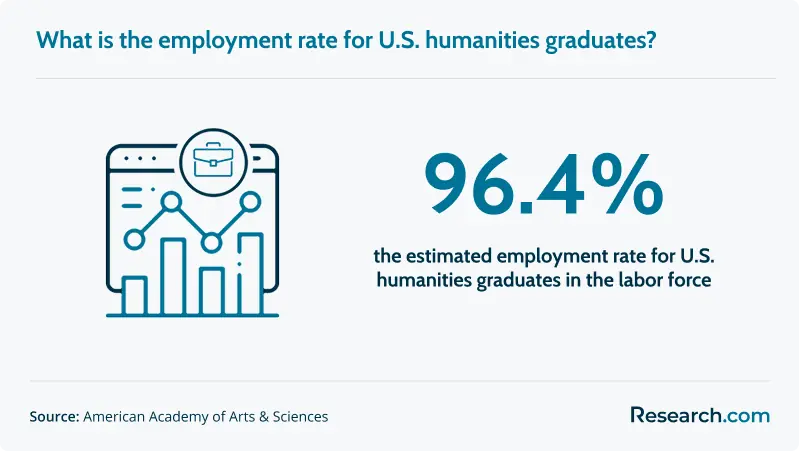
Across OECD countries, 87% of adults aged 25 to 64 with college degrees were employed, highlighting the employability of college graduates. Humanities graduates can build on their research, writing, and critical thinking skills to pursue opportunities in communications, education, business, and public service. Matching these abilities with employer needs can help them identify suitable roles and improve their employment prospects.
This article explores career paths, employment opportunities, and salary prospects for humanities graduates. It also examines industry demand to help students identify suitable jobs and make informed career decisions.
Key Benefits of Online Humanities Degree
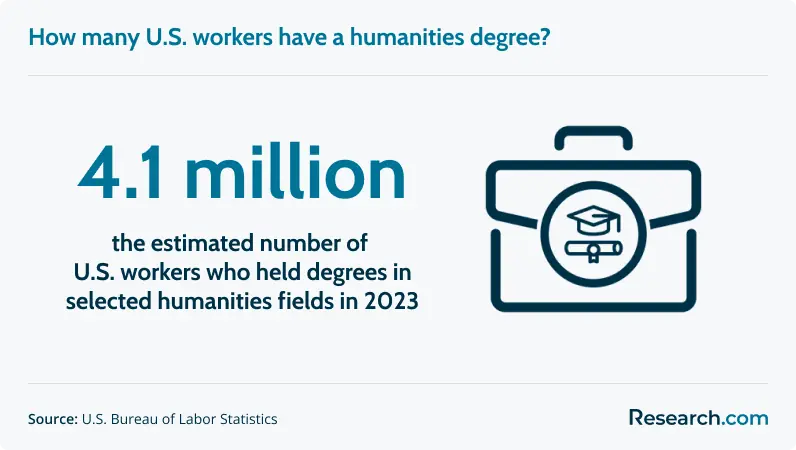
- In 2023, 4.1 million workers in the US held degrees in five selected humanities fields, demonstrating the broad employment reach of humanities education.
- In 2024, liberal arts degree holders, including humanities graduates, earned a median annual wage of $61,000, compared with $73,000 across all degree fields.
- Humanities graduates can pursue technical writing careers, where workers earn a median annual wage of $90,390, with about 3,200 job openings projected annually from 2025 to 2035.
Is a humanities online degree worth it in 2027?
An online humanities degree can be a worthwhile investment if you have a clear career direction and know how to translate academic skills into workplace competencies. Graduates can find opportunities in communications, education, business, public relations, research, and public service. However, earning potential varies by occupation, specialization, and professional experience.
Here is a more practical picture of what graduates can expect:
- Earning potential: Liberal arts degree holders, including graduates from several humanities-related disciplines, earned a median annual wage of $61,000 in 2024, compared with $73,000 across all degree fields.
- Career opportunities: Humanities graduates can apply their writing, research, and storytelling skills to media and communication careers, where workers earn a $76,910 median annual wage.
- Specialized careers: Graduates with strong writing and analytical skills can pursue technical writing by developing industry-specific knowledge, a field that pays a median annual wage of $ 90,390.
- Graduate hiring: Employers projected a 5.6% increase in hiring for the Class of 2026, giving humanities graduates opportunities to compete for entry-level positions by demonstrating transferable skills and relevant experience.
The degree's return on investment depends on program affordability, accreditation, and how effectively you connect your education to your intended career. Online delivery offers flexibility, but practical experience and specialized skills will help make the credential more competitive.
What jobs can you get with an online humanities degree?
There is a myriad of careers across communications, publishing, education, business, government, and nonprofit organizations waiting for humanities graduates. Rather than preparing graduates for one specific occupation, programs in English, history, philosophy, languages, and cultural studies develop transferable skills that employers use in research, writing, public engagement, and decision-making.
According to the US BLS, 4.1 million workers held degrees in five selected humanities fields in 2023. Some of the common career paths for humanities graduates include:
- Content Writers or Editors: Humanities graduates can apply their writing and language skills to create articles, edit publications, and develop digital content.
- Public Relations Specialists: Graduates can use their research, writing, and communication skills to develop press releases, manage public messaging, and maintain an organization's reputation.
- Technical Writers: Graduates with strong writing skills can specialize in explaining complex subjects through user guides, manuals, and technical documents.
- Market Research Analysts: Humanities graduates can use their research and analytical abilities to examine consumer preferences, interpret market trends, and support business decisions.
- Human Resources Specialists: Graduates can apply their communication and interpersonal skills to recruitment, employee relations, and staff development.
For faster alternative options, you can also research options for a top associate's degree in 6 months.
How much can you earn with a humanities degree?
The earning potential of a humanities degree becomes clearer when you consider how its core skills translate into workplace responsibilities. Research, persuasive writing, cultural awareness, and analytical thinking are valuable in occupations ranging from market research and human resources to technical communication and publishing.
The following occupations illustrate the earning potential of career paths related to the humanities:
- Technical Writers: These professionals create instruction manuals, user guides, and technical documents by translating complex information into accessible language. They earn a mean annual wage of $96,970.
- Editors: They review manuscripts, articles, and other publications to improve their accuracy, readability, and organization. They earn a mean annual wage of $90,060.
- Market Research Analysts: They use research and analytical skills to examine consumer preferences, evaluate market trends, and guide business decisions. They can expect a mean annual wage of $89,490.
- Writers or Authors: These professionals develop articles, books, scripts, and digital content for different audiences and publications. They receive a mean annual wage of $86,090.
- Human Resources Specialists: They apply communication and interpersonal skills to recruitment, employee relations, and workplace policies. Their mean annual wage is $81,990.
If you're interested in exploring other pathways, consider pursuing the easiest degree course.
A humanities degree is a foundation for high-paying careers when graduates build specialized knowledge and gain relevant professional experience. Fields such as law, marketing, public relations, and nonprofit management offer opportunities to apply research, persuasive communication, critical thinking, and negotiation skills in leadership and professional roles.
Humanities graduates can pursue several professional paths with the potential for higher earnings, such as:
- Lawyers: These professionals research legal issues, prepare arguments, negotiate agreements, and represent clients in legal proceedings. They earn a mean annual wage of $159,670. Take note that the profession requires a law degree and state licensure.
- Marketing Managers: These professionals develop marketing campaigns, evaluate consumer behavior, and oversee strategies that strengthen brand positioning. They earn a mean annual wage of $166,790.
- Public Relations Managers: They oversee media relations, organizational messaging, and communication strategies to maintain a positive public image. Their mean annual wage is $134,760.
- Fundraising Managers: These professionals organize fundraising campaigns, build donor relationships, and develop strategies to secure financial support for nonprofits and educational institutions. They earn a mean annual wage of $119,200.
Graduates who want to move into leadership, research, or teaching roles in these fields may also want to explore a PHD without dissertation, which can offer a doctoral-level credential without the traditional dissertation requirement.
The career opportunities available to humanities graduates often depend on how they apply their academic training to different industries. While some pursue writing and communication roles, others use their research, analytical, and interpersonal skills in business operations, public policy, education, and specialized professional services.
Industries that hire humanities graduates include:
- Educational services employ 14% of public relations specialists, and local public schools employ 84% of elementary teachers.
- Advertising, public relations, and related services employ 12% of public relations specialists, with a median of $77,480.
- Government employs 11% of public relations specialists, with a median salary of $81,350, the highest among their top industries. Local government employs 32% of librarians.
Humanities graduates can secure good entry-level jobs without full-time work experience, particularly in roles that value writing, research, communication, and critical thinking. Some positions require only a bachelor’s degree, while others may involve short-term training or basic industry knowledge.
Some jobs, such as public relations specialists, are occupations that typically require a bachelor’s degree but no related work experience or on-the-job training. Technical writing is another option, although some employers prefer candidates with relevant experience or technical subject knowledge. These pathways show how humanities graduates can enter professional fields by applying their academic skills to workplace needs.
Employers value humanities graduates for their ability to research, analyze information, communicate ideas, and work with others. These skills are developed through coursework in writing, history, literature, philosophy, and related disciplines.
National Association of Colleges and Employers (NACE) data show that teamwork is the most frequently sought competency, cited by 85% of employers. Analytical skills, creativity, and written communication also rank highly
With employers using skills-based hiring, humanities graduates should demonstrate these abilities through portfolios, internships, research projects, and practical work samples. They can also combine transferable skills with job-specific technical knowledge to strengthen their competitiveness across industries.
The best online humanities degrees provide transferable skills that graduates can apply across professional fields. Based on US BLS data, these five degree fields offer opportunities for career advancement, with median annual wages ranging from $65,000 to $72,000 among employed degree holders.
- English: Prepares graduates for careers in writing, editing, publishing, content development, and corporate communications.
- History: Builds research, interpretation, and analytical skills applicable to education, government, public history, and law-related fields.
- Philosophy and Religion: Develops logical reasoning and ethical analysis, which are useful in policy, management, and legal careers.
- Foreign Language: Provides language and cross-cultural skills for careers in translation, international business, education, and global organizations.
- Culture and Group Studies: Examines social structures and cultural perspectives, supporting work in research, community programs, and public service.
An online bachelor's degree in humanities can qualify graduates to pursue master's programs, professional degrees, and doctoral study, provided the institution and program meet the graduate school's admission requirements. Humanities coursework in research, writing, critical thinking, and communication can also provide a strong foundation for advanced academic and professional training.
Popular graduate pathways include a Master's in Education for teaching and educational leadership, a Master's in Public Administration for government and nonprofit work, and a Master's in Library and Information Science for careers in archives and information management.
Graduates may also pursue one year doctoral programs, including advanced degrees in communication, marketing, business administration, or law. Those interested in academic research or university teaching can consider doctoral programs.
How can you maximize your career opportunities with an online humanities degree?
A humanities degree gives a strong base, and students' choices during college shape the results. Students can improve their employment prospects by developing practical skills alongside their academic training. Plan early to connect coursework to employer needs and enter the job market with relevant experience.
Here are the other strategies that can help turn a humanities degree into career opportunities:
- Decide whether you are aiming for public relations, technical writing, law, or another path so you can pick matching electives.
- Collect writing samples, research papers, and projects, because employers want proof of skill.
- Internships and part-time work help you compete in a market.
- Learn basic AI tools through a course or practical project to build skills that employers increasingly seek.
- Develop technical knowledge in fields such as science or engineering to improve your opportunities in technical writing
- Employers highlight needed skills in postings, so tailor your resume to those exact skills
- Management roles often require years of experience, so start building leadership examples now.
Students can also explore which universities offer dual degree programs to combine humanities with other fields.
Other Things You Should Know About Humanities Degrees
Most online humanities bachelor's degrees take about four years of full-time study. Students with transfer credits may graduate sooner, while part-time learners may need additional time.
Accredited online humanities degrees generally receive the same academic recognition as their on-campus equivalents. Employers often consider accreditation, relevant skills, and professional experience when evaluating candidates.
Online humanities programs typically cover literature, history, philosophy, languages, cultural studies, and the arts. Students also develop research, writing, communication, and critical thinking skills through coursework and specialized electives.
- National Association of Colleges and Employers. (2026). Job Outlook 2026. www.naceweb.org/docs/default-source/default-document-library/2025/publication/research-report/nace-2026-job-outlook-report.pdf
- National Association of Colleges and Employers. (2026). Job Outlook 2026: Spring Update. https://www.naceweb.org/job-outlook/
- Organisation for Economic Co-operation and Development. (2025). How does educational attainment affect participation in the labour market? In Education at a Glance 2025. https://www.oecd.org/en/publications/education-at-a-glance-2025_1c0d9c79-en/full-report/how-does-educational-attainment-affect-participation-in-the-labour-market_ae451464.html
- US BLS. (2026). Advertising, Promotions, and Marketing Managers. https://www.bls.gov/ooh/management/advertising-promotions-and-marketing-managers.htm#tab-5
- US BLS. (2025). Field of Degree: Humanities Employment and Wages. https://www.bls.gov/careeroutlook/2025/data-on-display/field-of-degree-humanities-employment-and-wages.htm
- US BLS. (2026). Fundraising Managers. https://www.bls.gov/oes/2023/may/oes112033.htm
- US BLS. (2026). Kindergarten and Elementary School Teachers. https://www.bls.gov/ooh/education-training-and-library/kindergarten-and-elementary-school-teachers.htm
- US BLS. (2026). Lawyers. https://www.bls.gov/ooh/legal/lawyers.htm
- US BLS. (2026). Liberal Arts. https://www.bls.gov/ooh/field-of-degree/liberal-arts/liberal-arts-field-of-degree.htm
- US BLS. (2026). Public Relations Managers. https://www.bls.gov/oes/2023/may/oes112032.htm
- US BLS. (2026). Public Relations Specialists. https://www.bls.gov/ooh/media-and-communication/public-relations-specialists.htm
- US BLS. (2026). Technical Writers. https://www.bls.gov/ooh/media-and-communication/technical-writers.htm
- US BLS. (2026). Writers and Authors. https://www.bls.gov/ooh/media-and-communication/writers-and-authors.htm