Is a 2-Year Humanities Degree Worth It in 2027: Accelerated Bachelor's ROI & Time Trade-Offs
Audited and Verified:
Our Editorial and Data Verification Process
Research.com uses government datasets, official education statistics and primary institutional information to support its career and degree guides. Our review process checks factual accuracy, occupational definitions, source dates and the requirements associated with the credentials discussed.
How This Article Was Fact-Checked
Our editorial team verifies salary estimates, employment projections, education requirements and program information against original data providers and official organizations. Salary figures are checked against the relevant occupational definitions and reporting periods. Information about licensure, accreditation and required in-person training is reviewed separately.
Fact-checked and verified on:

Co-Founder and Chief Data Scientist
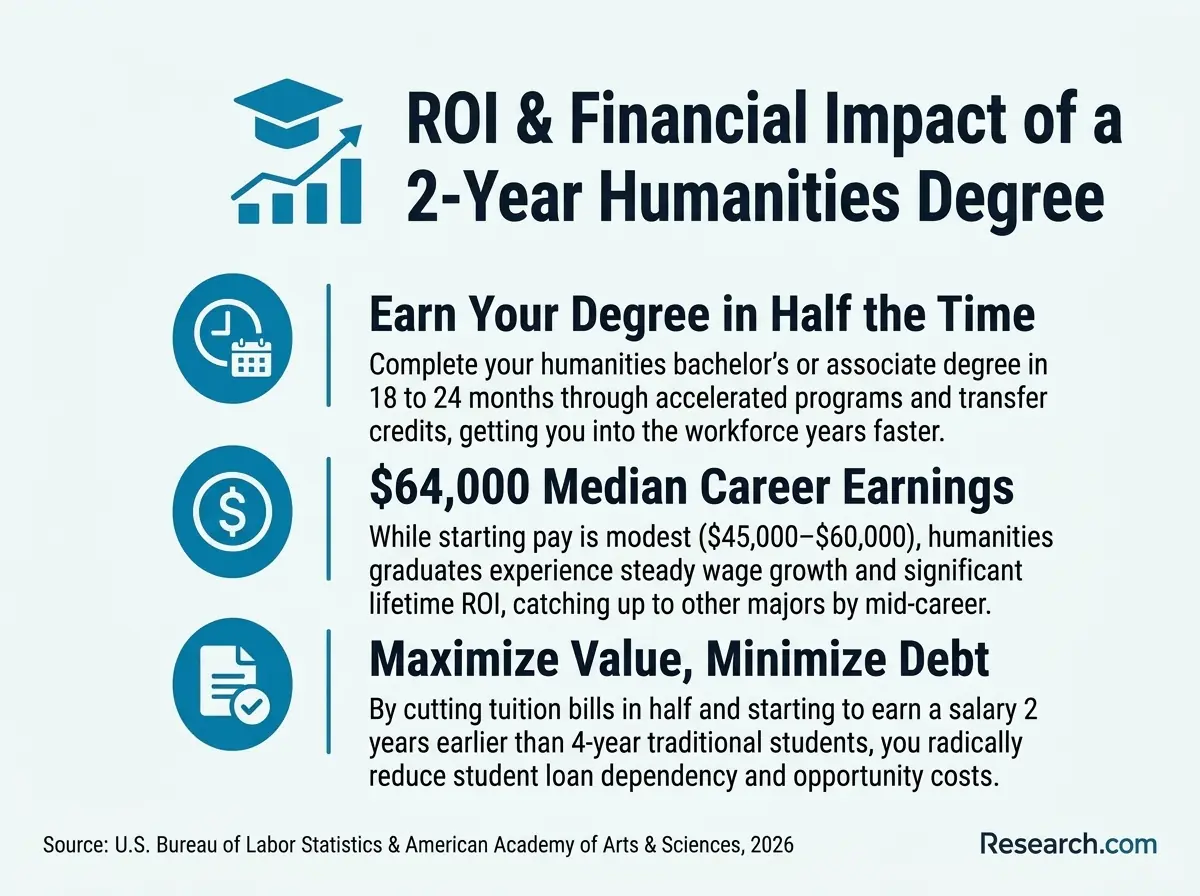
Workers with a humanities bachelor’s degree earn a median annual wage of $64,000. However, getting a four-year degree often means paying high tuition and waiting longer to start your career. If you finish a bachelor's degree in two years, or choose a focused two-year associate degree, you can save money and begin working sooner than most students.
But moving quickly has its trade-offs. Short 5- to 8-week terms often mean less time for summer internships, campus networking, or trying out different electives. Before you choose a fast-track program, compare how these accelerated humanities degrees stack up in terms of return on investment, career options, and workload.
Key Findings
- Humanities graduates often start with modest entry-level salaries. However, if they reduce tuition costs by 25% to 50% and join the workforce two years earlier than traditional four-year students, their net return on investment significantly improves.
- When a 120-credit bachelor's curriculum is compressed into 18 to 24 months, there are no summer breaks. As a result, students need to replace traditional multi-summer campus internships with options like remote work, micro-internships, and digital portfolios.
- Unlike a 2-year Associate of Arts, an accelerated Bachelor of Arts meets the typical four-year requirements for corporate hiring. It also gives graduates important skills that are in high demand, are less likely to be automated, and can help graduates move into leadership roles.
What Is a 2-Year Humanities Degree, and How Do Accelerated Bachelor’s Programs Work?
A "2-year humanities degree" can mean either an Associate of Arts (AA) in Humanities, which is 60 credits, or an accelerated Bachelor of Arts (BA) program that lets you finish the usual 120-credit degree in about 18 to 24 months. These faster bachelor’s programs offer more efficient structures but still employ the same academic requirements.
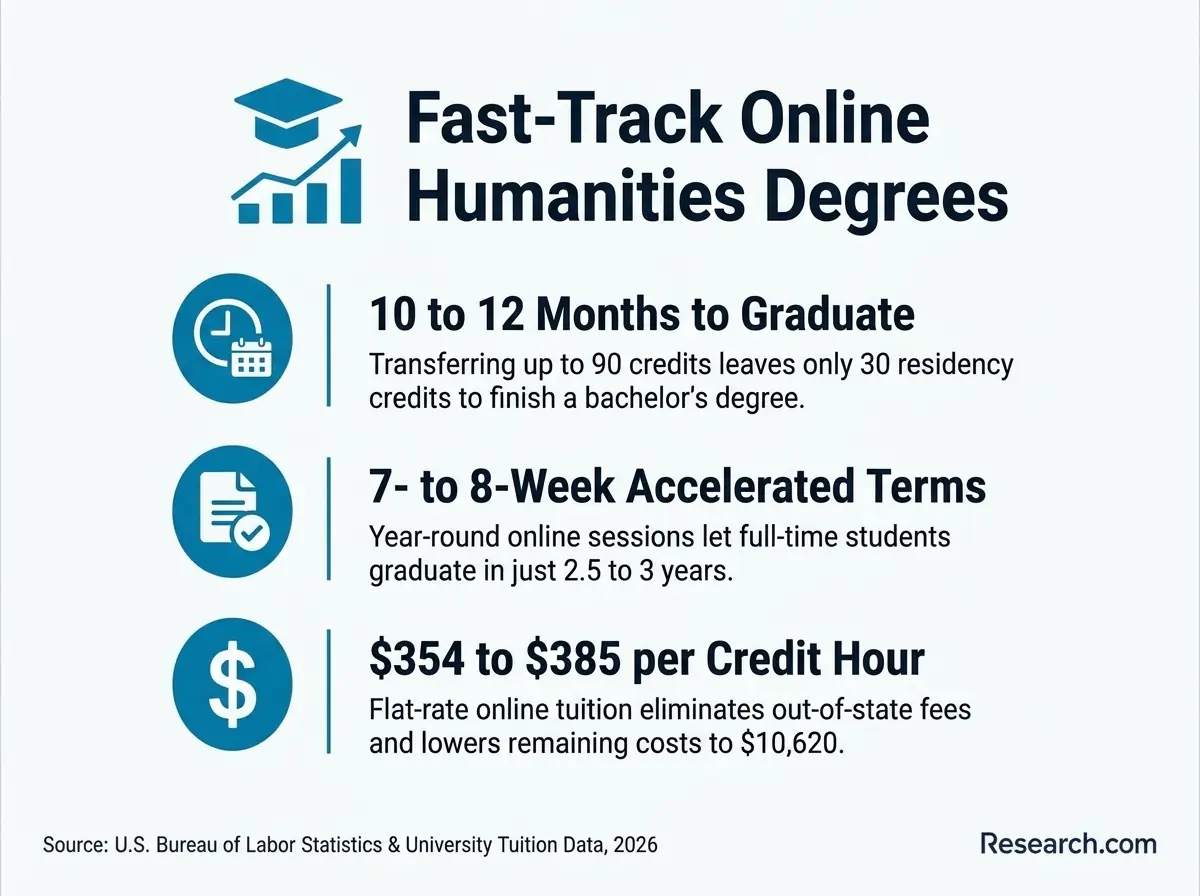
- Transfer and Prior Learning Credits: Most accredited programs let you transfer up to 90 credits from an associate degree, AP or IB exams, or military and work experience. This means you only need to finish 30 to 60 upper-level credits at the school where you earn your degree.
- Modular Year-Round Pacing: Classes are offered in short, intensive 5- to 8-week online or hybrid sessions throughout the fall, spring, and summer. This schedule removes the usual long breaks between terms.
What Subjects and Coursework Are Covered in an Accelerated Humanities Curriculum?
Accelerated humanities programs focus on human culture, ethics, communication, and history. Students take part in focused reading, analytical writing, and seminar discussions. Much like flexible degree-completion tracks such as RN to BSN programs without clinicals, these streamlined pathways prioritize transferable academic competencies over traditional in-person requirements. The main courses usually include:
- Foundational Disciplines: Literature, world and U.S. history, philosophy, applied ethics, religious studies, foreign languages, and cultural or media studies.
- Applied Concentrations: Interdisciplinary tracks like digital humanities, technical communication, organizational leadership, and pre-law studies, which combine critical analysis with practical workplace skills.
- Capstone Research: In the final term, students complete a thesis, portfolio, or research project to show their advanced skills in synthesis and persuasive writing.
How Much Does an Accelerated 2-Year Humanities Bachelor’s Cost Compared to a Traditional Degree?
Finishing a bachelor's degree in two years lowers tuition costs by reducing the number of semesters and campus fees you pay. For an online or accelerated humanities BA, total tuition usually falls between $30,000 and $50,000, and it can be much less if you transfer 60 credits from a community college. The main cost factors are:
- Reduced Living and Campus Expenses: Online classes that you can take on your own schedule remove costs for housing, meals, commuting, and student activity fees. Finishing your degree faster also means you spend less on textbooks and technology over time.
- Financial Aid Timing: If you take classes all year, you need to work closely with federal financial aid offices. Taking more credits during the summer can use up your yearly Pell Grant or federal loan limits faster than following a regular two-semester schedule.
What Is the Financial ROI of a 2-Year Humanities Degree Over Time?
Humanities graduates often start their careers with lower pay than those in STEM or business, but finishing school faster can boost their net return on investment (ROI). Similar to how an accelerated certified medical assistant program reduces upfront tuition and speeds up entry into healthcare roles, graduating sooner in the humanities lets students take on less debt and spend less time without income. Data from the U.S. Bureau of Labor Statistics (BLS) and the American Academy of Arts & Sciences show a clear financial pattern:
- Entering the workforce two years earlier than usual lets students start earning full-time wages and begin saving for retirement sooner. This helps offset lower starting salaries.
- In mid-career, people with a humanities bachelor’s degree earn a median annual wage of $64,000. Salaries vary by field, from $60,000 in English to $66,000 in foreign languages and $68,000 in cultural studies.
- After age 40, humanities majors often see their salaries grow faster than average as they move into management, executive communications, or strategic operations roles.
Switching from a traditional four-year academic schedule to two years of nonstop study means that reading and writing deadlines come much faster. Students face several built-in challenges:
- High Weekly Workload Density: When a 16-week literature or philosophy seminar is squeezed into just 7 weeks, students often spend 15 to 20 hours each week on reading, discussions with classmates, and writing essays for each course.
- No Academic Downtime: With classes running all year and no summer breaks, students who also work full-time or have family duties are at greater risk of burning out.
- Limited Exploratory Flexibility: Strict degree plans make it hard to change majors, retake classes, or try electives in other subjects without delaying graduation.
Finishing your degree in two years means you focus more on earning your credential than on the usual campus experience. Much like enrolling in a low-cost medical coding and billing online program to fast-track job readiness, prioritizing speed and affordability can lead to some trade-offs in professional development outside the classroom.
- Compressed Recruiting Windows: Shorter timelines mean traditional students often use their sophomore and junior summers for internships. However, students finishing in two years usually need to look for part-time, remote, or micro-internships while they are still taking classes.
- Reduced In-Person Networking: With more online classes and many students commuting, accelerated programs offer fewer chances for spontaneous connections with faculty, campus clubs, or study-abroad opportunities.
- Targeted Workarounds: To make up for these gaps, students can use alumni directories, create digital writing or research portfolios during their capstone courses, and join professional associations early.
About 4.1 million people in the U.S. have a bachelor’s degree or higher in the humanities. They work in private companies, education, government, and nonprofits. An accelerated BA meets the usual four-year degree requirement for many jobs, so you can apply for roles such as:
- Communications and Content Strategy: You could work as a public relations specialist, technical writer, editor, or brand strategist. Starting salaries are usually between $45,000 and $55,000, and experienced professionals can earn $65,000 to $85,000 or more.
- Business Operations and Human Resources: Possible jobs include HR coordinator, corporate trainer, market research analyst, and management consultant. The typical starting salary is between $48,000 and $60,000, with mid-career specialists earning $69,000 to $82,000.
- Public Service, Education, and Law: You might become a nonprofit program manager, museum or archival coordinator, K–12 educator, or paralegal. For these roles, the starting wage is between $42,000 and $55,000, with experienced professionals earning $60,000 to $75,000.
As generative AI automates routine coding, data entry, and basic drafting, employers increasingly value human judgment, ethical oversight, and complex communication. Just as professionals seeking leadership roles in regulated industries look for affordable accredited healthcare administration degrees to build managerial resilience, students choosing an accelerated humanities path gain durable skills that resist automation. Federal Reserve Bank of New York labor data shows recent philosophy majors posting a 5.1% unemployment rate—lower than the 7.0% rate recorded for computer science graduates. Humanities training builds core advantages in an AI-driven workplace:
- Critical Evaluation and Ambiguity Management: Auditing AI outputs for factual accuracy, logical consistency, and cultural bias requires deep reading and analytical rigor.
- Persuasive Communication and Stakeholder Trust: Translating complex technical or policy decisions into clear narratives for diverse audiences remains a core human bottleneck in AI adoption.
- AI-Humanities Hybridization: Graduates who pair humanities reasoning with practical digital literacy and prompt-engineering skills command stronger job security and faster promotion pathways.
Choosing among the three pathways depends on your existing credits, budget, and career ceiling:
A 2-Year Associate of Arts (AA) takes 60 credits over two years and is the most affordable choice, with tuition usually between $8,000 and $15,000. The 2-year AA offers access to local or commuter campus resources, but the degree usually leads to entry-level or support roles, so lifetime earning potential is lower than with a four-year degree.
A 2-Year Accelerated BA lets students with transfer credits finish their bachelor's degree in 1.5 to 2 years. Costs range from $20,000 to $50,000, depending on how many credits transfer. Internship and campus access are limited and mostly self-directed, but the degree meets standard corporate HR requirements. The 2-year accelerated BA also offers the same long-term earning potential as a traditional bachelor's.
A Traditional 4-Year BA covers 120 credits over four years and is the most expensive option, costing $40,000 to $120,000 or more. Like the accelerated BA, it meets all bachelor's degree requirements and leads to strong long-term earning potential. The traditional 4-year BA also offers the best early alumni network and the widest access to multi-summer recruiting, internships, and study abroad opportunities.
| Feature | 2-Year Associate of Arts (AA) | 2-Year Accelerated BA | Traditional 4-Year BA |
| Typical Duration | 2 years (60 credits) | 1.5–2 years (with transfer credits) | 4 years (120 credits) |
| Estimated Tuition Cost | 8,000–15,000 | 20,000–50,000 (varies by transfer credits) | 40,000–120,000+ |
| HR Credential Ceiling | Meets entry-level/support thresholds | Clears full bachelor's degree requirements | Clears full bachelor's degree requirements |
| Internship & Campus Access | Moderate (local/commuter) | Low to moderate (self-directed) | High (multi-summer recruiting, study abroad) |
| Long-Term Earning Potential | Lower lifetime earnings cap | High (matches standard BA trajectory) | High (strongest early alumni network) |
Who Should—and Shouldn’t—Choose an Accelerated 2-Year Humanities Degree?
An accelerated humanities bachelor's degree offers the most value when you have clear career goals and can manage your own learning. It is a great choice for transfer students with an associate degree or at least 45 college credits. This accelerated format is also ideal for working adults who need a bachelor's degree to get a promotion or pay raise.
An accelerated humanities program also works well for people changing careers into fields like communications, human resources, or management. Just as nurses seeking cost-effective career advancement research the most affordable BSN to DNP programs online, students who want an economical path to law school or other graduate programs may also find this accelerated format a better option.
On the other hand, this fast-paced program is usually not the best choice for recent high school graduates without transfer credits who want to try out different majors. Students who depend on campus recruiting to find their first internships, or who struggle to keep up with weekly writing assignments without breaks, often do better in traditional programs.
Before you enroll, use a checklist to compare programs. Make sure the school is regionally accredited, check how many transfer credits it accepts (ideally 60 to 90), and look for programs that offer career coaching or practical concentrations like digital humanities and technical writing.
- American Academy of Arts and Sciences. (n.d.). Earnings of humanities majors with a terminal bachelor's degree. Humanities Indicators. https://www.amacad.org/humanities-indicators/workforce/earnings-humanities-majors-terminal-bachelors-degree
- American Academy of Arts and Sciences. (n.d.). Effect of experience on the earnings of college majors. Humanities Indicators. https://www.amacad.org/humanities-indicators/workforce/effect-experience-earnings-college-majors
- Federal Reserve Bank of New York. (2026). The labor market for recent college graduates. https://www.newyorkfed.org/research/college-labor-market
- U.S. Bureau of Labor Statistics. (2026). Field of degree: Liberal arts. U.S. Department of Labor. https://www.bls.gov/ooh/field-of-degree/liberal-arts/liberal-arts-field-of-degree.htm