2027 Which Humanities Degree Careers Have the Lowest Unemployment Risk?
Audited and Verified:
Our Editorial and Data Verification Process
Research.com uses government datasets, official education statistics and primary institutional information to support its career and degree guides. Our review process checks factual accuracy, occupational definitions, source dates and the requirements associated with the credentials discussed.
How This Article Was Fact-Checked
Our editorial team verifies salary estimates, employment projections, education requirements and program information against original data providers and official organizations. Salary figures are checked against the relevant occupational definitions and reporting periods. Information about licensure, accreditation and required in-person training is reviewed separately.
Fact-checked and verified on:

Co-Founder and Chief Data Scientist
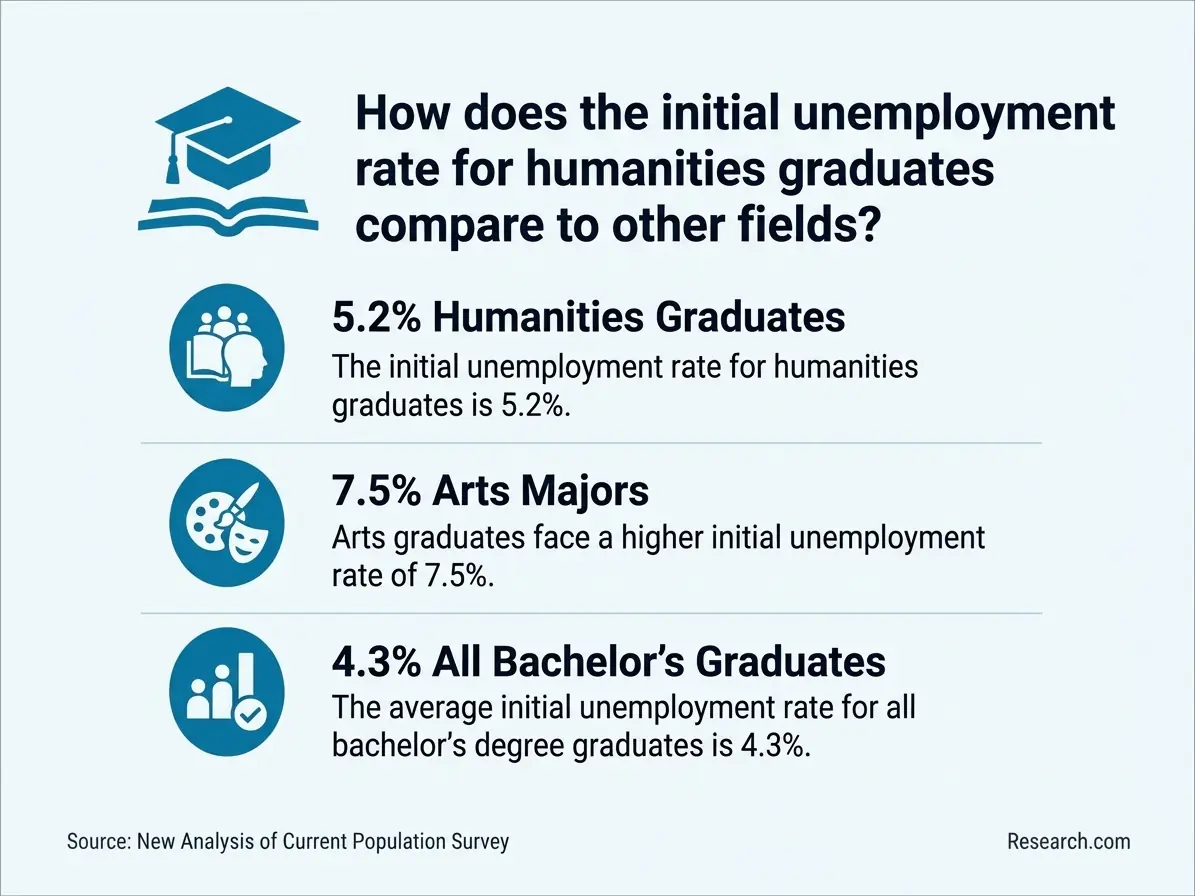
Graduates often struggle to determine which humanities degree careers carry the lowest unemployment risk. According to Cambridge University Press data, the 5.2% unemployment rate for humanities majors exceeds the 4.3% rate for all bachelor's degree holders, yet remains lower than the 7.5% rate for arts majors.
Drawing on over ten years of career planning expertise and only credible sources, our team examines job stability across humanities roles. Reading this guide helps graduates and students choose resilient careers and plan smarter next steps.
Key Things to Know About the Humanities Degree Careers With the Lowest Unemployment Risk
- Humanities graduates face a 5.2% initial unemployment rate, higher than the 4.3% all-bachelor's average yet lower than the 7.5% rate for arts majors. Long-term unemployment drops to 2% to 3% across resilient, human-centric roles like HR managers, UX researchers, technical writers, and high-earning marketing managers.
- Artificial intelligence (AI) is displacing transactional writing and administrative work. However, it boosts demand for human judgment in AI ethics and brand strategy, helping mid-career humanities unemployment stabilize at roughly 3%, matching STEM.
- Graduates can eliminate post-graduation employment gaps across top hiring industries by pairing their degrees with paid internships, verifiable digital portfolios, and targeted certifications in data analytics, SEO, UX, or project management rather than low-ROI academic master's degrees.
What Factors Lower Unemployment Risk for Humanities Majors in 2027?
Humanities majors lower their unemployment risk by pairing transferable analytical skills with targeted practical experience. This leverages reduced graduate supply and fills roles that require ethical oversight and human judgment alongside artificial intelligence. While entry-level salaries often trail technical degrees, labor data show humanities graduates achieve competitive employment rates by adapting across industries.
Core Drivers of Job Stability
- Skills-Based Hiring and Credential Pairing: Employers prioritize demonstrable competencies, such as investigative research, persuasive writing, and client communication, over rigid major requirements. Graduates who supplement their degrees with internships, digital literacy, or targeted certifications bridge the gap between academic theory and immediate workplace utility.
- Demand for Human Judgment in an AI Economy: As automation takes over routine coding and data processing, organizations hire humanities graduates to lead AI safety research, shape content policy, manage ethical compliance, and audit language model outputs. Machines cannot easily replicate critical evaluations of nuance, context, and communication.
- Cross-Disciplinary Adaptability: Training across diverse texts and cultural frameworks prepares graduates to pivot across sectors like public policy, marketing, user experience research, and law. Furthermore, a decade-long decline in humanities enrollments has tightened the graduate supply, reducing competition for roles that still depend on rigorous reading and synthesis.
Which Humanities Degree Careers Have the Lowest Unemployment Risk?
History, philosophy, and foreign languages drive the strongest long-term employment and earnings among humanities majors, even though few liberal arts tracks rival the entry-level pay of a highest paying degree in specialized technical or medical fields. Meanwhile, communications and English give graduates the broadest early-career flexibility across corporate and media roles.
Across all humanities disciplines, overall unemployment rates hover around 2% to 3%, matching the broader college-educated workforce.
Top Resilient Humanities Careers and Job Outlooks
- Human Resources Managers: Organizations rely on humanities graduates to mediate workplace conflicts, navigate labor compliance, and oversee talent retention. The U.S. Bureau of Labor Statistics (BLS) projects employment for HR managers to grow 6% from 2025 to 2035.
- UX Researchers and Digital Designers: Studying human behavior and cultural context helps product teams build intuitive software. BLS projections show 6% growth for web and digital interface designers through 2035, while the World Economic Forum ranks UI/UX roles among the fastest-growing globally.
- Public Relations Specialists: Managing brand reputation and crisis communications requires nuanced storytelling and audience awareness. BLS projects 2% employment growth through 2035, sustained by steady replacement openings.
- Technical Writers: Translating complex engineering and AI documentation into clear user guides generates roughly 3,200 annual job openings through 2035, with the strongest gains in software and scientific R&D.
- Policy Analysts: Evaluating regulatory frameworks and societal impacts keeps graduates in steady demand across government agencies and consulting firms, yielding roughly 400 openings yearly.
Which Humanities Majors Have the Best Employment Outcomes?
History, philosophy, and foreign languages deliver the strongest long-term employment and earnings outcomes among humanities majors. Meanwhile, communications and English offer the broadest entry-level career flexibility across corporate and media sectors.
Across all humanities disciplines, overall unemployment rates hover around 2% to 3%, matching the broader college-educated workforce.
Standout Disciplines and Career Strengths
- History: Builds strong research, source evaluation, and synthesis skills that support long-term advancement in policy, law, consulting, and executive roles, often yielding higher mid-career wages than several other humanities tracks.
- Philosophy: Sharpens logical reasoning, ethical analysis, and structured argument—competencies that translate well into strategy, governance, legal preparation, and AI or tech evaluation.
- Foreign Languages: Opens doors to global business, diplomacy, localization, and international organizations where cross-cultural fluency and multilingual communication are essential.
- English and Communications: Offers wide early-career access to content strategy, corporate communications, public relations, editing, and digital media across diverse industries.
Marketing managers, human resources managers, lawyers, technical writers, and UX researchers offer the highest pay and lowest layoff risk among humanities careers. These roles pair near- or above-six-figure salaries with essential corporate, legal, and tech functions.
High-ROI Humanities Career Paths
- Lawyers ($151,160 median wage): Philosophy, history, and English majors consistently achieve top LSAT scores. Legal counsel remains insulated from economic downturns due to ongoing regulatory, compliance, and litigation needs.
- Marketing Managers ($159,660 median wage): Communications and English graduates who transition into brand strategy and executive leadership command high salaries while driving essential revenue growth.
- Human Resources Managers ($140,030 median wage): Organizations depend on HR leaders to manage retention, labor law compliance, and organizational culture, keeping layoff rates among the lowest in corporate operations.
- User Experience (UX) Researchers ($101,800 median wage): Anthropology, psychology, and literature graduates translate qualitative user behavior into profitable digital products, sustaining steady demand across software and healthcare sectors.
- Technical Writers ($91,670 median wage): Explaining complex software, engineering, and AI systems requires precision that automated tools cannot independently verify, delivering high return on investment without requiring an advanced degree.
Artificial intelligence reshapes humanities job security by automating routine tasks. It also increases demand for human judgment, ethical oversight, and strategic communication, especially when professionals pair liberal arts training with flexible credentials like an artificial intelligence degree online.
- Tasks Facing Displacement: Entry-level copywriting, basic translation, standardized scheduling, and administrative reporting face high automation pressure. Generative AI tools draft routine summaries and manage repetitive workflows, reducing hiring for purely transactional support roles.
- Protected and Growing Roles: Careers centered on AI ethics, brand strategy, crisis communications, user research, and human resources remain insulated. Employers rely on humanities graduates to audit algorithmic bias, interpret cultural nuance, and build interpersonal trust that machines cannot replicate.
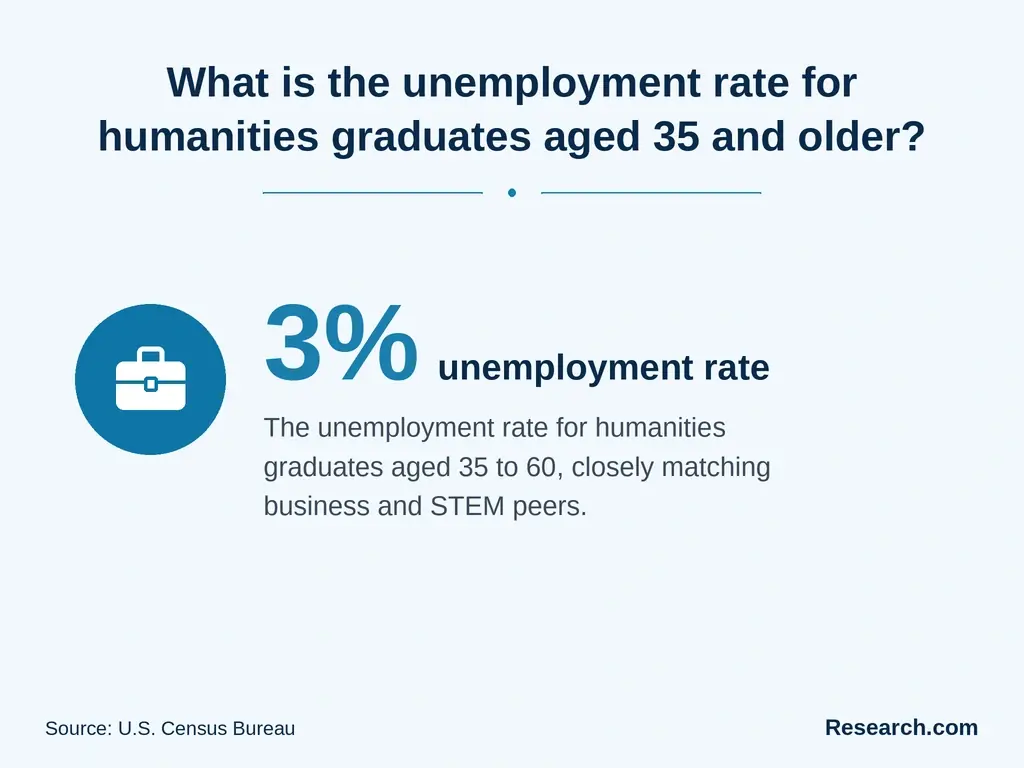
Humanities majors face slightly higher initial unemployment and underemployment than STEM and business graduates. However, their mid-career unemployment rates converge within roughly one percentage point of technical peers.
Recent humanities graduates encounter steeper entry-level friction because their degrees rarely match a single licensed occupation. Over 40% of humanities bachelor's holders face underemployment five years after graduation, whereas specialized STEM and business programs—or even the shortest masters program focused on applied skills—build direct corporate pipelines. However, tech-sector hiring slowdowns have narrowed this early gap, raising unemployment among recent computer science and engineering graduates.
During prime working years (ages 35 to 60), data from the American Academy of Arts & Sciences and the U.S. Census Bureau show humanities unemployment falling to roughly 3%, closely matching business and STEM peers. Although STEM workers earn higher median salaries ($98,000 versus $69,000 for humanities), long-term job stability levels out across all three fields.
Pairing a humanities degree with targeted digital, analytical, and operational credentials significantly lowers unemployment risk. These credentials signal immediate workplace readiness to employers.
- Data Literacy and Analytics: Earning a Google Data Analytics Certificate or learning SQL, Excel, and Tableau proves you can back qualitative insights with quantitative evidence.
- SEO and Content Strategy: Combining strong writing with HubSpot or Google Digital Marketing certifications opens direct pipelines into content marketing, editorial management, and brand communications.
- UX Research Methods: Completing coursework in human-computer interaction, usability testing, and Figma translates ethnographic and behavioral analysis into high-paying product design careers.
- Project Management: Credentials like the Certified Associate in Project Management (CAPM) or Google Project Management Certificate validate your ability to manage budgets, timelines, and cross-functional teams across corporate and nonprofit sectors.
Advanced degrees improve job security for humanities majors only when targeted toward applied professions like law, business, or a masters in construction management. Meanwhile, academic graduate programs often carry negative financial returns.
- Law Degrees and MBAs: Law programs deliver high stability and positive returns for 93% of graduates, while MBAs accelerate transitions into corporate management.
- Academic Master’s and PhDs: Humanities master’s programs often yield negative ROI because of high tuition and lost wages, while PhDs face severe academic job scarcity despite multi-year stipends.
- Workforce Entry: Entering the workforce with targeted certifications avoids graduate debt while building immediate, transferable experience.
Education, technology, healthcare administration, financial services, and nonprofit management hire the most humanities graduates in recent years. These sectors depend on strong communication, qualitative research, and ethical governance.
Top Hiring Industries for Humanities Talent
- Education and EdTech: Traditional school systems, universities, and educational technology firms remain the largest employers of liberal arts majors. Graduates work as postsecondary instructors, curriculum designers, and instructional coordinators, building digital learning materials and assessing student engagement.
- Technology and AI Development: Software companies actively recruit English, linguistics, and philosophy majors for UX research, technical writing, and natural language processing. These professionals refine AI model outputs, design intuitive interfaces, and translate complex engineering products for everyday users.
- Healthcare Administration: Rapid expansion across hospital networks and health-tech startups drives demand for patient advocacy, public health communications, and human resources management. Humanities graduates bridge clinical operations and patient understanding.
- Financial Services and Consulting: Banks, insurance firms, and management consultancies hire liberal arts graduates as client relations managers, regulatory compliance analysts, and corporate strategists. These professionals synthesize complex market risks into clear executive recommendations.
- Nonprofit Management and Public Policy: Foundations, advocacy groups, and government agencies rely on humanities backgrounds for grant writing, donor relations, program evaluation, and legislative research.
How Can Humanities Students Maximize Employability Before Graduation?
Humanities students maximize employability before graduation by turning academic skills into verifiable workplace proof. They achieve this through paid internships, digital portfolios, targeted alumni networking, and skill-building paths that open doors to high paying certificate jobs.
- Secure Paid Internships: Complete paid internships in communications, policy, or user research by junior year to gain measurable business metrics and full-time return offers.
- Build a Verifiable Portfolio: Publish applied work, such as SEO audits, research briefs, or usability case studies, to prove immediate value beyond academic transcripts.
- Leverage Alumni Networks: Conduct informational interviews with liberal arts alumni in tech, finance, and consulting to secure internal referrals and learn how to frame transferable skills.
Other Things You Should Know About Humanities Degrees
Philosophy and foreign languages rank among the hardest humanities majors due to abstract reasoning and steep skill requirements.
A BA in Humanities provides strong long-term career flexibility and low mid-career unemployment. Graduates develop critical thinking, persuasive writing, research, and ethical reasoning skills that apply across many industries.
Humanities graduates work across business, tech, media, government, education, and nonprofit sectors. Common roles include technical writer, UX researcher, content strategist, public relations specialist, human resources specialist, policy analyst, and corporate communications manager.
Management roles and specialized advisory careers, such as marketing managers, human resources managers, lawyers, and technical writers, offer the highest pay among humanities paths. Top corporate roles and legal careers regularly reach six-figure median compensation, especially with experience or advanced credentials like a law degree or MBA.
- American Academy of Arts & Sciences. (n.d.). Earnings of humanities majors with a terminal bachelor's degree. Humanities Indicators. https://www.amacad.org/humanities-indicators/workforce/earnings-humanities-majors-terminal-bachelors-degree
- American Academy of Arts & Sciences. (n.d.). Effect of experience on the earnings of college majors. Humanities Indicators. https://www.amacad.org/humanities-indicators/workforce/effect-experience-earnings-college-majors
- American Academy of Arts & Sciences. (n.d.). The employment status of humanities majors. Humanities Indicators. https://www.amacad.org/humanities-indicators/workforce/employment-status-humanities-majors
- U.S. Bureau of Labor Statistics. (2024, April 3). Occupational employment and wages news release. U.S. Department of Labor. https://www.bls.gov/news.release/archives/ocwage_04032024.htm
- U.S. Bureau of Labor Statistics. (2025, November 24). Projected job openings in occupations typically requiring a graduate-level degree, 2024–34. The Economics Daily. https://www.bls.gov/opub/ted/2025/projected-job-openings-in-occupations-typically-requiring-a-graduate-level-degree-2024-34.htm
- U.S. Census Bureau. (n.d.). American Community Survey (ACS). U.S. Department of Commerce. https://www.census.gov/programs-surveys/acs
- World Economic Forum. (2025). Future of jobs 2025: Jobs outlook. https://www.weforum.org/publications/the-future-of-jobs-report-2025/2-jobs-outlook