2027 Are Too Many Students Choosing Humanities? Oversaturation, Competition, and Hiring Reality
Audited and Verified:
Our Editorial and Data Verification Process
Research.com uses government datasets, official education statistics and primary institutional information to support its career and degree guides. Our review process checks factual accuracy, occupational definitions, source dates and the requirements associated with the credentials discussed.
How This Article Was Fact-Checked
Our editorial team verifies salary estimates, employment projections, education requirements and program information against original data providers and official organizations. Salary figures are checked against the relevant occupational definitions and reporting periods. Information about licensure, accreditation and required in-person training is reviewed separately.
Fact-checked and verified on:

Co-Founder and Chief Data Scientist
Unlike pre-professional degrees that train for a single job, a humanities background prepares graduates for diverse sectors. For example, some humanities graduates use their degrees to pursue law, public administration, or business careers. Others also take this degree to follow personal passions and curiosities in history, culture, and languages.
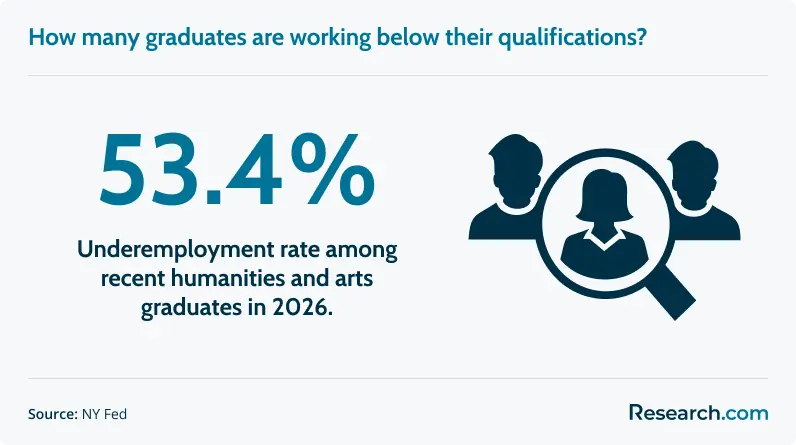
However, because humanities lacks a direct pipeline into a single profession, graduates experience higher rates of initial underemployment and lagging entry-level pay compared to engineering, business, or health sciences. In fact, 53.4% of graduates are working in jobs below their qualifications. Is a humanities degree still practical in 2027? In this article, we'll explore the realities of undertaking this degree, from the growing concerns about market saturation to graduates' employment prospects.
Key Things to Know About the Oversaturation, Competition, and Hiring Reality in the Humanities Field
- 4.94 million of the 6.3 million people with art and humanities degrees were employed in 2027.
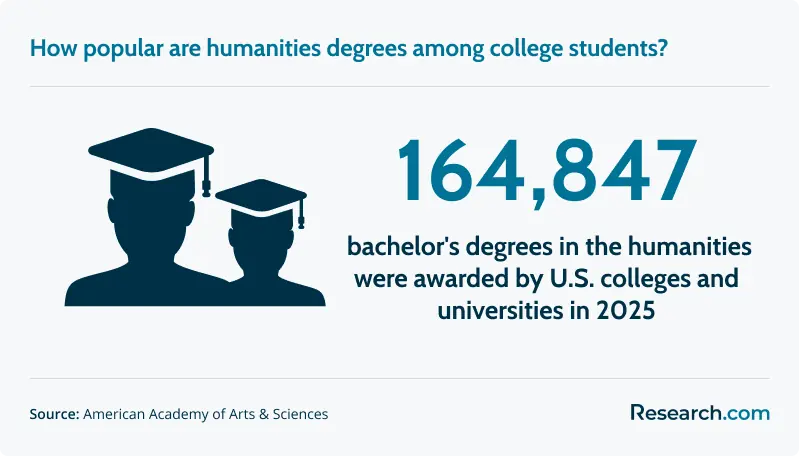
- 164,847 humanities bachelor's degrees were awarded in 2025. That's a 30.4% decline from the peak in 2012.
- English has the largest existing employment base among humanities majors, with 1,933,770 employed degree holders in 2024.
How Many Students Are Majoring in Humanities in the U.S?
In the U.S., students often treat humanities degrees as practical stepping stones for graduate school and high-paying corporate roles. Humanities degrees build strong analytical, persuasive writing, and critical thinking skills that directly prepare graduates for these paths. In fact, the Law School Admission Council (LSAC) even shows that majors like Philosophy, History, and English score among the highest on the LSAT and achieve higher acceptance rates than Criminal Justice majors.
Also, because the credit load is lighter, a humanities degree makes it much easier for students to graduate on time while still getting the skills and competencies needed for high-paying roles like management consultant, corporate communications lead, or UX researcher. These make humanities attractive for prospective students.
As of Fall 2025, 398,589 undergraduate students in the U.S. are enrolled in a humanities bachelor's degree as their first major. English Language & Literature is the largest traditional humanities major in the U.S. workforce. Graduates of this major often pursue careers in writing, editing, content or UX strategy, publishing, and law prep. Alongside English, History, Philosophy, Foreign Languages, and Religious Studies are also among the most popular humanities majors among students.
Are There Enough Jobs for Humanities Degree Holders in the U.S.?
Humanities students represent 4.8% of all U.S. bachelor's degree students. While still significant, this number is down from the 6.6% a decade before. Fewer U.S. students are enrolling in the humanities primarily due to a shift toward pre-professional STEM degrees.
Does this trend mean there are not enough jobs for humanities graduates? Not really. Humanities majors have similar or lower unemployment rates than many STEM majors. For example, foreign language majors posted an unemployment rate of 1.6%, while those with accelerated computer science degree sit at 7%.
Humanities graduates do get hired. The catch is that roughly 53% start in jobs that do not strictly require a bachelor's degree before working their way into salaried professional careers.
Only about 27% of humanities graduates work in a job directly tied to their specific major within two years of graduating. The rest fill roles across the broader economy where writing, research, and communication are required. These include jobs in marketing, public relations, human resources, legal services, K–12 education, government, and corporate management.
How Competitive Is the Job Market for Humanities Graduates?
The U.S. job market for humanities graduates is highly competitive for traditional roles like academia, publishing, and museums. According to the Modern Language Association (MLA) and American Historical Association (AHA), more humanities PhDs graduate each year than there are tenure-track professor jobs. In the academic year 2024-2025, there were 1,150 history PhD graduates while there were only about 340 tenure-track openings in U.S universities.
As a result, some PhDs pivot to administration or the private sector. The same is true for entry-level jobs in book publishing, editorial journalism, and museum curation. These roles attract thousands of applicants annually for very few openings.
On the other hand, general corporate and business roles have moderate competition for humanities graduates. Because employers in these fields value soft skills and adaptability, a humanities degree gives applicants an advantage. However, internships, a work portfolio, and a strong network are what actually win the job offer.
For roles in marketing, PR, HR, operations, sales, and project management, graduates with zero work experience face stiff competition and higher early underemployment. When recruiting for corporate functions, employers often target specialized business degrees over general humanities degrees. For example, NACE reports that business majors make up 6 of the top 10 most targeted bachelor's degrees in corporate functions. Meanwhile, only 30.4% of employers consider hiring candidates from any major regardless of whether it relates to their industry.
Humanities students are less likely to have pre-arranged campus recruiting pipelines than accounting, nursing, or engineering majors. As a result, most humanities graduates find full-time work within 3 to 6 months after graduation. Roughly 70% of humanities graduates secure full-time employment within a year. Others initially take interim, part-time, or non-degree roles while continuing to apply for salaried positions.
According to the National Association of Colleges and Employers (NACE), graduating seniors who complete paid internships receive more than twice as many job offers as peers without internship experience.
Moreover, graduates who target broad corporate or entry-level roles generally find work faster than those holding out exclusively for rare, hyper-competitive openings in publishing, media, museums, or academia.
Despite widespread myths about unemployable liberal arts majors, U.S. Census data shows that 87% of humanities bachelor's degree holders are employed. This figure closely matches the 89% employment rate of science and engineering graduates. It shows that humanities majors can turn their analytical skills into high-demand careers across the private and public sectors.
The most in-demand jobs for humanities graduates in the U.S. are in the following fields:
- Corporate: Over 17% of humanities bachelor's degree holders work in management roles, and 12% in business and financial operations. Corporations also often recruit humanities graduates for roles in communications and client relations because of their strengths in synthesis and persuasive messaging.
- Human Resources: Human resources departments rely on humanities graduates to handle employee relations, interviewing, training, and internal policy writing. Data from the U.S. Bureau of Labor Statistics shows that human resources specialists earn a median salary of $72,910 annually.
- Technical Writing: Businesses and software firms hire humanities graduates to translate complex technical documentation, manuals, and digital content into clear language for everyday users. 7% of humanities graduates work directly in arts, design, entertainment, and media roles.
- Law: Humanities majors perform strongly in legal careers because their undergraduate coursework focuses heavily on dense reading, evidence evaluation, and structured argumentation. According to the American Academy of Arts and Sciences, 13% of humanities majors who earn an advanced degree work in the legal sector.
- UX Research: Roles blending communication with technology offer a high starting pay without requiring a graduate degree. Employers expect 170 million new jobs to emerge this decade that prioritize human-centric skills like communication, empathy, and critical thinking.
- Education: Schools and universities remain a major employer of humanities graduates due to ongoing teacher demand and administrative staffing needs. According to the American Academy of Arts and Sciences, 10.5% of humanities bachelor's degree holders work in education-related occupations.
Data from the National Association of Colleges and Employers (NACE) shows that starting offers for humanities majors are around $50,700. However, the starting pay depends heavily on the industry a graduate enters rather than the major itself.
For example, here are the average starting pay for the common roles undertaken by humanities graduates:
- Publishing & Editorial Assistant: $50,294
- Paralegal: $49,343
- Technical Writer: $53,346
- Corporate Communications: $78,697
For comparison, the overall national average across all bachelor's degree graduates is $67,983. While humanities majors start lower than STEM graduates, their earnings climb substantially by mid-career, especially when paired with an affordable online master's in clinical psychology.
Data from the Georgetown Center on Education and the Workforce shows humanities graduates ages 25–54 earn a median of $69,000. Those who move into corporate management, tech, or law often surpass $100,000.
Despite years of headlines predicting the end of the liberal arts, enrolling in a humanities degree in the U.S. remains a practical choice in 2027. While overall humanities enrollments have declined partially due to anxiety over the impact of AI, humanities graduates who pair their acquired skills with AI fluency enjoy strong career outcomes.
In late 2027, major employers publicly noted a shift toward hiring more liberal arts graduates because of their ethical judgment. AI labs and enterprise tech firms are actively recruiting philosophers, linguists, and English majors for AI ethics and governance, trust and safety, model evaluation, and prompt design.
Roughly 350,000 new AI-related positions have recently emerged, specifically requiring backgrounds in philosophy, linguistics, and cultural analysis. Some of these roles include prompt engineers, human-AI collaboration specialists, and AI ethics officers.
Nonetheless, 40%-45% of routine tasks in traditional humanities-related jobs (e.g., basic copywriting, proofreading, standard translation, and archival data entry) are vulnerable to AI automation. Because generative tools can now handle first-draft content and surface-level research in seconds, entry-level roles that rely solely on mechanical writing or information retrieval are shrinking.
Labor market analyses of millions of job ads show that employers consistently list five concrete, verifiable competencies that humanities graduates can directly prove through tangible work samples:
- Written and Verbal Communication: These skills appear in over 40% of all U.S. job postings. It is the single most frequently requested skill in the labor market, and appears in over 70% of business, marketing, and management ads.
- Information Synthesis: Employers explicitly request research skills in roughly 15% to 20% of professional job ads, particularly in consulting, policy, market research, and corporate strategy roles.
- Analytical Reasoning: Recruiters require analytical reasoning as a core requirement in nearly 30% of bachelor's-level job postings. Employers increasingly use skills-based screening rather than filtering strictly by major.
- Project Organization: Over 25% of entry-level corporate job ads ask for project organization and time management. Recruiters measure capacity by looking at how applicants managed multiple client accounts, or balanced competing deadlines. An online doctorate in organizational leadership would greatly boost prospects in any corporate field.
- Data Literacy: Over 80% of high-skill job posts require baseline skills in digital productivity tools Having just one data-analysis skill (e.g., SQL or Excel modeling) doubles the chances that a humanities graduate can land entry-level jobs.
Employers also want proof of skills in practical, job-ready tools, not just strong thinking and writing. Earning a certification can boost a humanities graduate's hiring odds without the time or expense of a second degree.
Here are the most practical certifications that, when paired with the best degrees for the future, can make graduates stand out in the job market:
- Project Management Certificate: This certificate shows employers that a graduate can plan timelines, manage budgets, assess risks, and run agile workflows. The program costs $49 per month on Coursera, totaling roughly $294 at a standard six-month pace.
- Data Analytics Certificate: This credential proves a candidate can organize spreadsheets, query SQL databases, and build visual dashboards in Tableau and R. The subscription costs $49 per month, or about $294 total for a six-month completion timeline.
- UX Design Certificate: This demonstrates that a graduate can interview users, design app prototypes in Figma, and build a three-project usability portfolio. A Google UX Design Certificate grants graduates access to Google's hiring consortium of over 150 employers.
- HubSpot Content Marketing: This badge validates that a writer understands search engine optimization (SEO), content calendars, and audience outreach strategies. Over 200,000 professionals now hold HubSpot Academy badges, and marketing agencies widely recognize the credential as baseline proof of digital content skills.
- Society for Human Resource Management Certified Professional (SHRM-CP): This credential proves mastery of U.S. employment law, hiring compliance, workplace conflict resolution, and human resources operations. The SHRM-CP appears in over 4,200 active U.S. job postings at any given time, and certified HR professionals report earning 14% to 15% more than uncertified peers.
- Vanderbilt Prompt Engineering: This specialization shows employers that a graduate can structure reliable AI prompts, automate document analysis, and audit generative AI outputs without coding. Students pay $49 per month on Coursera, typically spending $49 to $98 to finish in one or two months.
What Alternative Career Paths Exist for Humanities Graduates?
Many prospective students worry that a humanities degree will lock them into low-paying or scarce jobs. Fortunately, humanities graduates can easily build lucrative careers in technology, healthcare, government intelligence, and business operations.
Here are alternative career paths that humanities graduates can pursue across high-growth industries:
- User Experience (UX) Researcher: This role involves interviewing software users, running usability tests, and writing intuitive in-app text to ensure digital products meet human needs. Entry-level pay for these positions starts around $85,000 and grows to $110,000 with more experience.
- AI Model Evaluator: They check AI answers for mistakes, bias, and safety risks while helping tech companies set clear rules. For these roles, tech firms look for strong critical thinkers who know how to test AI prompts.
- Grant Writer: Grant writers research funding groups, write persuasive proposals, and talk to donors to raise money for schools, hospitals, and charities. Graduates can get hired with strong research writing and basic budgeting skills, earning about $64,761 on average.
- Regulatory Compliance Analyst: These roles check company rules, track new laws, and spot legal or ethical problems for banks, businesses, and government offices. The U.S. Bureau of Labor Statistics reports a median pay of $80,730 for these jobs each year, with 32,700 openings.
- Healthcare Administrator: Healthcare administrators manage clinic schedules, improve how staff talk to patients, and support hospital ethics boards. According to the American Academy of Arts and Sciences data shows about 7% of humanities bachelor's grads work in healthcare and social services.
Those considering further education may explore online MBA programs no GMAT to enhance their career prospects in management or leadership roles.
Other Things You Should Know About Humanities Degrees
Yes, most humanities graduates are not tied strictly to their major and work in broad corporate and service roles. The U.S. Census data shows that over 900,000 humanities graduates work in management positions, and 11% of managers hold a bachelor's degree in the humanities.
The tightest graduate-to-job ratios appear in academia, publishing, media, and cultural institutions. Over 120,000 humanities bachelor's degrees are awarded annually, while openings directly tied to those majors remain limited. For example, in higher education, universities produce more humanities PhDs than there are open tenure-track faculty jobs.
Federal data shows that most humanities graduates are employed one year after graduation, but underemployment is high. 56.5% of recent liberal arts graduates are working in jobs that typically do not require a college degree.
Humanities majors benefit most from gaining practical AI fluency, basic data analysis, and project management. Skills like building basic spreadsheets or creating data visualization are shown to help graduating seniors earn more than twice as many job offers as peers without them.
- American Academy of Arts and Sciences. (2026). Bachelor's degrees in the humanities. https://www.amacad.org/humanities-indicators/higher-education/bachelors-degrees-humanities
- Angeles, D. (2025, September). Field of degree: Humanities employment and wages. U.S. Bureau of Labor Statistics. https://www.bls.gov/careeroutlook/2025/data-on-display/field-of-degree-humanities-employment-and-wages.htm
- Georgetown University Center on Education and the Workforce. (2025). The major payoff: Evaluating earnings and employment outcomes across bachelor's degrees. https://cew.georgetown.edu/cew-reports/major-payoff/
- National Center for Education Statistics. (2026). Digest of education statistics. U.S. Department of Education. https://nces.ed.gov/programs/digest/
- U.S. Census Bureau. (2025). Field of bachelor's degree in the United States. https://www2.census.gov/library/publications/2025/demo/acs-59.pdf