2027 Different Types of Humanities Degrees and Their Salaries
Audited and Verified:
Our Editorial and Data Verification Process
Research.com uses government datasets, official education statistics and primary institutional information to support its career and degree guides. Our review process checks factual accuracy, occupational definitions, source dates and the requirements associated with the credentials discussed.
How This Article Was Fact-Checked
Our editorial team verifies salary estimates, employment projections, education requirements and program information against original data providers and official organizations. Salary figures are checked against the relevant occupational definitions and reporting periods. Information about licensure, accreditation and required in-person training is reviewed separately.
Fact-checked and verified on:

Co-Founder and Chief Data Scientist
Because of the high cost of a college education, choosing a major can feel like a high-stakes financial decision. Annual tuition and fees average $12,290 at in-state public four-year universities and $46,350 at private nonprofit colleges. Yet, prospective students drawn to literature, history, philosophy, or languages often get the warning that a humanities degree will not pay the bills.
Students trying to justify the tuition and map out a lucrative career outside of academia must understand the realities of the job market after graduation. Here, we'll discuss how each specialty fares after graduation and which ones offer the strongest return on investment.
Key Points About Different Types of Humanities Degrees and Their Salaries
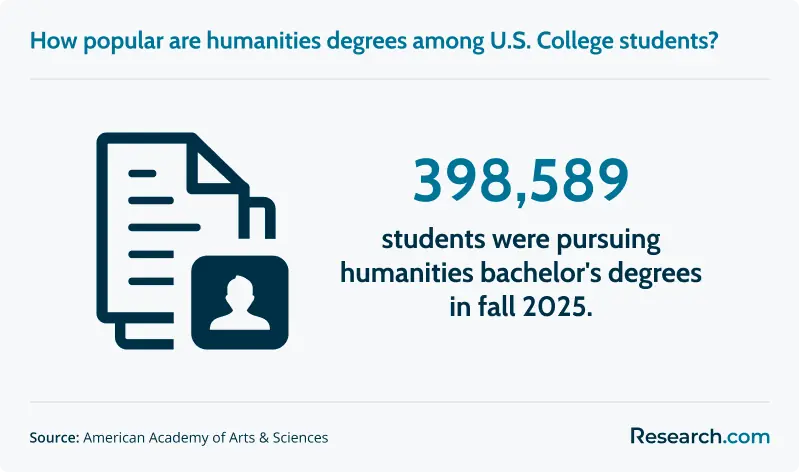
- Even amid tuition concerns, many students still pursue humanities majors in 2027. U.S. colleges conferred 164,847 bachelor's degrees in the humanities in 2025.
- Humanities graduates' salaries grow steadily as they move into leadership and specialized roles. Mid-career median wages are between $60,000 and $68,000 across disciplines.
- Employers increasingly hire based on transferable human skills. Around 69.5% of employers use skills-based hiring, and 61.0% say they are not replacing entry-level roles with artificial intelligence.
What Are the Most Popular Humanities Majors in the United States?
Although humanities are not always on the top answers for what college majors make the most money, it offers students the flexibility to pivot across industries. This is why humanities attract hundreds of thousands of learners. In 2025 alone, U.S. colleges conferred 164,847 bachelor's degrees in the humanities.
Within this field, five disciplines capture the largest share of students:
- Communication & Media Studies: With 127,279 active majors in fall 2025, this is the largest field in the humanities. Enrollees are heavily concentrated at large public research universities and master’s-level regional universities, which award 39% of all humanities degrees. Unlike purely theoretical majors, students view media studies as an immediate bridge to public relations, brand strategy, digital marketing, and corporate communications.
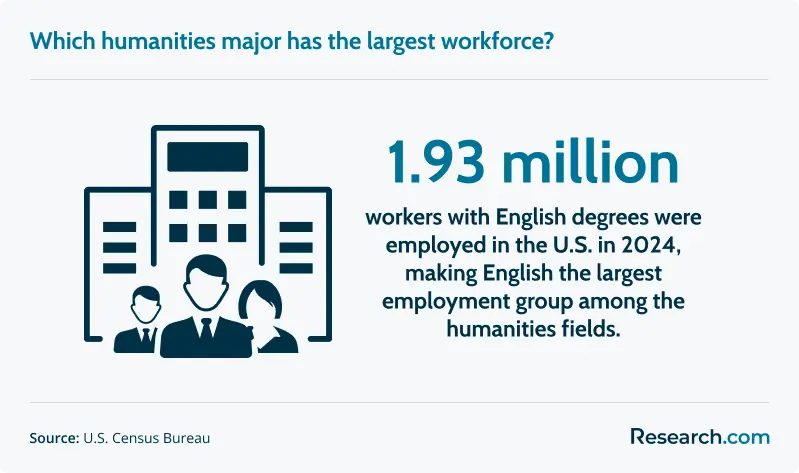
- English Language and Literature: This major is the largest traditional humanities discipline. It recorded 92,329 active first majors and 1.6 million course enrollments in 2025. Today, 1.94 million English degree holders work across the United States. Students choose this major for its broad flexibility across law, tech writing, and management.
- History: It generates over 1 million undergraduate course enrollments per term and roughly 20,000 bachelor's enrollments every year. History serves as a top feeder major for law school, intelligence agencies, and public policy roles. Interestingly, enrollment density is strongest in the Northeast and Mid-Atlantic.
- Foreign Languages: These programs generate over 900,000 undergraduate course enrollments per term, and roughly 870,640 foreign language graduates enter the U.S. labor force every year. Spanish and East Asian language tracks remain the most popular options. Students often pair foreign language majors with international business or global health. This is because bilingual skills qualify graduates for roles in multinational corporations, diplomacy, and non-governmental organizations.
- Philosophy and Religious Studies: Philosophy awarded 5,918 bachelor's degrees in 2025, up from 5,763 in 2024. Large public flagships with strong pre-law programs attract high enrollment for this major. Philosophy majors consistently achieve top scores on the LSAT and GRE exams. This test performance makes the major a premier pathway to law school and graduate programs.
Which Humanities Majors Have the Highest Starting Salaries?
While overall starting pay for humanities graduates is comparable to technical fields, it is one of the easiest online degrees that pay well right out of college. Communications, Philosophy, and Foreign Languages command the highest starting salaries among core humanities majors.
- Communications: Graduates of this major can earn around $63,767. The field's growth is driven by corporate demand in public relations, digital marketing, and brand strategy. For example, public relations specialists earn a median annual wage of $74,750, while marketing specialists and market research analysts earn a median salary of $78,760
- Philosophy: This major commands the highest starting salary among traditional humanities majors, with starting wages averaging $52,600. The degree trains students in skills directly sought by high-paying industries like management consulting, tech, finance, and law. Entry-level management consultants earn between $65,000 and $85,000 per year. Meanwhile, AI ethics and trust and safety analysts have a starting pay between $60,000 and $80,000.
- Foreign Languages: Global trade, multinational operations, and cross-border diplomacy drive demand for bilingual talent. For example, interpreters and translators earn a median annual wage of $60,170. Graduates can also transition into international business and management roles with salaries exceeding $72,000.
Do Employers Value Humanities Degrees?
Employers actively value humanities degrees because modern hiring prioritizes transferable human skills. Labor data show that companies rely heavily on the exact competencies humanities programs develop. More specifically, 69.5% of employers now rely on skills-based hiring for entry-level roles.
Employers rate communication and teamwork as the most important career-readiness skills. These competencies earn a 4.5 importance score (out of 5) in industry surveys. This is because companies can train new hires on technical software, but employees must already know how to collaborate, resolve conflicts, and persuade clients. Humanities degrees build this exact foundation as students spend four years analyzing diverse viewpoints, defending complex arguments, and translating dense information into clear messaging.
Moreover, employers do not just hire humanities graduates for entry-level work. Businesses actively elevate them into leadership roles for their strong communication skills, emotional intelligence, and problem-solving skills. In fact, the U.S. Bureau of Labor Statistics tracks over 1 million humanities degree holders working in management roles across corporate, legal, public, and creative sectors.
Rapid advances in artificial intelligence lead many people to assume employers only care about coding and technical skills in 2027. However, the Global workforce data tells a different story.
In the World Economic Forum Future of Jobs Report, analytical thinking ranks as the top core skill employers seek worldwide. Businesses can automate routine software tasks, yet companies still depend on human judgment and ethical reasoning. This workplace reality fuels strong hiring demand across three specific humanities majors.
- Communications and Media Studies: Communications graduates see strong hiring demand across advertising agencies, healthcare networks, technology firms, and financial services. Companies actively recruit these majors for roles such as public relations specialist, market research analyst, social media strategist, and corporate communications manager. Employment for market research analysts and marketing specialists is projected to grow 8% through 2033. This expansion outpaces the national average for all occupations and creates 87,800 job openings every year.
- Foreign Languages: Hospitals, courts, and government agencies employ roughly 40% of all professional interpreters and translators in the United States. The demand for this major is also driven by the persistent shortage of bilingual staff for client-facing and operational roles. report a gap in foreign language skills across their workforce.
- English Language: English graduates find strong demand in software and IT services, scientific consulting, defense contracting, and healthcare administration. Employers rely on these majors to step into roles as technical writers, user experience (UX) writers, proposal managers, and corporate content strategists. Computer systems design and scientific consulting firms employ the largest share of technical writers nationwide.
Many people assume a humanities degree leads directly to the classroom or a library. However, according to the American Academy of Arts and Sciences, fewer than 1 in 5 employed humanities graduates work in education. This means over 80% build careers outside teaching. Rather than funneling into a single profession, humanities majors disperse across the wider roles.
- Business and Finance: Corporate operations represent the largest overall destination for humanities graduates. Nearly 30% of employed humanities graduates work directly in corporate management, business, and financial operations. Companies across banking, insurance, and retail hire these majors for human resources, project management, corporate training, and client relations.
- Media: Approximately 7% of employed humanities bachelor's degree holders work in arts, design, entertainment, sports, and media occupations. English, history, and communication programs train students to structure compelling narratives and edit complex drafts. Newsrooms, book publishers, and digital media outlets rely on these exact skills every day.
- Law and Public Policy: Nearly 7% of all employed humanities degree holders work directly in legal occupations, and thousands more serve in public administration. Humanities graduates are known to excel as attorneys, legislative aides, intelligence analysts, foreign service officers, and urban policy researchers.
- Technology: Tech companies increasingly hire humanities graduates to bridge the gap between complex engineering and everyday users. Tech companies increasingly hire humanities graduates to bridge the gap between complex engineering and everyday users. Thousands more fill non-coding product roles across the tech sector.
A four-year humanities bachelor's degree in the United States costs an average of $113,396 at an in-state public university and $243,696 at a private nonprofit college. After scholarships and grant aid, average net four-year costs drop to $86,640 for in-state public students and $154,160 for private college students.
Geography heavily shapes the cost of a humanities degree. Public universities in the South and Mountain West charge the lowest baseline rates in the country. The average 2026–2027 in-state public tuition and fees are only $6,360 in Florida and $7,690 in North Carolina.
By contrast, public universities in the Northeast and Mid-Atlantic carry much steeper rates. In-state students in New Jersey pay an average of $18,710 per year in tuition and fees, and Vermont reaches $19,797.
Earning a master’s degree or a Ph.D. in the humanities generally leads to higher salaries. Advanced credentials increase long-term earning power, especially when paired with specialized non-academic career tracks.
According to 2026 labor market tracking, full-time workers with a master’s degree earn 19% more than bachelor's degree holders. That's over $300,000 in additional earnings over a 20-year career. A general humanities master's degree yields modest gains for K–12 or adjunct teaching, where median wages hover near $58,120.
Meanwhile, master's degrees in public policy, technical communication, and library and information science unlock senior management and UX research roles paying $85,000 to $110,000.
Research shows 45% of tasks in humanities-related occupations face potential automation. However, automating routine tasks does not eliminate entire careers. Artificial intelligence adoption creates demand for human oversight. In fact, roles in AI ethics and digital humanities have grown by over 30% in the past five years. Employers also increasingly rely on graduates who can audit algorithms and guide responsible technology use.
Moreover, growing corporate risks around automated systems further protect human-centric jobs. According to the Stanford HAI 2026 AI Index Report, artificial intelligence incidents jumped to 362 in 2025, from 233 the previous year. As a result, corporate AI governance roles expanded by 17% in a single year. Companies need trained ethicists, writers, and policy analysts to help prevent these costly errors.
Humanities degrees remain a worthwhile investment in today’s job market. While humanities graduates generally earn lower starting salaries than engineering or finance peers, long-term workforce data show steady mid-career wage growth.
Bachelor's degree holders in the humanities earn a median lifetime payoff of hundreds of thousands of dollars above high school graduates. Around 87% of humanities bachelor's degree holders also report overall satisfaction with their current jobs, closely matching the 90% benchmark across all college fields.
To maximize the return on a humanities degree, prospective students should follow practical strategies. Attending an in-state public university or securing institutional grant aid keeps student loan balances low and shortens the break-even timeline. Pairing a humanities major with a certificate in business, data analytics, or digital media boosts starting pay.
What Are the Long-Term Career Prospects for Humanities Graduates?
According to the Federal Reserve Bank of New York, humanities majors experience 60% to 75% wage growth between their early twenties and their mid-career. Beyond rising paychecks, humanities graduates can advance into senior management, corporate communications leadership, law partnerships, and nonprofit executive roles at rates comparable to business majors.
Technical skills often expire as software and tools evolve. By contrast, persuasive communication, ethical judgment, and strategic people management grow more valuable at every step up the corporate ladder.
Other Things You Should Know About Humanities Degree Programs & Salaries
An average bachelor's degree takes roughly 12 years to recoup its total cost. Because humanities graduates earn starting salaries roughly 20% lower than STEM or business peers, their payback period is slightly longer. Nevertheless, their lifetime earnings still yield a net return of 300% to 700% above a high school diploma.
Yes, humanities graduates currently experience higher initial underemployment than the overall college average. The underemployment rate for humanities majors frequently exceeds 53% in their first few years out of school. Meanwhile, the overall underemployment rate for recent college graduates is 42.5%.
Yes, the vast majority secure employment, even if their first role isn't directly tied to their major. Around 69.5% of employers use skills-based hiring, giving humanities grads immediate access to entry-level roles across multiple industries.
Yes. In fact, the majority of humanities graduates build successful careers in the corporate, legal, tech, and public sectors. Humanities majors make up roughly 25% of the legal profession, while over 1 million humanities graduates work in management roles.
- American Academy of Arts and Sciences. (2026, September 8). Enrollment data signal more humanities degree declines ahead. Humanities Indicators. https://www.amacad.org/news/enrollment-data-signal-more-humanities-degree-declines-ahead
- Angeles, D. (2025, September 15). Field of degree: Humanities employment and wages. U.S. Bureau of Labor Statistics, Career Outlook. bls.gov
- Carnevale, A. P., Cheah, B., & Wenzinger, E. (2025, October 15). The major payoff: Evaluating earnings and employment outcomes by college major. Georgetown University Center on Education and the Workforce. georgetown.edu
- Federal Reserve Bank of New York. (2026, November). The labor market for recent college graduates. https://www.newyorkfed.org/research/college-labor-market
- Gray, K. (2026, September 3). Starting salaries climb for the Class of 2025. National Association of Colleges and Employers. naceweb.org
- Ithaka S+R. (2026, May 11). The state of the humanities in higher education. https://sr.ithaka.org/blog/the-state-of-the-humanities-in-higher-education/
- Strada Education Foundation. (2026, November 10). 2026 state opportunity index. https://www.strada.org/state-opportunity-index
- U.S. Census Bureau. (2026). College majors and earnings growth (Center for Economic Studies Working Paper No. CES-WP-26-14). census.gov