2027 DSW Leadership Courses vs Clinical Specialization Courses: Comparing Curriculum Fit
Audited and Verified:
Our Editorial and Data Verification Process
Research.com uses government datasets, official education statistics and primary institutional information to support its career and degree guides. Our review process checks factual accuracy, occupational definitions, source dates and the requirements associated with the credentials discussed.
How This Article Was Fact-Checked
Our editorial team verifies salary estimates, employment projections, education requirements and program information against original data providers and official organizations. Salary figures are checked against the relevant occupational definitions and reporting periods. Information about licensure, accreditation and required in-person training is reviewed separately.
Fact-checked and verified on:

Co-Founder and Chief Data Scientist
A DSW leadership track and a clinical track may award the same degree while preparing students for different kinds of work. That distinction matters when you are deciding whether doctoral study will strengthen your current practice, support a move into agency leadership, or add coursework you do not need.
This comparison is for experienced social workers weighing those options. It shows how to examine course sequences, faculty, capstones, delivery, and cost, and how to separate educational benefits from licensing and salary claims, before committing to a program.
Key Things You Should Know
- Choose by the work product. Leadership courses usually emphasize organizational change, policy, budgets, and program evaluation; clinical courses emphasize advanced practice, consultation, and treatment-related evidence.
- A clinical DSW is not a license. Neither specialization replaces state-required clinical supervision, examinations where applicable, or board approval.
- Compare costs with realistic career evidence. The May 2025 median wage for mental health and substance abuse social workers was $60,280, but that occupation-wide figure does not measure a DSW salary premium.
How do DSW leadership and clinical specializations differ?
A Doctor of Social Work (DSW) is generally a practice-oriented doctorate, but its specialization name tells you less than its required courses and final project. A leadership specialization typically develops the ability to change services across teams, organizations, or systems.
A clinical specialization typically develops advanced reasoning about direct practice, supervision, and the application of evidence to client care. Both may teach ethics, research appraisal, and program evaluation.
The decisive distinction is the problem you want to solve. If you want to improve an agency's intake process across sites, leadership coursework is likely the closer fit. If you want to develop a supervised training approach for clinicians serving a particular population, clinical coursework may fit better.
Neither label guarantees a specific set of electives. Use social work program comparisons for future students to develop a shortlist, then compare the actual DSW catalogs rather than treating a broad program listing as evidence of track content.
What courses are typically required in each DSW specialization?
Course titles vary, and a program may have one common DSW curriculum rather than separate tracks. The table shows what to look for in required coursework, not a universal list of requirements. Ask for the course descriptions and sequence applicable to your intended entry term.
| Curriculum area | Leadership emphasis | Clinical emphasis |
| Practice and systems | Organizational change, service design, policy implementation | Advanced assessment, intervention models, clinical consultation |
| Management and supervision | Budgets, workforce development, governance, quality improvement | Clinical supervision, case consultation, practitioner development |
| Evidence and evaluation | Program measures, implementation, stakeholder reporting | Critical appraisal of treatment evidence, practice outcomes, implementation in care settings |
| Applied project | An agency or systems improvement question | A clinical practice, training, or service-quality question |
A clinical DSW often builds on skills acquired in an MSW and subsequent practice; it need not repeat introductory therapy courses. If your immediate gap is foundational clinical preparation rather than doctoral-level inquiry, start by planning graduate study for clinical social work instead of assuming a DSW is the appropriate first step.
What careers can leadership and clinical DSW specializations prepare graduates for?
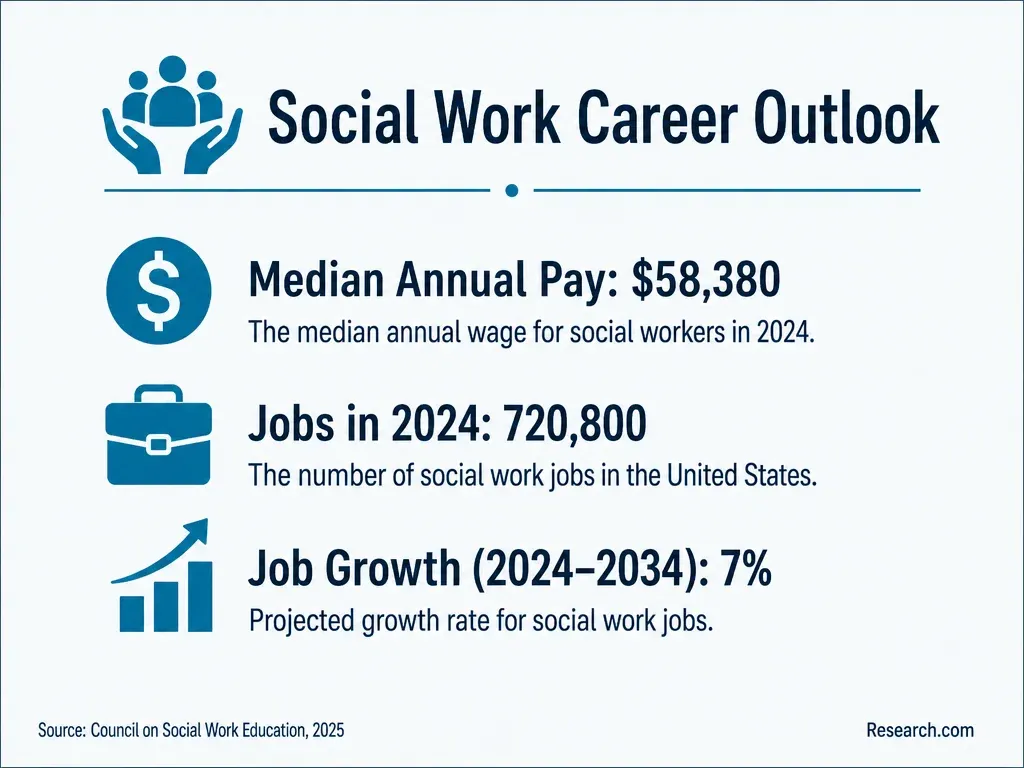
Leadership study can support experienced social workers pursuing program director, quality-improvement, policy, training, or executive responsibilities. Clinical study can support roles involving advanced practice consultation, clinical education, supervision where separately authorized, or practice improvement in behavioral health and healthcare settings.
Employers may value the doctorate, but they also assess management history, clinical competence, credentials, and experience with the population served.
For example, a clinician moving toward a behavioral health director role may need budgeting and personnel management more urgently than another advanced intervention seminar. Conversely, an independently licensed clinician who wants to train teams in evidence-informed care may benefit more from clinical consultation and implementation coursework than from executive finance.
For a broader map of roles available before doctoral study, see graduate social work career planning. A DSW is not necessarily required for either advancement path; a targeted certificate, supervised experience, or a stretch assignment may address a narrower skills gap.
Check institutional accreditation and DSW programmatic status separately. Confirm the institution's status with its recognized institutional accreditor, then search the Council on Social Work Education (CSWE) directory for the exact doctoral program and any status or cohort information it lists.
Do not infer that a university's CSWE-accredited BSW or MSW automatically extends that status to its DSW. Ask the DSW program to explain its current status in writing and what, if anything, that status means for your entry cohort.
If you are reviewing your earlier qualifications as well, social work bachelor's accreditation questions concern a different degree and should be checked independently. Finally, if a prospective employer or state board has an education requirement for a particular role, obtain its interpretation directly; a school's accreditation statement is not a licensing decision.
A clinical DSW specialization does not itself issue a social work license, expand an existing license's legal scope, or waive post-MSW supervised experience. State boards determine the qualifying degree, license category, examination and supervision requirements where applicable, and authorization for independent clinical practice. Those rules vary by jurisdiction.
Before choosing clinical coursework for a licensing goal, identify your present license and target state, then ask that state's board whether the proposed study affects any requirement. Do not count DSW case simulations, academic projects, or routine employment as board-approved supervised hours without the board's confirmation.
For an MSW applicant who has not yet established the educational route, online MSW program eligibility by intended state is the earlier question; a later DSW cannot be assumed to repair an MSW eligibility problem.
Many DSW programs seek applicants with an MSW, substantial professional experience, and a credible practice or leadership question. Some specify an active social work license, particular years of experience, or supervisory responsibilities; others do not.
Clinical tracks may expect relevant clinical practice or licensure, while leadership tracks may emphasize management experience. Verify the exact degree, license, experience, references, writing sample, and project-proposal requirements for each program rather than treating these patterns as admission rules.
Your application should connect prior work to the track's methods. An agency manager might document responsibility for a service change and identify an evaluation question; a clinician might explain the practice problem they could investigate without promising access to client records.
If you are still considering an MSW, a guide to recommendation-free MSW applications addresses a different admissions stage: an MSW program's reference policy does not predict a DSW program's requirements.
Online, hybrid, and campus DSW programs can teach either specialization through seminars, applied assignments, consultation, and faculty-supervised projects. The format matters most when a course requires live role-play, group decisions, presentations, site-based inquiry, or short campus residencies. "Online" does not establish that all activities are asynchronous or that a student can conduct an agency project remotely.
Request a sample term calendar showing live-session times, group-work expectations, travel, and project milestones. If you are balancing employment or caregiving, compare that calendar with your available hours and ask how leaves or a change of project site affect progress. Advice on online MSW scheduling for working adults can help frame scheduling questions, but an MSW's delivery pattern does not establish a DSW's flexibility.
DSW duration depends on credit requirements, course sequencing, enrollment pace, and how long the applied project takes. Schools may advertise a standard completion schedule, but project access, approvals, revisions, and leaves can change an individual timeline. Compare the published plan with the minimum and maximum completion policies for your cohort.
To estimate total cost, use the program's current per-credit or term charges and required credits, then add mandatory fees, technology, books, travel for residencies, and any continuation charges after coursework. Account for reduced work hours if project or live-class demands require them.
Ask whether employer assistance covers doctoral tuition and whether an award is guaranteed for the full program or contingent on continued eligibility. Affordable online MSW programs provide a lower-degree comparison only if an MSW, rather than a doctorate, would meet your goal; their prices should not be used to estimate DSW tuition.
There is no reliable occupation-wide "leadership DSW salary" or "clinical DSW salary" in standard federal workforce data. Titles differ across agencies, and the Bureau of Labor Statistics (BLS) categories do not isolate graduates by doctoral specialization. The closest clinical social work categories offer context, not a forecast of what the degree will earn you.
BLS reports May 2025 median annual wages of $60,280 for mental health and substance abuse social workers and $67,880 for healthcare social workers. It projects employment growth of 10% and 8%, respectively, from 2025 to 2035.
Those figures cover workers with different degrees, licenses, settings, and experience; they do not establish a DSW pay premium. Leadership positions may fall under management occupations instead, so compare actual job postings, pay bands, and qualification requirements for your target employer.
If your goal is entry into paid social work rather than advancement from established practice, investigate social work bachelor's admission doorway requirements before using doctoral salary comparisons to justify an education plan. For current MSW practitioners, the more useful calculation is the likely value of a specific promotion or role change against the DSW's total cost and time away from paid work.
How should you evaluate faculty expertise and capstone requirements before choosing a track?
Faculty fit is strongest when an available advisor has experience with your type of problem and method, not merely your preferred specialization label. For a leadership project, that could mean implementation, policy, budgeting, or program evaluation expertise.
For a clinical project, it could mean relevant population knowledge, clinical training, supervision, or practice-outcome evaluation. Ask who actually advises students, how advisors are assigned, and what happens if a faculty member becomes unavailable.
Then examine completed project descriptions and the current capstone handbook. Determine whether the deliverable is a dissertation, applied project, portfolio, or another format; what data access and agency cooperation it requires; and who decides whether research ethics review or other approval is necessary.
A feasible project can use appropriately authorized, privacy-protected information and still answer a meaningful practice question. Do not assume that employment gives you permission to use client records or publish agency findings.
If your preparation is not yet at the MSW level, comparing online MSW entry requirements is more useful than choosing a hypothetical doctoral advisor now. If you are ready for a DSW, ask each program for a sample project timeline, advisor workload expectations, and a written explanation of what support it provides when project access falls through.
Other Things You Should Know About Social Work Programs
Possibly. Ask whether cross-track electives are permitted, whether they fit the course sequence, and whether the final project can integrate both areas.
Check the positions you want. A practice-focused DSW may suit clinical or practice teaching; research-intensive faculty roles often expect a stronger original-research record, commonly developed through a PhD.
Program policies differ. Request a written review of which completed courses apply, whether an advisor is available, and whether switching changes the project or graduation schedule.
Not necessarily. Some projects use other approved partners or data sources. The program must accept the design, and any agency access, confidentiality safeguards, and required approvals must be in place before work begins.
- Requirements for holders of an LMSW seeking an LCSW | Texas Behavioral Health Executive Council https://bhec.texas.gov/texas-state-board-of-social-worker-examiners/applying-for-a-social-work-license/how-to-become-an-lcsw/requirements-for-holders-of-an-lmsw-seeking-an-lcsw/
- Accreditation in the U.S. | ed.gov http://www.ed.gov/laws-and-policy/higher-education-laws-and-policy/college-accreditation/accreditation-in-the-us
- Explore Types of Social Worker Career Paths | UMass Global https://www.umassglobal.edu/blog-news/types-of-social-workers
- Doctorate in Clinical Social Work (DSW) | Penn SP2 https://sp2.upenn.edu/programs/doctoral/doctor-of-clinical-social-work/
- Doctorate of Social Work (DSW) | Long Island University https://www.liu.edu/brooklyn/academics/school-of-health-professions/academic-programs/doctorate-of-social-work
- Accreditation | Executive Vice President and Provost https://provost.umn.edu/academic-oversight/accreditation
- Maximizing Your MSW: Career Advancement Without a Doctorate | UK College of Social Work https://socialworkonline.uky.edu/resources/article/expand-professional-practice/
- What is Social Work and What Do Social Workers Do? | buffalo.edu https://socialwork.buffalo.edu/admissions/is-social-work-right-career-for-me/what-is-social-work.html
- What Can You Do With an MSW Besides Clinical Work? | Missouri Baptist University (Mobap) https://www.mobap.edu/news/msw-career-paths-beyond-clinical-work-leadership-and-policy-roles/
- DSW Curriculum & Course Descriptions | School of Social Work https://socialwork.rutgers.edu/academics/doctor-social-work-dsw/dsw-curriculum-course-descriptions