2027 Return on Investment (ROI) of a Humanities Degree Program
Audited and Verified:
Our Editorial and Data Verification Process
Research.com uses government datasets, official education statistics and primary institutional information to support its career and degree guides. Our review process checks factual accuracy, occupational definitions, source dates and the requirements associated with the credentials discussed.
How This Article Was Fact-Checked
Our editorial team verifies salary estimates, employment projections, education requirements and program information against original data providers and official organizations. Salary figures are checked against the relevant occupational definitions and reporting periods. Information about licensure, accreditation and required in-person training is reviewed separately.
Fact-checked and verified on:

Co-Founder and Chief Data Scientist
Evaluating the return on investment (ROI) of a humanities degree involves looking beyond tuition costs and considering the long-term financial and professional benefits. While earnings may vary depending on the career path, a humanities education can develop valuable skills in communication, critical thinking, research, and problem-solving that employers across industries seek.
In this guide, we will explore the return on investment (ROI) of a humanities degree by examining its costs, potential earning opportunities, career prospects, and long-term professional benefits.
Key Things to Know About Humanities Degree ROI
- Humanities graduates in selected fields earn median annual salaries ranging from $50,000 to $68,000, depending on their area of study.
- Approximately 4.1 million U.S. workers hold degrees in selected humanities disciplines, demonstrating their presence across various professional fields.
- Management occupations are projected to grow by 6.2% from 2025 to 2035, offering potential advancement opportunities for humanities graduates with relevant experience and qualifications.
How Much Does a Humanities Degree Cost?
The cost of earning a humanities degree depends on the institution, degree level, and location of the college or university. In the United States, humanities programs generally follow the same tuition structure as other undergraduate programs, meaning students typically pay based on whether they attend a public or private institution rather than their chosen major.
According to our research, the average annual tuition and fees for the 2026–2027 academic year are approximately $12,290 at public four-year colleges for in-state students, $32,730 for out-of-state students, and $46,350 at private nonprofit four-year institutions.
However, tuition is only one part of the overall investment in a humanities degree. Students must also account for additional expenses such as housing, meals, textbooks, transportation, technology, and other academic fees. The College Board estimates that the average annual cost of attendance, including these expenses, reaches approximately $32,030 for in-state students at public four-year institutions and $67,610 at private nonprofit four-year colleges.
Evaluating the cost of a humanities degree alongside its potential earning opportunities helps students determine whether the investment aligns with their financial and career goals. Comparing these costs with other educational pathways, such as accredited online MBA programs, can also provide perspective on the financial commitments and potential returns of different degree options.
What Is the Average Salary of Humanities Graduates?
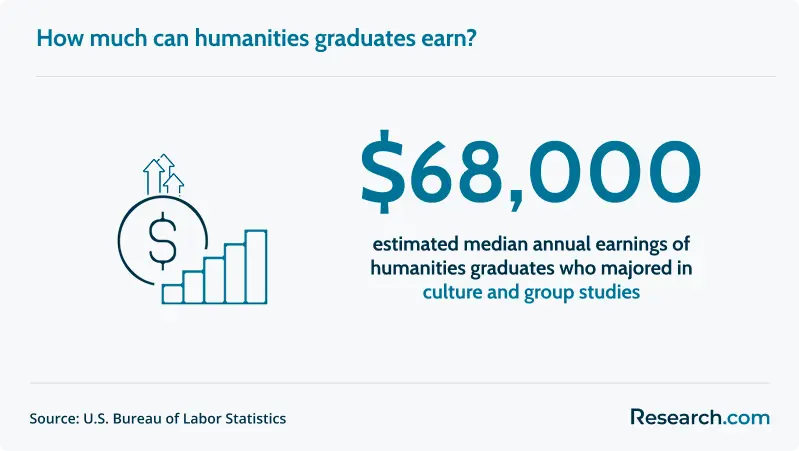
The earning potential of humanities graduates varies depending on their major, occupation, level of education, and work experience. According to the U.S. Bureau of Labor Statistics (2025), median annual wages for workers with bachelor's or higher degrees in selected humanities fields ranged from $50,000 to $68,000 in 2023.
Culture and group studies graduates had the highest median earnings at $68,000, followed by foreign language graduates at $66,000, philosophy and religion graduates at $65,000, English graduates at $60,000, and theology graduates at $50,000. These figures provide a general picture of the earning potential across different humanities disciplines.
However, these figures should not be treated as guaranteed starting salaries, as they represent median annual earnings among employed workers with bachelor's or higher degrees in the respective fields. Actual salaries can differ based on career choice, geographic location, industry, and additional qualifications. For example, humanities graduates who pursue careers in management, communications, publishing, education, or other specialized fields may experience different earning trajectories.
`
How Long Does It Take to Recover the Cost of a Humanities Degree?
The time it takes to recover the cost of a humanities degree depends on several financial and career-related factors, including tuition expenses, starting salary, and employment opportunities. While some graduates may recoup their educational investment within a few years, others may need more time depending on their chosen career path and financial circumstances.
- Total Education Costs: Graduates who attend affordable public universities or receive scholarships may recover their educational expenses faster than those who pay higher tuition at private institutions.
- Starting Salary: Humanities graduates who secure well-paying entry-level positions may be able to repay student loans and offset their education costs sooner.
- Career Advancement: Opportunities for promotions, leadership positions, and salary increases can help graduates recover their initial educational investment over time.
- Student Loan Debt: Graduates with substantial student loans may take longer to achieve a positive financial return because of interest payments and monthly repayment obligations.
- Employment Opportunities: Graduates who find stable employment soon after completing their degrees can begin earning income earlier and recover their education expenses more quickly.
- Additional Qualifications: Professional certifications, graduate degrees, and specialized training may improve earning potential, although these investments can also increase overall education costs.
For graduates looking to improve their earning potential while managing education costs, programs such as a fast track social work degree online offer flexible pathways to career advancement. Comparing online and on-campus degree options can help students identify programs that balance affordability, completion time, and future income potential.
Although humanities degrees are often associated with careers in education, writing, and the arts, some majors can lead to higher-paying professional opportunities. Earning potential depends on the graduate's career path, industry, experience, and additional qualifications, but the following humanities majors offer promising financial prospects:
- Philosophy: Philosophy graduates develop strong analytical, logical reasoning, and problem-solving skills that can translate into careers in law, business, consulting, and management.
- Economics: Although often classified as a social science, economics is closely related to the humanities and can lead to lucrative careers in finance, policy analysis, research, and consulting.
- Political Science: Graduates can pursue careers in government, public policy, international relations, and political consulting, with opportunities for advancement into leadership positions.
- International Relations: This major can lead to careers in diplomacy, international development, government, and global organizations, particularly for graduates with advanced qualifications.
- Communications: This major prepares students for careers in public relations, corporate communications, marketing, and media management, where specialized experience can increase earning potential.
- English: English graduates can pursue careers in technical writing, content strategy, publishing, editing, and communications, particularly in industries that value strong writing skills.
- History: History graduates can apply their research and analytical abilities to careers in law, education, public administration, archival management, and research.
- Foreign Languages: Proficiency in multiple languages can open opportunities in international business, translation, diplomacy, localization, and global communications.
Humanities graduates can find employment across various industries because their education develops transferable skills such as communication, critical thinking, research, creativity, and problem-solving. These abilities are valuable in both traditional humanities-related careers and professional fields, including the following:
- Education: Schools, colleges, and universities hire humanities graduates as teachers, academic researchers, curriculum developers, and educational administrators.
- Media and Publishing: Publishing houses, news organizations, and media companies employ graduates as writers, editors, journalists, content creators, and communications specialists.
- Business and Corporate Services: Companies value humanities graduates for roles in human resources, corporate communications, marketing, public relations, and business development.
- Government and Public Administration: Government agencies hire humanities graduates for policy research, public affairs, administrative services, cultural programs, and community development.
- Law and Legal Services: Humanities graduates, particularly those with backgrounds in philosophy, history, and political science, can pursue legal careers after completing the required legal education and qualifications.
- Arts and Culture: Museums, galleries, cultural institutions, and nonprofit organizations employ graduates in curatorial work, archival management, cultural preservation, and arts administration.
- Technology: Technology companies hire humanities graduates for content design, technical writing, user experience research, content strategy, and other roles that require understanding human behavior and communication.
- International Organizations: Nonprofits, development agencies, and international institutions recruit humanities graduates for research, advocacy, translation, diplomacy-related work, and humanitarian programs.
Humanities graduates looking to expand their career opportunities may consider further education, such as an online masters in psychology, to qualify for specialized roles across different industries. Exploring advanced degree options can help graduates identify additional career paths and determine which qualifications best align with their professional interests and long-term goals.
A humanities degree equips students with transferable skills that are valuable across various industries and professions. Through studying subjects such as literature, history, philosophy, and languages, graduates develop abilities that help them adapt to different workplace demands and pursue diverse career opportunities, including the following:
- Critical Thinking: Humanities students learn to evaluate information, analyze complex issues, and develop logical conclusions, making these skills useful in research, business analysis, law, and management.
- Communication Skills: Reading, writing, and presenting ideas help graduates communicate effectively, preparing them for careers in journalism, public relations, marketing, education, and corporate communications.
- Research and Analytical Skills: Conducting research and interpreting information prepares graduates for roles in policy development, market research, academic research, and consulting.
- Problem-Solving: Humanities programs encourage students to examine different perspectives and develop thoughtful solutions, which can benefit careers in administration, business operations, and project management.
- Cultural Awareness: Studying different societies, histories, and traditions helps graduates understand diverse perspectives, making them valuable in international relations, human resources, diplomacy, and global business.
- Creativity and Adaptability: Exposure to different ideas and interpretations strengthens creative thinking and adaptability, which are important in media, advertising, content development, and other evolving industries.
- Ethical Reasoning: Humanities graduates learn to evaluate moral questions and consider the broader consequences of decisions, preparing them for responsibilities in public service, law, organizational leadership, and nonprofit management.
- Collaboration and Interpersonal Skills: Group discussions, presentations, and collaborative projects help students develop teamwork and relationship-building abilities that are essential in leadership, education, customer relations, and organizational roles.
Yes, a humanities degree can offer good long-term career growth, particularly for graduates who apply their transferable skills to industries with opportunities for professional advancement. According to the U.S. Bureau of Labor Statistics (2025), approximately 4.1 million workers in the United States held degrees in selected humanities fields, including English, foreign languages, philosophy and religion, theology, and culture and group studies.
Their median annual earnings ranged from $50,000 to $68,000 in 2023. These figures demonstrate that humanities graduates can establish careers across different professional fields, although earning potential varies by occupation and experience. Humanities graduates can move into management, communications, education, research, public administration, and other specialized positions as they gain professional experience or obtain additional qualifications. For example, BLS projections show that management occupations are expected to grow by 6.2% between 2025 and 2035, with a median annual wage of $126,520 in 2025.
Students looking to maximize career growth while managing education expenses can explore cost-effective learning pathways. Enrolling in affordable online bachelor degree programs can help reduce educational costs while providing opportunities to develop skills and qualifications that support long-term professional advancement.
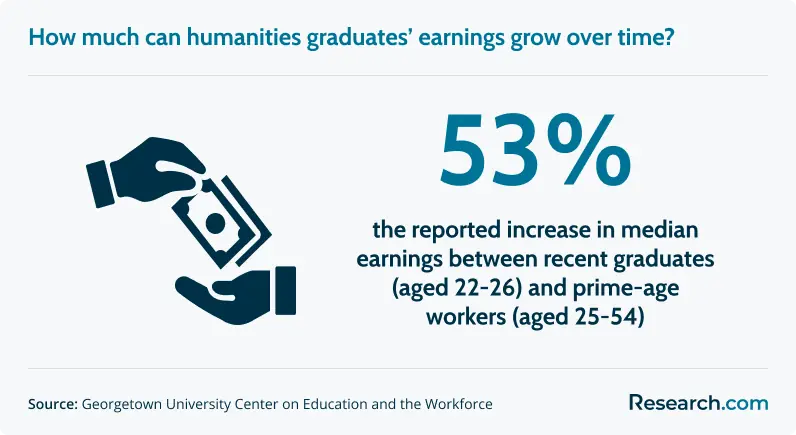
When comparing the return on investment (ROI) of humanities, STEM, and business degrees, STEM and business programs generally offer higher earning potential. According to the U.S. Census Bureau data analyzed by Georgetown University's Center on Education and the Workforce (2025), median annual earnings for bachelor's degree holders aged 25 to 54 were $98,000 for STEM graduates, $86,000 for business and communications graduates, and $69,000 for humanities and arts graduates.
These figures suggest that STEM and business degrees may provide stronger financial returns in terms of earnings, although actual outcomes vary depending on the specific major and career path.
While STEM and business graduates may have an advantage in certain high-paying technical and corporate positions, humanities graduates can improve their earning potential through professional experience, advanced education, and specialized training. Therefore, students should consider tuition expenses, career opportunities, and long-term advancement prospects rather than evaluating ROI based on salary alone.
Yes, pursuing graduate studies or professional certifications can improve the return on investment (ROI) of a humanities degree by helping graduates develop specialized expertise, qualify for advanced positions, and increase their earning potential. Additional qualifications can also make candidates more competitive in industries that require specific technical or professional skills. Some options worth considering include:
- Master's Degrees: Pursuing a master's degree in fields such as education, communications, public administration, or business can help humanities graduates qualify for specialized roles and leadership positions. Data from the Institute for Fiscal Studies also indicates that applied master's degrees (such as an MBA or advanced degrees in economics and public policy), in particular, can bring wage premiums of up to 15%.
- Law Degrees: Humanities graduates with backgrounds in philosophy, history, or political science can pursue legal education to access careers in law, corporate compliance, and legal consulting. According to data from Foundation for Research on Equal Opportunity (FREOPP), more than 86% of graduates of professional/doctoral programs benefit from a positive net ROI.
- Teaching Certifications: Obtaining professional teaching credentials can help graduates qualify for educational positions, improve their career prospects, and pursue advancement in academic institutions.
- Project Management Certifications: Credentials such as the Project Management Professional (PMP) certification can strengthen organizational and leadership skills, opening opportunities in project coordination and management. Data from College Scorecard also verifies that post-graduate credentials in fields like project management and data analytics can help humanities graduates earn an average of more than $70,000 annually.
- Human Resources Certifications: Professional credentials in human resource management can help graduates pursue careers in recruitment, employee relations, talent development, and organizational management.
- Digital Marketing Certifications: Certifications in search engine optimization (SEO), social media marketing, and content strategy can help humanities graduates qualify for specialized roles in advertising, marketing, and digital communications.
- Graduate Certificates: Shorter postgraduate programs allow graduates to develop expertise in specific areas without committing to a full master's degree, potentially offering a more affordable way to improve their qualifications.
Humanities graduates can also consider pursuing an associates degree in a specialized field to develop additional skills and expand their career options. Combining a humanities background with further education or professional training can help graduates qualify for in-demand roles and improve their long-term earning potential.
What Factors Should Students Consider When Evaluating the ROI of a Humanities Degree?
Evaluating the return on investment (ROI) of a humanities degree requires looking beyond tuition expenses and potential salaries. Students should consider how their educational investment aligns with their career goals, financial circumstances, and long-term professional opportunities. The following factors can help them make a more informed decision:
- Tuition and Education Costs: Students should compare tuition fees, academic expenses, and other costs associated with completing a humanities degree to understand their total financial investment.
- Location and Cost of Living: Employment opportunities and salary levels vary by location, so students should consider regional job markets and living expenses when estimating their potential financial returns
- Potential Earning Opportunities: Researching average salaries across different humanities-related careers can help students estimate their potential earnings after graduation.
- Employment Prospects: Students should examine job availability, industry demand, and employment trends to determine whether their chosen major offers promising career opportunities.
- Career Advancement Opportunities: Evaluating the potential for promotions, leadership positions, and professional development can help students understand the long-term financial benefits of their degree.
- Student Loans and Financial Aid: Scholarships, grants, and manageable student loan obligations can significantly influence the overall cost of education and the time needed to recover expenses. The latest data from the College Scorecard of the U.S. Department of Education, humanities majors face a median debt of $21,000 (Philosophy majors) to $24,000 (Liberal Arts and Humanities majors).
- Transferable Skills: Students should consider how skills in communication, critical thinking, research, and problem-solving can provide access to employment opportunities across different industries.
- Additional Education and Certifications: Graduate studies, professional certifications, and specialized training can improve qualifications and earning potential, but they may also increase overall education costs.
Students should also expect some challenges upon graduation, such as the slightly higher unemployment rate for recent college graduates (5.6% in 2026, according to the Federal Reserve) and potentially lower entry-level salaries. However, earnings in humanities careers potentially grow over time, with data from the American Academy of Arts & Sciences showing that humanities majors aged 49 to 60 with an advanced degree can earn a median salary of up to $91,000.
Other Things You Should Know About Humanities Degrees
Yes, a humanities degree can be worth the investment for students interested in careers that value communication, critical thinking, research, and problem-solving skills. Although salaries vary by major and profession, graduates can pursue opportunities across education, business, media, government, and other industries.
Yes, some humanities graduates can earn six-figure salaries, particularly those who advance into management, law, consulting, and other specialized professions. However, reaching this income level typically depends on work experience, additional qualifications, industry, and career progression.
Humanities graduates can improve their earning potential by gaining relevant work experience, pursuing graduate studies, obtaining professional certifications, and developing specialized skills. Building professional networks and exploring opportunities in higher-paying industries can also support career advancement and long-term financial growth.
- Angeles, D. (2025, September). Field of degree: Humanities employment and wages. U.S. Bureau of Labor Statistics. https://www.bls.gov/careeroutlook/2025/data-on-display/field-of-degree-humanities-employment-and-wages.htm
- Georgetown University Center on Education and the Workforce. (2025). The major payoff: Evaluating earnings and employment outcomes across bachelor's degrees. https://cew.georgetown.edu/cew-reports/major-payoff/
- The College Board. (2026). Trends in college pricing: Highlights. https://research.collegeboard.org/trends/college-pricing/highlights
- U.S. Bureau of Labor Statistics. (2026). Occupational projections and worker characteristics. https://www.bls.gov/emp/tables/occupational-projections-and-characteristics.htm
- Federal Reserve Bank of New York. (2026). The Labor Market for Recent College Graduates https://www.newyorkfed.org/research/college-labor-market
- American Academy of Arts & Sciences (Humanities Indicators). (2026). Effect of Experience on the Earnings of College Majors. https://www.amacad.org/humanities-indicators/workforce/effect-experience-earnings-college-majors