2027 Military-Friendly Online Humanities Degree Programs: Benefits, Accreditation, and Career Outcomes
Audited and Verified:
Our Editorial and Data Verification Process
Research.com uses government datasets, official education statistics and primary institutional information to support its career and degree guides. Our review process checks factual accuracy, occupational definitions, source dates and the requirements associated with the credentials discussed.
How This Article Was Fact-Checked
Our editorial team verifies salary estimates, employment projections, education requirements and program information against original data providers and official organizations. Salary figures are checked against the relevant occupational definitions and reporting periods. Information about licensure, accreditation and required in-person training is reviewed separately.
Fact-checked and verified on:

Co-Founder and Chief Data Scientist
For active-duty members, reservists, and veterans, looking for military-friendly online humanities degree programs requires extra steps. On top of choosing a concentration and keeping track of deadlines, service members may also need to check veteran benefits and ask about military credit transfer. This bloats the process and prevents prospective students from finding the best college that maximizes their service experience and helps them develop skills for civilian employment or higher-rank positions.
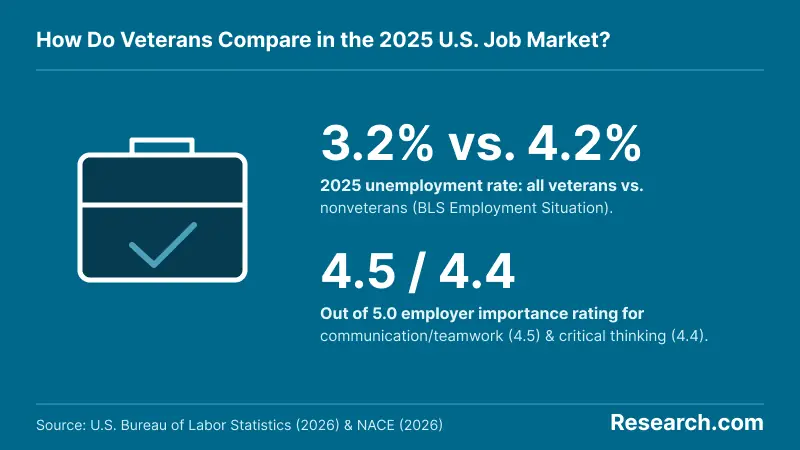
With US veteran unemployment at 3.2% in 2025, getting through this process can make a significant difference. As such, this article dives into what you need to look for, why it’s essential for military-friendly online degrees, and how you can choose a college based on these factors.
Key Things You Should Know
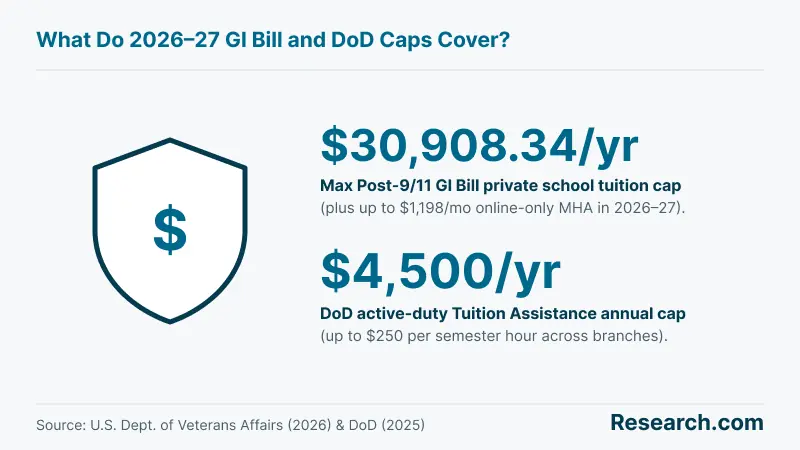
- The Post-9/11 GI Bill can cover up to 100% of public in-state tuition and up to $30,908.34 in private tuition.
- The DoD Tuition Assistance (TA) can cover up to $250 per credit.
- Active-duty members and veterans can earn more than $90,000 as a technical writer with the potential to earn more through corporate positions and career ladders.
How do military-friendly online humanities degree programs work?
The distinction between military-friendly online humanities degree programs and the typical online college lies in their awareness of the unique challenges attributed to being in the service. Participating institutions sign the DoD Voluntary Education Partnership Memorandum of Understanding (MOU). Though a mouthful, all it means is that partner institutions agree to provide transparent information on costs and requirements, offer support services, and maintain accreditation standards. So far, partner institutions number more than 2,500 and can be found in all 50 states.
Typically, any degree in an online college provides more flexibility compared to their in-person counterparts. Military-friendly online institutions take this a step further for service members. Benefits can include:
- Accelerated 6- to 8-week terms, such as accelerated associate degrees and bachelor’s completion tracks
- Readmission protections for unavoidable deployments
- Acceptance of military credit transfers
- Protections for students using Tuition Assistance
What tuition benefits and housing allowances apply to military humanities students?
Prospective students—whether in-service, veterans, or their spouses—fund a GI Bill online humanities degree through various federal programs:
- Post-9/11 GI Bill Rates: Effective from August 1, 2026 to July 31, 2027, qualifying veterans with at least 36 months of service, active-duty members who received a Purple Heart, and veterans with at least 30 days of continuous service before being discharged for service-related disability are eligible for 100% of public in-state tuition or a maximum of $30,908.34 in private institutions. The Department of Veterans Affairs also published specific covered rates for foreign institutions, non-degree programs, and flight training, among others.
- Monthly Housing Allowance (MHA): Despite offering full benefits to in-person students, full-time online-only students pursuing programs, like the cheapest psychology degree online, receive a percentage of the MHA up to $1,198 monthly. If, for example, you enroll in at least one class in person, you may receive a higher MHA rate.
- DoD Tuition Assistance: Active-duty members qualify for this tuition benefit that offers $250 per credit or $4,500 per fiscal year. Spouses can also request up to $4,000 tuition subsidy.
What are the career outcomes and salaries for military humanities graduates?
Prospective students in military-friendly online humanities programs benefit from the experiences and skills they learn and apply in the field. As a result, military humanities career outcomes shine in fields that require leadership, communication, compliance, and ethics, to name a few.
These curricula build on the knowledge you gain from writing never-ending reports, surveying areas, and training your teams. It makes you versatile and adaptable, allowing you to pursue various careers or further study in more specialized areas, such as online counseling degrees.
Career options for graduates of military-friendly humanities degrees include:
- Training & Development Specialists ($69,280/year)
- Public Relations Specialists ($74,750)
- HR Specialists ($75,940)
- Compliance Officers ($80,730)
- Technical Writers ($90,390)
Accreditation is, perhaps, the single most important thing you need to verify before choosing a college and program. You are eligible for tuition benefits and housing allowance only if you choose an accredited online humanities degree for military learners.
What track you choose—whether it’s a history degree or a prep course for an online SLP program—matters less than the recognition and accreditation of the US Department of Education (USDE). Failure to verify this factor can result in you sacrificing your GI Bill eligibility. It can also jeopardize future education plans, as the credits you earn might not be transferable to most other colleges.
For online humanities degrees, you need to look for institutional accreditation from an agency recognized by the USDE or the Council for Higher Education Accreditation. Ideally, look for regional accreditations, such as the Middle States Commission on Higher Education or the Northwest Commission on Colleges and Universities, which protect credit transfers.
Military-friendly online humanities programs strive to help you translate your military career into skills that can help you thrive in civilian environments. If you excel in writing reports that detail situations and responses, you already have an advantage in careers like technical or professional writing. If you have a knack for keeping order in your barracks or ensuring that your squad is aligned with regulations, then you may be a stand-out candidate for compliance roles.
The benefits of your experience are well-recorded. The BLS, for example, reports a 3.2% unemployment rate for veterans compared to the 4.2% nonveteran rate. Moreover, skills like communication, teamwork, and critical thinking are the most important career readiness skills, according to participating employers in NACE’s 2026 Job Outlook report. That it happens to be skills that you develop while in service is a benefit that you can leverage.
Considering the risk of losing your or your spouse’s benefits, choosing military-friendly online humanities degree programs to apply for requires you to look beyond the marketing copy and the initial details. This means:
- Beyond the program’s required credits, are military credits transferable?
- Beyond funding options, do they participate in the Yellow Ribbon Program?
- Beyond tuition per credit, does it fit in the maximum amount offered by the GI Bill and the DoD tuition assistance?
- Beyond the schedule of classes, do they secure your readmission in case of deployments?
- Is the program accredited?
In the same way that experienced educators take the time to evaluate fully funded EDD programs online, you need to be meticulous about your humanities degree options. See if the admissions office offers support to active-duty members or veterans and request assistance if it’s available.
Request a Joint Services Transcript (JST) to include in your program application. For Air Force or Space Force personnel, you will have to request the document from the Community College of the Air Force (CCAF). This document carries the bulk of the work on translating your military experience and skills into civilian terms. It also details the recommended credits for each of your military schooling and work history. Common factors that translate well into an online humanities degree include leadership from boot camps and seminars, career field experience, and college-level exams like language scores and CLEP.
How should you choose a military-friendly online humanities program?
Choose military-friendly online humanities degree programs to apply for with the intention of maximizing your benefits. Be patient with the extra steps required of you to ensure that college is more of an opportunity and less a financial burden. Remember: accreditation, credit transfers, and tuition — these factors take priority. Though, of course, it’ll be for nothing if you miss your deadlines. As such: check, then double-check.
Frequently Asked Questions (FAQs)
Yes, as long as you’re on active duty or in the Selected Reserve, completed at least six years of service, commit to four more, and your dependent is enrolled in the Defense Enrollment Eligibility Reporting System.
No. Under the IRS Publication 970 (2025), VA benefits and housing allowances are tax-free.
Yes, National Guard and Reserve members qualify for up to 36 months of education benefits under the Montgomery GI Bill Selected Reserve program.
Depends on when your service ended. If it was before January 1, 2013, your benefits expire 15 years after your separation date. If it ended on or after January 1, 2013, your benefits won’t expire courtesy of the Forever GI Bill - Harry W. Colmery Veterans Educational Assistance Act.
- American Association of Colleges and Universities (AACU). (2025). Findings Show Clear Alignment Between Liberal Education Outcomes and Evolving Workforce Needs. Press Release. AACU.
- Bureau of Labor Statistics (BLS). (2026a). Employment Situation of Veterans Summary. Economic News Release. BLS.
- Bureau of Labor Statistics (BLS). (2026b). Occupational Outlook Handbook. Publications. BLS.
- National Association of Colleges + Employers (NACE). (2026b). 2026 Job Outlook: Spring Update. NACE.
- Internal Revenue Service (IRS). (2025). Publication 970 (2025), Tax Benefits for Education. Publications. IRS.
- US Department of Veterans Affairs (VA). (2026a). Montgomery GI Bill Selected Reserve (MGIB-SR). Education and training. VA.
- US Department of Veterans Affairs (VA). (2026b). Post-9/11 GI Bill rates. Education and training. VA.
- US Department of Veterans Affairs (VA). (2026c). Post-9/11 GI Bill (Chapter 33). Education and training. VA.
- US Department of Veterans Affairs (VA). (2026d). Transfer your Post-9/11 GI Bill benefits. Education and training. VA.