2027 How Fast Can You Get a Humanities Degree Online?
Audited and Verified:
Our Editorial and Data Verification Process
Research.com uses government datasets, official education statistics and primary institutional information to support its career and degree guides. Our review process checks factual accuracy, occupational definitions, source dates and the requirements associated with the credentials discussed.
How This Article Was Fact-Checked
Our editorial team verifies salary estimates, employment projections, education requirements and program information against original data providers and official organizations. Salary figures are checked against the relevant occupational definitions and reporting periods. Information about licensure, accreditation and required in-person training is reviewed separately.
Fact-checked and verified on:

Co-Founder and Chief Data Scientist
Juggling a full-time job with your studies can be difficult. But just how quickly can you earn a humanities degree online and still keep your career on track? Online degree programs provide a level of flexibility to accommodate busy schedules. Accelerated online degree programs may even enable you to complete your degree faster. But several factors impact how long it takes to graduate, including transfer credits, the pace at which you take classes, and whether you take time off between terms.
According to the National Student Clearinghouse Research Center’s 2026 report, the median time to graduate for those earning bachelor's degrees in liberal arts and sciences, general studies, and humanities was 4.7 years, and 3.7 years for those earning a bachelor’s degree overall. The data reflects the 2024-25 academic year and is one of the reasons why it’s important to consider the time it may take to complete your program.
This guide explores how long it typically takes to earn a humanities degree, which online degrees offer accelerated paths, whether you can use transfer credits, and how you can make progress toward your degree while working full-time.
Key Things You Should Know About Accelerated Humanities Degree Online
- A bachelor’s degree in the humanities will typically take four years to complete, though some allow students to graduate in three years or even less if they have transfer credits.
- Accelerated online programs usually offer shorter terms, year-round enrollment, or degree-completion programs to help students graduate as quickly as possible.
- Competency-based education, transfer credits, and prior learning assessments can help you cut down the time it takes to complete a degree by allowing you to prove that you already have knowledge.
How long does it take to earn a humanities degree online?
On average, it usually takes four years to complete an online bachelor's degree in humanities. However, some universities offer shorter completion pathways for transfer students or learners who can follow accelerated schedules. The number of credits already attained, enrollment pace, and course availability will also influence how long it takes to graduate.
For example, Georgetown University reports an average completion time of three years for its online Bachelor of Arts in Liberal Studies. California State University, Fullerton also offers a three-year pathway through its online humanities and social sciences program. Other universities follow timelines closer to the traditional four-year bachelor's degree.
The following table compares five online humanities and related liberal arts programs.
| University | Online Degree Program | Required Credits | Completion Time |
| Georgetown University | BA in Liberal Studies | 120 | 3 years |
| California State University, Fullerton | BA in Humanities and Social Sciences | 120 | 3 years |
| Antioch University | BA in Liberal Studies | 120 | 36 months |
| University of Missouri–Kansas City | BA in English | 120 | 3–4 years |
| New England College | BA in Humanities | 120 | 4 years |
What factors affect how quickly you can earn a humanities degree online?
Several factors determine how long students need to complete an online humanities degree. Although most bachelor's programs require around 120 credits, students may graduate sooner or later depending on their academic history, course load, and program structure.
- Transfer credits: Credits can often be transferred from previous college study to reduce the total number of credits that must be obtained for a degree.
- Enrollment status: Typically, full-time students will progress faster than part-time students as they can complete more college credits in a year.
- Course load: Students can often finish a degree faster if they undertake additional courses, as long as they continue to fulfill course criteria.
- Course schedules: Programs offering shorter terms, multiple start dates, and summer classes may allow students to complete requirements throughout the year.
- Program requirements: Some humanities degrees also require electives, research, an internship, or a capstone. These can impact the length of graduation timelines.
- Personal commitments: Students’ work, family, and other personal factors may affect the number of courses they can study in one term.
Students should also consider their long-term career goals when selecting a program. Comparing the most useful college degrees can help prospective students evaluate different majors based on their interests, academic strengths, and potential career opportunities.
Are there accelerated online humanities degree programs?
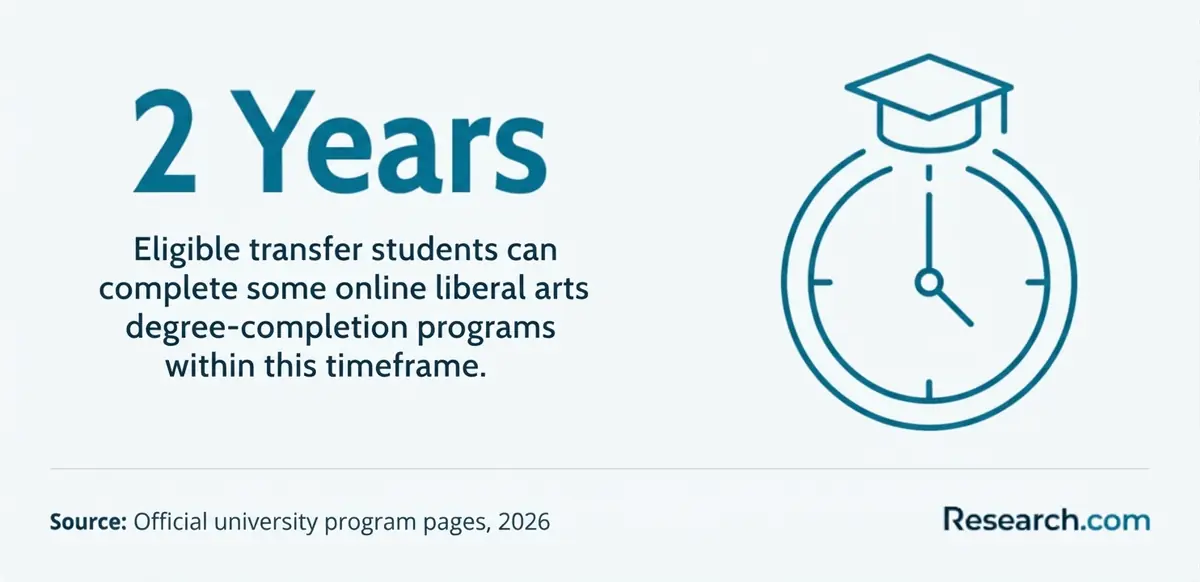
Yes. Certain universities offer accelerated programs online in the humanities or other liberal arts through shorter terms, year-round enrollment, or a degree completion program. All of these options can shorten the time it takes you to earn your degree in comparison to the typical four-year model. How fast you actually complete your degree depends on a variety of factors, including how many transfer credits you take, the availability of the courses you need, and the number of courses you take per term.
Some universities employ these strategies through shorter courses or degree completion programs that are more flexible. Of course, that doesn't mean that all of these programs will guarantee that you can finish your degree in a shorter time than you might otherwise.
| University | Online humanities or liberal arts program | Accelerated format or completion option |
| University of Rhode Island | BA in Interdisciplinary Studies | Fully online, seven-week courses; degree-completion pathway for students with prior college credits. |
| Montclair State University | BA in Liberal Studies | Seven-week online courses; Those who have 60+ credits can complete their degree in 18 months or less. |
| National University | Online humanities and arts degrees | Fast-track four- and eight-week online programmes. |
| University of Arizona Global Campus | BA in Applied Liberal Arts | Online courses run in five-week sessions, with one course taken at a time. |
| University of Maine at Presque Isle | YourPace BA in Liberal Studies | Competency-based online format with eight-week sessions and flexible progress. |
| California State University, Fresno | BA in Liberal Arts | Online degree-completion pathway; Can be completed in one to two years. |
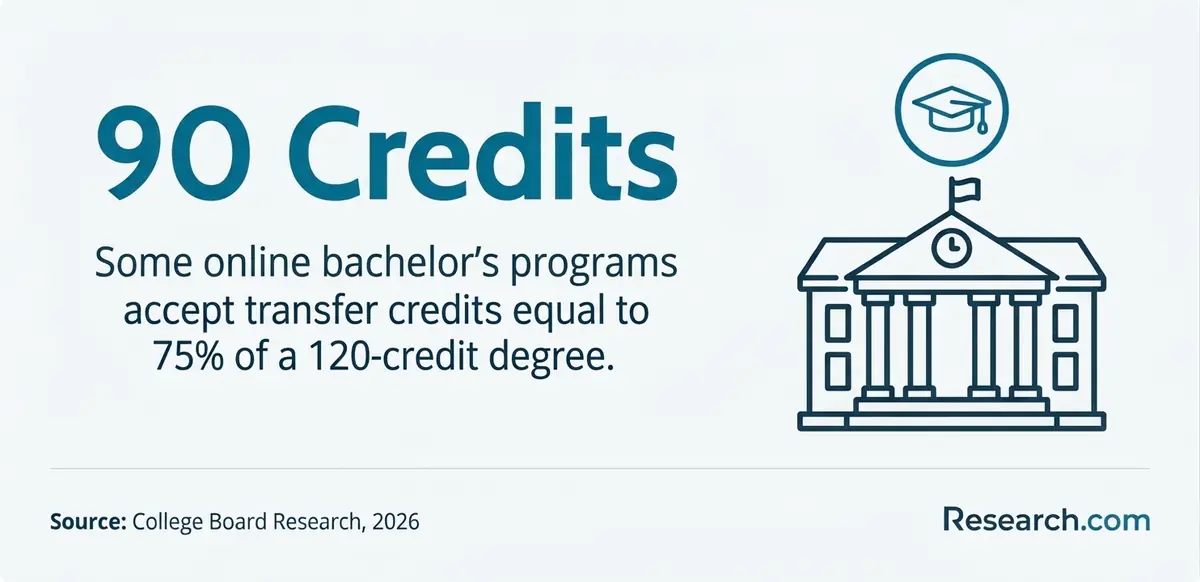
| Regis University | BA in Liberal Arts | Five-, seven-, and eight-week online format; Transferable credits are accepted up to 90. |
| California State University, Fullerton | BA in Humanities and Social Sciences | Online degree completion program. Eight-week modules and three-year duration. |
As you can see from the examples above, it is not always possible to finish an entire undergraduate degree in a year or two. In some cases, a program might have shortened the course duration, while in other cases, the program has decreased the time needed by allowing students to transfer in credits.
Students must find out what requirements are in place at the college they plan to attend, including the transfer credits that are allowed and the number of courses that must be taken, before making any decisions about advertised program completion times.
Students can graduate quicker in certain areas of study by utilizing a competency-based education (CBE). Students are then able to learn and move forward at an individual rate that is suited to their current level of understanding. This can prove especially suitable for those who have experience of both academic and non-academic environments.
Despite these advantages, a student still needs to achieve an appropriate number of credits and successfully undertake assessments in order to formally show that they have learned. Universities may also set criteria around the length of time that students are expected to be on a course, as well as when assessments need to take place.
Students should analyze whether a course's format, teaching, and expectations correlate to both their educational and career aspirations. Reviewing alternative pathways, including bachelor degrees that pay well, can also help students consider how a humanities degree fits into their broader education and career plans.
Transfer credits and prior learning assessments can reduce the number of courses students need to complete for an online humanities degree. Universities may accept eligible credits from previously attended colleges, recognized examinations, military training, or professional learning. However, acceptance depends on institutional policies, course equivalencies, accreditation requirements, and how closely previous learning matches the degree's requirements.
Students should request a transfer credit evaluation before enrolling to understand which requirements remain. They should also check whether professional certifications or other nontraditional learning experiences qualify for academic credit. Although certifications can strengthen a student's qualifications, they do not automatically count toward a bachelor's degree. Exploring the easiest certifications to get that pay well may help students identify additional career-development options, but they should confirm credit eligibility directly with their chosen university.
Yes. Many online humanities degree programs allow for flexibility in your studies so you can pursue an education while working full-time. Online classes may be asynchronous, allowing you to attend lectures at your convenience. Some programs also offer more flexibility with your schedules. However, online accelerated humanities degree courses are fast-paced, and you may not be able to take on too much at once. You may need to complete readings, homework, and assessments over a span of a few weeks.
To manage your coursework, you will need to put certain strategies into place, including:
- Allocating specific times each week for coursework, such as reading, completing homework, and watching lectures.
- Keeping track of homework and exam deadlines when you begin each term.
- Taking on a reasonable amount of coursework as you are working full-time; you might be tempted to take several accelerated courses, but a lighter load may be more feasible
- Utilizing online course resources, such as recorded lectures, online libraries, and discussion boards, to keep up with coursework if your work hours vary.
- Reach out to your instructors if your work schedule prevents you from engaging in the course and see if there are any ways you can be helped.
- If your goal is to gain more skills for your career, you might look into some of the short certificate programs that pay well online to achieve this goal while keeping your course load manageable
While it is possible to fit in an accelerated degree while working full-time, you should not be concerned with completing your degree as quickly as possible. Instead, you should pursue your studies at a pace that allows you to manage both work and your learning.
A traditional online degree course is associated with semesters, and programs tend to last 15-16 weeks. A degree program can be completed at a faster rate through an online accelerated degree. Often, these are 5-8 weeks in duration and enable individuals to study more courses within a year.
While a course may be quicker than that of a traditional online program, students are still typically expected to complete the same number of credits, along with equivalent work and assessment, as stipulated by their university.
| Comparison Category | Accelerated online degree | Traditional online degree |
| Course duration | Often 5-8 weeks | Usually 15-16 weeks |
| Study speed | Faster, with earlier deadlines | Additional time allowed per course |
| Volume of study | Greater density | Less intense workload |
| Timing | May offer frequent start dates | Often follows semester schedules |
| Most appropriate for | Students comfortable with intensive coursework | Students who prefer a steadier pace |
Factors such as a student’s time availability, approach to studying, and career aims must all be taken under consideration. Alongside analyzing degree courses, individuals can also research what jobs can be obtained with a trade school qualification, to recognize the relationship between various study options and potential future careers.
Reviewing the best jobs for trade school graduates can also provide perspective on alternative education pathways when weighing a humanities degree against other career-focused options.
How should you choose an accelerated online humanities degree?
Students should consider various aspects of an online accelerated humanities degree along with selecting a suitable university. Factors such as the course content, accreditation, and both credit transfer and timetables will all affect how quickly a student can complete a degree. Nonetheless, it is crucial that the course still aligns with a student’s learning and career aims.
Consider the following:
- Institution accreditation: Identify if the university is appropriately accredited. This indicates that it complies with recognized standards of quality.
- Course curriculum: Investigate both core and optional modules and whether there is a requirement to complete a major project or dissertation.
- Credit transfer: Discover how many credits from previous study can be transferred to a course and if these can count towards a student’s major area of study.
- Course availability: Confirm that the required courses are available frequently enough to enable you to adhere to your planned timetable.
- Cost: In addition to the cost per credit, assess the overall expense of the course, including college fees and the cost of books and further items.
- Support: Identify what support is available, such as academic guidance, teaching support, library and IT resources.
- Career Relevance: Reflect on how well the degree and transferable skills it imparts align with your interests.
Other Things to Know About Accelerated Humanities Degree Online
It is possible to graduate from a fast-track online humanities degree in under 2 years. This is often the case when students have existing college credits that can be transferred. Colleges can also provide fast-track and adaptable study options in order to help students to graduate faster. Those who do not have college credits may, however, need to spend longer to study for and complete their degree.
In most cases, yes. Students must still undertake the same courses, earn the same amount of credit and sit the same assessments as those on non-fast-track degrees. Although the speed of and approach to studying differs between these, typically the volume of knowledge that is expected to be acquired is similar. Students should ensure that an accelerated online humanities degree includes the right modules and develops the correct skill set for a graduate-level qualification.
They can be, provided the university offering the degree holds recognized institutional accreditation. Students can verify a college’s accreditation through the relevant accrediting body or the U.S. Department of Education’s database. Students should also explore whether the degree satisfies any further criteria related to their desired profession or further studies.
Yes. Students can either move universities or move on to a fast-track option if they are eligible. Again, not all courses will always be accepted for credit. Having an assessment of your credits can be useful in gauging which courses still need to be undertaken.
- Federal Student Aid. (2026). Institutional reporting and disclosure requirements. In 2026–2027 Federal Student Aid Handbook. https://fsapartners.ed.gov/knowledge-center/fsa-handbook/2026-2027/appendices/appx-e-institutional-reporting-and-disclosure-requirements
- National Center for Education Statistics. (2025). Number and percentage of students enrolled in degree-granting postsecondary institutions, by distance education participation, location of student, level of enrollment, and control and level of institution: Fall 2023 and fall 2024 (Digest of Education Statistics, Table 311.15). https://nces.ed.gov/programs/digest/d25/tables/dt25_311.15.asp
- National Student Clearinghouse Research Center. (2026, October 1). Time to degree: Measuring student pathway impacts on degree attainment. https://nscresearchcenter.org/time-to-degree/
- National Student Clearinghouse Research Center. (2026, March 18). Tracking transfer: Measures of effectiveness in helping community college students to complete bachelor’s degrees. https://nscresearchcenter.org/tracking-transfer/
- U.S. Department of Education. (2025). Improving credit mobility and transfer support to equitably improve postsecondary student success: A playbook. https://www.ed.gov/sites/ed/files/2025-01/RTB%20Credit%20Transfer%20Playbook_v2_508_7.pdf