2027 Different Types of Humanities Bachelor's Degrees: Specializations, Careers, and Salaries
Audited and Verified:
Our Editorial and Data Verification Process
Research.com uses government datasets, official education statistics and primary institutional information to support its career and degree guides. Our review process checks factual accuracy, occupational definitions, source dates and the requirements associated with the credentials discussed.
How This Article Was Fact-Checked
Our editorial team verifies salary estimates, employment projections, education requirements and program information against original data providers and official organizations. Salary figures are checked against the relevant occupational definitions and reporting periods. Information about licensure, accreditation and required in-person training is reviewed separately.
Fact-checked and verified on:

Co-Founder and Chief Data Scientist
In 2025, the National Student Clearinghouse (NSC) reported that the decline in bachelor’s degrees in humanities awarded by colleges and universities has reached 17% since 2020. However, recent data show that this trend is slowing. While a major in liberal arts has been viewed as impractical compared to STEM majors, recent humanities majors are posting lower unemployment rates.
With employers increasingly giving importance to human judgement, ethical reasoning, and persuasive communication, the concerns on the employability of humanities majors are diminishing. In this AI-driven economy, the distinct discipline of the humanities is about to make a comeback. This guide breaks down every core specialization, career pathway, and salary benchmark so you can choose a degree that aligns with both your intellectual strengths and financial goals.
Key Things You Should Know
- Nearly 75% of arts and humanities graduates earn mid-career median salaries above $65,000. Entry-level humanities salaries start lower than STEM fields but earning an advanced degree boosts median pay by 36% to $87,000, nearly matching the $93,000 national median for all advanced degree holders.
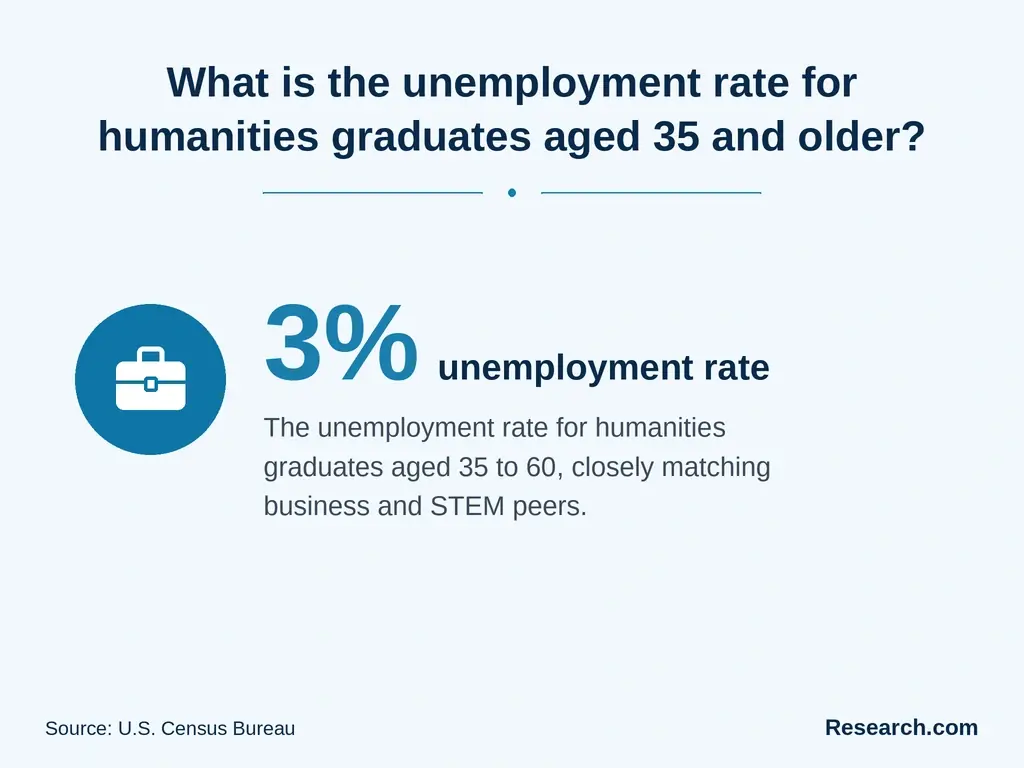
- Humanities graduates are seeing strong demand. Recent philosophy degree graduates recorded a lower unemployment rate (5.1%) than computer science graduates (7.8%), and overall humanities unemployment sits at 2.13%, matching the national bachelor's average.
- Given that humanities majors are not limited within a single vocational path, graduates succeed across corporate leadership, tech (UX research, content strategy), law, and policy. Increased demand is also observed for graduates with AI fluency, or a practical minor in business, data analytics, or SEO.
What Is a Humanities Bachelor's Degree, and How Does It Differ from Social Sciences and Fine Arts?
A BA in the Humanities is an undergraduate degree focused on the study of human culture, thought, language, history, and values. In the US, there are approximately 4.1 million people in the workforce who have a BA or higher in the core humanities disciplines. Compared with degrees in the sciences, which involve a lot of lab work or commercial production, a BA in the humanities is essentially interpretive, critical, and historical in its approach to the study of how humans have recorded, questioned, and made sense of the human experience over time.
It is important to note that there is a line that separates the humanities from the rest of the liberal arts disciplines. While social sciences (such as psychology, sociology, and economics) rely on empirical data, statistical modeling, and quantitative observation to explain human behavior, the humanities emphasize qualitative text analysis, ethical reasoning, and cultural context. In the same manner, fine arts prioritize creative execution and physical craft, while humanities disciplines like art history or musicology analyze the historical, theoretical, and cultural significance of those works.
What Are the Main Types of Humanities Degree Designations (B.A., B.S., and B.L.S.)?
The B.A. is a degree that is more flexible in terms of structuring your course of study. It is very common for students to take a major in one of the humanities and then add on a minor in another field, such as business, computer science, or pre-law. The majority of US colleges will give a humanities major a B.A. (120 credits), which is essentially a broad liberal arts degree with a focus on seminar work and intermediate to advanced foreign language study.
In contrast, a B.S. in a humanities field (e.g., a B.S. in History, Philosophy, or Technical Communication) would meet the language requirement. In addition, a B.S. will also require quantitative research methods, data analytics, or laboratory science electives. Some universities also offer the Bachelor of Liberal Studies (B.L.S.) or the Bachelor of Interdisciplinary Studies for the non-traditional, transfer, or adult learner looking for a more flexible curriculum. This allows you to take courses from a range of different humanities and social science departments as part of a single program, creating a strong stepping stone toward online MSW programs affordable for working adults.
Which Traditional Humanities Majors Are Most Popular Among Undergraduates?
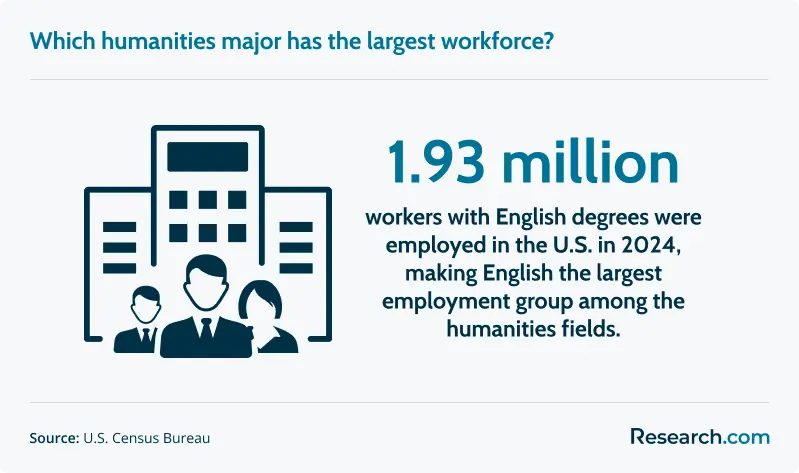
English Language and Literature is still the most popular traditional humanities major in the U.S., with over 1.94 million degree holders working today. Students in English, Creative Writing, and Rhetoric study literary traditions, how stories are structured, and how to write persuasively. History is another leading field, where students learn to investigate archives, study how history is written, and evaluate original sources from the U.S., Europe, and around the world.
World Languages and Linguistics is the second most common field for humanities graduates, with more than 870,000 degree holders. This area combines learning languages like Spanish, Mandarin, or Arabic with studying how languages work. Philosophy and Religious Studies (over 543,000 workers) and Theology (over 400,000 workers) are also key majors, where students focus on logic, ethics, world religions, and classic texts.
What Emerging and Interdisciplinary Humanities Specializations Are Growing Today?
Many universities today combine traditional humanities research with new technology and practical skills. In Digital Humanities, students employ literary, historical, and cultural analysis and enhance it with tools like data visualization, text mining, GIS, and digitizing archives. This helps graduates handle large cultural datasets and create digital archives for the public, with many cheap online colleges now offering flexible, tech-integrated pathways into these fields.
Other growing areas, such as environmental policy and healthcare, also employ humanities concepts. Medical and Health Humanities brings together bioethics, narrative medicine, and public health history to assist health and policy workers focus on patient care. Environmental Humanities looks at climate change, sustainability, and ecological ethics through history, literature, and philosophy. This approach helps groups simplify complex environmental issues for the public.
The National Association of Colleges and Employers (NACE) Job Outlook 2026 survey shows that employers value teamwork, problem-solving, and communication most when hiring for entry-level jobs. Humanities bachelor's degrees help students learn how to make sense of complex information. Through the mix of disciplines in the humanities, they are able to build strong, well-supported arguments. Moreover, participation in seminar discussions, writing research papers, and analyzing texts closely empower undergraduates to improve their writing, speaking, critical thinking, and ethical reasoning.
The ability to understand different cultures and speak more than one language gives humanities graduates an advantage in terms of employability. Surveys show that one in four U.S. employers have lost significant business opportunities due to the lack of employees with foreign language skills, and 56% expect the need for multilingual workers to grow. The ability to explain technical or specialized ideas to a wide range of people keeps humanities graduates at the forefront of this increasing demand, making affordable online degree programs in the humanities a practical pathway into today's workforce.
Because humanities degrees are not limited to a specific career path, graduates can pursue opportunities in various private, public, and nonprofit organizations. Humanities graduates find roles that require their skills in fields like media, publishing, and corporate communications. In these organizations, they often work as editors, content strategists, copywriters, journalists, or public relations specialists. Even in technology and business sectors, humanities majors are hired as user experience (UX) researchers, human resources specialists, training managers, and management analysts.
The job options for humanities graduates also cut across government, law, and cultural organizations. They can take on roles such as work as policy analysts, legislative aides, grant writers, foreign service officers, museum archivists, and K–12 teachers with state certification. Many humanities majors also use their degree as a starting point for graduate school. About 42% go on to earn advanced degrees in areas like law (J.D.), business (M.B.A.), public administration (M.P.A.), or library science (M.L.I.S.).
According to the U.S. Bureau of Labor Statistics (BLS), the majors with the highest median annual wage are graduates of Culture and Group Studies at $68,000. This is closely followed by Foreign Languages at $66,000, and Philosophy and Religion at $65,000. For English majors, the median wage is $60,000, while Theology graduates have a median salary of $50,000. This lower figure for Theology is understandable because graduates work in religious and nonprofit ministries.
Humanities graduates who pursue corporate leadership, compliance, or specialized communications often earn six-figure salaries. For instance, Directors of Human Resources receive an average salary of $109,608 per year, Proposal Managers earn $107,748, and Regulatory Affairs Managers make $106,129. Development Directors, on the other hand, average $103,808, and Senior Editors earn $93,563—comparable to the earning potential available to graduates who pair communication skills with an online degree real estate credential for corporate property or development roles.
The Georgetown University Center on Education and the Workforce reports that humanities degree graduates have a median income of $69,000 per year, while those in STEM fields earn $98,000. Typically, entry-level salaries for humanities majors are lower than those for engineering or computer science. For example, early-career philosophy majors earn a median of $52,000, compared to $87,000 to $90,000 in computer science. However, around 30% of arts and humanities majors reach median mid-career salaries above $65,000.
Getting an advanced degree helps close this wage gap. The American Academy of Arts & Sciences Humanities Indicators identifies that earning an advanced degree or professional credential increases median earnings for humanities majors by 36%. This then brings their median annual wage to $87,000, which is within 6% of the $93,000 median for all advanced degree holders nationwide.
Employers are placing more importance on human judgment, ethical oversight, and complex problem-solving. While AI is used in routine coding and entry-level drafting, the intervention of the humanities majors are becoming more crucial for businesses to be armed with the right insights.
The Federal Reserve Bank of New York reports that recent philosophy graduates had a lower unemployment rate (5.1%) than computer science graduates (7.8%). The overall unemployment rate for humanities degree holders is about 2.13%, which is almost the same as the 2.17% rate for all bachelor's degree holders.
However, planning your career carefully to get a good return on investment still applies, whether you are weighing a liberal arts track or researching the cost of accounting degree online programs to pair business credentials with critical thinking. This is to avoid underemployment early on in your career. With 47.1% of recent philosophy graduates facing underemployment compared to 19.1% in computer science, this becomes more important. NACE reports that 10.5% of entry-level job postings now ask for AI skills. Combining your humanities major with AI skills like data analysis, project management, or SEO will ensure that your humanities degree will be worth the investment.
How Should You Choose the Right Humanities Specialization and Degree Format?
Start by identifying your strengths and match those with your daily coursework. For example is archival research is your strength, History might be the best specialization for you. If you prefer formal logic and ethics, consider Philosophy. For those interested in structured language systems, Linguistics might be a good fit. It is also helpful to check what each department offers, like faculty mentorship, research grants for undergraduates, study abroad programs, and how well alumni do in your target industries.
Pick a degree format that is aligned with your budget and schedule. Evaluate your options. With traditional four-year programs on campus, you can get in-depth seminars and access to campus recruiting. On the other hand, accredited online programs and community college transfer options can lower tuition and allow working adults to earn a degree without relocating.
- American Academy of Arts & Sciences. (2023). Earnings of humanities majors with an advanced degree. Humanities Indicators. https://www.amacad.org/humanities-indicators/workforce/earnings-humanities-majors-advanced-degree
- American Academy of Arts & Sciences. (2023). The employment status of humanities majors. Humanities Indicators. https://www.amacad.org/humanities-indicators/workforce/employment-status-humanities-majors
- American Council on the Teaching of Foreign Languages. (2019). Making languages our business: Addressing foreign language demand among U.S. employers. https://www.actfl.org/uploads/files/general/MakingLanguagesOurBusiness_FullReport.pdf
- Angeles, D. (2025, September). Field of degree: Humanities employment and wages. Career Outlook, U.S. Bureau of Labor Statistics. https://www.bls.gov/careeroutlook/2025/data-on-display/field-of-degree-humanities-employment-and-wages.htm
- Federal Reserve Bank of New York. (2026, February 4). The labor market for recent college graduates: Outcomes by major. https://www.newyorkfed.org/research/college-labor-market#--:explore:outcomes-by-major
- Morris, C., Cheah, B., & Strohl, J. (2025). The major payoff: Evaluating earnings and employment outcomes across bachelor's degrees. Georgetown University Center on Education and the Workforce. https://cew.georgetown.edu/cew-reports/major-payoff/
- National Association of Colleges and Employers. (2025, November). Job outlook 2026. https://www.naceweb.org/research/reports/job-outlook/2026/