How Long Does It Take to Earn an Online Humanities Degree?
Audited and Verified:
Our Editorial and Data Verification Process
Research.com uses government datasets, official education statistics and primary institutional information to support its career and degree guides. Our review process checks factual accuracy, occupational definitions, source dates and the requirements associated with the credentials discussed.
How This Article Was Fact-Checked
Our editorial team verifies salary estimates, employment projections, education requirements and program information against original data providers and official organizations. Salary figures are checked against the relevant occupational definitions and reporting periods. Information about licensure, accreditation and required in-person training is reviewed separately.
Fact-checked and verified on:

Co-Founder and Chief Data Scientist
Online Humanities degrees can help you graduate faster, but they are generally designed for flexibility. In fact, if you’re balancing work, family, or other obligations, enrolling in an online program at your own pace—often part-time—will mean a longer completion time.
As online education gains acceptance in higher education (54.7% of U.S. college students took at least one distance education course in 2024, according to NCES), getting to know the range of possible timelines to finish an online Humanities degree across degree levels will help you plan ahead.
In this article, you will also learn the factors that affect completion time, the myriad ways to potentially fast-track your studies, and how to estimate your completion time.
Key Benefits of Online Humanities Degree
- The median time to complete a bachelor’s degree is 3.7 years for first-time college students.
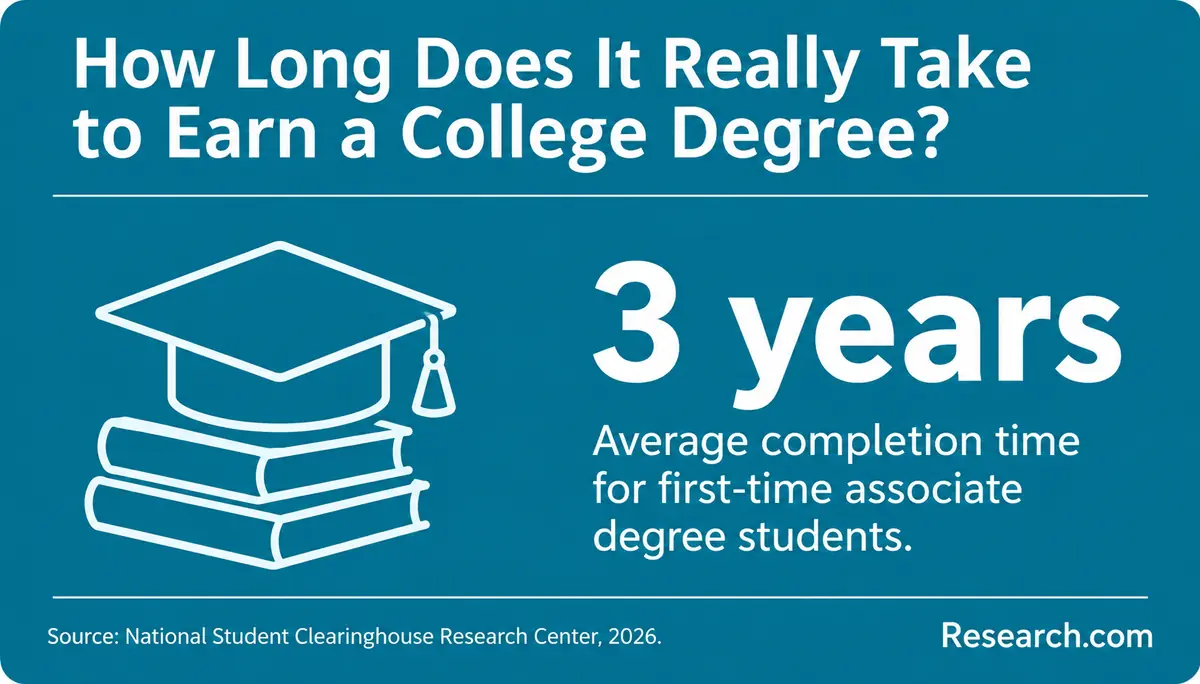
- First-time associate degree students, meanwhile, take 3 years on average.
- Transfer students take 5-13 months more to finish a degree.
How Long Does It Take to Complete an Online Humanities Degree?
The typical range to complete an online Humanities degree is from two years to seven years across associate, bachelor’s, and master’s degree levels. Doctoral degree timelines are more unpredictable given the extent of research at this stage.
Associate Degree in Humanities
You need two years to cover 60 credits in a regular academic schedule. As the entry point to higher education, an online associate degree in Humanities introduces you to literature, philosophy, history, communication, and cultural studies, on top of general education courses.
Completion time can take longer if you take fewer courses per term, as we see in the National Student Clearinghouse Research Center (NSCRC) report, where the median completion time is 3 years for first-time college students.
Incidentally, if you want to enter the workforce or transfer to a bachelor's program sooner, enrolling in the quickest associate's degree online can help you finish your general education and foundational humanities credits in a fraction of the usual time.
Bachelor’s Degree in Humanities
A typical bachelor’s program takes four years to complete 120 credits. You also cover courses given in associate programs, but with more depth and specialization. For instance, expect to study advanced literary studies, art history and criticism, and gender and cultural studies.
Interestingly, the NSCRC 2025 data shows first-time bachelor’s degree holders have completed their education faster than the regular timeline, at 3.7 years on average.
Master’s Degree in Humanities
Graduate students often finish their master’s in one to two years, depending on the program structure and time availability. Here, you focus on advanced coursework, and are likely to be required to complete a research or capstone project.
Professionals often take a longer time to finish a master’s because of work obligations compared with full-time students fresh off their undergraduate.
Doctoral Degree in Humanities
The completion timeline for doctoral degree in Humanities is more varied because the students here are likely professionals in high-level positions with unpredictable schedules. They may take four to seven years to finish extensive research and defend their dissertation.
While an accelerated one year online doctorate is generally not available in research-heavy humanities fields—where shorter online doctoral tracks typically still take around four years—choosing a structured, cohort-based program can prevent your dissertation timeline from dragging out.
What Factors Affect How Long It Takes to Earn an Online Humanities Degree?
You can group the factors that impact your completion timeline into two: academic and personal factors.
Full-Time vs. Part-Time Enrollment vs. Overtime
If you enroll full-time, you get to finish the required courses on time. Conversely, taking a part-time course load means fewer subjects per semester, thus more time to finish the degree.
You can expect a difference of four to six months, but hardly a year or more, among these different enrollment pacing options.
Transfer Credits
Some institutions accept up to 90 to over 100 transfer credits, or about 75% off the course load towards an online Humanities degree.
Conversely, other universities may find some, if not all, of your previous credits do not match their academic requirements. That is one reason why a 2024 Utah System of Higher Education found that transfer students take five to thirteen months longer to complete their education.
Both instances impact the time to finish your Humanities degree.
Transfer policy per institution varies. Make sure to ask for a transcript evaluation before enrolling to find out the exact credits you get to roll over.
Course Scheduling
Online Humanities degree programs typically offer asynchronous classes, but it does not mean they are always available around your schedule.
These classes follow a rotational start date, for instance, every two months for a term. If you fail to make the cutoff, you will have to wait out the two months.
A delay in finishing a prerequisite course means pushing back the succeeding courses.
On the other hand, institutions may offer accelerated programs that consolidate courses into fewer subjects. Similarly, an institution may allow year-long enrollment, letting you take summer classes in between semesters. In both cases, you get to finish faster, albeit at a heavier pace.
Work or Family Obligations
Work and family commitments can limit your ability to take a full course load. Humanities typically demand extended focus on reading, writing, research, and critical analyses, things you may struggle with if you have other priorities.
How Can You Complete an Online Humanities Degree Faster?
Whether you’re fresh off high school or have some college credits, you might earn an online Humanities degree faster through these routes.
Take more courses or classes than usual.
Look for an institution that allows for year-long enrollment or accelerated course load. Fresh high school graduates will find this route their only likely option to fast-track their studies.
Combining year-round enrollment with compressed terms is often the fastest way to get an associate's degree before transitioning into upper-level undergraduate coursework.
For instance, Southern New Hampshire University offers six terms per year, including summer classes.
National University has monthly start dates, so your target courses are always available in the following month.
Arizona State University Online offers 7.5-week terms, which means you can get ahead of the traditional four-year timeline.
Look for institutions with a high transfer credit cap.
If you have some college background, look for a program that will recognize most of your previous college credits. For instance, Excelsior University accepts up to 113 transfer credits, while Franklin University offers a 90 transfer credit cap.
Transfer credits are, of course, subject to approval by the institution based on their evaluation terms. Make sure to request a transcript evaluation to get your exact transfer credits.
Competency-based education (CBE)
Competency-based education (CBE) programs allow you to demonstrate Humanities-relevant knowledge or skills from work or military training, among others, and may make you eligible for these programs.
CBE programs focus on your subject mastery instead of classroom time. As you pass assessments, you can move through courses over a shorter period.
Programs such as the University of Maine at Presque Isle - YourPace and the University of Wisconsin Flexible Option offer CBE-based Humanities and Liberal studies.
How to Estimate Your Online Humanities Degree Completion Timeline
To estimate your online Humanities degree completion timeline, look at your remaining credits, your course load plan, and the program schedule.
To know your outstanding credits, ask for a transcript audit. For a CBE-based program, request a knowledge/skills assessment.
Then, plan for your course load until you graduate. Do you plan to take year-long classes or opt for part-time?
Also, check the start dates of your courses, specifically course prerequisites. Make sure they align with your course load plan.
As a final word, remember to factor in your other commitments to avoid struggling with your studies.
If committing to a multi-year academic track doesn't fit your current timeline or career goals, you might also compare the types of jobs you can pursue after trade school to see if a shorter, skills-based credential aligns better with your plans.
Other Things You Should Know About Online Humanities Degree Programs
Yes, if it means reducing the number of semesters and the frequency of paying for education-related fees such as books and technology access. However, accelerated programs and year-long enrollment may have higher tuition due to heavier course loads, thus dampening the savings.
Yes, several U.S. institutions accept international students for their online programs. They may be required to take English-proficiency tests and go through credential assessments. These students do not need a student visa, as they are based in their home countries even as they complete their U.S. online Humanities degree.
Generally, no. Accredited institutions typically award the same academic credential to students who complete equivalent online and on-campus programs. The diploma does not necessarily identify the learning format. Students should verify the institution's accreditation and program recognition before enrolling.
1. National Center for Education Statistics. (2025). Digest of Education Statistics, Table 311.15. https://nces.ed.gov/programs/digest/d25/tables/dt25_311.15.asp
2. National Student Clearinghouse Research Center. (2026). Time to Degree. https://nscresearchcenter.org/time-to-degree/
3. Utah System of Higher Education. (2024). Impacts of Student Transfer: Who Transfers, Where They Go, and How They Fare. https://ushe.edu/wp-content/uploads/pdf/reports/general_report/2025/Impacts_Student_Transfer_Full_Report.pdf
4. U.S. Department of Education. (2024). Direct Assessment (Competency-Based) Programs. https://www.ed.gov/laws-and-policy/higher-education-laws-and-policy/higher-education-policy/direct-assessment-competency-based-programs