2027 Can You Get Into a Humanities Program with a Low GPA? Admission Chances & Workarounds
Audited and Verified:
Our Editorial and Data Verification Process
Research.com uses government datasets, official education statistics and primary institutional information to support its career and degree guides. Our review process checks factual accuracy, occupational definitions, source dates and the requirements associated with the credentials discussed.
How This Article Was Fact-Checked
Our editorial team verifies salary estimates, employment projections, education requirements and program information against original data providers and official organizations. Salary figures are checked against the relevant occupational definitions and reporting periods. Information about licensure, accreditation and required in-person training is reviewed separately.
Fact-checked and verified on:

Co-Founder and Chief Data Scientist
Can you get into a humanities program with a low GPA? In most cases, yes. A GPA below 3.0 can feel like a locked door, especially if your heart is set on history, philosophy, literature, or languages. But most US humanities programs are far less selective than headlines suggest, and admissions officers look past a single number. This 2027 guide covers your real admission chances, what colleges weigh besides grades, and practical workarounds to get into a humanities program this year.
Key Things to Know About Admission Chances Into a Humanities Program with a Low GPA
- Most students at US four-year colleges attend schools that admit at least three out of four applicants, so a GPA below 3.0 rarely shuts you out of humanities study altogether.
- High school grades are still the top admission factor, but colleges also weigh course rigor, essays, and character, which gives humanities applicants room to show strengths a GPA misses.
- Community college transfer, open-admission and online programs, and a strong writing sample are proven workarounds that can lead to a humanities bachelor's degree.
What counts as a low GPA for humanities admissions?
There is no national cutoff, but most admissions offices treat anything under a 3.0 on a 4.0 scale as below average, and anything under 2.5 as a real hurdle. "Low" is also relative to the school. A 2.8 may sit near the middle of the admitted class at a regional public university and far below it at a selective liberal arts college.
At the freshman level, most humanities majors do not run a separate admission process. You are admitted to the college first, then declare English, history, philosophy, or a language later. Some departments do set a minimum college GPA, often around 2.0 to 2.5, to declare or stay in the major. If you are still deciding on a field, comparing humanities with other easy degrees to get online can help you choose a program that fits your record.
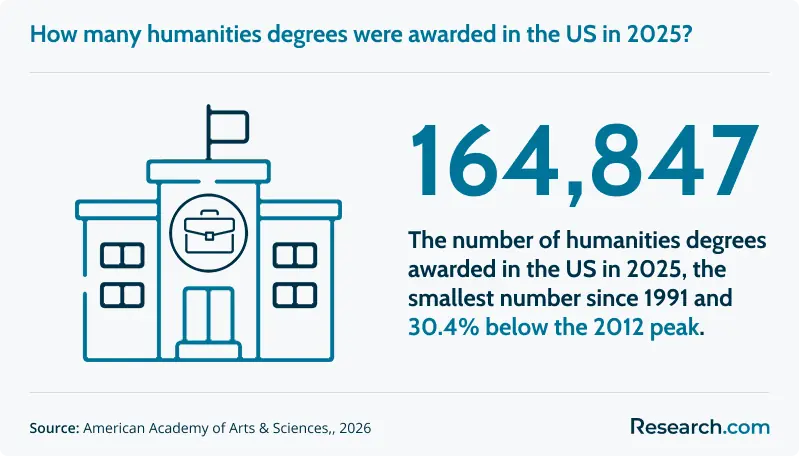
Are humanities programs easier to get into as enrollment drops?
Yes, and that works in your favor. Humanities enrollment has been shrinking for over a decade, which means many departments are actively recruiting rather than turning students away.
Fewer majors mean smaller classes and more attention from faculty. It also means departments have a reason to support students who arrive with uneven grades but genuine interest.
What do colleges weigh besides GPA in humanities admissions?
Grades still carry the most weight, but they are not the whole picture. The National Association for College Admission Counseling (NACAC) asked colleges which factors held "considerable importance" for fall 2023 freshman admissions.
Two takeaways matter for low-GPA applicants:
- Colleges look closely at grades in core academic courses, so strong marks in English, history, and languages can outweigh weaker grades elsewhere.
- Essays and character count for more than test scores now, and writing is exactly where humanities applicants can shine.
Start by showing a trend. An upward grade pattern in your last two years tells admissions officers that a rough start does not define you. Use the additional information section to explain circumstances like illness, family duties, or work hours, briefly and without excuses.
Next, make your writing do the heavy lifting. A thoughtful personal essay or a graded analytical paper is direct evidence that you can handle humanities coursework. Strong recommendations from an English or history teacher reinforce that message.
You can also build a fresh academic record. Dual enrollment, summer sessions, or fast track college courses give you recent college-level grades that often matter more than an old high school GPA. Finally, apply to a wider range of schools so a single decision doesn't define your options.
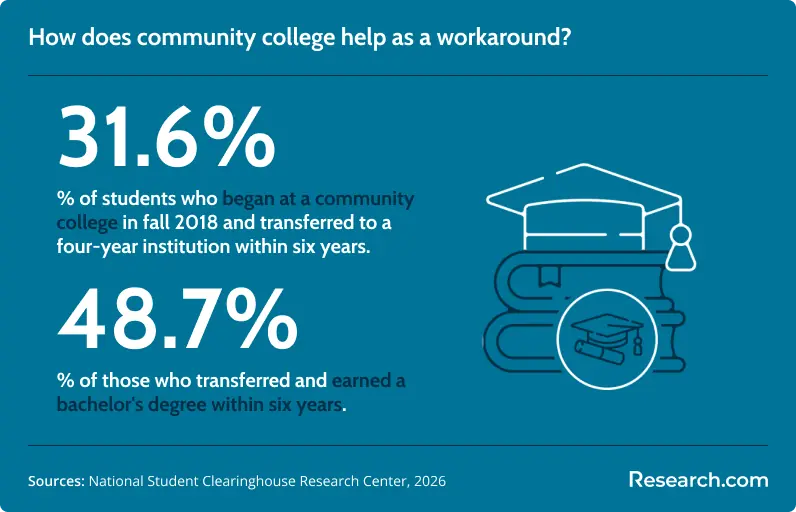
For many students, it is the most reliable one. Most community colleges have open admission, and once you transfer, your college GPA usually replaces your high school record in the eyes of the four-year school. An associate degree in liberal arts or humanities also covers many general education courses you would take anyway.
The numbers below show that transfer works best with a plan. Choose a community college with guaranteed admission or articulation agreements with the universities you want, meet with an advisor early, and take courses that count toward your intended humanities major.
They are where most students already are. Highly selective schools get the headlines, but they enroll a small slice of undergraduates. Federal data on full-time, first-time students entering four-year colleges in fall 2022 show how enrollment spreads across schools by acceptance rate.
More than half of these students (54.7%) attend schools that admit at least 75% of applicants. Many of these colleges offer solid English, history, and philosophy departments, and graduating with a strong record there can open doors to graduate school later.
Applying to several of these schools also lowers your risk, and it costs less if your shortlist includes accredited schools online with no fee to apply.
Online programs are often a good fit for applicants with a low GPA, especially adult learners whose high school grades are years old. Many programs use rolling admissions and place more weight on work experience, motivation, and recent coursework. Online study is also mainstream now. In fall 2023, 54.2% of US undergraduates took at least one distance education course.
Look for regional accreditation, transfer-friendly credit policies, and programs that let you start with a few courses before formally declaring a major. If you decide a hands-on career suits you better than a four-year humanities path right now, the most popular vocational schools online offer another route, and you can return to the humanities later.
Is a humanities degree worth it if you start with a low GPA?
A bachelor's degree still pays off, no matter how you got into the program. According to the US Bureau of Labor Statistics (BLS), workers age 25 and over with a bachelor's degree earned a median weekly pay of $1,578 in 2025, compared with $966 for those with only a high school diploma. Their unemployment rate was 2.8%, versus 4.3%.
Earnings for humanities graduates vary widely by career path. Writing, research, communication, and analysis skills lead to jobs in education, law, publishing, marketing, and public service. If salary is a top priority, compare your options against 4 year degrees that pay well and consider pairing a humanities major with a practical minor or a graduate degree.
Other Things You Should Know About Humanities Degrees
Yes, though it takes more effort. Many master's programs list a 3.0 minimum but consider applicants below it who show a strong upward trend, an excellent writing sample, and solid recommendations. Some schools offer conditional or probationary admission, and taking a few graduate-level courses as a non-degree student can prove you are ready.
No. Many public regional universities, private colleges, and online institutions admit students in this range, especially when the rest of the application is solid. Open-admission colleges accept nearly all applicants with a high school diploma or equivalent, and community college transfer offers a second path into a four-year humanities program.
It depends on the school. Many colleges recalculate GPA using only core academic courses such as English, math, science, social studies, and languages, and some add weight for honors or AP classes. That is why strong grades in rigorous humanities courses can help your case even if your overall GPA is low.
Retaking a course can help if your school replaces the old grade or if the course is a prerequisite for your major. In most cases, though, earning strong grades in new college-level courses, through dual enrollment or community college, is a better use of your time because it shows current ability rather than repair work.
- American Academy of Arts & Sciences, Humanities Indicators. (2026). Bachelor's degrees in the humanities. AMACAD.
- BLS. (2026). Unemployment rates and earnings by educational attainment, 2025. BLS.
- NACAC. (2023). Factors in the admission decision. NACAC.
- NCES. (2024). Digest of Education Statistics, Table 326.30. NCES.
- NCES. (2024). Digest of Education Statistics, Table 311.15: Students enrolled by distance education participation, fall 2022 and fall 2023. NCES.
- National Student Clearinghouse Research Center. (2026). Tracking transfer. NSC Research Center.