2027 Online Humanities Degree Programs Costs: Tuition & Fees
Audited and Verified:
Our Editorial and Data Verification Process
Research.com uses government datasets, official education statistics and primary institutional information to support its career and degree guides. Our review process checks factual accuracy, occupational definitions, source dates and the requirements associated with the credentials discussed.
How This Article Was Fact-Checked
Our editorial team verifies salary estimates, employment projections, education requirements and program information against original data providers and official organizations. Salary figures are checked against the relevant occupational definitions and reporting periods. Information about licensure, accreditation and required in-person training is reviewed separately.
Fact-checked and verified on:

Co-Founder and Chief Data Scientist
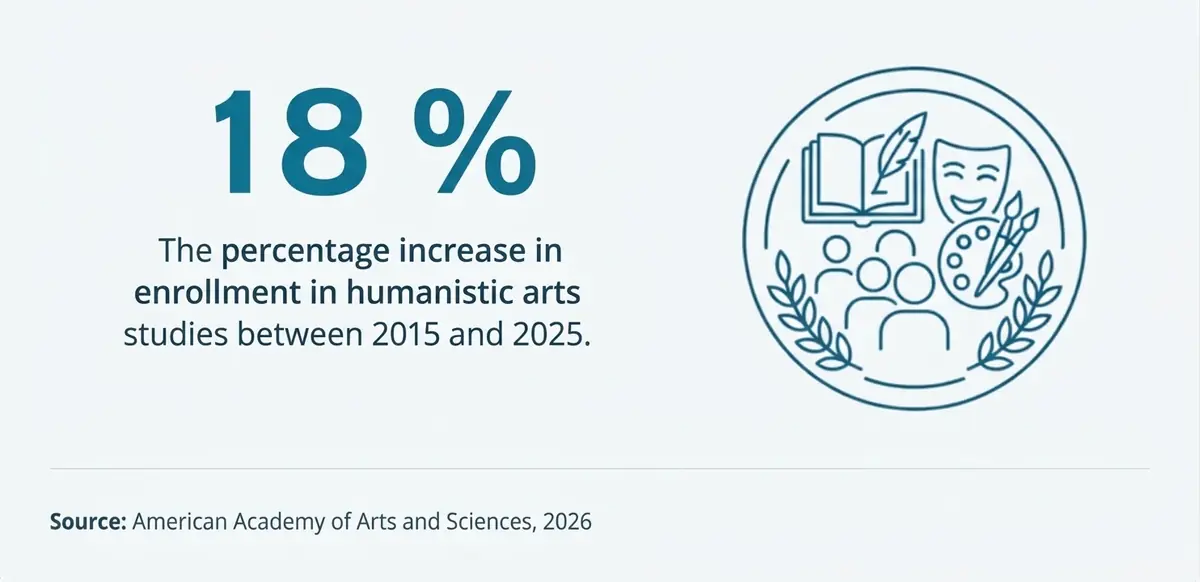
Is the value of a humanities degree greater than the cost of pursuing it? This is a valid question as college costs continue to rise and students become more deliberate in choosing their majors. According to the American Academy of Arts and Sciences, the number of students pursuing a bachelor’s degree in the humanities dropped 28% from 556,369 in 2015 to 398,589 in 2025. Worries about job prospects, income, and the financial investment of college could be contributing to this declining interest in humanities majors.
Getting an online humanities degree doesn’t have to be expensive. Tuition can vary based on the school you attend, your residency status, the number of transfer credits you receive, and the pace at which you earn your degree. There are also additional fees you’ll have to pay that could make your degree cost more than you anticipate. This guide will cover tuition and fees, affordable programs, budgeting for your humanities degree, and the potential return on investment. It will help you determine if a humanities degree is a worthwhile investment.
Key Things You Should Know About Online Humanities Degree Costs
- The total cost of online bachelor's degrees in humanities is between about $40,536 and $63,185, depending on the school and the student's residency status.
- The maximum Federal Pell Grant award for the 2026-2027 academic year is $7,395; the minimum award is $740.
- Although students can save money on housing, transportation, parking, and meal costs by enrolling in an online program, they may be responsible for additional fees related to technology and distance learning.
How much do online humanities degree programs cost?
The total tuition costs of online bachelor’s degree programs in the humanities are estimated to range from $40,536 to $63,185, depending on the type of institution and the residency status of the student. The average cost for students from in-state areas who are enrolled in public institutions is around $356 per credit, while the average cost for students from out-of-state areas is $492 per credit. Given that a bachelor’s degree is generally comprised of 120 credits, the total tuition can vary greatly depending on the student’s residency status.
The cost per credit of a bachelor's degree program in humanities offered online at a public university is $337 for in-state residents and $499 for nonresidents. Based on these rates, the total cost of tuition is estimated at $40,440 and $59,880, respectively. A private university that charges $467 per credit would have a tuition cost of about $56,040 for a 120-credit program. Make sure to verify that the tuition rates quoted will apply to your enrollment status. Additionally, transfer credits may reduce the total number of credits for which you will need to pay tuition.
What factors influence the cost of an online humanities degree?
The cost of an online humanities degree depends on the institution and program. Getting an idea of the total costs can help you estimate what it might take to complete your degree and plan your education budget. Some of the factors that may impact the final cost of your degree include:
- Public or private: Public schools may offer a lower cost to in-state residents than private schools, which tend to have a set tuition regardless of residency status. However, some private schools offer discounted tuition for online learners.
- In-state or out-of-state: Public schools may have a higher per-credit cost for out-of-state students. Other schools offer a flat tuition rate for online learners, allowing students to pay the same tuition price regardless of residency status.
- Transfer credits: If you can transfer credits from previous college coursework, you might be able to pay less in tuition, and you may graduate sooner by avoiding having to take additional classes.
- Full-time or part-time: Full-time students may be eligible for a flat tuition rate or a discount from the school. Part-time students will typically pay a per-credit tuition.
- Format: Accelerated programs and competency-based education may allow you to graduate sooner, but their pricing structures vary. Some programs charge a per-credit tuition, while others charge a flat fee per term, akin to a subscription service.
- Other costs: Technology, course, registration, and graduation fees can all add to the cost. You will also need to budget for textbooks, digital materials, and any necessary software.
Are online humanities programs cheaper than traditional on-campus programs?
Although many online humanities programs cost less than a traditional degree on campus, it's not always the case. While you can save money on commuting, campus housing, meal plans, and other fees required for on-campus study, an online humanities degree isn't always cheaper.
In fact, tuition rates for online degree programs are sometimes the same as on-campus rates, and some universities charge a distance learning or technology fee for online students. That is why it is important to compare the total cost of completing both the online program and the traditional on-campus program.
When comparing the cost of an online humanities degree to a traditional degree, consider the following:
- Tuition: While some universities charge a lower tuition rate for their online programs, others charge the same rate whether you are attending classes on campus or completing your degree online. Other universities offer a separate distance learning tuition rate. For example, the University of Idaho lists online tuition rates for its 2026–2027 undergraduate courses at $491 per credit (part-time) with a $35 fee for web-based courses.
- Housing and transportation: If you are able to stay at home while attending online classes, you can save on campus housing costs as well as the costs of parking, transportation, and fuel. You can also save money on meals, since you won't have to eat out each day.
- Technology and course fees: While online degrees save you money in some areas, they come with their own expenses. You will need a computer, access to the Internet, and possibly software and digital textbooks to take classes online. Most universities charge an online course fee, and some charge additional fees for certain courses or services.
- Campus access and personal expenses: Students who attend campus classes will be charged for student activities, facilities, and other services and fees associated with being a student on campus. However, if you complete your online degree from home, you won't have to pay these fees. Some universities include fees in their distance learning tuition rates, however.
If you're considering graduate school, it's helpful to contrast the cost of an undergraduate program with that of an online master degree cheap to see the difference in tuition as you move to the next level of your plan. Take the time to compare the cost of tuition, fees, materials, and living expenses for both on-campus and online degree programs before determining which is the better value.
The tuition for an online humanities degree can vary depending on the university, the program, and the tuition structure in place. Some universities charge all of their online students the same tuition rate, while others offer a reduced rate for in-state residents. Comparing tuition rates among universities can help students find an online humanities degree program that matches their education budget.
Below, you can find several online humanities degree programs at different universities, each with its own unique tuition structure.
| Institution | Online Program | Tuition |
| University of Maryland Global Campus | BA in Humanities | $337 per semester credit for Maryland residents; $499 for nonresidents |
| LSU Alexandria | Bachelor of General Studies in Humanities | $353 per semester credit (including fees) |
| Oregon State University | BA/BS in Applied Humanities | $409 per quarter credit, which includes a distance education fee |
| University of Illinois Urbana-Champaign | Bachelor of Liberal Studies | $442 per semester credit, plus $4 in student fees |
| Cairn University | BA in Liberal Arts | $4,900 per semester for 12–18 credits; this is the equivalent of $272 per credit if you take 18 credits |
When choosing an online humanities degree program, students should also consider the accreditation and transfer credit policies. If you are comparing online schools with national accreditation, make sure to check the school’s accrediting agency to make sure it is the type of accreditation you are looking for. Additionally, a school’s transfer credit policy can impact your overall cost: the more transfer credits they accept, the fewer courses you’ll have to pay for.
There are several ways that a student may reduce the cost of an online humanities degree. From transferring credits to applying for scholarships, there are various things that a student can do to keep the tuition and other costs associated with his or her education down
There are several ways to make your online humanities degree more affordable:
- Transfer previously earned college credits: If you’ve already taken college courses, you may be able to transfer those credits toward your humanities degree. Some schools also accept test scores, military training, or other forms of prior learning. By looking into a school’s transfer policies, you can learn how many of your degree requirements you can fulfill without enrolling in additional coursework.
- Look into scholarships and grants: Search for scholarships, grants, and other forms of financial aid, whether from your institution, private organizations, or the federal or state government. Grants and scholarships are forms of financial aid that don’t have to be repaid, as long as you meet the requirements for these awards.
- Take general education courses at a community college: Consider taking general education classes at a more affordable community college before transferring to a four-year university. This may help you cut back on tuition expenses for your degree. You should make sure that the university you transfer to accepts credits from the community college you attend.
- Take advantage of flat-rate tuition: Depending on the university you attend, you may be able to enroll in enough credits per semester to take advantage of a flat-rate tuition. If your schedule permits, you can save money by taking more classes, and you may be able to complete your degree in a shorter amount of time.
- Explore accelerated degree pathways: If you want to complete your degree faster, research accelerated pathways and schools that are friendly to transfer students. An associate degree can also be a good stepping stone for bachelor’s level study. It’s important to learn how long does it take to get an associate degree and whether you’ll be able to transfer those credits into your desired online humanities degree.
An online humanities degree student may be eligible for several types of financial aid based on their financial need, academic achievement, and the college or university they attend. Financial aid can be used to pay for tuition, fees, books, and other education expenses, but it has different eligibility requirements. Students should confirm with their online college that it participates in financial aid programs.
- Federal Pell Grants: If you are an undergraduate student with financial need, you may qualify for a Federal Pell Grant. The maximum award amount for 2026-2027 is $7,395, while the minimum award amount is $740. In general, Pell Grant money does not have to be repaid if students meet the requirements.
- Federal student aid: You may be eligible for a Federal Pell Grant. The maximum award for 2026-2027 is $7,395, and the minimum award is $740. In general, you do not have to pay back Pell Grant money as long as you meet the requirements.
- School scholarships and grants: Schools can offer a range of scholarships and grants, including those for merit, need-based, transfer, and adult learners. Depending on the college, there are different scholarships and grants, which may have different renewal requirements.
- State grants and scholarships: Many states have grants and scholarships for students who meet their residency requirements and attend an approved college or university. These grants and scholarships can have different eligibility requirements, such as residency, enrollment, and academic criteria.
- Private scholarships: Nonprofit organizations, foundations, and professional associations offer a variety of scholarships to students. These scholarships may be based on academic interests, community service, or financial need.
- Employer tuition assistance: Some employers provide assistance to employees to pay for a college education. Tuition assistance programs may include tuition reimbursement and education benefit programs. Students should confirm that their employer provides assistance for online college undergraduate programs and understand the requirements.
To apply for federal student aid, students must complete the FAFSA every academic year. The U.S. Government Accountability Office reported that 9.9 million students qualified for Pell Grants for the 2024-2025 academic year, which was a 6% increase from the previous academic year.
The return on investment for the degree depends on the student's major, career goals and ambitions, work experience, and the cost of their education. An online humanities degree can help graduates get jobs in multiple industries. While humanities degree graduates don't all enter the same line of work, employment and salary statistics can help potential humanities degree students estimate the return on their investment.
Humanities graduates can use their research, writing, communication, and analytical skills to pursue several different career paths, including:
- Education: teachers, academic support specialists, and education program coordinators.
- Writing and publishing: writers, editors, copywriters, and publishing assistants.
- Communications and public relations: communications specialists, public relations coordinators, and content strategists.
- Government and public service: policy assistants, research associates, and public affairs specialists.
- Business and nonprofit organizations: human resources specialists, program coordinators, and community outreach professionals.
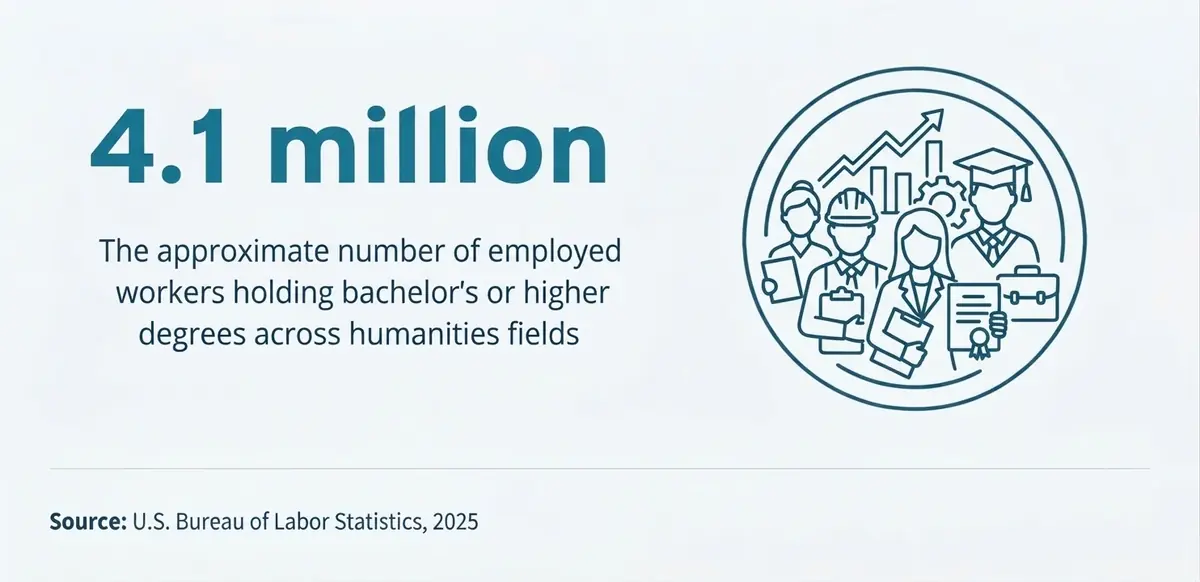
According to the U.S. Bureau of Labor Statistics (BLS), there were around 4.1 million employed people with a bachelor's degree or higher in five selected humanities fields in 2023. The median annual wages for workers with these degrees ranged from $50,000 for theology degree holders to $68,000 for culture and group studies degree holders. Individuals with English degrees accounted for the largest number of employed humanities degree holders, with around 1.94 million employed individuals. The median annual wage for English degree holders was $60,000.
The above numbers show that humanities degree holders can land jobs in various fields, but salaries can vary based on major and occupation. If you're considering pursuing a doctoral degree, check out 1 year PhD, but note that the time to complete a program can vary.
How can students budget for an online humanities degree?
By determining the total amount you need to pay for the number of credits you still need, and developing a payment schedule, you can better plan for your budget and associated costs throughout your online humanities degree program. To budget for your online humanities degree, you must calculate tuition, fees, book costs, and other expenses related to your education.
Below are some steps you can take to create an education budget for yourself:
- Determine how many credits you need to graduate. Subtract any transfer credits that the university has accepted. This will give you a baseline figure for how much tuition you have left to pay.
- Figure out how much you will have to pay in tuition and fees. Once you have the number of remaining credits that you need to pay for, multiply it by the tuition rate. You will also need to include mandatory fees, such as registration fees, technology fees, and online course fees.
- Make sure your budget includes the cost of books and technology. You will need to purchase books and other learning materials in addition to budgeting for an Internet connection, the maintenance of any required technology, and any other software.
- Create a semester-based budget. Once you have an idea of your total education costs, divide it by the number of semesters you expect to be enrolled. Some universities offer monthly payment plans or other installment payment options to help you manage tuition payments.
- Account for financial aid. Be sure to subtract any scholarships, grants, tuition assistance from your employer, or other sources of financial aid that you are eligible for. This will give you a more accurate idea of how much you need to pay..
If you plan to pursue a graduate degree after you receive your bachelor’s degree, you might want to take future education costs into account when you are budgeting. Check out this article on easy PhD degrees to find out more about what it takes to pursue a doctoral degree.
If you are considering pursuing a graduate degree, be sure to evaluate the requirements, program length, and cost of tuition before including it in your long-term budget. A semester-by-semester budget can help you figure out how much you need to save and whether you are taking a financially sustainable course load.
Other Things You Should Know About Humanities Degree Program Costs
Yes, most online humanities degree programs charge extra costs apart from tuition. These include technology fees, fees for virtual library services, and fees for exams and course materials, among others. Although the fees might not be as big as the tuition, they are worth a mention and should be accounted for when budgeting for the degree program.
Yes, many of the online humanities degree programs for 2027 charge an extra technology fee. These range from $20 to $100 per credit or sometimes a flat fee of $50 to $300 per term. Some of the schools also charge an online course delivery fee. You can find this fee listed separately from the tuition in the program's cost schedule.
It is possible. Many colleges have a refund policy that dictates how much tuition you can get back when you decide to drop a course or withdraw from the degree program. The amount you will get back will often depend on when you submit your request to withdraw. It is important to check the official refund deadlines since withdrawing after this time period may lead you to lose some or all of the tuition you paid.
Yes. If you fail a course or need to repeat the course, you will be required to pay tuition for the credits again. Depending on the university's policies, taking the same course again might also affect your progress and financial aid. Reviewing the course requirements and available academic support services can help you avoid incurring such expenses.
- Angeles, D. (2025, September). Field of degree: Humanities employment and wages. U.S. Bureau of Labor Statistics. https://www.bls.gov/careeroutlook/2025/data-on-display/field-of-degree-humanities-employment-and-wages.htm
- College Board. (2026). Trends in college pricing and student aid 2026. https://research.collegeboard.org/trends/college-pricing/highlights
- Townsend, R. (2026, September 8). Enrollment data signal more humanities degree declines ahead. American Academy of Arts and Sciences. https://www.amacad.org/news/enrollment-data-signal-more-humanities-degree-declines-ahead
- U.S. Department of Education, Federal Student Aid. (2026, January 30). 2026–27 Federal Pell Grant maximum and minimum award amounts (GEN-26-01). https://fsapartners.ed.gov/fsa-print/publication/1006930
- U.S. Government Accountability Office. (2026, April 14). Pell Grants: Overall student eligibility increased after Free Application for Federal Student Aid simplification (GAO-26-107928). https://www.gao.gov/products/gao-26-107928