2027 Admission Requirements for Humanities Degree Programs
Audited and Verified:
Our Editorial and Data Verification Process
Research.com uses government datasets, official education statistics and primary institutional information to support its career and degree guides. Our review process checks factual accuracy, occupational definitions, source dates and the requirements associated with the credentials discussed.
How This Article Was Fact-Checked
Our editorial team verifies salary estimates, employment projections, education requirements and program information against original data providers and official organizations. Salary figures are checked against the relevant occupational definitions and reporting periods. Information about licensure, accreditation and required in-person training is reviewed separately.
Fact-checked and verified on:

Co-Founder and Chief Data Scientist
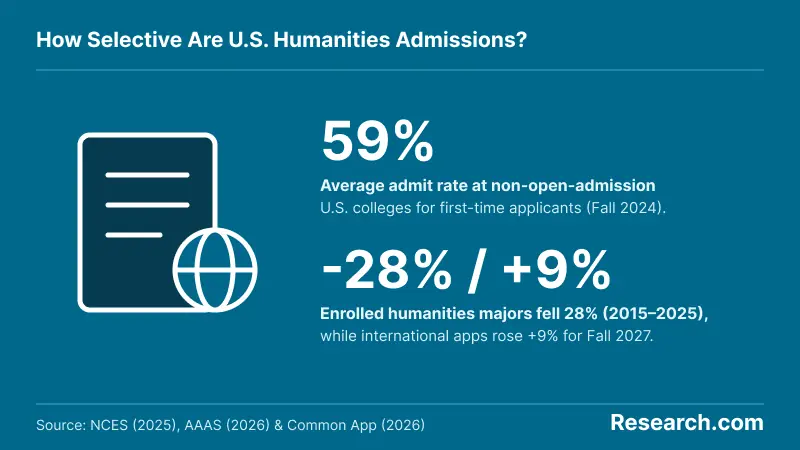
Applying for college can be a high-stress situation as you keep track of documents to submit, deadlines to meet, and financial aid to apply for. For prospective humanities students, there’s a silver lining. The American Academy of Arts & Sciences found that enrollment for humanities degrees dropped 28% from fall 2015 to fall 2025. As such, more humanities departments across the country are actively welcoming prepared applicants.
The keyword, of course, is prepared. Admission requirements for humanities degree programs don’t have to be disheartening. This article strives to prepare you for it, offers strategies, and sets your expectations. It eliminates the guesswork so that you can focus on the excitement of starting a new stage in your education.
Key Things You Should Know
- 76.8% of admissions committees perceive high school grades and college prep with considerable importance.
- Most schools, whether undergraduate or graduate, are test-optional.
- Federal aid applications open every October 1 each year and will require you to prepare for it at least nine to 12 months in advance.
What prior education is required for undergraduate and graduate programs?
For undergraduate programs, you will need at least a high school diploma or GED. Graduate students are expected to have an accredited bachelor’s degree. That said, your path to college or advanced study may not be as straightforward. You could already be in the workforce, whether as a recent high school graduate or a veteran professional, and are looking to formalize your education. You could also be looking to shift career paths. In cases like this, the admission requirements for humanities degree programs may look like this:
- First-Year Applicants: A high school diploma or GED is non-negotiable. However, if you have an associate’s degree, then you can use this to lower the cost of a bachelor’s by submitting the courses that you’ve already taken. Those transferring or switching majors can also submit prior coursework or exam credit as part of the requirements.
- Working Adults: If there’s a sizable gap between your workforce entry date and your application to a humanities bachelor’s or master’s degree, then prior education may matter less than your experience. You can submit portfolios, industry certifications, and licenses so that the committee can see if you qualify for a shorter path or an accelerated college degree.
What GPA and coursework do humanities programs expect?
The undergraduate humanities GPA requirements are often between 2.0 and 2.5, while graduate programs aim to admit candidates with at least a 3.0. NACAC’s State of College Survey reveals that these grades are considerably important for 76.8% of admissions. If you fall slightly below these standards, then it may be comforting to know that 63.8% place considerable importance on the strength of your high school curriculum.
Most admissions committees take a holistic approach in evaluating candidates to make space for students who may have faced difficulties and complexities early in their lives. As such, failing to meet the GPA and coursework requirements can be offset by the following:
- Your individual grades in humanities-specific subjects, such as history, English, or a foreign language,
- Your participation in seminars,
- The upward trend of your grades,
- And a strong personal essay.
Do humanities programs require SAT, ACT, and GRE scores?
It depends on the school you choose, but most institutions are test-optional. In fact, the Common App’s latest 2026 report revealed that only 5% of their members required standardized test scores. This is even more apparent in graduate study as schools offer flexible or easy master degrees for working professionals who may not have the time or funds to get their GRE scores.
That said, the Common App also reported an 11% year-over-year increase in applicants who submitted their test scores. They may already have it by default as part of their college prep, but more importantly, it may be beneficial for those who need to supplement their application to test-optional humanities programs. As such, if you lack confidence in your high school grades or essay writing skills, you could consider including your test scores in your application.
Though it varies from program to program, most humanities programs admission requirements will require you to submit the following:
- Official transcripts of your prior education.
- Personal statement or written essay detailing your goals.
- Two to three letters of recommendation from teachers, employers, or any other person of authority who can vouch for your character and skills.
- Resume or CV to demonstrate previous experience, seminars, internships, apprenticeships, or passion projects.
- Relevant portfolios or writing samples.
When you begin collecting your application materials, take a moment to evaluate their strength. You can check the program details of the specific degree you want and see if your prior education, skills, or experience align with the program’s curriculum. That way, you can adjust as necessary by strengthening different areas of your application.
Don’t forget to give focused attention to anything written, either your statement of purpose or the written essay. Given how the number of conferred humanities degrees has dropped to 164,847—the lowest since 1991—and how this decline is expected to continue, demonstrating a clear strategy and use for the degree can establish why you might be a strong, determined candidate.
Varying admission rules is another reason why you should take the time to go through the program’s page and read through the fine print. Performing or visual arts may require you to demonstrate your innate skills through auditions or portfolios. Creative writing tracks may prefer application packets with enclosed drafts. And international applicants—whose application volume rose 9% on the Common App’s latest survey—may be asked to submit English proficiency scores. Yes, that means you can’t keep ignoring Duolingo’s persistent reminders or forget where you’re supposed to take your TOEFL.
Check the program’s page and the institution’s admissions site. Compile a list of requirements to ensure that you meet admissions expectations, whether on a department- or campus-wide level. For those in associate’s degree accelerated tracks, you can contact the admissions office to see which prior credits can be considered and what you’ll need to provide proof.
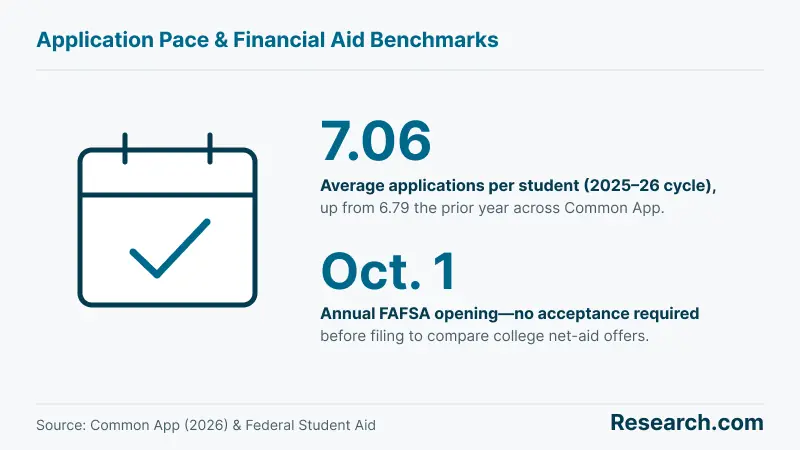
The Free Application for Federal Student Aid (FAFSA), available to both undergraduate and graduate students, opens every October 1. Don’t wait — an acceptance letter to your college of choice isn’t required, and you will be in competition with most first-time college applicants, who comprise 27.6% of FAFSA applicants, as well as 72.4% of aid candidates who have previously attended college.
Start gathering application materials nine to 12 months in advance, and ensure that you track other aid sources, such as institutional grants and university scholarships. Get a sense of how much it’ll cost to earn a humanities degree and see if it’s feasible considering the aid available to you. If not, then you might want to explore lower-cost routes like certifications for in-demand trade jobs.
Accredited online humanities degree admission requirements usually align with in-person programs because they follow industry and campus standards. Flexibility is where you can expect a difference. Whether you’re looking at national options or regional lists like online colleges in Florida that accept FAFSA, always verify what you need to submit and when.
Where in-person humanities programs usually have set dates per semester, online programs can have rolling start dates that allow you to apply whenever you’re ready. Admission requirements may also be more lenient for online programs as they evaluate prior credit work, whether experiential or military, to determine a candidate’s preparedness for the degree. If you’re worried about the strength of your application, consider an online degree. But if you’ve spent the better part of high school tailoring your college application, then go ahead and take a shot at your in-person university choices.
How can you build a stronger humanities application?
Meeting the admission requirements for humanities degree programs requires clear-eyed preparation. Ideally, you would’ve prepared for it in high school or college prep. But if your personal circumstances made that difficult or you’re taking a less straightforward path in your education, then evaluate your application materials objectively. Choose and maximize your strengths. Leverage them to fill the gaps instead of aiming for perfection.
Frequently Asked Questions (FAQs)
It’s more commonly a Bachelor of Arts (BA) degree, though some concentrations, like linguistics or digital humanities, can offer a Bachelor of Science (BS) track.
It depends on your interests and ideal career. If you want to work in the academe, degrees like philosophy and history might be a good fit. If you want to aim for corporate positions, then look at English, communication, or technical writing degrees.
For undergraduate programs, not really, but it can supplement your application. Master’s degrees are more likely to require it because your understanding of topics can rely on your experience.
- American Academy of Arts & Sciences. (2026a). Bachelor’s Degrees in the Humanities. Humanities Indicators. American Academy of Arts & Sciences.
- American Academy of Arts & Sciences. (2026b). Enrollment Data Signal More Humanities Degree Declines Ahead. Academy Article. American Academy of Arts & Sciences.
- Common Application. (2026). First-year Application Trends Through December 1. Common App.
- Hanson, M. (2026). Financial Aid Statistics. Education Data Initiative.
- National Association for College Admission Counseling (NACAC). (2023). Factors in the Admission Decision. NACAC.