2027 Fastest Online Humanities Degree Programs You Can Finish in Under 2 Years
Audited and Verified:
Our Editorial and Data Verification Process
Research.com uses government datasets, official education statistics and primary institutional information to support its career and degree guides. Our review process checks factual accuracy, occupational definitions, source dates and the requirements associated with the credentials discussed.
How This Article Was Fact-Checked
Our editorial team verifies salary estimates, employment projections, education requirements and program information against original data providers and official organizations. Salary figures are checked against the relevant occupational definitions and reporting periods. Information about licensure, accreditation and required in-person training is reviewed separately.
Fact-checked and verified on:

Co-Founder and Chief Data Scientist
Four years is the standard picture of a bachelor's degree, but many students take longer than that, and many working adults simply cannot wait that long. The good news is that the fastest online humanities degree programs let you earn a degree in English, history, philosophy, communication, or liberal studies in far less time. With accelerated terms, competency-based formats, and generous transfer policies, many learners complete their degree in under two years.
This 2027 guide explains how the fastest online humanities programs work, what kind of student they suit, what they cost, and what the job market looks like after graduation. It also covers the shortcuts that shave the most time off a degree.
Key Benefits of Online Humanities Degree Programs You Can Finish in Under 2 Years
- Accelerated 5- to 8-week terms, competency-based education, and credit for prior learning are the three main ways online humanities students finish in under two years.
- Starting with transfer credits matters more than anything else: a student with 60 credits can often finish a bachelor's degree in 12 to 20 months.
- Humanities graduates move into writing, communication, education, and media roles, where BLS reports steady demand and median pay above the all-occupation average for many roles.
What makes an online humanities degree "fast"?
A fast online humanities degree is one that removes the time barriers built into a traditional calendar. Instead of two 16-week semesters a year, accelerated programs run 5- to 8-week terms year-round, so a full-time student can complete 36 to 45 credits in 12 months.
Three features usually drive the speed. The first is accelerated terms with multiple start dates. The second is competency-based education, where you move on as soon as you prove mastery rather than when the term ends. The third is generous credit transfer, which can include exam credit (CLEP, DSST), military training, and credit for prior learning portfolios.
Students who are starting from zero often begin with the easiest associate degree they can find in the liberal arts, then roll those 60 credits into a bachelor's completion program. That two-step route is how many adults reach a humanities bachelor's degree in well under the usual four years.
How popular are humanities degrees right now?
Humanities degrees are a smaller slice of higher education than they once were, which makes the graduates who do hold them more distinct in the job market. The fields covered include English, history, philosophy, languages, religion, and liberal arts and general studies.
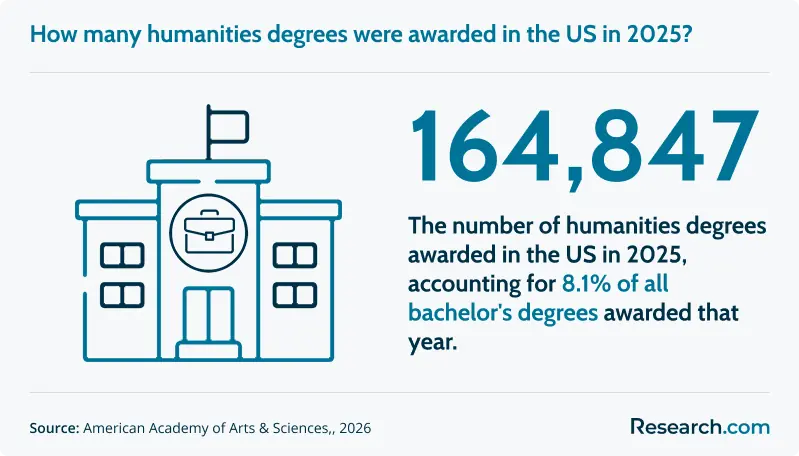
According to the American Academy of Arts & Sciences' Humanities Indicators, which draws on federal IPEDS data, US colleges awarded 164,847 bachelor's degrees in the humanities in 2025. That is 30.4% below the 2012 peak, and the humanities accounted for just 8.1% of all bachelor's degrees awarded that year.
For online learners, this decline has a practical upside. Colleges are redesigning humanities programs to attract working adults, and accelerated online formats are a big part of that effort.
How many college students already study online?
Online study is now mainstream, so an accelerated online humanities degree is no longer an unusual choice. Data from the National Center for Education Statistics (NCES) show that more than half of US undergraduates took at least one distance education course in fall 2024.
Of the 16.4 million undergraduates enrolled that fall, 3.9 million studied exclusively online. Another 5.1 million mixed online and in-person courses, while 7.4 million took no distance courses at all.
This scale matters for anyone weighing a fast-track humanities degree. Large online enrollments have pushed colleges to build stronger digital libraries, writing centers, and advising services, all of which humanities students rely on heavily.
The humanities majors that finish fastest online are the ones with flexible, broad requirements. These include degrees in liberal studies, interdisciplinary studies, general studies, English, history, communication, and humanities with a self-designed concentration.
Liberal and interdisciplinary studies are usually the quickest because they accept the widest range of transfer courses. Almost any college-level credit can count toward the major, so less of your past work is wasted. English and history programs tend to require a fixed set of upper-level courses, which can add a term or two.
Cost often goes hand in hand with speed. Paying per credit and moving through more credits per term usually lowers the total bill, which is why students comparing cheap online degrees often end up looking at accelerated humanities programs. Flat-rate subscription tuition, offered by some competency-based schools, rewards students who complete many courses within one pricing period.
The students who finish fastest are rarely brand-new freshmen. They are usually adults who already have college credit, steady study habits, and a clear reason to finish, such as a promotion or a graduate school plan.
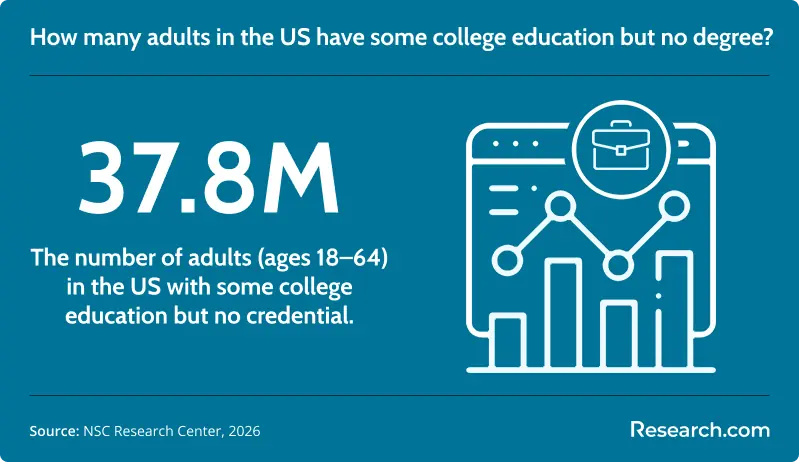
That group is large. The National Student Clearinghouse (NSC) Research Center reports that 37.8 million US adults ages 18 to 64 had some college but no credential at the start of the 2024–25 academic year. About 1.03 million of them re-enrolled in 2024–25, an increase of 3.4% over the prior year.
If you fall into this group, an accelerated humanities program lets you turn old credits into a finished degree. Before you enroll, request an unofficial transcript evaluation so you know exactly how many credits will carry over.
A humanities degree builds writing, research, and communication skills that employers in media, business, and the public sector rely on. Many of these roles list a bachelor's degree as the typical entry-level requirement, so finishing quickly can mean entering the field sooner.
The US Bureau of Labor Statistics (BLS) reports that media and communication workers earned a median annual wage of $74,250 in May 2025, compared with $50,980 for all occupations. Technical writing stands out, with a median of $90,390.
Humanities graduates also work in education, nonprofit management, human resources, marketing, and government. Those who move into management later in their careers sometimes return for a phd organizational leadership program to qualify for executive and consulting roles.
For most students, yes, because a bachelor's degree raises earnings and lowers unemployment risk. BLS data for 2024 show that full-time workers with a bachelor's degree earned a median of $1,543 per week, against $1,020 for those with some college but no degree. Their unemployment rate was 2.5%, compared with 3.8%.
Finishing in under two years adds to that return. Every term you save is a term of tuition you do not pay and a term sooner that you can earn at a degree holder's wage.
An accelerated online humanities degree is also a strong base for graduate study. Graduates with a background in languages, linguistics, or communication often move into online speech pathology programs, which build directly on the language and analysis skills a humanities major develops.
How do you choose the fastest online humanities degree program for you?
The right program is accredited, transparent about transfer credit, and built for the pace you can actually sustain. Think one step ahead, too: if you plan to become a licensed counselor, check that the graduate schools you are considering offer cacrep accredited programs, and use your electives to cover their psychology prerequisites.
Use this checklist when comparing programs:
- Accreditation: Confirm the school is accredited by an agency recognized by the US Department of Education.
- Transfer policy: Ask how many credits you can transfer, including exam credit and prior learning credit.
- Term length and start dates: Shorter terms and monthly starts reduce downtime between courses.
- Pricing model: Compare per-credit tuition against flat-rate terms based on how many courses you can handle.
- Support services: Look for online tutoring, library access, writing help, and an assigned advisor.
- Course load limits: Some programs cap how many accelerated courses you can take at once, which sets your real finish date.
Other Things You Should Know
Yes, but it usually depends on how many credits you bring with you. Students who transfer in 60 or more credits, or who earn credit through exams and prior learning, can often complete a bachelor's degree in 12 to 20 months with year-round accelerated terms. Students starting with no credits will typically need longer unless they take a heavy course load in a competency-based program.
Employers generally care about accreditation, not how fast you finished or whether you studied online. A degree from a regionally or nationally accredited school carries the same credential as its on-campus version, and most diplomas do not mention the delivery format. Strong writing samples, internships, or a portfolio will help you stand out further.
Plan on roughly 15 to 20 hours per week for each accelerated course, since an 8-week course covers the same material as a 16-week one. Taking two courses at once can feel like a full-time job. Many working adults take one course per term to keep a steady but manageable pace.
Yes. Graduate programs look at your GPA, writing ability, and recommendations rather than how long your degree took. A humanities background is especially useful for graduate study in law, education, library science, counseling, communication sciences, and public administration, as long as you complete any required prerequisite courses.
- American Academy of Arts & Sciences, Humanities Indicators. (2026). Bachelor's degrees in the humanities. AMACAD.
- National Student Clearinghouse Research Center. (2026). Some college, no credential: 2026 report for the nation and the states. NSC Research Center.
- NCES. (2026). Digest of Education Statistics 2025, Table 311.15: Number and percentage of students enrolled in degree-granting postsecondary institutions, by distance education participation, fall 2023 and fall 2024. NCES.
- BLS. (2025). Education pays, 2024. Career Outlook. BLS.
- BLS. (2026). Media and communication occupations. Occupational Outlook Handbook. BLS.