2027 Humanities Degree Careers That Do Not Require Graduate School
Audited and Verified:
Our Editorial and Data Verification Process
Research.com uses government datasets, official education statistics and primary institutional information to support its career and degree guides. Our review process checks factual accuracy, occupational definitions, source dates and the requirements associated with the credentials discussed.
How This Article Was Fact-Checked
Our editorial team verifies salary estimates, employment projections, education requirements and program information against original data providers and official organizations. Salary figures are checked against the relevant occupational definitions and reporting periods. Information about licensure, accreditation and required in-person training is reviewed separately.
Fact-checked and verified on:

Co-Founder and Chief Data Scientist
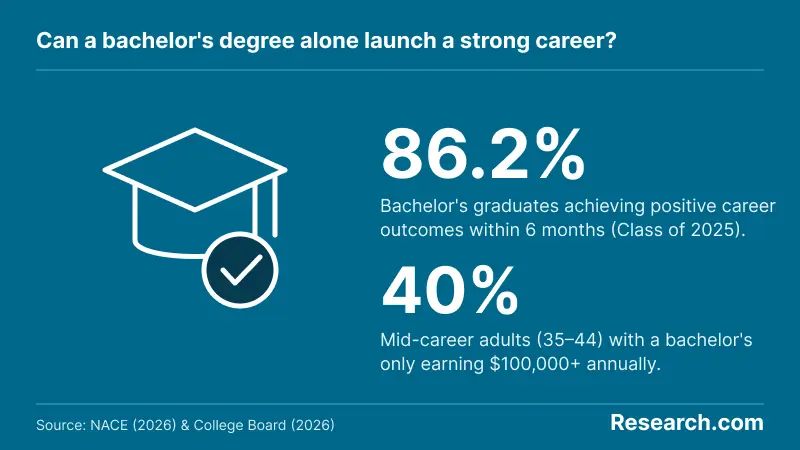
The pressure to make the most out of a humanities degree can often push graduates to pursue advanced credentials. Not only can this be an expensive venture, it may also be unnecessary. Data from the NACE illustrates this point: bachelor’s degree graduates had a career outcomes rate of 86.2%, just three percentage points behind the master’s graduates’ 89%.
Paycheck sacrifices, employment difficulties, and industry pressure make the gap bigger than it seems. As such, this article unpacks this assumption and explores humanities degree careers that do not require graduate school, what that looks like in terms of your salary and skills, and addresses a few myths along the way.
Key Things You Should Know
- Nearly 40% of mid-career adults who have not pursued further study beyond a bachelor’s degree earn upwards of $100,000 a year.
- Prime-age humanities bachelor’s degree holders earn anywhere between $40,000 to $105,000 a year.
- The most in-demand skills by employers include communication, teamwork, and critical thinking — skills you can gain at a bachelor’s degree level.
Can you really build a strong career with just a bachelor’s degree in the humanities?
The answer is yes, and it’s backed by data. If your main concern is that a bachelor’s degree might be insufficient for higher-level positions, a College Board report in 2026 found that 40% of mid-career adults with a bachelor’s degree earn more than $100,000 a year. For transparency, the figure is 58% for those with advanced degrees. If your concern is more specific to your humanities degree, then Georgetown University’s 2025 data indicates that humanities graduates earn between $48,000 to $105,000 in their prime.
It’s an undoubtedly wide range, but it’s not inexplicable. For one, the lower-end of spectrum may be based on fulfillment-based roles, such as non-profit positions or arts-based jobs. It could also be an average taken from humanities graduates who chose freelancing and thus earn a varying amount year by year.
As for the higher-end of the range, it can be attributed to their choice of work and early career planning strategies. As such, if you’re to build a career that aims for the upper-end of the spectrum, then you’ll have to be prepared, adaptable, and opportunistic.
Which career tracks welcome humanities majors with no graduate school?
When you start looking for humanities careers without graduate school, it may be immediately apparent that roles often fall into three categories:
- Words and Narrative: This category is for those who have a knack for telling stories and may prefer working alone or with a small team. This is where roles like public relations specialist ($74,750 per year), editors ($77,920), and writers ($76,910) fall, all of which are accessible with a bachelor’s degree.
- People and Operations: For those who find satisfaction in making sure that processes in a company are well-oiled and smooth, then you can explore bachelor-entry roles like human resources specialists ($75,940) and training and development specialists ($69,280). You might benefit from an added business administration degree, but that might be overkill, especially if you finished your humanities degree with hands-on internships and experience.
- Rules and Policy: Graduates with an extraordinary sense of fairness and ethics can make a career out of it through roles like compliance officers ($80,730) and paralegals ($62,890). It capitalizes on your ability to comprehend and implement policies, which could be interesting to someone who enjoys simplifying complex text and knowing what it means in practice.
What are the highest-paying humanities careers without a master’s or PhD?
High-paying humanities jobs aren’t mythical or unrealistic; they only require patience and effort, especially at the beginning of your career. Fields under the humanities umbrella are more likely to benefit from experience, adaptability, and skill acquisition over time. That said, it’s not unreasonable to expect fair compensation from the start. Your options include:
- Project Management Specialists ($102,320)
- Technical Writers ($90,390)
- Compliance Officers ($80,730)
- Market Research Analysts ($78,760)
- Editors ($77,920)
- Writers & Authors ($76,910)
As you’ve likely noticed, these jobs encompass different industries and settings. This is the primary benefit of a humanities degree without graduate school. It hones your ability to grasp information, understand the human condition, and navigate complexity.
This breadth ensures transferable skills and is also the primary reason why it may take time for humanities graduates to see a $100,000 annual salary. Think of the degree as a brand-new workbench equipped with the basic tools. What goes into the drawers—what gets added and what you need to invest in—will only be clear to you as you pick your niche, encounter challenges, and grow. This is why graduates sometimes go on to pursue specific credentials, such as a cheap online accounting degree.
If you want to narrow down your skills to the most relevant for as many industries as possible, you can. The NACE released a 2026 update on this topic and found that, on a 5-point scale, employers rated the following skills as the most important:
- Communication (4.5)
- Teamwork (4.5)
- Critical Thinking (4.4)
- Professionalism (4.3)
- Technology (4.0)
Most of these skills can be honed throughout your degree. Communication, for example, is naturally honed through a deeper understanding of diverse cultures, while critical thinking may be developed through assigned readings.
Once you know what skill your prospective employers are looking for, how you present them in your resume can determine how you appeal to recruiters. Skill-based hiring for humanities majors is common, and 59% of employers would prefer if you listed specific skills and provided examples. Don’t write a novel, but make sure to highlight your skills in practice, whether it’s in designing compliant AI workflows for companies, faithfully translating an important foreign text, or editing a user guide.
Applying for entry-level humanities jobs is a strategic start to what can be a high-paying career. To illustrate — editors often begin as editorial assistants, training & development specialists may begin as junior HR professionals, and compliance officers may have a background as a paralegal. These entry-level jobs give you an opportunity to learn from those who have been in the trade for longer and have honed skills that may not have been taught to you during your humanities degree.
To qualify for these entry-level jobs, you often just need your bachelor’s degree. However, if you want to start farther down the path, then you can add further study on your resume. It doesn’t have to be a graduate degree. In fact, 81% of employers perceive microcredentials positively. UX/UI design, digital marketing, and qualitative research are prime examples of microcredentials that you might want depending on the position you’re applying for. Career changes, on the other hand, could pursue associate degrees or even quick bachelor’s degrees like an accelerated human services degree online.
Considering how available humanities careers without graduate school are, the main obstacle to qualifying for them may just be your misconceptions and apprehensions. For example:
- Your job search is limited because your search queries are limiting. Searching for “history major jobs” or “writing positions” yield fewer results than if you use a skills-based search, such as “research”, “documentation”, or “close reading”.
- You’re applying for roles that require experience and you think that you need to supplement your degree with additional credentials or even rush toward accelerated MBA programs. In reality, you can gain experience through internships or perceive stepping-stone roles as opportunities to hone your skills and gain what you need for higher-level positions.
- You’re looking in the wrong places and relying on third-party job search sites. The humanities community is tight-knit. If you can’t find an opportunity that aligns with your skills and preferences, you can tap your connections, mentors, and even your college’s career support.
Consider graduate school only when it’s the natural progression to your humanities career. Specifically, if the position you want to qualify for requires more advanced knowledge and skills that you can’t gain through your degree or experience. This is often applicable to technical fields, such as law and medicine, especially if you’re aiming for technical or professional writing roles in those areas.
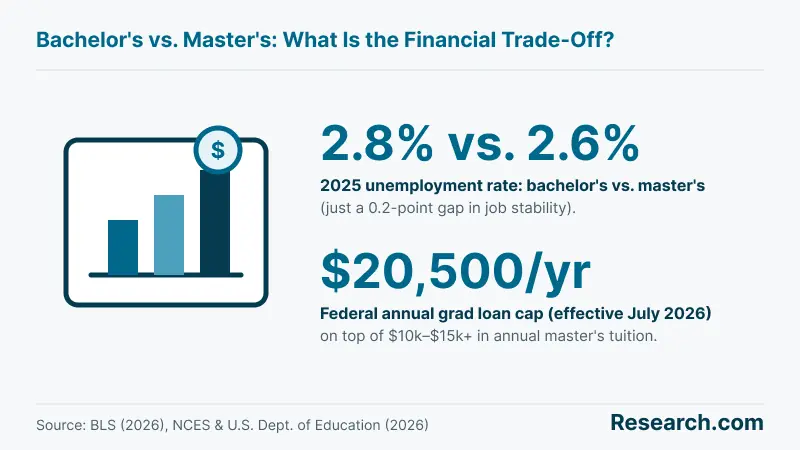
Graduate school has a significant financial impact. Not only does it cost anywhere between $10,000 to $16,000 a year, according to the NCES, graduate school may also require you to borrow up to $20,500 a year in student loans. Preemptively enrolling in advanced degrees or even one year doctoral programs can be a sound strategy, but ensure that the return on investment justifies the cost.
How should you launch your humanities career without grad school?
Start from the beginning. Choose any one of the entry-lane humanities careers that do not require graduate school. Base it on your degree, specific skillset, and preferences. Once you know what they’re looking for, consider your projects and internships and organize them into a portfolio that illustrates your specific skills. Finally, commit to gaining experience for one to two years before you ever consider graduate school.
Other Things You Should Know About Humanities Degrees
Technical writers earn more than $90,000 per year, while those in non-traditional humanities careers can earn upwards of $100,000 for roles like project management specialist.
Yes. Portfolio-based roles like content writing, editorial assisting, and writing prioritize the projects that you’ve already finished and submitted.
It can be, especially if you’re in corporate roles. A microcredential or certificate can be more beneficial and valuable than a full master’s degree.
No. Current data shows equal job satisfaction for those with a terminal bachelor’s degree and those who went on to pursue advanced degrees.
- American Academy of Arts & Sciences. (2023). Advanced Degrees in the Humanities. Humanities Indicators. American Academy of Arts & Sciences.
- American Association of Colleges and Universities (AACU). (2025). Findings Show Clear Alignment Between Liberal Education Outcomes and Evolving Workforce Needs. Press Release. AACU.
- Bureau of Labor Statistics (BLS). (2025). Field of degree: Humanities employment and wages. Career Outlook. BLS.
- Bureau of Labor Statistics (BLS). (2026). Occupational Outlook Handbook. Publications. BLS.
- Carnevale, A. P., Morris, C., Campbell, K. P., & Cheah, B. (2025). The major payoff: Evaluating earnings and employment outcomes across bachelor's degrees. Georgetown University Center on Education and the Workforce. Georgetown University.
- College Board. (2026). A College Degree Still Pays Off—But Student Choices Matter. Newsroom. College Board.
- National Association of Colleges + Employers (NACE). (2026a). 2026 First Destinations for the College Class of 2025. NACE.
- National Association of Colleges + Employers (NACE). (2026b). 2026 Job Outlook: Spring Update. NACE.
- Palmer, K. (2025). In ‘Rocky’ Labor Market, Your College Major Matters. Careers. Inside Higher Ed.