2027 Easiest Online Humanities Degree Programs That Pay Well: High-Salary Degrees with Simple Admissions
Audited and Verified:
Our Editorial and Data Verification Process
Research.com uses government datasets, official education statistics and primary institutional information to support its career and degree guides. Our review process checks factual accuracy, occupational definitions, source dates and the requirements associated with the credentials discussed.
How This Article Was Fact-Checked
Our editorial team verifies salary estimates, employment projections, education requirements and program information against original data providers and official organizations. Salary figures are checked against the relevant occupational definitions and reporting periods. Information about licensure, accreditation and required in-person training is reviewed separately.
Fact-checked and verified on:

Co-Founder and Chief Data Scientist
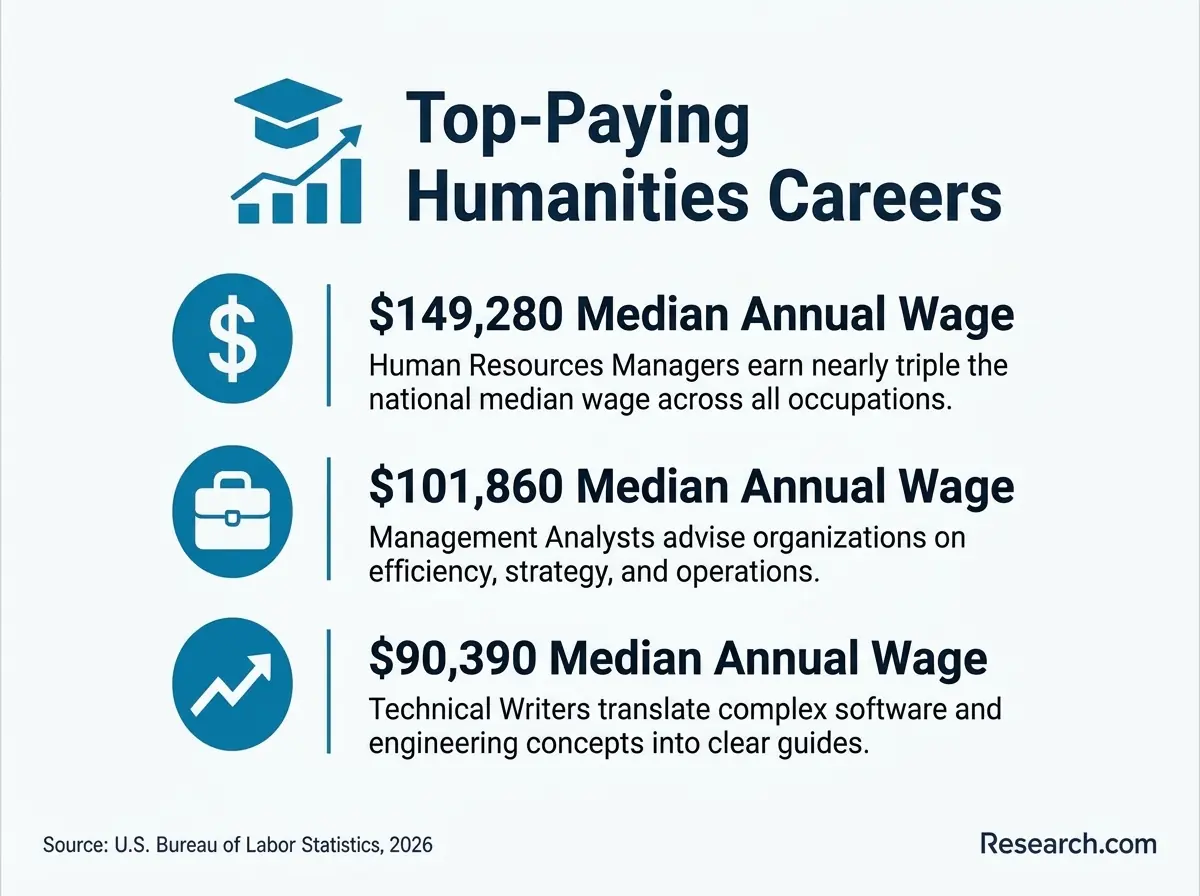
Despite persistent stereotypes about low-paying liberal arts careers, the U.S. Bureau of Labor Statistics data show that jobs accessible with a humanities bachelor's degree often pay more than the $50,980 national median annual wage. Technical writers earn $90,390, while human resources managers earn $149,280. Better yet, earning a degree no longer requires navigating rigid academic requirements.
Today's accredited online humanities programs remove common enrollment barriers. They offer test-optional admissions, no prerequisite coursework, and generous transfer policies that accept up to 90 credits. At flat-rate universities, this can reduce remaining tuition to roughly $10,620. This guide explores the easiest-to-enter online humanities degrees, their true costs, and the career pathways that can lead to six-figure earning potential.
Key Things You Should Know
- Most accredited online humanities programs waive SAT/ACT scores, personal essays, and recommendation letters. Instead, they require only a high school diploma or GED and offer rolling start dates every 5 to 8 weeks. Together, these features let adult learners and transfer students enroll quickly at regionally accredited institutions.
- Humanities majors are not limited to low-paying academic or nonprofit roles. Pairing communication and analytical skills with targeted credentials such as data analytics, UX writing, SHRM-CP, or PMP opens doors to high-paying corporate careers, including technical writers ($90,390 median), management analysts ($101,860 median), and human resources managers ($149,280 median).
- Using up to 90 transfer credits alongside low-cost alternatives like CLEP exams or ACE-recommended courses at flat-rate online universities ($354–$385 per credit) can shorten a 4-year degree to 10–12 months and reduce remaining tuition to roughly $10,620.
Which Online Humanities Bachelor's Degree Programs Have Simple Admissions?
Online humanities programs with streamlined admissions make enrollment easier while maintaining regional accreditation. Applicants are not required to submit academic portfolios, attend auditions, or complete prerequisite college coursework. Accessible bachelor's programs in liberal studies, English, communications, and history primarily consider high school completion or transcripts from previous college coursework.
Institutions designed for adult learners and transfer students typically feature:
- Minimal baseline credentials: A high school diploma or GED, often with a flexible minimum GPA requirement (commonly 2.0 to 2.5).
- Waived application barriers: No mandatory personal essays, letters of recommendation, or application fees.
- Rolling enrollment windows: Multiple start dates throughout the year, often every 5 to 8 weeks, eliminating rigid fall-only admission deadlines.
Are There Test-Optional Online Humanities Degrees Without SAT or ACT Requirements?
Yes, most accredited online Humanities bachelor's degree programs in the United States do not require SAT or ACT scores for admission. These programs often serve working professionals, military service members, and community college transfers. As a result, admissions committees generally see standardized test scores as limited predictors of adult academic success.
Even at public state universities that consider test scores for traditional first-year applicants, adult and online degree-completion programs usually waive testing requirements. Students who graduated from high school more than two years ago or transfer with at least 12 to 24 college credits can usually apply without standardized test scores.
This test-optional approach also extends to graduate-level study for humanities graduates looking to advance into human services or clinical careers. Many CSWE-accredited online MSW programs waive GRE requirements and accept bachelor's degrees from any regionally accredited major. Instead, they evaluate applicants on undergraduate GPA, relevant experience, and personal statements.
Which Online Humanities Majors Offer the Highest Earning Potential?
All humanities degrees build transferable skills in critical analysis, research, and persuasive communication. However, majors that connect with business, technology, or regulatory policy tend to lead to higher starting and mid-career salaries. In the corporate job market, programs that combine qualitative reasoning with quantitative skills or technical writing often outperform purely theoretical tracks.
The highest-earning online humanities concentrations include:
- Economics (Bachelor of Arts): Combines liberal arts inquiry with market analysis, preparing graduates for roles as financial analysts (103,570 median pay) or management analysts (101,860 median pay).
- English & Professional/Technical Writing: Students learn how to turn complex software, engineering, and medical information into clear documentation. This prepares them for jobs like technical writer (median pay: $90,390) or editor (median pay: $77,920).
- Communications & Media Studies: This field offers a clear path into corporate messaging, brand strategy, and public relations management. Median wages are $74,750 for public relations specialists and $146,910 for public relations managers. For public relations and fundraising managers combined, the median is $136,470.
- Philosophy & Applied Ethics: Increasingly valued in corporate governance, compliance, and artificial intelligence ethics frameworks, supporting careers such as compliance officers ($80,730 median pay).
What Are the Highest-Paying Career Paths for Humanities Graduates?
Graduates with online humanities degrees often find well-paying jobs in management, consulting, technology, and corporate communications. Their career options are not limited to academia or nonprofits. U.S. Bureau of Labor Statistics (BLS) Occupational Employment and Wage Statistics show that several careers open to humanities bachelor's degree holders pay more than the national median wage of $50,980 across all occupations.
Top-paying roles and their May 2025 BLS median annual wages include:
| Human Resources Manager | $149,280 |
| Management Analyst | $101,860 |
| Technical Writer | $90,390 |
| Market Research Analyst | $78,760 |
| Public Relations Specialist | $74,750 |
| Editor | $77,920 |
Beyond corporate and communications roles, a humanities background also serves as a strong foundation for graduates interested in mental health and human services. Many students leverage their bachelor's degree in psychology, sociology, or liberal studies to pursue an accredited counseling degree online, preparing for licensed clinical practice, school counseling, or organizational wellness roles while maintaining flexible, remote study schedules.
Technology and corporate employers actively recruit humanities graduates to bridge the gap between technical engineering teams and end users. While engineers build software and data models, organizations rely on writers, ethicists, and communicators to make products usable, compliant, and persuasive.
Humanities graduates typically enter high-paying corporate and tech tracks through three primary pathways:
- UX Content Design & Technical Documentation: Applying English and linguistics training to write user interface microcopy, API documentation, and software onboarding guides.
- AI Ethics & Regulatory Compliance: Leveraging philosophy, history, and political science backgrounds to audit algorithmic bias, draft data-privacy policies, and manage corporate risk.
- Change Management & People Operations: Using psychology, sociology, and communications expertise to lead corporate training, talent acquisition, and organizational restructuring.
A standard bachelor's degree requires 120 semester credits and typically takes four years of full-time study on a traditional academic calendar. Many accredited online humanities programs offer accelerated courses that last 7 to 8 weeks. These courses run year-round across six sessions, so motivated students can finish much faster than they would in a two-semester system.
Depending on enrollment intensity and prior college experience, completion timelines generally fall into three tiers:
- Zero prior credits (full-time accelerated): 2.5 to 3 years by taking two courses per 8-week term year-round (36 credits annually).
- Associate degree or 60 transfer credits: 1.5 to 2 years of full-time online study.
- Maximum transfer credits (up to 90 credits): As little as 10 to 12 months to finish the remaining 30 residency credits required for graduation.
Finishing an undergraduate degree on an accelerated schedule also helps working professionals move into graduate-level management training sooner. Experienced graduates who advance into leadership roles often pursue an EMBA online, which typically spans 18 to 24 months and pairs strategic business coursework with flexible virtual or weekend modules.
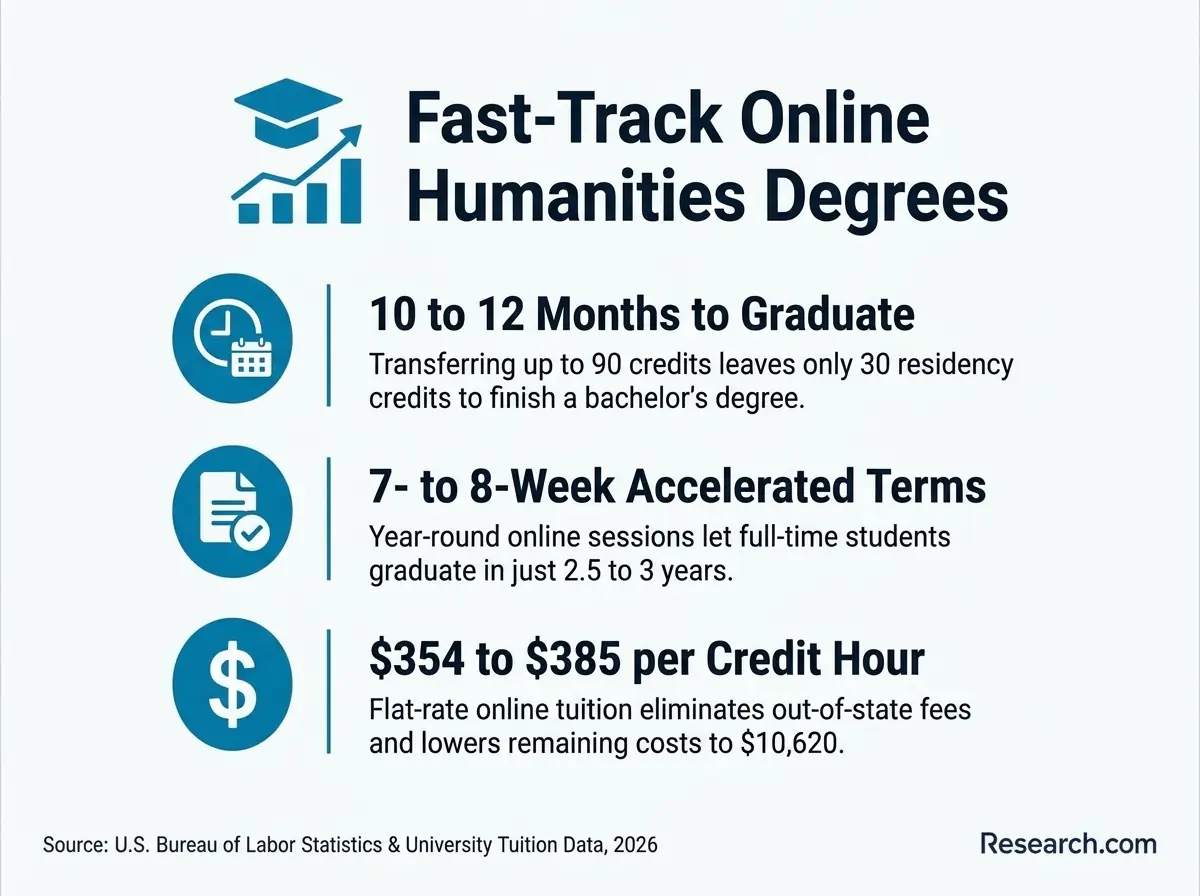
Generous transfer policies are the most effective way to cut both graduation time and total tuition costs. Many online universities accept up to 90 transfer credits toward a 120-credit bachelor's degree. This means that students need to complete only the final 30 upper-level credits at the degree-granting institution.
Beyond traditional community college transcripts, students can accelerate degree completion through the following alternative credit pathways:
- Credit-by-Exam Programs: Passing standardized exams through CLEP or DSST earns 3 to 6 college credits per test at roughly $32 to $42 per credit (including exam and proctoring fees).
- ACE-Recommended Online Coursework: Completing self-paced general education courses through platforms like Study.com or Sophia Learning transfers directly into partner universities.
- Prior Learning Assessments (PLA) & Military Transcripts: Universities award academic credit for verified workplace training, professional certifications, portfolio reviews, and Joint Services Transcripts (JST).
Affordable accredited online humanities programs typically charge $300 to $450 per credit hour, regardless of whether the student is in-state or out-of-state. Because online learners do not use campus housing, athletic facilities, or physical classrooms, flat-rate online tuition models eliminate the need for expensive out-of-state surcharges.
For example, Southern New Hampshire University charges $1,062 per 3-credit course, with no application or mandatory per-course technology fees. The University of Massachusetts Lowell charges $1,155 per 3-credit course for online undergraduate coursework. At $354 per credit, a full 120-credit degree has a sticker price of $42,480 before financial aid. Transferring 90 credits reduces the remaining tuition to $10,620.
Keeping undergraduate tuition low also frees up financial resources if you plan to pursue graduate credentials later. Many humanities graduates build on their bachelor's degree by enrolling in accelerated one year online masters programs in fields like management, education, or sociology, allowing them to earn an advanced qualification in 12 months without taking on heavy student debt.
Choosing a regionally accredited, nonprofit university ensures your degree is recognized by corporate employers, federal financial aid programs, and graduate schools. The best-value institutions combine low, flat-rate tuition with high transfer-credit caps and broad curricular flexibility.
Notable accredited universities offering accessible, high-value online humanities degrees include:
- Southern New Hampshire University (SNHU): Offers online B.A. programs in Liberal Studies, English, Communication, and History at $354 per credit, accepts up to 90 transfer credits, and requires no application fee or SAT/ACT scores.
- University of Massachusetts Lowell: Provides an online Bachelor of Liberal Arts (BLA) with customizable concentrations at $385 per credit and generous credit-for-prior-learning options.
- University of Illinois Springfield: Features an online B.A. in Liberal Studies and History with e-tuition rates for online learners and strong academic advising for degree-completers.
- Fort Hays State University: Known for some of the lowest online undergraduate tuition rates in the nation alongside flexible general studies and communications tracks.
What Certifications and Add-On Skills Maximize a Humanities Degree's ROI?
Pairing a broad humanities education with targeted, industry-recognized credentials signals to hiring managers immediate job readiness. Because humanities majors already possess strong writing and critical-thinking skills, adding a single technical or business credential substantially increases starting salary offers.
High-ROI add-on skills and certifications include:
- Data Analytics & Visualization: Certificates in SQL, Excel, Tableau, or Google Data Analytics qualify humanities majors for market research ($78,760 median) and business operations roles.
- UX Writing & Content Strategy: Building a portfolio of interface copy, user journey maps, and content audits prepares English and communications majors for tech product teams.
- Project Management (CAPM or PMP): Validates organizational and leadership capabilities for corporate consulting and operations management.
- Human Resources Credentials (SHRM-CP): Positions liberal arts graduates for accelerated advancement into high-paying HR specialist (75,940 median) and HR manager(149,280 median) roles.
Beyond short, single-skill badges, many accredited universities and industry providers offer online certification programs that people can complete part-time in just a few months. Adding one of these credentials to a humanities bachelor's degree can help graduates move into in-demand fields such as project coordination, digital marketing, and business operations—without going back for another four-year degree.
- American Council on Education. (n.d.). The ACE National Guide. https://www.acenet.edu/national-guide
- College Board. (n.d.). Register for an exam. CLEP. https://clep.collegeboard.org/register-for-an-exam
- Fort Hays State University. (2026). FHSU online tuition. https://www.fhsu.edu/online/admissions/tuition/
- Southern New Hampshire University. (n.d.). How much is tuition? Online tuition costs. https://www.snhu.edu/tuition-and-financial-aid/online
- University of Illinois Springfield. (n.d.). Online programs and tuition. https://www.uis.edu/online
- University of Massachusetts Lowell. (n.d.). Tuition and fees. Division of Graduate, Online & Professional Studies. https://gps.uml.edu/paying-for-college/tuition-and-fees.cfm
- U.S. Bureau of Labor Statistics. (2026, May 15). Occupational employment and wage statistics: May 2025 national occupational employment and wage estimates. U.S. Department of Labor. https://www.bls.gov/oes/2025/may/oes_nat.htm