2027 SLP Certifications to Advance Your Career

Co-Founder and Chief Data Scientist

Reviewed by Rhea Paul, PhD
SLP Education & Research Expert
Which SLP certification is worth pursuing after - or before - you qualify to practice? The answer depends on whether you need an entry-to-practice credential, want to demonstrate advanced clinical expertise, or are considering training focused on a particular population. Those options serve different purposes, and none automatically replaces a state license. This guide compares major speech-language pathology credentials, explains their requirements and costs, and shows how to check whether a certification will matter for the role you want.
Key Things You Should Know
- The CCC-SLP is ASHA's general clinical certification; state licensure is a separate legal requirement, and specialty credentials generally build on established clinical practice.
- Board-certified specialties include swallowing, fluency, child language, and neurologic communication disorders; an autism-focused course certificate should not be mistaken for an ASHA-recognized board specialty.
- The U.S. Bureau of Labor Statistics projects 17% employment growth for speech-language pathologists from 2025 to 2035, but no additional certification guarantees a job or pay increase.
- What SLP certifications can advance your speech-language pathology career? SLP Certifications
- Which SLP certification best matches your career goals and current credentials? Best Certification
- What is the difference between ASHA certification, state licensure, and specialty credentials? Certification Differences
- How does the CCC-SLP credential affect employment, licensure, and professional mobility? CCC-SLP Impact
- Which certification path offers the strongest career value for different SLP roles? Career Value
What SLP certifications can advance your speech-language pathology career?
Start by separating credentials that establish broad professional qualifications from those that signal a clinical focus. The Certificate of Clinical Competence in Speech-Language Pathology (CCC-SLP), issued by the American Speech-Language-Hearing Association (ASHA), is the principal national certification for qualified SLPs. Specialty board certifications recognize more advanced work in defined practice areas. Other offerings may certify completion of a training course rather than independently assess advanced clinical competence.
The comparison below shows what each category can reasonably tell an employer or client. Recognition still depends on the setting, job description, and credentialing body.
| Credential type | Examples | Best fit | Important limitation |
| General professional certification | CCC-SLP | SLPs establishing nationally recognized clinical qualifications | Does not itself authorize practice in every state |
| Specialty board certification | Swallowing, fluency, child language, or neurologic communication disorders | Experienced clinicians with a sustained specialty caseload | Eligibility and renewal differ by board |
| Focused training or private credential | Autism-focused, AAC, voice-treatment, or instrumental-assessment training | Clinicians developing a specific service or technique | Course completion is not equivalent to specialty board certification |
If you do not yet hold the qualifying graduate degree, additional specialty training cannot substitute for it. Compare degree formats - including intensive online speech pathology programs - against accreditation, clinical training, and your state's licensure rules before focusing on post-degree certificates.
Which SLP certification best matches your career goals and current credentials?
Choose the credential that closes a real qualification gap. If you are entering the profession, prioritize the graduate education, supervised experience, examination, and state requirements needed for practice. If you already practice independently, look for a specialty credential that matches your caseload and the expertise employers actually request.
For example, an SLP who regularly evaluates dysphagia in a medical setting has a stronger reason to investigate swallowing board certification than an SLP whose work centers on school-age language. A clinician new to swallowing care may benefit more immediately from supervised experience and targeted training than from pursuing a board credential before meeting its experience requirements.
Career changers with a bachelor's degree outside communication sciences and disorders should first identify the prerequisite coursework required by prospective graduate programs. Cohort-based online speech pathology bridge programs may offer a structured route into that coursework, but a bridge is not an SLP license or the CCC-SLP.
What is the difference between ASHA certification, state licensure, and specialty credentials?
State licensure is legal permission to practice under a state's rules. ASHA certification is a national professional credential; the CCC-SLP demonstrates that its holder met ASHA's certification standards. Specialty certification is an additional recognition of expertise in a defined area, not a replacement for either a required license or general professional preparation.
The distinction matters because requirements can overlap without being identical. A state may use the CCC-SLP in its licensing process, while still requiring its own application and approval. School-based work may also involve separate state education-agency rules. Check the regulator for the state and setting where you intend to work rather than assuming one approval covers every role.
For prospective students, supervised university clinical practice, a post-degree clinical fellowship, certification, and licensure are different milestones. When comparing fast online speech pathology programs with supervised practice, confirm which experiences occur during the degree and which requirements remain after graduation.
How does the CCC-SLP credential affect employment, licensure, and professional mobility?
The CCC-SLP can make an applicant eligible for positions that specify ASHA certification and can provide a recognizable record of professional qualifications when changing employers or states. Its value is practical rather than automatic: an employer may require it, prefer it, or rely primarily on state licensure and demonstrated skills. You must still satisfy the rules of each state in which you seek to practice.
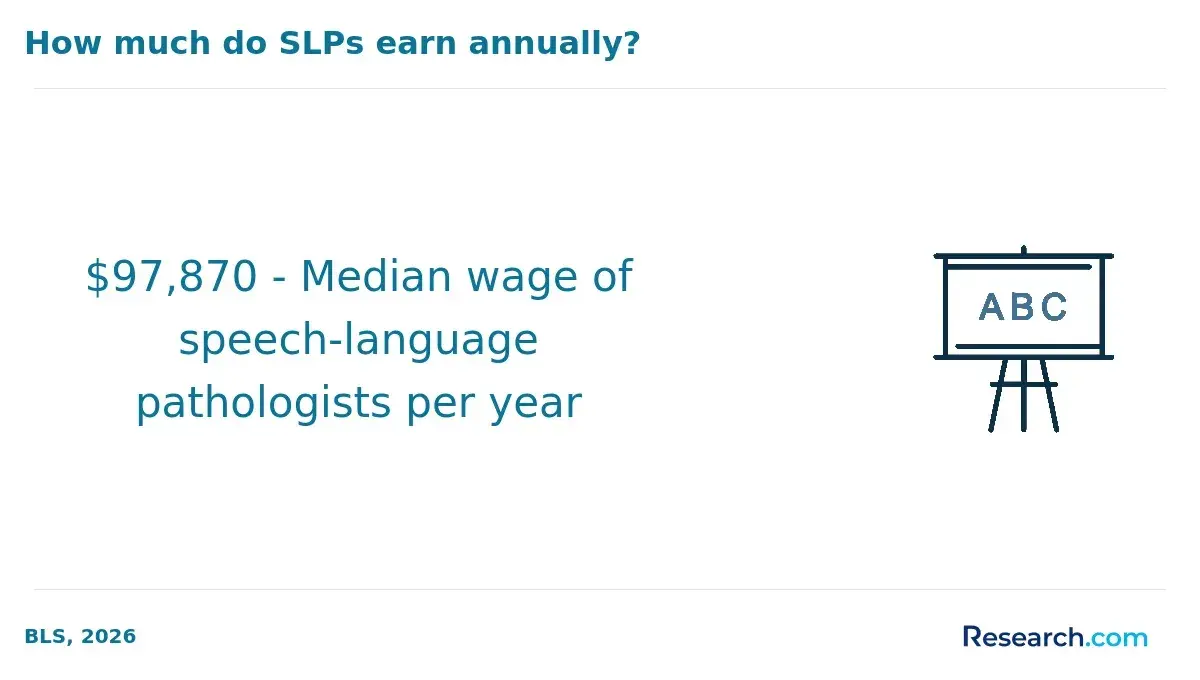
The U.S. Bureau of Labor Statistics reports a median annual wage of $97,870 for speech-language pathologists in May 2025. That occupation-wide figure is not a CCC-SLP premium or a forecast of what a newly certified clinician will earn. When assessing a job offer, compare its setting, responsibilities, location, and benefits; data on speech pathologist salary by experience can help frame those questions without treating certification as a salary guarantee.
Before paying to maintain a credential, read several relevant job postings and ask prospective employers whether they require an active CCC-SLP, accept an applicant completing a clinical fellowship, or have additional school or medical-setting requirements.
Which SLP specialty certifications are available in areas such as swallowing, fluency, and autism?
Recognized SLP board-specialty pathways include swallowing and swallowing disorders, fluency and fluency disorders, child language and language disorders, and neurologic communication disorders. The applicable board - not ASHA's general CCC-SLP application - sets each specialty's detailed eligibility, assessment, and maintenance rules.
Autism requires closer scrutiny because similarly named offerings can represent very different achievements. An autism-focused certificate may document coursework or training offered by an independent organization; it should not be described as an ASHA-recognized SLP board specialty without verifying that status. The same distinction matters for augmentative and alternative communication (AAC), voice methods, and instrumental swallowing assessments: useful training does not necessarily confer a board certification or independently establish competence to perform a procedure.
Match the offering to the work you want to do. For a hospital swallowing role, ask about supervised dysphagia experience and any procedure-specific competency assessment. For an autism-focused role, ask whether the employer values a particular credential or instead prioritizes experience with communication assessment, AAC, and collaborative care.
What eligibility requirements apply to major SLP certification programs?
For the CCC-SLP, applicants generally need a qualifying graduate degree, required academic and supervised clinical preparation, a passing national examination, and a completed clinical fellowship under ASHA's current standards. ASHA describes the clinical fellowship as at least 36 weeks and 1,260 hours. Confirm the standards that apply to your application, especially if your education or clinical training followed a nonstandard route.
Specialty boards typically expect an active professional credential, substantial practice in the specialty, documented experience, and an assessment or portfolio process. Requirements are not interchangeable: do not assume that eligibility for swallowing board certification also qualifies you for fluency board certification. Private autism or treatment-method credentials may have different prerequisites and should be evaluated on their own terms.
If you are still comparing master's programs, admissions accessibility is a separate question from certification eligibility. Resources on the easiest speech pathology master's programs to enter can help you identify options to investigate, but verify each program's current admissions criteria, accreditation status, and clinical preparation before applying.
How much do SLP certifications cost, and how long do they take?
There is no reliable single price for "SLP certification." Charges depend on the issuing organization, membership choices, application stage, assessment, renewal cycle, and any required training or travel. Because fee schedules change, use the issuer's current published prices rather than an older estimate when building a budget.
Request or look up the following prices before committing. Separating one-time charges from recurring costs makes competing pathways easier to compare.
- CCC-SLP: current application charges and ongoing certification or membership-related charges, as applicable to your status.
- Specialty board certification: application, examination or portfolio-review, and renewal prices charged by the relevant board.
- Focused courses or private credentials: tuition or registration, travel, materials, and any recertification prices.
The clinical fellowship's minimum duration is 36 weeks, but the overall time from entering a master's program to receiving the CCC-SLP also depends on degree completion, examination, fellowship scheduling, and application processing. A specialty board pathway generally takes longer to become eligible for because it requires relevant clinical experience; a short course may be completed sooner but carries a different level of recognition.
If graduate education is still ahead of you, separate that larger investment from credential fees. Investigate scholarships for online speech pathology master's students and compare total program costs, including required clinical travel, rather than judging affordability by tuition alone.
Which SLP certifications recognize advanced clinical skills or specialized expertise?
Specialty board certifications are the clearest fit when your goal is formal recognition of advanced practice in an established SLP specialty. They are more persuasive when your documented caseload, mentorship, and continuing education support the same focus. A credential alone should not be used to imply expertise across every condition within a broad field.
Focused training has a different, often immediate use. A course on an AAC system or treatment approach may help you learn a technique relevant to your current patients, while workplace supervision and competency checks help determine whether you can apply it appropriately. For procedures such as instrumental swallowing assessment, confirm your employer's privileging requirements and any applicable state rules instead of assuming a course certificate grants independent authority.
Ask a prospective credentialing body exactly what it evaluates: attendance, a test of knowledge, a review of clinical work, or demonstrated performance. That answer is more useful than the word "certified" on a marketing page.
How should SLPs verify certification recognition, renewal rules, and continuing education requirements?
Check requirements with the organization that issues the credential and with the regulator or employer that will recognize it. Standards and fees can change, and a credential's value depends partly on whether you can maintain it while meeting separate state obligations.
Use this sequence before applying or paying for training:
- Identify the exact credential name, issuing organization, and whether it is a general certification, board specialty, or course-completion certificate.
- Read the issuer's current eligibility, assessment, fee, renewal, and continuing-education rules; note any specialty-specific documentation you must retain.
- Confirm state licensure and, if relevant, school credential or employer privileging requirements for the work you intend to perform.
- Ask target employers whether the credential is required, preferred, or not considered for the specific role.
A common mistake is to count the same learning activity toward multiple renewals without checking each organization's rules. Another is letting a license or certification lapse while maintaining a less essential specialty certificate. Keep separate records and renewal dates for every credential you hold.
Which certification path offers the strongest career value for different SLP roles?
The strongest value usually comes from the credential that removes a hiring barrier or credibly supports work you already do. The Bureau of Labor Statistics projects about 12,500 SLP openings each year, on average, from 2025 to 2035. That signals broad occupational demand, not demand for every specialty certificate; local job requirements remain the better test of a credential's return.
For a student or clinical fellow, focus on the qualifications needed for state practice and the CCC-SLP if target employers expect it. For a school-based SLP, verify state education requirements before buying unrelated specialty training. For an established medical SLP with a substantial dysphagia caseload, swallowing board certification may align well with advancement goals. For a clinician serving autistic clients, targeted training may be valuable, but compare its assessed skills and employer recognition rather than relying on its title.
Before choosing, collect a few job descriptions for the role you want, identify repeated credential requirements, and estimate both the initial and renewal commitments. If a costly certificate appears in no relevant requirements and does not address a skill gap you can clearly name, supervised experience or a narrower course may be the better next investment.
References:
- U.S. Bureau of Labor Statistics - Speech-Language Pathologists https://www.bls.gov/ooh/healthcare/speech-language-pathologists.htm
- ASHA EdFind - Accredited Speech-Language Pathology Programs https://find.asha.org/ed/
- Audiology and Speech-Language Pathology Interstate Compact https://aslpcompact.com/compact-map/
- Ithaca College - Online Master of Science in Speech-Language Pathology https://slponline.ithaca.edu/programs/masters-speech-language-pathology-online
- New York University - Online MS, Communicative Sciences and Disorders (Speech@NYU) https://steinhardt.nyu.edu/degree/online-ms-communicative-sciences-and-disorders
- Auburn University, Montgomery - Master of Science in Speech-Language Pathology https://www.aum.edu/degree/ms-speech-language-pathology/
- Pennsylvania Western University - Master of Science in Speech-Language Pathology https://online.pennwest.edu/programs/speech-language-pathology-grad/index.php
- James Madison University - Master of Science (M.S.) in Speech-Language Pathology (Distance Education / Online) https://www.jmu.edu/chbs/csd/online_ms/index.shtml
Other Things You Should Know About Speech Pathology
Potentially, under the authorization and supervision rules that apply in your state and setting. Confirm the required license, provisional credential, or other approval before beginning work; a clinical fellowship is not permission to practice without it.
No short certificate replaces the qualifying graduate education and clinical preparation required for entry to SLP practice. Check the specific program's accreditation and your state's requirements if you are considering an online degree pathway.
Most specialty SLP certifications require the ASHA Certificate of Clinical Competence in Speech-Language Pathology (CCC-SLP) first. ASHA certification requires a graduate degree from an accredited program, a passing score on the Praxis Speech-Language Pathology exam, and completion of a clinical fellowship with supervised professional experience.
Possibly, if the activity meets ASHA's current maintenance rules and you document it properly. Check the course's eligibility and each credentialing organization's requirements; acceptance by one organization does not establish acceptance by another.