2027 Do Employers Respect Online MSW Degrees?

Co-Founder and Chief Data Scientist
Choosing an online MSW is not just a convenience decision. It affects licensure eligibility, field placement quality, employer confidence, cost, scheduling, and the type of social work career you can pursue after graduation. For working adults, caregivers, career changers, and BSW graduates seeking advanced standing, the right online program can make graduate school possible without relocating or leaving a job.
The key question is not whether the degree is online. Employers and licensing boards care most about accreditation, supervised field experience, clinical readiness, and whether you can meet state requirements. This guide explains how online MSW degrees are viewed by employers, how accreditation works, what to check before enrolling, and how program format may affect your career options, timeline, and earning potential.
Key Things You Should Know
- In 2026, approximately 78% of U.S. employers recognize online MSW degrees as equivalent to traditional ones for licensure and employment, reflecting growing acceptance.
- Accreditation by the Council on Social Work Education (CSWE) remains critical; employers prioritize candidates from CSWE-accredited online programs for quality assurance.
- Data from 2024 shows graduates with online MSWs secure jobs within six months as often as traditional graduates, highlighting equal career competitiveness.
Do Employers Respect Online MSW Degrees?
Yes, many employers respect online MSW degrees when they come from properly accredited programs and include strong supervised fieldwork. In social work hiring, the most important signal is usually not whether coursework was completed online or on campus. It is whether the program is accredited by the Council on Social Work Education (CSWE), whether the graduate is eligible for licensure, and whether the candidate can demonstrate practical skills with clients, agencies, documentation, ethics, and interdisciplinary teams.
Employer acceptance of online degrees has improved substantially. A 2025 University of Phoenix survey by The Harris Poll found that 98% of hiring leaders view online degrees as more credible than a decade ago. That shift matters for MSW students because online education is no longer unusual, especially among working adults who need flexible graduate options.
Still, respect is not automatic. Employers may look more carefully at online MSW graduates from lesser-known schools, programs without clear field placement support, or institutions with weak reputations. The strongest candidates make it easy for hiring managers to see that the degree met professional standards.
What employers usually look for
- CSWE accreditation: This is the central credential for MSW legitimacy in the United States.
- Field placement quality: Employers want evidence of supervised experience in relevant settings such as hospitals, schools, community agencies, behavioral health clinics, or child welfare organizations.
- Licensure readiness: Candidates should understand the pathway to LMSW, LCSW, or comparable state credentials where they plan to work.
- Skill evidence: Strong resumes describe assessment, case management, treatment planning, crisis response, advocacy, documentation, and ethical decision-making.
- Professional references: References from field supervisors often carry more weight than general academic recommendations.
Graduates of reputable online MSW programs can compete for roles such as clinical social worker, school social worker, healthcare social worker, child welfare specialist, case manager, program coordinator, and policy analyst. During interviews, online graduates should be ready to discuss their practicum setting, supervision model, client populations served, and how the program assessed practice skills.
Students planning long-term academic, leadership, or advanced clinical careers may eventually consider doctorate in social work programs. For most direct-practice roles, however, the more immediate priority is choosing a CSWE-accredited MSW with reliable field placement support and a clear path to state licensure.
Are Online MSW Degrees Accredited the Same as Campus Ones?
Online and campus MSW programs can be accredited under the same professional standard. The Council on Social Work Education (CSWE) accredits MSW programs based on educational quality, competencies, curriculum, assessment, and supervised field education. CSWE accreditation does not become weaker because a program is delivered online.
This distinction is critical. Licensing boards in every U.S. state require a degree from a CSWE-accredited program for licensure, and that rule applies equally to online and traditional degrees. If an online MSW is CSWE-accredited and meets state-specific requirements, graduates can generally pursue the same licensure pathway as campus-based students.
What accreditation does—and does not—tell you
- It confirms professional standards: CSWE accreditation indicates that the program has been reviewed against social work education requirements.
- It supports licensure eligibility: A CSWE-accredited MSW is typically required for social work licensure.
- It does not guarantee job placement: Accreditation helps, but hiring still depends on experience, interview performance, references, licensure status, and local labor demand.
- It does not replace state review: Students must still confirm requirements with the licensing board in the state where they plan to practice.
Prospective students should also confirm the institution's regional accreditation for online MSW degrees. Institutional accreditation and CSWE programmatic accreditation serve different purposes, and both can matter for credit transfer, federal aid eligibility, employer confidence, and graduate school recognition.
Field education deserves special attention. Practical fieldwork remains a mandatory, supervised part of accredited MSW training. Before enrolling, ask whether the school secures placements, helps students identify local agencies, approves employment-based placements, and has staff dedicated to resolving placement delays.
If cost is a major deciding factor, review tuition and aid options carefully before applying. Research.com provides additional guidance on how much does a masters in social work cost.
Can You Become a Licensed Social Worker with an Online MSW?
Yes, you can become a licensed social worker with an online MSW if the program is CSWE-accredited and meets the requirements of the state where you plan to practice. Online delivery by itself does not prevent licensure. The deciding factors are accreditation, field education, exam eligibility, supervised post-degree hours where required, and compliance with state board rules.
Most licensing pathways require candidates to complete a CSWE-accredited MSW, pass the Association of Social Work Boards (ASWB) exam, and complete supervised clinical hours when pursuing independent or clinical licensure. Requirements vary by state, so students should never rely only on a school’s general marketing language. They should verify details directly with the state licensing board.
Licensure checklist for online MSW students
- Confirm that the MSW program is CSWE-accredited.
- Ask whether the program provides support for local practicum placements.
- Check whether your state licensing board accepts degrees from that specific online program.
- Review whether your state requires post-degree supervised clinical hours.
- Confirm which ASWB exam applies to your intended license level.
- Ask whether the program’s field placements align with clinical, school, healthcare, or macro practice goals.
Many online MSW programs arrange or approve local practicum placements, allowing students to complete supervised training in their own communities. This can be a major advantage for students who plan to work in the same region after graduation because field placements often lead to references, networking, and job leads.
Employer acceptance also continues to grow. Over 70% of organizations hired online degree holders in the past year, highlighting broader acceptance of online education's rigor. Even so, licensing is separate from employer perception. A respected degree still must satisfy the legal requirements for practice in your state.
Because social worker requirements for online MSW graduates vary by state, students should review state-specific rules before enrollment, before field placement, and again before graduation. For compensation information by location, see the MSW degree salary guide by state.
The main differences between online and campus MSW programs are delivery format, scheduling structure, peer and faculty interaction, field placement logistics, and the level of self-direction required. When both programs are CSWE-accredited, the academic and professional standards should be comparable, but the student experience can feel very different.
Online MSW programs
Online MSW programs are usually best for students who need flexibility because of work, family responsibilities, location, military service, or limited access to a nearby campus. Coursework may be asynchronous, synchronous, or a mix of both. Students often complete assignments remotely while completing fieldwork in approved local settings.
The trade-off is that online students must be proactive. They need to manage deadlines, participate meaningfully in virtual discussions, communicate with faculty, and stay ahead of field placement requirements. A flexible format can become stressful if the program does not provide strong advising or placement support.
Campus MSW programs
Campus programs provide more face-to-face interaction with classmates, faculty, advisors, and local agency partners. Students who learn best through in-person discussion, structured schedules, and immediate access to campus resources may prefer this format. Campus programs may also have longstanding internship pipelines in the surrounding region.
The trade-off is reduced flexibility. Commuting, fixed class times, relocation, and less adaptable schedules can make campus study difficult for working adults or caregivers.
How to choose between formats
- Choose online if: you need schedule flexibility, plan to complete fieldwork locally, and are comfortable with independent learning.
- Choose campus if: you want in-person networking, structured class meetings, and direct access to campus-based support.
- Compare carefully if: your goal is clinical licensure, because field placement quality and supervision are essential in either format.
Employer preferences increasingly emphasize demonstrated skills over mode of study. According to the NACE Job Outlook 2025 survey, nearly two-thirds of employers prioritize skills-based hiring for entry roles. For MSW students, that means practicum performance, communication skills, ethical judgment, and readiness for client-facing work may matter more than whether classes were online or on campus.
Students weighing is a masters in social work worth it should treat format as a career-readiness decision, not only a convenience decision. The best option is the one that helps you finish, meet licensure rules, complete strong fieldwork, and build a professional network.
Online MSW programs typically cover the same core areas as campus-based MSW programs: human behavior, social welfare policy, research, ethics, assessment, intervention, field education, and practice with individuals, families, groups, organizations, and communities. The goal is to prepare students for competent, ethical social work practice across clinical and nonclinical settings.
Most programs combine foundation coursework with advanced concentration courses. Foundation courses build broad professional knowledge. Advanced courses help students focus on clinical practice, children and families, healthcare, mental health, school social work, community practice, policy, administration, or another specialization.
Common MSW curriculum areas
- Human behavior in the social environment: How people develop and function within families, communities, institutions, and cultures.
- Social welfare policy: How laws, benefits, public systems, and social programs affect vulnerable populations.
- Research methods: How to evaluate evidence, measure outcomes, and apply research to practice.
- Clinical social work techniques: Assessment, interviewing, treatment planning, crisis intervention, and evidence-based interventions.
- Ethics and professional practice: Confidentiality, boundaries, mandated reporting, informed consent, and professional responsibility.
- Cultural competence and advocacy: Practice with diverse populations and systems-level advocacy for equity and access.
- Specialized topics: Family dynamics, mental health, substance abuse, trauma-informed care, child welfare, gerontology, and healthcare social work.
Field practicum or internships are a required part of the curriculum. Students complete supervised experience at approved agencies, hospitals, schools, behavioral health organizations, or community programs. For online students, the strength of field placement support can determine how smoothly the program fits their career goals.
Training in evidence-based interventions and outcome measurement is especially important for students pursuing clinical roles. Employers increasingly expect graduates to document progress, use appropriate assessment tools, collaborate across systems, and explain why an intervention is appropriate for a client’s needs.
According to the UIC Online Programs report (2023 data), 96% of online MSW graduates report positive returns on investment, particularly regarding employment prospects. That outcome depends heavily on choosing an accredited program with a curriculum and field experience aligned with the student’s intended career path.
Admission requirements for online MSW programs usually include a bachelor’s degree from an accredited institution, academic transcripts, a personal statement, letters of recommendation, and evidence that the applicant understands the profession’s service, ethics, and fieldwork expectations. Many programs look for a GPA near 3.0, though requirements vary by school.
Applicants with a bachelor’s in social work (BSW) may qualify for advanced standing, which can shorten degree completion time. Advanced standing is typically designed for students who completed a recent BSW from an accredited program and meet GPA or prerequisite standards. Applicants without a BSW usually enter a traditional MSW track and complete foundation coursework before advanced practice courses.
Typical application materials
- Accredited bachelor’s degree: A BSW is helpful but not always required for standard MSW admission.
- Transcripts: Schools review undergraduate performance, prerequisite coursework, and academic readiness.
- GPA near 3.0: Many programs use this as a benchmark, although some consider applicants holistically.
- Letters of recommendation: Two to three letters are commonly requested from academic, professional, or service-related contacts.
- Personal statement: Applicants should explain why they are pursuing social work, what populations they hope to serve, and how the program fits their goals.
- Relevant experience: Volunteer, advocacy, human services, case management, healthcare, education, or nonprofit experience can strengthen an application.
- GRE scores: Standardized tests like the GRE are often requested, though some schools waive this to improve accessibility.
- Interview: Some programs use live or recorded interviews to evaluate communication skills, judgment, and motivation.
Practicum requirements can also create admissions or pre-enrollment obligations. Background checks, immunization records, drug screening, or agency-specific documentation may be required before field placement, especially in healthcare, school, or community settings.
The strongest applications connect personal motivation to professional readiness. Admissions committees generally want to see that applicants understand social work is demanding, client-centered, ethically complex, and rooted in service to individuals, families, groups, and communities.
According to the OnlineU study on MSW outcomes, graduates of online programs achieve employment and salary levels comparable to traditional graduates. That parity is most meaningful when the program is accredited, field education is well supported, and the student chooses a pathway aligned with licensure and career goals.
Online MSW programs usually take two to three years to complete, depending on enrollment status, prior education, field placement requirements, and program structure. Full-time students typically finish in about two years, while part-time students may take three or more years. Students with advanced standing may finish faster if they qualify through a BSW background.
Most programs require 60 credit hours, combining classroom instruction and supervised clinical internships. Accelerated tracks may shorten completion to 12-18 months but are less common online due to the intensive nature of clinical placements.
Factors that affect completion time
- Full-time or part-time enrollment: Part-time study can be more manageable for working adults but extends the timeline.
- Advanced standing eligibility: BSW graduates may qualify for a shorter curriculum.
- Field placement availability: Delays in securing an approved practicum site can delay graduation.
- Course sequencing: Some required courses are offered only in certain terms.
- Transfer credits: Policies vary, and not all graduate credits transfer.
- Year-round enrollment: Programs with summer or continuous terms may allow faster progress.
Clinical training remains a vital part of MSW education. The ERIC mixed-methods study on MSW perceptions, 2024 update, highlights concerns among human service administrators regarding the clinical training quality of fully online programs. Students should respond to that concern by asking detailed questions before enrolling: Who approves field sites? How are supervisors vetted? What happens if a placement falls through? How often do students receive supervision? Are placements aligned with licensure goals?
Applicants should not choose the fastest program automatically. A shorter timeline can be useful, but only if the program still provides adequate field preparation, academic support, and licensure alignment. For many students, a slightly longer program with stronger placement support is the better professional investment.
An online MSW degree from an accredited program can prepare graduates for many of the same careers as a campus-based MSW. Career options depend on specialization, field placement experience, state licensure, and whether the graduate pursues clinical or macro-level practice.
Common career paths
- Licensed clinical social worker: Provides therapy, assessment, diagnosis-related support where permitted, treatment planning, and ongoing counseling in settings such as clinics, hospitals, agencies, or private practice after meeting licensure requirements.
- Healthcare social worker: Helps patients and families navigate illness, discharge planning, care coordination, hospice, rehabilitation, insurance issues, and community resources.
- School social worker: Supports students facing academic, behavioral, attendance, family, mental health, or social-emotional challenges.
- Child welfare social worker: Works with children and families involved in safety, permanency, foster care, prevention, and family support systems.
- Mental health or substance abuse social worker: Supports clients dealing with behavioral health conditions, recovery, crisis needs, and treatment planning.
- Policy analyst or advocate: Works in government, nonprofit, or research settings to analyze social issues, evaluate programs, and improve services.
- Program coordinator or administrator: Oversees social service programs, grants, staff coordination, community partnerships, and service delivery.
Students who want clinical careers should pay particular attention to licensure requirements and field placement settings. A placement in a behavioral health clinic, hospital, counseling agency, or integrated care setting may support clinical goals better than a general administrative placement. Students interested in policy, administration, or community practice should look for internships involving program evaluation, advocacy, grant-funded services, or nonprofit leadership.
Employers increasingly accept online MSW degrees, reflecting a broader trend: over half of U.S. students now take at least one online course, normalizing online credentials. Even so, candidates should be prepared to show concrete evidence of readiness: practicum achievements, supervisor evaluations, population experience, documentation skills, crisis response training, and commitment to ethical practice.
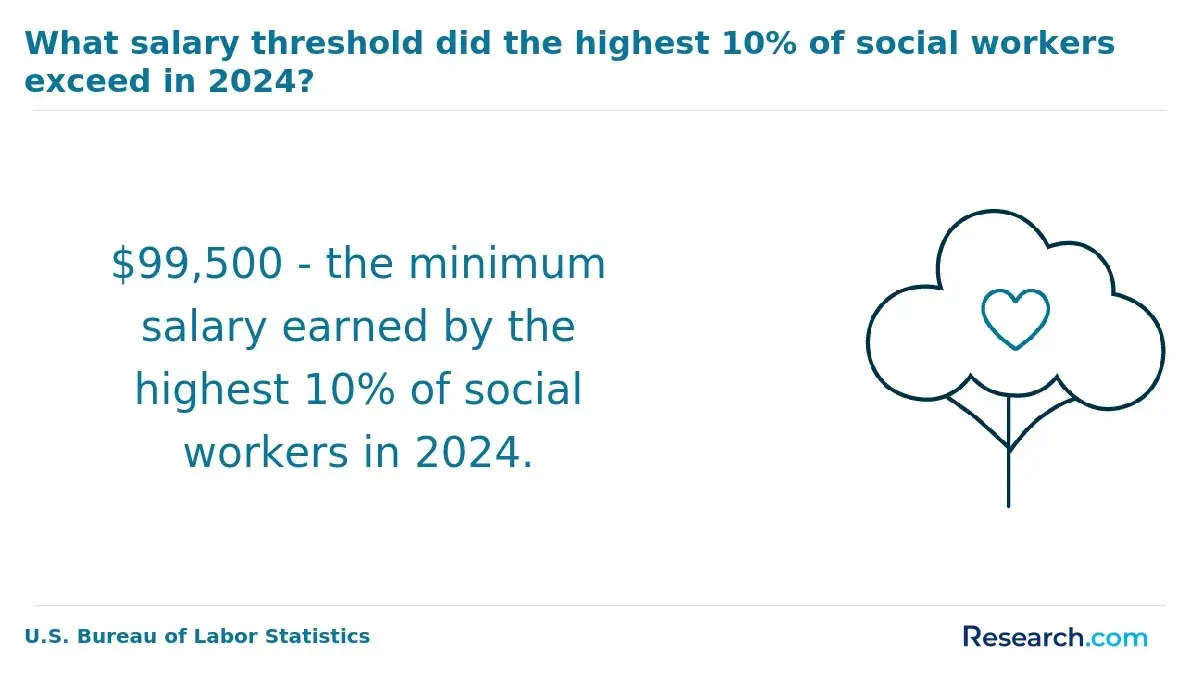
The average salary for MSW graduates varies by role, location, experience, licensure level, and work setting. Entry-level social workers earn around $50,000 to $60,000 annually, while those with experience in clinical or specialized settings can make $70,000 to $80,000 or more. In certain metropolitan areas or positions requiring advanced licensure, salaries often exceed $90,000.
Salary should be evaluated carefully because “MSW graduate” covers many different jobs. A nonprofit case manager, school social worker, hospital social worker, LCSW, program director, and policy specialist may all hold MSW degrees but have different pay ranges and advancement paths.
What affects MSW salary most
- Job setting: Clinical social workers in healthcare and mental health agencies typically have higher salaries than community-based or nonprofit social workers.
- Geographic location: Urban centers usually offer better compensation than rural areas, reflecting cost of living and demand.
- Licensure level: Licensed Clinical Social Workers (LCSWs) command higher wages due to their credentials and ability to provide independent therapy.
- Specialization: Healthcare, behavioral health, school social work, substance abuse, and gerontology roles may offer different compensation depending on local demand.
- Experience and supervision: Post-degree supervised clinical hours can be important for moving into higher-paid independent practice roles.
Online MSW degrees are gaining acceptance, with 85% of hiring leaders expecting industries to favor candidates who hold these credentials in the near future, according to a University of Phoenix survey done by The Harris Poll in 2025. For salary purposes, the degree format is usually less important than accreditation, licensure, field experience, and role fit.
To improve earning potential, students should choose field placements strategically, pursue licensure as early as allowed, seek supervision that supports clinical advancement, and build experience in high-demand settings. They should also compare salaries by state and local cost of living before assuming that a higher salary automatically means better financial outcomes.
Is Job Outlook Strong for Social Workers with Online MSWs?
Yes, the job outlook is strong for social workers with online MSWs when the degree is accredited and the graduate meets licensure and experience expectations. Demand is especially tied to healthcare, behavioral health, child welfare, aging services, schools, community agencies, and mental health access needs.
Growth in the social work field is projected at about 12% over the next decade, driven by demand in healthcare, child welfare, and mental health. This growth benefits both online and traditional MSW graduates, provided they meet licensing and practical experience requirements.
Employer views of online education have also improved. Advances in technology and improved curriculum delivery have led 68% of employers surveyed by the University of Phoenix and The Harris Poll to see online degrees as more credible. That does not mean every employer treats every online program the same, but it does indicate that online delivery is no longer the barrier it once was.
How online MSW graduates can strengthen job prospects
- Choose a CSWE-accredited program before considering convenience, speed, or price.
- Complete field placements in settings aligned with the roles you want after graduation.
- Build strong relationships with field supervisors who can serve as references.
- Track specific practice skills and outcomes from internships for resumes and interviews.
- Understand your state’s licensure process before you graduate.
- Join professional networks, attend local social work events, and seek mentorship.
- Consider targeted experience in clinical social work, substance abuse, healthcare, school social work, gerontology, or child welfare if those areas match your goals.
The best employment outcomes usually come from combining the MSW credential with verified field experience, licensure progress, and a clear professional focus. For online students, the most important step is to choose a program that does not leave field education to chance. Strong practicum support, responsive advising, and transparent licensure guidance can make the difference between simply earning a degree and entering the workforce prepared.
Other Things You Should Know About Social Work
Effective communication, empathy, and strong organizational skills are essential for social workers. They must be able to assess clients' needs accurately and develop appropriate intervention plans. Critical thinking and cultural competence also play key roles in addressing diverse populations ethically and effectively.
Yes. Employers and state licensing boards look for programs accredited by the Council on Social Work Education, or CSWE. In 2027, CSWE accreditation is the standard signal that an online MSW meets professional education requirements for licensure, field education, and supervised practice eligibility.
After earning an MSW, social workers can pursue additional certifications such as Licensed Clinical Social Worker (LCSW) or Certified School Social Work Specialist (C-SSWS). These credentials often require supervised clinical hours and passing specific exams. Specializations in areas like healthcare or substance abuse counseling may also offer certification options.
Yes, internships or practicum experiences are typically required in online MSW programs. These experiences provide practical, hands-on learning that is essential for developing the skills necessary for social work practice and are crucial for meeting licensure requirements.
- Full-time online MSW programs https://www.onlinemswprograms.com/online-social-work-degrees/full-time-online-msw-programs/
- How Long is a Master of Social Work Program? Length of MSW Programs https://www.masterofsocialwork.com/faqs/length-of-msw-programs
- What Do Employers Think About Your Online Degree? | OnlineMBA.com https://www.onlinemba.com/resources/employers-thoughts-on-online-degrees/
- After Your MSW: A State-by-State Guide to Social Work Licensing https://www.onlinemastersdegrees.org/student-resources/social-work/license-requirements/
- How to Become a Licensed Social Worker https://onlinecounselingprograms.com/mental-health-careers/how-to-become-licensed-social-worker/
- How Long Does it Take to Become a Social Worker? https://socialworklicensemap.com/become-a-social-worker/how-long-does-it-take/
- MSW Program Length: 1-4 Year Timeline Guide for 2025 https://www.socialworkdegrees.org/faq/how-long-does-it-take-to-complete-a-msw-program
- Social Worker Salary in AU (May, 2026) – SEEK https://au.seek.com/career-advice/role/social-worker/salary
- Social Work Salaries https://www.socialworkers.org/careers/career-center/kickstart-your-job-hunt/social-work-salaries
- How to Become a Social Worker https://www.snhu.edu/about-us/newsroom/social-sciences/how-to-become-a-social-worker