2027 CSWE Accreditation Explained for Future Social Work Students

Co-Founder and Chief Data Scientist
Choosing a social work program is not just an academic decision. It can affect whether you qualify for licensure, where you can complete field education, how employers view your degree, and whether your credits or graduate credentials will be recognized later. For students comparing BSW, MSW, online, accelerated, or doctoral pathways, CSWE accreditation is one of the first details to verify.
The Council on Social Work Education (CSWE) is the main specialized accreditor for social work education in the United States. Its approval signals that a program meets national standards for curriculum, field training, ethics, diversity, assessment, and professional preparation. This guide explains what CSWE accreditation means, why it matters for licensure and employment, how to verify a program’s status, and what to consider before enrolling.
Key Things You Should Know
- CSWE accreditation is mandatory for U.S. social work programs to ensure compliance with rigorous educational standards and prepares over 95% of licensed social workers nationwide.
- In 2026, CSWE updated competencies emphasize diversity, equity, inclusion, and evidence-based practice, reflecting evolving societal needs and professional expectations.
- Graduating from a CSWE-accredited program is critical for eligibility to sit for licensing exams, enhancing employment prospects in clinical, community, and policy roles.
What is CSWE accreditation in social work?
CSWE accreditation is the recognized quality standard for U.S. bachelor’s and master’s programs in social work. It is granted by the Council on Social Work Education after a program demonstrates that its curriculum, field education, faculty qualifications, student assessment, and professional outcomes meet national expectations for social work education.
For students, the most important point is practical: a CSWE-accredited degree is commonly required for social work licensure eligibility. State licensing rules vary, but licensing boards often expect applicants to graduate from a CSWE-accredited BSW or MSW program before they can pursue the appropriate Association of Social Work Boards (ASWB) exam and supervised practice requirements.
CSWE accreditation is different from general institutional accreditation. A college or university may be regionally accredited while its social work program is not CSWE-accredited. That distinction matters because employers, licensing boards, graduate schools, and certification bodies may evaluate the social work program specifically, not only the university as a whole.
In practice, CSWE accreditation helps confirm that a program includes:
- Coursework in ethics, policy, human behavior, research, diversity, and social work practice
- Supervised field education connected to professional competencies
- Assessment of student learning outcomes
- Preparation for generalist or advanced social work practice, depending on degree level
- Faculty oversight aligned with national social work education standards
Students planning long-term advancement may later consider graduate or doctoral options, including a doctorate of social work online. Even then, the foundation matters: a CSWE-accredited BSW or MSW can preserve more options for licensure, employment, and future study.
Why is CSWE accreditation essential for social work students?
CSWE accreditation is essential because it connects your education to the professional standards used by licensing boards and employers. A degree from a non-accredited social work program may still provide useful coursework, but it can create serious barriers if your goal is licensed practice, clinical work, government employment, or advanced social work credentials.
The biggest risk is enrolling in a program that appears legitimate but does not meet specialized social work accreditation requirements. Students may discover too late that their degree does not support the licensure pathway they intended to pursue. This is especially important for career changers, online students, and applicants comparing newer programs.
CSWE accreditation can affect several major decisions:
- Licensure eligibility: Many state licensing boards require a CSWE-accredited social work degree for BSW- or MSW-level licensure pathways.
- Clinical career options: Students aiming for clinical social work typically need an accredited MSW before completing post-graduate supervised experience and licensing requirements.
- Employer screening: Healthcare systems, schools, government agencies, and nonprofits may require or strongly prefer CSWE-accredited degrees.
- Graduate study: Advanced standing MSW programs, doctoral programs, and certifications may expect prior CSWE-accredited preparation.
- Financial value: Accreditation helps protect the return on your tuition investment by aligning your degree with recognized professional standards.
Recent data from the CSWE Annual Survey shows a 14.3% increase in accredited master's social work programs despite an overall decline in higher education enrollment. That growth reflects continued demand for recognized MSW pathways and the importance of accreditation in a regulated profession.
If affordability is a concern, compare tuition and aid carefully, but do not treat cost as the only deciding factor. A lower-cost program that does not support licensure may be more expensive in the long run. Students comparing the cost of MSW program options should verify CSWE accreditation before applying.
How do I verify if a social work program has CSWE accreditation?
The most reliable way to verify CSWE accreditation is to use CSWE’s official accreditation directory, not only a school’s marketing page. Search by institution name, state, and program level, then confirm whether the exact BSW, MSW, or practice doctorate program you are considering is fully accredited or in candidate status.
As of June 2025, CSWE accredits 550 baccalaureate, 347 master's, and 4 practice doctorate programs, plus 11 candidate baccalaureate and 33 candidate master's programs pursuing accreditation. Those categories matter. A fully accredited program has completed the accreditation process, while a candidate program is still moving toward full approval and may carry different risks depending on your timing and state licensure goals.
Use this verification process before you enroll:
- Check CSWE’s official list. Confirm the institution name, degree level, campus or delivery format, and accreditation status.
- Ask the program directly. Request written confirmation from admissions or the social work department, especially if the program is new, online, or recently changed format.
- Confirm state licensure rules. Contact your state licensing board if you plan to practice in a specific state after graduation.
- Review field placement policies. For online programs, make sure the school can support approved placements where you live.
- Save documentation. Keep screenshots or official pages showing accreditation status at the time you applied or enrolled.
Be cautious if a school says it is “aligned with CSWE standards” but does not appear as accredited or in candidacy. Alignment is not the same as accreditation. Also confirm whether accreditation applies to the social work program itself rather than only the broader institution.
Students considering shorter pathways, such as 1 year MSW programs, should be especially careful. Faster timelines can be legitimate, but they still need verified accreditation, appropriate field education, and a structure that fits licensure requirements.
CSWE requirements are designed to ensure that social work graduates develop both classroom knowledge and supervised practice skills. Programs must demonstrate that students learn core competencies, complete appropriate field education, and are assessed on outcomes tied to professional social work practice.
For Bachelor of Social Work programs, students complete foundational coursework in areas such as human behavior, social environment, social welfare policy, ethics, research, diversity, and generalist practice. BSW students also complete a minimum of 400 hours of supervised field education. That field component is not optional; it is where students connect academic concepts to real client, agency, and community settings.
For Master of Social Work programs, students complete advanced coursework that may focus on clinical practice, administration, community organization, policy, or other concentrations. MSW students complete at least 900 hours of supervised field education. Programs must also show that graduates meet measurable learning outcomes in research, ethical practice, leadership, cultural responsiveness, and advanced practice skills.
CSWE’s standards also recognize the diversity of social work students and the populations they will serve. Demographic data show approximately 87% female, 63.6% under age 25, 21.7% African American/Black (non-Hispanic), 49.1% White (non-Hispanic), and 17.9% Hispanic/Latinx. These figures underscore why accredited programs are expected to address cultural competence, equity, ethical service delivery, and practice with diverse communities.
When comparing BSW or MSW programs, look beyond the course catalog. Ask specific questions:
- How are field placements assigned and supervised?
- Can online students complete field education in their local area?
- What concentrations or electives match your intended career?
- How does the program assess competency development?
- What support is available for licensure planning, advising, and career placement?
A program can meet minimum requirements and still differ greatly in placement quality, faculty expertise, advising, and student support. Those differences can affect your readiness for practice.
Graduates of CSWE-accredited programs enter a field with demand across healthcare, mental health, child and family services, aging services, schools, and community-based organizations. Employment in social work is projected to rise 13% from 2024 to 2034, faster than most occupations, according to the U.S. Bureau of Labor Statistics.
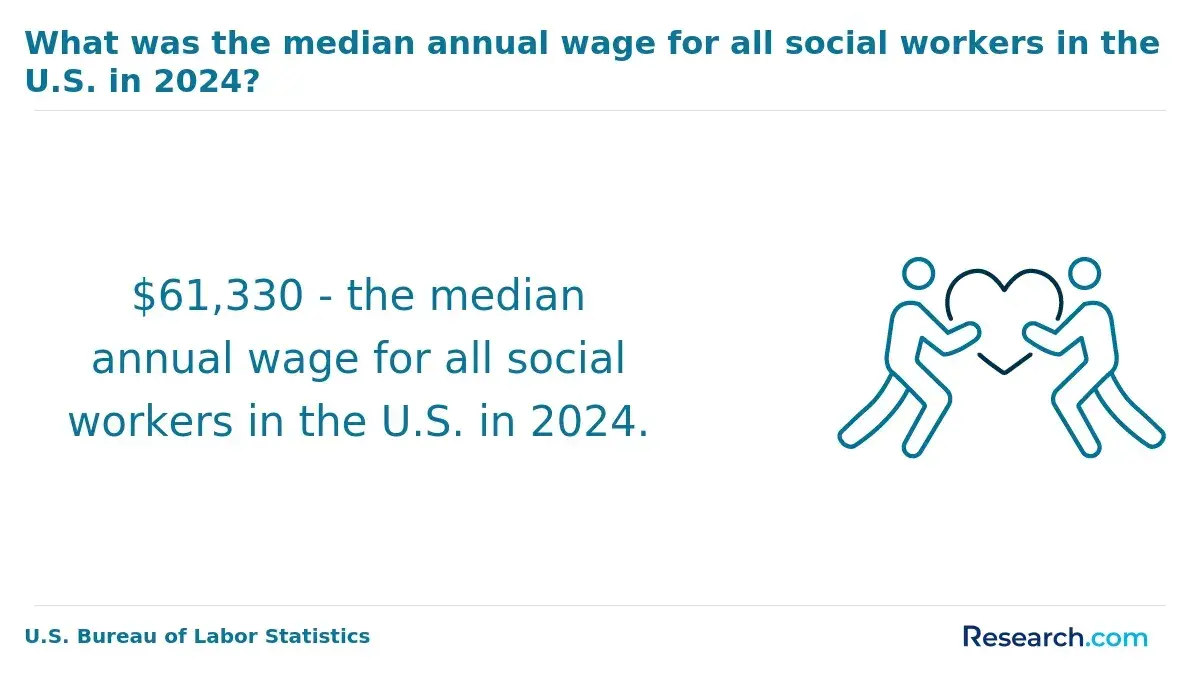
Salary depends heavily on degree level, licensure, setting, location, specialization, and experience. Entry-level baccalaureate social workers typically earn between $40,000 and $50,000 annually. Those with master's degrees, particularly clinical social workers, often start at $55,000 to $65,000. Advanced practitioners and administrators may earn $80,000 or more, with doctoral-level professionals in academia or research fields earning upwards of $90,000.
These figures should be treated as broad ranges rather than guarantees. Social work compensation can vary substantially between nonprofit agencies, hospitals, schools, government systems, private practice, and administrative leadership. Rural and urban labor markets may also differ in both salary and job availability.
Several factors can improve long-term earning potential:
- Licensure: Clinical or advanced licensure can qualify graduates for higher-responsibility roles.
- Specialization: Healthcare, behavioral health, clinical practice, and administration may offer stronger compensation in some markets.
- Experience: Supervisory, program management, and leadership experience can raise earning potential.
- Work setting: Public and private healthcare sectors usually offer higher salaries than nonprofit or government agencies.
- Location: Urban locations tend to provide better compensation than rural areas.
Interest in doctoral social work programs continues to grow, with more students pursuing practice and research doctorates in recent years. For professionals targeting university teaching, high-level clinical research, policy leadership, or executive roles, doctoral study may be worth considering after evaluating cost, time commitment, and career return.
CSWE accreditation does not guarantee a specific salary, but it helps ensure that the degree is recognized by employers and licensing boards. That recognition is often the foundation for accessing better career pathways.
How to choose the best CSWE-accredited social work school?
The best CSWE-accredited social work school is the one that fits your licensure goals, budget, schedule, field placement needs, and preferred area of practice. Start by confirming accreditation through CSWE, then compare programs using practical criteria rather than reputation alone.
Use these factors to evaluate your options:
- Accreditation status: Confirm the exact BSW, MSW, or doctoral program is CSWE-accredited or understand what candidacy status means before enrolling.
- Licensure alignment: Check whether the curriculum and field education support licensure in the state where you plan to practice.
- Degree level: Choose a BSW for generalist entry-level preparation, an MSW for advanced or clinical pathways, and doctoral study for specialized leadership, teaching, research, or practice goals.
- Format: Compare full-time, part-time, online, hybrid, and campus-based options based on your work schedule, learning style, and field placement needs.
- Field education: Review practicum site variety, supervision quality, placement support, and relevance to your target population or specialty.
- Cost and aid: Consider tuition, fees, travel, lost work time, scholarships, assistantships, and likely borrowing.
- Faculty expertise: Look for instructors with experience in your area of interest, such as clinical practice, child welfare, healthcare, policy, or community work.
- Student outcomes: Ask about graduation rates, licensure support, employment outcomes, and alumni feedback.
Location also matters. Even online students may be affected by state authorization, field placement availability, local agency partnerships, and licensure rules. A school with strong community ties in your intended practice area may provide better placements and networking than a more recognizable program with limited local support.
Review data from the 2023-2024 CSWE Annual Survey on graduation rates, enrollment, and student debt when available. These indicators can help you evaluate affordability and program performance, but they should be considered alongside advising quality, field education, and licensure preparation.
Before committing, contact admissions, field education staff, and current students or alumni if possible. Ask direct questions about placement support, workload, faculty access, online learning expectations, and licensure preparation. A strong program should be able to explain clearly how it helps students move from enrollment to graduation to professional practice.
Other Things You Should Know About Social Work
CSWE-accredited programs must include supervised field education, usually called practicum or internship. BSW programs require at least 400 field hours, and MSW programs require at least 900 hours. These placements must be supervised and aligned with CSWE competency standards.
The time required varies based on the level of licensure and educational background. Generally, obtaining a Bachelor of Social Work (BSW) takes four years, while a Master of Social Work (MSW) requires an additional two years. After completing education, most states require supervised clinical experience that can range from 2 to 4 years before social workers become fully licensed.
Yes, social work degrees open doors beyond clinical roles. Graduates can work in community organizations, schools, government agencies, policy advocacy, and nonprofit management. The discipline's versatility allows professionals to contribute in diverse environments focused on social justice, program development, and resource coordination.
Certain social work fields, such as clinical social work, child welfare, or healthcare social work, may require specialized certifications or additional training. These often involve extra coursework, supervised practice, or passing specialty exams. Pursuing such specializations can enhance career opportunities and allow social workers to focus on specific populations or issues.
- Types of Social Work Degrees https://www.socialworkers.org/Careers/Career-Center/Explore-Social-Work/Types-of-Social-Work-Degrees
- GRADUATES OF U.S. SOCIAL WORK DEGREE PROGRAMS ACCREDITED BY CSWE (COUNCIL ON SOCIAL WORK EDUCATION) - OCSWSSW https://www.ocswssw.org/applicants/us-bsw-msw/
- What CSWE Accreditation Tells You About an MSW Program https://www.chamberlain.edu/blog/what-is-cswe-accreditation-and-what-are-its-benefits
- Social work salaries: How much can I earn with an MSW degree? https://www.masterofsocialwork.com/faqs/social-work-salaries
- High-demand social work roles in 2026: trends and opportunities https://socialwork.pacific.edu/blog/high-demand-social-work-roles-2026-trends-and-opportunities
- The Importance of a CSWE Accredited Program in Social Work - Tulane School of Social Work https://socialwork.tulane.edu/blog/importance-of-cswe-accredited-program/
- Humanservicesedu https://humanservicesedu.org
- Social Worker (LCSW, MSW) Salary Guide By State https://socialworklicensemap.com/social-work-careers/social-work-salary/
- Accreditation | CASWE-ACFTS https://caswe-acfts.ca/our-activities/accreditation/
- Online Master’s in Social Work Programs https://onlinecounselingprograms.com/online-counseling-degrees/cswe-accredited-online-msw-programs/