2027 Most Affordable Online MSW Programs With High ROI

Co-Founder and Chief Data Scientist
Switching into social work after earning a bachelor’s degree in another field is possible, but the choice of MSW program matters. The wrong program can leave you with high debt, limited licensure options, or field placement problems. The right one can give you a flexible route into clinical practice, healthcare, child welfare, school social work, community services, or nonprofit leadership.
This guide focuses on affordable online MSW programs with strong return on investment. It explains how to compare tuition, accreditation, field education, licensure preparation, program length, salaries, and job demand so you can choose a program that fits your budget and career goals.
Key Things You Should Know
- Online MSW programs in 2026 offer average tuition between $12,000 and $25,000, providing significant savings compared to traditional on-campus options.
- Graduates from affordable online MSW programs report an average 10-year return on investment above 50%, reflecting strong employment growth in social services.
- Flexible online formats enable working professionals to advance careers without income loss, with 85% of students balancing study and employment successfully.
What are the most affordable online MSW programs?
The most affordable online MSW programs are usually offered by public universities that combine lower tuition with Council on Social Work Education accreditation, flexible course delivery, and field placement support. Schools such as the University of Central Florida and the University of Texas at Arlington offer scalable tuition rates typically between $12,000 and $20,000 for the entire program, making them strong options for students who need a lower-cost path into social work.
Cost alone should not drive the decision. A low-tuition MSW is only a good value if it supports licensure, provides supervised field experience, and helps graduates move into stable social work roles. Private schools often exceed $40,000 in tuition, so students should compare the full program cost against expected earnings, available aid, and the type of role they plan to pursue.
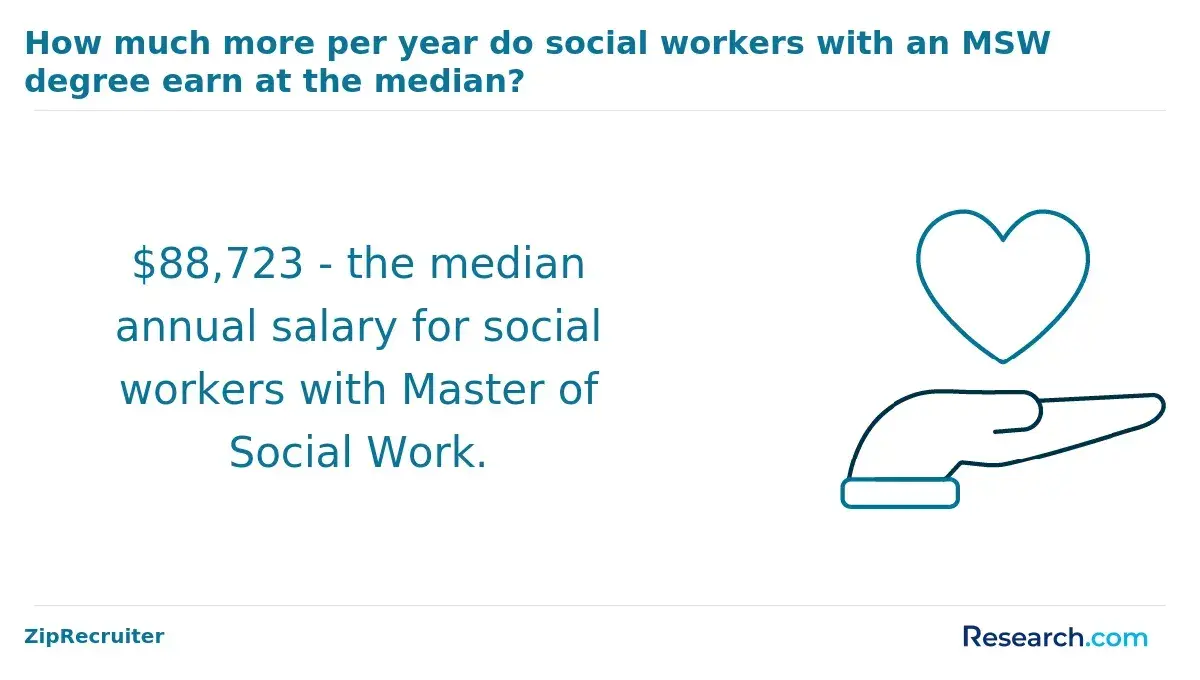
According to the U.S. Bureau of Labor Statistics, social workers with a master's degree earned a median annual wage of $61,330 in 2025, a 25% increase over those with only a bachelor's degree. That wage premium can make an affordable MSW financially worthwhile, especially for students who avoid excessive borrowing.
Program length also affects affordability. Accelerated programs may reduce opportunity costs by allowing students to graduate in 12-18 months, but they can be demanding. Part-time programs may be easier for working adults because they spread coursework and tuition over more terms, but they can delay the salary benefits of completing the degree.
When comparing affordable options, look beyond the advertised tuition and ask:
- Is the program CSWE-accredited and accepted for licensure in your state?
- What is the total estimated cost, including fees, books, technology charges, and field placement expenses?
- Does the school help arrange local field placements?
- Are scholarships, grants, public service awards, or employer tuition benefits available?
- Does the program offer advanced standing if you already have eligible social work coursework?
Schools such as the University of Missouri and University of Florida offer online MSW options with strong financial aid, including scholarships targeting public service careers. These incentives can make a major difference for students who want to enter lower-paying but high-impact areas of social work without taking on unsustainable debt.
For students considering advanced credentials after the MSW, the best online DSW programs may provide a later pathway into leadership, teaching, advanced practice, or applied research roles.
Which online MSW programs offer the highest ROI?
The online MSW programs with the highest ROI are typically those that keep total tuition low, reduce residency-related price differences, support timely graduation, and prepare students for licensure-eligible roles. A program does not need to be the cheapest to offer strong ROI, but it must provide a clear value: reasonable cost, credible accreditation, field placement support, and employment outcomes that justify the investment.
Flat-rate tuition can be especially valuable for out-of-state students. Boise State University highlights this model by offering a flat-rate online MSW program, enabling out-of-state students to save between $15,000 and $25,000 compared to typical residency premiums at many public universities in costly states. This makes the program attractive for students who want the best affordable online MSW degrees for career earnings without paying large nonresident tuition premiums.
Students may benefit most from this type of pricing when they:
- Live in a high-cost state but are open to enrolling in an online public university elsewhere.
- Need to continue working while completing the MSW.
- Want to reduce debt before entering a field where salaries vary widely by specialization and employer.
- Plan to pursue licensure or supervisory roles that can improve long-term earnings.
ROI also depends on factors that are easy to overlook. A lower tuition rate may be offset by weak field placement support, limited advising, or a program format that makes it hard to finish on time. Stronger ROI usually comes from programs that combine affordability with high graduation rates, responsive faculty, career advising, and clear licensure guidance.
When comparing online MSW programs with highest return on investment, calculate the total cost of attendance rather than relying only on the per-credit price. Include institutional fees, travel for any required campus visits, books, background checks, technology costs, and lost income if you plan to reduce work hours. Then compare that cost with the career path you actually intend to pursue, not just the highest-paying social work roles.
For a broader list of value-focused options, review the most affordable online MSW programs.
How much do online MSW programs cost on average?
Online MSW programs in the United States generally range from $15,000 to $40,000 in total tuition. The final price depends on the institution type, residency policy, number of required credits, transfer or advanced standing eligibility, and mandatory fees. Public universities are often less expensive, with in-state tuition rates sometimes as low as $500 per credit hour, while private schools can exceed $1,200 per credit.
Students should be careful with per-credit comparisons because they do not always show the real cost of the degree. Two programs may advertise similar tuition rates but require different credit totals, fees, or field education expenses. Technology fees, placement fees, course materials, background checks, liability insurance, and travel can add thousands to the overall cost.
A practical cost review should include:
- Total tuition for the entire MSW, not just the per-credit rate.
- Mandatory university and online learning fees.
- Field placement-related expenses, including transportation and background checks.
- Whether the program charges different rates for in-state and out-of-state students.
- Scholarships, grants, assistantships, employer assistance, and federal aid eligibility.
- Whether an accelerated or advanced standing option can reduce the number of credits required.
Program format can also affect cost. Accelerated tracks may help students enter the workforce sooner, while part-time tracks can make tuition payments easier to manage alongside employment. However, part-time study may delay the financial benefits of the degree.
The University of Georgia is an example of a program with a strong ROI comparison for affordable online MSW degrees, offering competitive tuition alongside a 95% employment rate for graduates within six months. Outcomes like this matter because employment after graduation is central to whether the degree produces a strong financial return.
Before enrolling, compare program costs with likely earnings in your intended state and specialization. Reviewing the LCSW salary can help you evaluate whether the expected debt level is reasonable for your planned career path.
The most important accreditation for an online MSW is accreditation by the Council on Social Work Education. CSWE accreditation confirms that the program meets national standards for social work education, including ethics, policy, human behavior, research, clinical and generalist practice, and supervised field education.
This matters because state licensure boards commonly require an MSW from a CSWE-accredited program before graduates can pursue licensure or certification. Without CSWE accreditation, graduates may be unable to sit for licensing exams or qualify for clinical and advanced social work roles, even if the program is otherwise legitimate.
Students should verify accreditation directly before applying and again before enrolling. Confirm that the program is currently CSWE-accredited, that the online format is included, and that the school’s field education model satisfies the requirements in the state where you plan to practice. Regional institutional accreditation can be important for federal aid and academic recognition, but it does not replace CSWE accreditation for social work licensure.
Online delivery can vary. Some programs are synchronous, with scheduled live classes. Others are asynchronous, allowing students to complete coursework on a more flexible schedule. Hybrid models may combine online coursework with occasional in-person requirements. CSWE accreditation helps ensure that, regardless of format, the program still provides required curriculum coverage and field education oversight.
Fort Hays State University offers a CSWE-accredited MSW with cost-effective synchronous options, helping graduates achieve a 28% average salary increase. This illustrates why accreditation, affordability, and career outcomes should be evaluated together rather than separately.
Before choosing a program, ask these accreditation and licensure questions:
- Is the MSW currently accredited by the Council on Social Work Education?
- Does the program meet the educational requirements for licensure in your state?
- Who is responsible for finding and approving field placement sites?
- Are there any in-person requirements that could affect cost or scheduling?
- Does the program provide licensure advising for your intended state?
Students who want a more accessible admissions route can also review the easiest online MSW program, but accreditation should remain nonnegotiable. The best accreditation for online MSW degrees is the accreditation that keeps the degree professionally recognized and usable for licensure.
Yes, you can complete MSW coursework fully online through many accredited universities, but licensure is not granted by the school. Licensure is controlled by state boards, and requirements vary by state. An online MSW can support the path to licensure if it is CSWE-accredited and includes approved supervised field education that meets your state’s rules.
Most online MSW programs include the same core elements as campus-based programs: graduate coursework, practice training, ethics, research, policy, and field placements. The key difference is delivery. Coursework may be online, but field education usually takes place in an approved agency, clinic, school, hospital, nonprofit, or community setting near the student.
Students should not assume that “fully online” means “no in-person requirements.” Even if classes are entirely online, practicum hours are typically completed in real-world service settings. Some programs help students secure local or virtual placement options, while others expect students to take a more active role in identifying agencies.
Specialized emphases can also improve alignment with local workforce needs. New Mexico State University's Multicultural Focus Leader MSW is one example. According to the CSWE 2025 Workforce Trends Report, these programs have experienced 35% higher demand for behavioral health roles serving diverse populations, highlighting the value of targeted preparation for students who plan to work in culturally responsive practice settings.
Before enrolling in a fully online MSW, confirm:
- The program’s CSWE accreditation status.
- Your state’s licensure requirements for the level of practice you want to pursue.
- Whether the school supports field placements in your geographic area.
- Whether your state has rules affecting online or out-of-state MSW programs.
- Whether the curriculum aligns with clinical, macro, school, healthcare, or child welfare goals.
Fully online MSW programs that are accredited and properly structured can provide a valid path toward licensure. The safest approach is to check both the school and your state licensing board before you apply.
Most online MSW programs require a bachelor’s degree from an accredited institution, official transcripts, letters of recommendation, a resume, and a personal statement. Many programs prefer a minimum GPA of 3.0, although some schools review applicants holistically and may consider work history, volunteer experience, academic improvement, or a strong statement of purpose.
Applicants from non-social-work backgrounds can still qualify for traditional MSW tracks. Advanced standing tracks are usually designed for students who already completed qualifying undergraduate social work education. If your bachelor’s degree is in psychology, sociology, education, criminal justice, healthcare, public health, or another related field, you may have relevant experience, but you should not assume you qualify for advanced standing unless the program explicitly says so.
Common admission materials include:
- Official transcripts from all colleges attended.
- A resume showing work, volunteer, internship, or service experience.
- Letters of recommendation from academic, professional, or community supervisors.
- A personal statement explaining your interest in social work and commitment to professional ethics.
- Possible interview, either live or recorded.
- Background checks, immunization records, or other documents required for field placements.
The GRE is increasingly optional, but some schools may still request standardized test scores or additional writing samples. Clinical tracks may also prefer applicants with prior coursework in areas such as psychology, sociology, human development, or research methods.
Online learners should be prepared to show that they can manage graduate-level work independently. Reliable internet access, comfort with learning platforms, time management, and professional communication are all important. Admission committees often look for evidence that the applicant understands the realities of social work, including emotionally demanding client situations, documentation responsibilities, and ethical decision-making.
Valdosta State University's Hybrid MSW format, designed for working professionals, reflects a trend toward flexible learning options. According to the 2025 Program Retention Study by the Council on Social Work Education, hybrid MSW programs had 22% lower dropout rates among full-time employed students compared to fully online formats. For working adults, program structure can be as important as admission flexibility.
An online MSW program generally takes 2 to 3 years to complete full-time. Accelerated tracks may allow motivated students to finish in 18 to 24 months, while part-time options can extend the timeline to 3 or more years. The right pace depends on your work schedule, family responsibilities, field placement availability, and financial situation.
Program length is shaped by enrollment status and curriculum design. Full-time students often complete 30 to 40 credits within two years. Part-time students take fewer credits per term, which can make the workload more manageable but may delay graduation. Advanced standing can shorten the path for eligible students with prior social work coursework, while traditional tracks are designed for students entering from other undergraduate majors.
Each timeline has trade-offs:
- Accelerated: faster graduation and earlier workforce entry, but heavier weekly workload.
- Full-time: balanced pace for students who can commit substantial time to coursework and field education.
- Part-time: better fit for working professionals and caregivers, but longer time to completion.
- Advanced standing: shorter and often less expensive, but typically limited to students with qualifying prior social work education.
Field placement is often the scheduling factor students underestimate. Even online students must complete supervised practice requirements, and those hours may need to occur during standard agency operating times. Before choosing an accelerated option, confirm that you can realistically handle coursework, field hours, employment, and personal obligations at the same time.
Affordable online MSW programs, such as those offered by the University of Wyoming at under $300 per credit, can improve the financial case for graduate study. According to the Georgetown University Center on Education and the Workforce 2025 MSW ROI Analysis, Wyoming's program achieves a 4.2x ROI within five years based on lifetime earnings projections, making cost, duration, and post-graduation outcomes important parts of the same decision.
The career outlook for MSW graduates is strong, with job demand projected to grow by 13% over the next decade. Demand is supported by needs in mental health, healthcare, substance use services, child and family services, aging populations, schools, crisis response, and community-based support programs.
MSW graduates can work in several practice areas, including clinical social work, school social work, healthcare social work, child welfare, community organization, nonprofit administration, policy advocacy, and program management. Opportunities can be especially important in underserved urban and rural areas where access to behavioral health and social services is limited.
Clinical licensure can expand career options, particularly in therapy, counseling, assessment, and mental health treatment roles. However, licensure usually requires supervised post-graduate experience and state-specific exams after the MSW. Students who want clinical careers should choose programs that clearly support clinical preparation and explain licensure pathways.
Program format may also affect career progress for working adults. Asynchronous online MSW programs can make it easier to keep a job while completing coursework. Graduates from Western New Mexico University's asynchronous MSW program advanced to supervisory roles 18% faster compared to synchronous learners, according to OnlineMastersDegrees.org's 2025 Format Impact Study.
To strengthen employment prospects, students should look for programs that offer:
- Field placements in the type of setting where they want to work.
- Training in trauma-informed care, cultural competence, ethics, and telehealth.
- Career services and licensure advising.
- Faculty with experience in the student’s target practice area.
- Flexible formats that allow students to gain or maintain relevant work experience.
The strongest career outcomes usually come from matching the MSW program to a specific professional goal. A student pursuing hospital social work, for example, should evaluate healthcare placements and medical social work coursework. A student aiming for therapy should focus on clinical preparation and state licensure alignment.
MSW salaries vary by specialization, license level, location, employer, and experience. The U.S. Bureau of Labor Statistics reports a median annual wage of about $60,000 for social workers, with clinical social workers earning closer to $68,000. Entry-level salaries typically range from $45,000 to $55,000, while experienced professionals in urban or healthcare-focused roles often surpass $75,000.
Salary expectations should be tied to the specific role you plan to pursue. Clinical, healthcare, supervisory, and specialized behavioral health positions often pay more than some entry-level public sector or nonprofit roles. Child welfare and public service roles may start lower, but they can offer mission-driven work, benefits, pension systems, loan forgiveness eligibility, or stipend-supported training opportunities.
Texas A&M Commerce's Title IV-E stipend-supported MSW is one example of how targeted aid can improve affordability for students pursuing child welfare. This program lowered net student debt by 65% for child welfare track graduates in 2025, showing that program-specific funding can improve ROI even when starting salaries are not the highest in the field.
Other salary factors include:
- State and metropolitan labor market conditions.
- Clinical licensure and post-graduate supervised experience.
- Employer type, such as hospitals, government agencies, schools, nonprofits, or private practice settings.
- Specialization in mental health, substance use, healthcare, aging, child welfare, or administration.
- Supervisory responsibility and years of experience.
Career growth through supervisory or specialized clinical roles can increase salaries beyond $80,000. Students should evaluate total compensation, not salary alone. Health insurance, retirement benefits, paid leave, supervision support, tuition benefits, and loan forgiveness opportunities can significantly affect the real value of a social work job.
How to choose the best affordable online MSW program?
The best affordable online MSW program is the one that meets licensure requirements, fits your budget, supports your field placement needs, and aligns with your career goal. A low advertised tuition rate is not enough if the program lacks CSWE accreditation, does not support placements in your area, or fails to prepare you for the type of social work you want to practice.
Start with accreditation. Prioritize programs accredited by the Council on Social Work Education because CSWE accreditation is central to licensure eligibility and professional recognition. Then confirm that the curriculum supports your intended path, whether that is clinical practice, school social work, healthcare, child welfare, administration, policy, or community advocacy.
Field placement support is one of the most important quality indicators. Strong programs help students identify appropriate practicum sites, clarify supervision requirements, and resolve placement issues. Weak placement support can delay graduation or force students into settings that do not match their goals.
Use this checklist when comparing programs:
- Accreditation: Confirm current CSWE accreditation.
- Total cost: Compare full tuition, fees, books, and placement-related expenses.
- Licensure alignment: Check whether the program meets requirements in your state.
- Format: Decide whether asynchronous, synchronous, hybrid, full-time, part-time, or accelerated study fits your life.
- Field education: Ask how placements are arranged and whether support is available near you.
- Outcomes: Review graduation, employment, and licensure exam pass rates when available.
- Student support: Look for advising, writing support, career counseling, and networking opportunities.
- Financial aid: Ask about scholarships, grants, stipends, employer assistance, and public service funding.
Salary outcomes and job demand should also factor into the decision. The U.S. Bureau of Labor Statistics projects a 13% growth in social work jobs from 2025 to 2030, with 40% of new clinical roles filled by online MSW graduates. Programs connected to healthcare, mental health, or child welfare sectors may offer stronger placement and employment pathways for students targeting those areas.
Choose the program that gives you the best combination of affordability, licensure preparation, practical training, and flexibility. The goal is not simply to earn an MSW online; it is to graduate with a recognized credential, manageable debt, and a realistic path into the social work role you want.
Other Things You Should Know About Social Work
Most online MSW programs require a reliable computer, broadband internet, webcam, microphone, and an updated browser. Some also require Microsoft Office or Google Workspace, plus access to video-conferencing tools such as Zoom or Teams. Field placement sites may require secure email and background-check documentation.
Admission prerequisites for online MSW programs in 2027 typically include a bachelor's degree from an accredited institution, a minimum GPA of 3.0, and completed coursework in social sciences. Some programs may also require relevant work or volunteer experience in social services.
Students in 2027 should expect to need a reliable internet connection, a computer with updated software capabilities, and familiarity with online learning platforms like Zoom and Blackboard. Some programs might also require specific applications for virtual simulations or interactive coursework.
- 50 Most Affordable CSWE-Accredited MSW Programs https://www.mswguide.org/schools/affordable-online-msw-programs/cswe-accredited/
- Social Work Salaries - How Much Do Social Workers Make? https://www.onlinemswprograms.com/careers/social-worker-salaries/
- Most Affordable MSW Programs in Texas https://www.texassocialworkedu.org/most-affordable-msw-programs-in-texas/
- Most Affordable Online MSW Programs in 2025 https://www.onlinemastersdegrees.org/most-affordable/msw-programs/
- Most Affordable MSW Programs in California - CaliforniaSocialWorkEDU https://www.californiasocialworkedu.org/most-affordable-msw-programs-in-california/
- Online MSW Programs No GRE Required - MasterofSocialWork.com https://www.masterofsocialwork.com/faqs/gre-requirements-online-msw-programs
- Master in Social Work https://www.umassglobal.edu/academic-programs/master-in-social-work
- Social Worker (LCSW, MSW) Salary Guide By State https://socialworklicensemap.com/social-work-careers/social-work-salary/