2027 Why More Adults Are Choosing Online MSW Programs

Co-Founder and Chief Data Scientist
Choosing an MSW program is not just an academic decision. For many adults, it is a decision about whether they can prepare for social work licensure, change careers, or move into advanced practice without leaving a job, relocating, or putting family responsibilities on hold.
Online Master of Social Work programs have become a practical route for working adults, caregivers, rural learners, career changers, and bachelor’s-level social service professionals who need flexibility but still want a degree that meets professional standards. The key is knowing which programs are properly accredited, how field education works, what the true cost will be, and whether the format fits your learning style and career goals.
This guide explains why adults are increasingly choosing online MSW programs, how they compare with campus-based options, what admission and accreditation requirements to check, how long programs take, what they cost, and what career and salary outcomes MSW graduates may pursue.
Key Things You Should Know
- In 2025, 67% of U.S. adults pursuing an MSW opted for online programs due to increased flexibility and career demands, reflecting a 12% rise since 2023.
- Accredited online MSW programs offer advanced virtual practicum opportunities, enhancing practical skills remotely while maintaining compliance with Council on Social Work Education standards.
- Cost-effectiveness and reduced relocation expenses make online MSW degrees more accessible, especially for working professionals balancing employment and family responsibilities.
Why are more adults choosing online MSW programs?
More adults are choosing online MSW programs because they make graduate social work education possible for students who cannot pause their lives for a traditional campus schedule. A working adult may need to keep earning income, care for children or aging relatives, complete field hours locally, and study outside standard business hours. Online MSW programs are built around that reality.
The main advantage is flexibility. Many programs combine asynchronous coursework, which students complete on their own schedule, with scheduled live sessions for discussion, advising, or skills practice. This structure can be especially useful for healthcare workers, case managers, teachers, nonprofit employees, military spouses, and parents whose weekly schedules are not predictable.
Cost and access also matter. Online students may avoid relocation, campus commuting, parking, and some childcare costs. They can also apply to programs outside their immediate region while completing required field education near home, if the school supports local placements.
The appeal of online MSW programs is also tied to workforce demand. In 2022-2023, over 21,000 students graduated from 225 MSW programs in the U.S., reflecting strong enrollment despite workforce shortages. Online options help expand that pipeline by reaching students who might not otherwise attend graduate school.
Quality, however, depends on the program. Adults should look for accredited programs with strong field placement support, responsive advising, clear licensure guidance, and courses aligned with the type of social work they want to practice. Students planning longer-term advancement may also compare MSW pathways with doctoral options, including an online doctor of social work.
Common reasons adults choose an online MSW
- Work continuity: Students can often remain employed while completing coursework.
- Geographic access: Learners outside major metro areas can apply to programs without moving.
- Local fieldwork: Many programs help students complete practicum requirements in or near their communities.
- Career change: Adults without a BSW can use traditional MSW tracks to enter the profession.
- Advanced standing: BSW graduates may qualify for shorter tracks that build on prior social work training.
What is an online MSW program?
An online MSW program is a graduate social work program delivered primarily through digital learning platforms. Students complete lectures, readings, assignments, group discussions, exams, and skills-based activities online while also fulfilling supervised field education requirements in approved practice settings.
Accredited online MSW programs are designed to meet the same Council on Social Work Education (CSWE) standards as accredited campus-based programs. The delivery method may differ, but the core purpose is the same: to prepare students for advanced social work practice in areas such as clinical services, community practice, administration, policy, healthcare, child and family services, and school-based support.
Most online MSW programs use one or both of the following formats:
| Format | How it works | Best fit |
| Asynchronous online learning | Students complete course materials, discussion posts, and assignments by weekly deadlines without logging in at a fixed class time. | Working adults, caregivers, and students with changing schedules. |
| Synchronous online learning | Students attend live virtual classes, seminars, or skills sessions at scheduled times. | Students who want real-time interaction and a more structured weekly routine. |
Field education remains a central part of the degree. Online does not mean practice-free. Students must complete supervised placements that meet program and licensure-related expectations. Strong programs help identify approved agencies, clarify hour requirements, and coordinate supervision, although the level of placement support varies by school.
Online MSW degree programs can expand access for first-generation master's students, working professionals, caregivers, rural learners, and students who cannot relocate. They may also serve students who already work in human services and want to move into clinical, supervisory, or specialized roles. Applicants looking for lower-cost options can begin by comparing cheap MSW online programs, while still verifying accreditation, field support, and licensure alignment.
How does online MSW differ from campus-based programs?
The biggest difference between an online MSW and a campus-based MSW is delivery, not necessarily academic level. In a well-designed accredited program, students study comparable social work theories, methods, ethics, policy, research, and practice skills. The difference is how they access instruction, interact with faculty and peers, and manage field education.
Online programs use learning platforms for lectures, assignments, discussion boards, advising, and sometimes live class meetings. Campus-based programs require students to attend classes in person, which can offer stronger face-to-face connection but less scheduling flexibility. For adults with full-time jobs, family responsibilities, or long commutes, that distinction can determine whether graduate school is realistic.
More than 375 CSWE-accredited MSW programs nationwide offer online options, enabling enrollment without relocating. Both online and campus students must complete field placements, but online students often seek placements near where they live, while campus students commonly complete placements near the university or within its regional partner network.
| Factor | Online MSW | Campus-based MSW |
| Schedule | Often more flexible, especially when asynchronous coursework is available. | Usually tied to fixed class times and campus attendance. |
| Location | Students may enroll without relocating, depending on state authorization and placement availability. | Students generally need to live within commuting distance of campus. |
| Peer and faculty interaction | Occurs through live sessions, discussion boards, group projects, email, and virtual advising. | Occurs in classrooms, campus offices, events, and informal in-person settings. |
| Field education | Often completed locally with program approval and supervision. | Often arranged through the school’s regional agency network. |
| Best for | Self-directed learners who need flexibility and can manage deadlines independently. | Students who prefer in-person structure, campus resources, and direct interaction. |
Online learning requires reliable technology, time management, and comfort communicating in virtual settings. Campus learning may be better for students who need more immediate face-to-face support or who learn best through in-person discussion. Neither format is automatically better; the right choice depends on your schedule, learning preferences, field placement options, and licensure goals.
Career planning should also factor into the decision. Social work pay varies by setting, state, licensure status, and specialization. Students planning clinical practice can review expected LCSW therapist salary information as they compare programs and long-term return on investment.
Online MSW programs should hold accreditation from the Council on Social Work Education (CSWE). For most students, CSWE accreditation is the nonnegotiable credential to verify before applying because it is closely tied to licensure eligibility, employer recognition, field education standards, and transferability into advanced professional pathways.
Accreditation confirms that a program has been reviewed against recognized social work education standards. That includes curriculum quality, faculty qualifications, assessment practices, field education requirements, and preparation for professional practice. A program can be online, hybrid, or campus-based; what matters is whether the MSW program itself has the appropriate CSWE status.
Licensure rules vary by state, but many states expect or require graduates to hold a CSWE-accredited degree for clinical social work pathways. California and New York have strict mandates that require CSWE-accredited degrees for clinical practice. Students who plan to become licensed should check both the program’s accreditation and the licensing board requirements in the state where they intend to work.
Online programs also play a role in widening access. Online MSW cohorts tend to include a higher percentage of African-American students (28% vs. 23% compared to in-person) and adults over age 30, illustrating how flexible delivery can support students who have historically faced greater barriers to graduate education.
How to verify an online MSW program
- Check CSWE status directly: Do not rely only on marketing pages. Confirm the program’s accreditation through official sources.
- Ask about state licensure alignment: Make sure the curriculum and field hours match the state where you plan to practice.
- Review field placement support: Accreditation does not guarantee that placement coordination will be equally strong at every school.
- Confirm institutional accreditation: The university should also be appropriately accredited as an institution.
- Be cautious with vague claims: Phrases such as “aligned with standards” are not the same as CSWE accreditation.
For students asking is a MSW worth it, accreditation is one of the first factors that determines the degree’s practical value. A flexible online format is useful only if the credential supports the professional outcomes you are pursuing.
Admission requirements for online MSW programs usually include a bachelor’s degree from an accredited college, official transcripts, letters of recommendation, and a statement of purpose. Many programs expect a minimum GPA around 3.0, although policies vary by school and track.
Applicants are typically evaluated on academic readiness, communication skills, commitment to social work values, understanding of the profession, and potential for ethical practice. Relevant experience in social services, healthcare, education, community work, advocacy, or volunteer service can strengthen an application, especially for competitive or advanced standing pathways.
Standardized testing is less common than it once was. Many online MSW programs waive the GRE or do not require it. Simmons University's online MSW program accepts students without GRE scores, easing enrollment and expediting the process. Students aiming for direct practice can finish in as few as nine months through options like full-time, part-time, accelerated, or advanced standing pathways, according to Fortune Education.
| Requirement | What it usually shows | Applicant tip |
| Bachelor’s degree | Baseline academic eligibility for graduate study. | Confirm whether your degree qualifies for traditional or advanced standing admission. |
| Transcripts | Academic performance, prerequisites, and GPA. | Explain major academic gaps or low grades when the application allows. |
| Recommendations | Professionalism, readiness, ethics, and interpersonal strengths. | Choose supervisors, faculty, or service leaders who can speak specifically about your work. |
| Statement of purpose | Motivation, career goals, and fit with social work values. | Connect your goals to the program’s curriculum, field options, and populations served. |
| Experience | Exposure to human services, advocacy, care work, or community needs. | Paid work, internships, and sustained volunteer service can all be relevant. |
International students usually must prove English proficiency through TOEFL or IELTS exams. Programs may also require background checks, immunization records, or other documentation because field placements often take place in schools, hospitals, clinics, or community agencies. Some schools use interviews or supplemental essays to assess ethics, leadership, resilience, or readiness for fieldwork.
Students without a BSW generally apply to traditional or direct-entry MSW tracks. BSW graduates may qualify for advanced standing, which can shorten the program by recognizing prior social work coursework and field education. The strongest applications are specific, honest, and grounded in a realistic understanding of social work practice.
Online MSW programs generally take between 12 and 36 months to complete, depending on the student’s prior education, enrollment pace, fieldwork schedule, and program design. The fastest options are typically for students who already hold a Bachelor of Social Work, while traditional tracks for students from other majors usually take longer.
Students without a BSW often enter a traditional online MSW track that includes foundational social work coursework, advanced coursework, and required field education. These tracks commonly take about 27 months, though part-time formats may extend the timeline for students balancing work or caregiving.
BSW graduates may qualify for advanced standing programs because they have already completed undergraduate social work coursework and field experience. For example, the University of Denver's Online Advanced-Standing MSW program enables BSW holders to graduate in as few as 12 months by recognizing previous coursework and field experience.
| Student profile | Typical pathway | Completion considerations |
| No BSW | Traditional online MSW | Usually includes foundational and advanced coursework plus field education. |
| BSW holder | Advanced standing online MSW | May reduce time by giving credit for prior social work preparation. |
| Working adult | Part-time or flexible online MSW | May be easier to manage but can lengthen time to graduation. |
| Student seeking fastest route | Accelerated or full-time pathway | Can shorten completion time but may be difficult to balance with employment. |
When comparing timelines, look beyond the advertised completion date. Field placement availability, required weekly practicum hours, course sequencing, and whether classes are offered every term can all affect graduation timing. A shorter program is not always better if it creates an unrealistic workload or limits placement quality.
The cost of online MSW programs varies widely by school type, credit requirements, residency policy, technology fees, and program length. Public universities generally charge between $10,000 and $30,000 for the entire degree, with in-state students paying less than out-of-state attendees. Private schools often have higher tuition, ranging from $20,000 to $60,000.
Many programs use a per-credit pricing model, averaging $500 to $1,200 per credit hour. For example, a 60-credit hour program can cost between $30,000 and $72,000 in tuition alone. Tuition is only part of the total cost, so applicants should calculate the full price before enrolling.
| Cost category | What to check |
| Tuition | Per-credit rate, total required credits, and whether online students pay in-state or separate online tuition. |
| Fees | Technology fees, student service fees, graduation fees, placement fees, and any required campus visit costs. |
| Books and materials | Textbooks, software, assessment tools, and course materials. |
| Field placement costs | Transportation, background checks, immunizations, professional clothing, and lost work hours if placements are unpaid. |
| Financing | Federal aid eligibility, scholarships, employer tuition reimbursement, payment plans, and loan repayment options. |
Accelerated online MSW programs may reduce total time in school and some indirect costs, especially for advanced standing students. Part-time programs can make tuition payments more manageable across terms but may extend the period before a student qualifies for higher-level roles or licensure steps.
Applicants should compare net cost, not just sticker tuition. Ask each school for a complete cost breakdown, confirm whether field placement support is included, and review scholarship deadlines before applying.
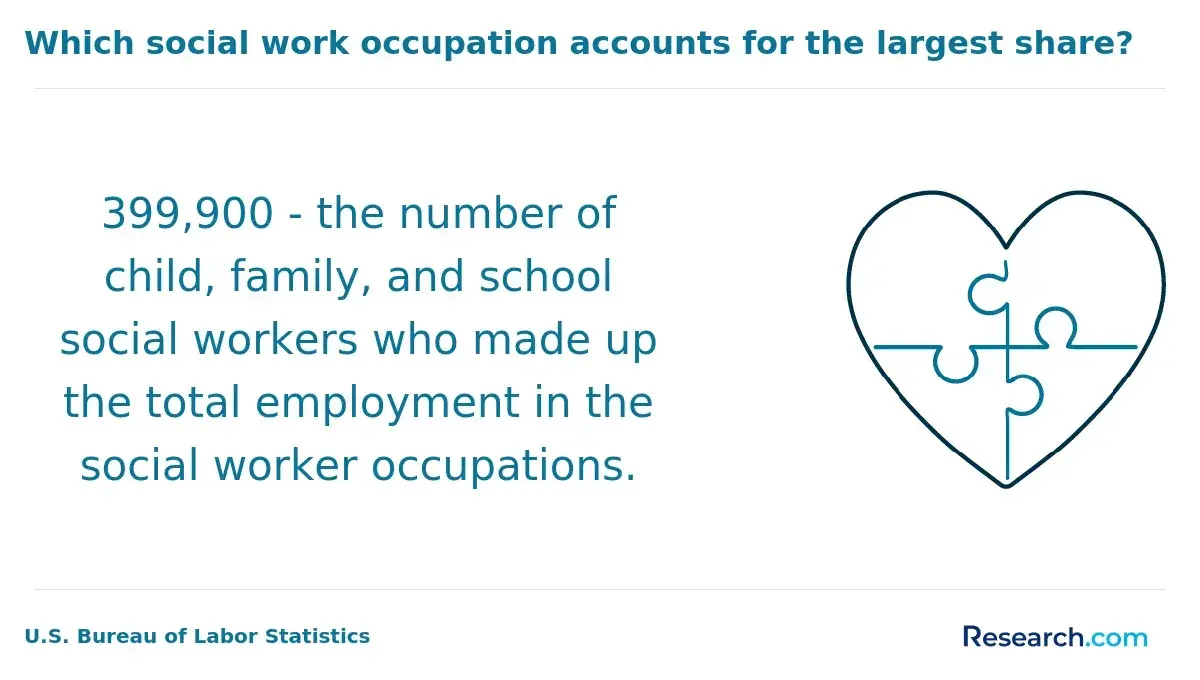
Job growth for child, family, or school social worker roles is projected at 8%, with median salaries near $56,680. This data from U.S. News & World Report and the Bureau of Labor Statistics can help students weigh the financial commitment of an online MSW against expected career opportunities, while remembering that pay varies by role, state, employer, and licensure status.
An MSW degree can lead to careers in clinical practice, healthcare, schools, child and family services, nonprofit leadership, public policy, community development, and social service administration. The right path depends on your specialization, field placements, licensure goals, and the populations you want to serve.
Many MSW graduates pursue clinical social work, providing assessment, therapy, crisis intervention, and treatment planning in settings such as hospitals, community clinics, behavioral health agencies, and private practice. Clinical roles typically require additional supervised experience and state licensure after graduation.
Other graduates focus on macro or community practice. These roles may involve program design, nonprofit management, policy advocacy, grant administration, community organizing, or systems-level work intended to improve access to services.
| Career area | Common work settings | Typical focus |
| Clinical social work | Mental health clinics, hospitals, private practice, community agencies. | Therapy, assessment, diagnosis-related support, treatment planning, and crisis response. |
| Child and family social work | Child welfare agencies, foster care organizations, family service nonprofits. | Child safety, family support, permanency planning, and advocacy. |
| Healthcare social work | Hospitals, hospice programs, rehabilitation centers, public health settings. | Care coordination, discharge planning, patient advocacy, and family support. |
| School social work | K-12 schools, districts, alternative education programs. | Student mental health, attendance, family engagement, crisis support, and academic barriers. |
| Policy and administration | Government agencies, nonprofits, research organizations, advocacy groups. | Program leadership, policy analysis, community planning, and service improvement. |
| Gerontological social work | Aging services, long-term care, hospitals, community agencies. | Elder care coordination, caregiver support, benefits navigation, and quality-of-life planning. |
Online MSW programs can help adults transition from related fields into specialized areas such as trauma counseling, substance abuse treatment, health equity, school support, or community organizing. Fieldwork is especially important because it gives students supervised experience, professional references, and exposure to the day-to-day demands of the role.
Costs vary widely, from $33,634 for advanced-track online students to $181,140 for out-of-state traditional programs, so students should connect their career goal to the program’s price, placement network, and licensure preparation. Licensure requirements differ by state and specialty, and therapeutic roles often require clinical credentials after the MSW.
MSW salaries vary by specialization, state, employer, licensure level, years of experience, and whether the role is clinical, administrative, school-based, healthcare-focused, or community-oriented. An MSW can improve access to advanced roles, but it does not guarantee a specific salary.
Entry-level social workers with a master's degree typically earn between $50,000 and $60,000 annually. Specializing in areas such as mental health, trauma, or health equity can open doors to higher salaries, often ranging from $65,000 to $85,000 or more.
Advanced roles such as clinical social workers, healthcare social workers, supervisors, program directors, and administrators frequently report salaries exceeding $75,000. Clinical licensure can also affect earning potential because it may qualify social workers for independent practice, insurance reimbursement, supervisory roles, or specialized therapy positions, depending on state rules.
Factors that influence MSW salary
- Licensure: Clinical credentials may expand role options and compensation in some settings.
- Specialization: Mental health, healthcare, trauma, and administrative tracks may lead to different salary ranges.
- Location: Pay can vary substantially by state, city, cost of living, and local workforce demand.
- Employer type: Hospitals, government agencies, schools, nonprofits, and private practices often have different pay structures.
- Experience: Supervised post-graduate hours, leadership experience, and specialized training can affect advancement.
Students should compare salary expectations with total program cost, debt, field placement demands, and the time required for licensure. The strongest financial outcomes often come from choosing a program that aligns with a clear practice area rather than selecting a degree solely because it is online or fast.
What is the job outlook for social workers?
The job outlook for social workers is strong across multiple practice areas. Employment for social workers is expected to grow 12% from 2024 to 2034, outpacing many other professions. Demand is supported by healthcare needs, mental health service expansion, child and family programs, school-based support, substance abuse treatment, and services for aging populations.
Opportunities differ by specialization. Clinical social workers often pursue Licensed Clinical Social Worker (LCSW) certification for therapy and mental health roles. Healthcare social workers may focus on care coordination, patient advocacy, and discharge planning. School social workers support students, families, and educators. Child and family social workers often work with protective services, foster care, prevention programs, or family support agencies.
Geography also affects job prospects. Urban areas may offer more positions across hospitals, schools, clinics, and nonprofits, but competition can be stronger. Rural and underserved areas may have fewer providers and may offer incentives such as loan forgiveness. Students should research both job demand and licensure requirements in the state where they plan to practice.
The growing enrollment of first-generation and international students in MSW programs is also helping diversify the profession, which matters in a field built on culturally responsive service. For prospective students, the practical takeaway is clear: an MSW can support entry into a field with broad demand, but career outcomes depend on accreditation, field experience, licensure planning, specialization, and local labor market conditions.
Other Things You Should Know About Social Work
Most programs require a laptop or desktop, reliable broadband, webcam, microphone, and access to Zoom or a similar platform for live classes. Some also require secure file-sharing and a background check before field placement. Field agencies may set additional technology, training, and confidentiality rules.
Yes, accredited online MSW programs require students to complete supervised field placements or internships as part of their curriculum. These practical experiences are arranged in the student's local community and provide hands-on training essential for professional licensure. Fieldwork allows students to apply classroom knowledge directly in real-world social work settings.
Many MSW programs accept applicants with bachelor's degrees outside of social work, often offering bridge or foundation courses to build essential knowledge. However, some programs may require prerequisite coursework in areas like psychology, sociology, or human development. It is important to check specific program requirements before applying.
- Full-time online MSW programs https://www.onlinemswprograms.com/online-social-work-degrees/full-time-online-msw-programs/
- Online Master of Social Work https://socialwork.pacific.edu/programs/online-msw-programs
- Online MSW Programs https://socialworklicensemap.com/social-work-degrees/online-msw-programs/
- The Benefits of Earning Your MSW Degree Online https://www.chamberlain.edu/blog/the-benefits-of-earning-your-msw-degree-online
- Online MSW vs Campus MSW: 2025 Outcomes & Career Guide https://www.socialworkdegrees.org/online-msw-vs-campus-msw
- Your Guide to Choosing an Online Master of Social Work Program https://onlinedegrees.keuka.edu/blog/online-msw-worth-it
- Explore Social Work https://www.socialworkers.org/Careers/NASW-Career-Center/Explore-Social-Work
- Social Worker Salary and Jobs in Social Work https://teach.com/online-ed/social-work-degrees/online-masters-social-work/salary-and-career-outlook/
- Best Online Master's Programs For Social Work 2025 https://www.psychology.org/social-work/best-masters-programs/
- MSW Career Outlook https://www.kysu.edu/academics/college-as/school-of-social-work/careers/msw-career-outlook.php