2027 How to Plan Your Social Work Career Before Starting an MSW

Co-Founder and Chief Data Scientist
Choosing an MSW is not just a graduate school decision. It is a career-design decision that affects your licensure options, field placements, specialization, schedule, debt, and future job market. The best program for one student may be a poor fit for another if it does not support the state license, population focus, or practice setting the student wants.
This guide helps prospective social workers plan before enrolling. It explains what an MSW prepares you to do, which career paths and salaries to evaluate, what accreditation matters, how admissions and program formats differ, and how to connect your education plan to licensing requirements after graduation. It is especially useful for applicants coming from another undergraduate field, working adults comparing online and campus options, and students deciding between clinical practice, school social work, healthcare, policy, administration, or community work.
Key Things You Should Know
- Planning your social work career before starting an MSW involves understanding licensure requirements, which vary by state and impact specialization choices and employment opportunities.
- Research shows that nearly 40% of social workers enter clinical roles; gaining relevant experience early can improve job prospects and readiness for certification exams.
- Financial planning is critical; with average MSW tuition rising 5% annually, budgeting for education costs alongside potential internships ensures smoother career progression.
What is an MSW degree and why pursue it for social work?
An MSW degree, or Master of Social Work, is the graduate credential that prepares students for advanced social work practice. It builds skills in assessment, intervention, case management, advocacy, ethics, research use, and program evaluation. Depending on the program and concentration, students may prepare for clinical work with individuals and families, community practice, policy advocacy, school-based services, healthcare roles, or agency leadership.
The main reason to pursue an MSW is that many advanced social work roles are not available with only a bachelor's degree. In many states, an MSW is also required before a graduate can begin the path toward licensed clinical social worker (LCSW) status. For students who want to provide therapy, move into clinical supervision, work in healthcare systems, or qualify for higher-responsibility positions, the degree is often a necessary step rather than an optional credential.
Employment for social workers holding an MSW is projected to grow 6% from 2024 to 2034, faster than average, with around 74,000 annual job openings. That demand is connected to the need for mental health, healthcare, child welfare, aging, school, and community-based services. Still, students should not choose an MSW based on job growth alone. The stronger approach is to match the program to a specific practice goal, population, state licensing plan, and preferred work environment.
Common reasons students pursue an MSW
- To qualify for advanced licensure, including clinical licensure in many states
- To enter roles in healthcare, schools, government agencies, nonprofits, and behavioral health settings
- To gain supervised field experience tied to a chosen specialization
- To move from frontline service work into clinical, administrative, policy, or leadership roles
- To build a foundation for long-term work in social justice, community development, and systems change
Students interested in research, executive leadership, or advanced academic preparation after the master's level may also compare online doctorate in social work programs.
What career paths open with an MSW degree?
An MSW can lead to both direct-practice and macro-practice careers. Direct-practice roles usually involve working with individuals, families, or groups through assessment, counseling, service coordination, crisis intervention, or case management. Macro-practice roles focus more on programs, organizations, communities, policy, research, and advocacy. Many social workers move between these areas over time.
Clinical social work is one of the most common MSW pathways. Graduates who pursue clinical licensure may provide psychotherapy and behavioral health services in clinics, hospitals, community agencies, schools, or private practice settings after meeting state requirements. Other graduates work in child, family, and school social work, supporting students, caregivers, foster youth, and families facing instability or crisis.
Healthcare social workers help patients and families navigate illness, discharge planning, long-term care, benefits, and community resources. Geriatric social workers support older adults and their families in nursing homes, hospitals, hospice programs, and community settings. Community organization and policy roles focus on program design, advocacy, grant-funded services, social welfare systems, and organizational change.
Specializations like mental health and substance abuse social work have the highest growth potential, projected at 11% from 2022 to 2032, according to Jacksonville State University Social Work Department. This growth makes behavioral health an important option to evaluate, but it also requires students to understand licensing, supervision, emotional workload, and documentation expectations before committing to the path.
How to narrow your MSW career direction
- Choose a population: children, families, older adults, people with disabilities, patients, students, veterans, people experiencing homelessness, or communities affected by poverty and inequality.
- Choose a practice level: individual counseling, family services, group work, community organizing, policy, administration, or research.
- Check licensure needs early: therapy and independent clinical practice usually require post-MSW supervised experience and an exam.
- Look at field placements: the practicum site often shapes your first job opportunities more than the course catalog does.
- Compare program strengths: some MSW programs are stronger in clinical training, while others emphasize policy, community practice, or leadership.
Students weighing program choice against affordability should also review masters in social work cost before applying.
What jobs can you get with an MSW and expected salaries?
MSW graduates work in healthcare, schools, behavioral health, child welfare, government, corrections, nonprofits, aging services, and private or group practice settings. The job title alone does not determine pay. Salary often depends on the state, employer type, licensure level, years of experience, specialization, union coverage, and whether the role is clinical, supervisory, administrative, or grant funded.
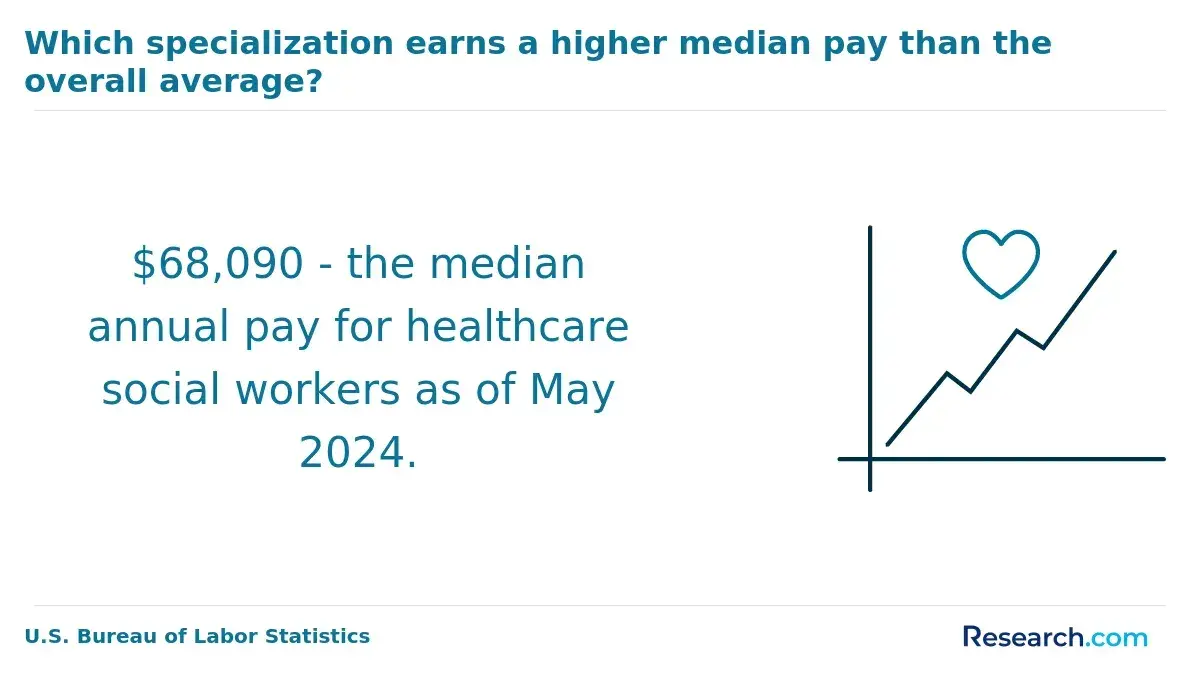
According to the Association of Social Work Boards Workforce Study Report 2, licensed social workers earned a median salary of $49,590, roughly $85,000 when adjusted for inflation. Those with clinical licenses or specialized expertise can earn more, often exceeding $75,000 annually. Applicants should treat these figures as broad reference points rather than guaranteed outcomes, because compensation varies significantly by location and role.
| MSW role | Typical work focus | Important planning factor |
| Licensed clinical social worker | Assessment, therapy, diagnosis-related treatment planning, and ongoing client care | Usually requires post-MSW supervised clinical hours and a licensing exam |
| Medical social worker | Discharge planning, patient advocacy, care coordination, crisis support, and resource navigation | Healthcare experience and comfort working in interdisciplinary teams can be valuable |
| School social worker | Student support, family engagement, crisis response, attendance issues, and special services coordination | Some states or districts require school-specific credentials or certifications |
| Child welfare specialist | Family assessment, safety planning, foster care support, case documentation, and court-related work | Roles can involve high caseloads, regulatory requirements, and crisis response |
| Community or policy social worker | Program development, advocacy, community engagement, policy analysis, and systems change | Licensure may be less central than experience with data, grants, coalitions, and public systems |
To improve long-term earning potential, look for roles and field placements that support licensure supervision, specialized training, strong documentation skills, and advancement into senior clinician, supervisor, program manager, or director positions. For location-specific compensation context, review this licensed clinical social worker salary guide.
The most important programmatic accreditation for MSW programs in the United States is accreditation from the Council on Social Work Education (CSWE). For many students, this is the first item to verify because state licensing boards commonly require a degree from a CSWE-accredited program for clinical social work licensure or other social work credentials. If a program does not meet the requirements of the state where you plan to practice, you may face licensing delays or find that your degree does not support your intended career path.
Institutional accreditation also matters. MSW programs are usually offered by colleges or universities with regional accreditation from agencies such as the Middle States Commission on Higher Education or the Higher Learning Commission. Regional accreditation helps establish the institution's legitimacy for federal financial aid, credit transfer, and graduate education standards. However, it does not replace CSWE accreditation for social work professional preparation.
Accreditation checklist before applying
- Confirm that the MSW program has current CSWE accreditation.
- Check whether the program is fully accredited or in another status, such as candidate status.
- Ask the state social work board where you plan to work whether graduates from the program meet education requirements for licensure.
- Verify the institution's regional accreditation status.
- Confirm that online, hybrid, and campus tracks are covered as part of the accredited program structure.
- Keep screenshots or written documentation from the program and licensing board for your records.
Programs with only "candidate status" from CSWE are not the same as fully accredited programs. Candidate status may be part of the accreditation process, but students should confirm how the status affects licensure eligibility in their intended state before enrolling.
Employment geography is another factor to weigh alongside accreditation. For instance, the Columbia School of Social Work reported that 78% of graduates found jobs in the Northeast, including New York and Washington, DC. If you know where you want to work, prioritize programs with field placement networks, alumni connections, and licensing alignment in that region. Students seeking flexible formats can compare online MSW programs, but accreditation should remain non-negotiable.
Top MSW programs generally require a bachelor's degree from an accredited college or university. Many programs look for a minimum GPA of 3.0, although applicants with a lower GPA may still be considered if they show strong professional experience, academic improvement, compelling recommendations, or readiness for graduate-level work. Applicants do not always need a bachelor's degree in social work, but those with a BSW from an eligible program may qualify for advanced standing options at some schools.
Common application materials include official transcripts, two or three letters of recommendation, a resume, and a personal statement explaining the applicant's motivation, values, relevant experience, and career goals. Human services experience can strengthen an application, whether it comes from paid work, internships, AmeriCorps-style service, crisis lines, advocacy organizations, case management support, community programs, healthcare settings, schools, shelters, or volunteer roles.
Many schools are moving away from requiring GRE scores and instead using holistic review. Some programs may still request standardized test scores, so applicants should check each school's current policy. International students may need English proficiency scores such as TOEFL or IELTS. Interviews, whether virtual or in person, may be used to evaluate communication skills, ethical awareness, maturity, and fit for the profession.
How to make an MSW application stronger
- Connect your goals to the program: name the population, practice area, or social issue you want to focus on and explain why the program fits.
- Show readiness for fieldwork: describe experience with clients, communities, advocacy, teamwork, boundaries, or crisis situations.
- Be honest about career direction: you do not need to have every detail settled, but you should show thoughtful alignment between the MSW and your goals.
- Choose recommenders carefully: strong letters from supervisors, faculty, or service leaders are more useful than generic letters from people with impressive titles.
- Address academic weaknesses directly: if your transcript has gaps, explain what changed and why you are prepared now.
Clinical-focused programs may value mental health, healthcare, crisis response, or direct-service experience. Policy, research, or community-practice tracks may look closely at writing ability, analytical thinking, organizing experience, and commitment to systems-level change. According to the Association of Social Work Boards Workforce Study Report 2, nearly 70% of licensed master's social workers plan to remain in their roles over two years, which underscores the importance of choosing a program that matches long-term professional goals rather than applying only by brand name.
A traditional full-time MSW program generally takes two years. Part-time tracks may take three or four years, which can be useful for students who need to keep working or manage family responsibilities. Accelerated options may take 12 to 18 months, but they usually require a heavier course load and less schedule flexibility. The right timeline depends on your finances, work obligations, field placement availability, and tolerance for academic intensity.
Tuition costs vary widely between public and private institutions, typically ranging from $20,000 to over $60,000. Public universities may offer lower tuition, especially for in-state students. Private institutions may cost more but can sometimes offer scholarships or placement networks that matter to specific applicants. Students should calculate total cost, not just advertised tuition.
Costs to include in your MSW budget
- Tuition and required fees
- Books, course materials, and technology requirements
- Transportation or relocation costs
- Lost work hours during field placement
- Licensing exam preparation and application fees after graduation
- Health insurance, childcare, and living expenses if your schedule changes
Financial aid options may include merit-based scholarships, need-based aid, assistantships, employer tuition support, and loan forgiveness options. Before borrowing, ask programs for completion rates, field placement support, licensure exam preparation resources, and employment outcomes where available. A less expensive program is not automatically better if it lacks the placements or supervision pathway you need, but a high-cost program should be able to justify its value with concrete support.
When comparing timelines, remember that speed has trade-offs. Accelerated programs can help students enter the workforce sooner, but the pace can be demanding. Part-time programs may reduce weekly pressure, but they delay completion and may extend the period in which students balance work, study, and field education. California forecasts a 14% job growth for social workers through 2033, driven by increasing mental health and healthcare needs (University of the Pacific School of Social Work), which highlights the value of timely credentialing for students planning to work in expanding service areas.
An MSW curriculum combines classroom learning with supervised field education. The goal is to prepare students to understand human behavior, social systems, ethics, policy, research, and intervention methods while applying those concepts in real service settings. Most programs begin with foundational content and then move into advanced coursework tied to a concentration or specialization.
Core courses commonly cover human behavior and the social environment, social welfare policy and services, research methods, practice with individuals and families, practice with groups and communities, ethics, diversity, and culturally responsive practice. These courses help students understand how psychological, social, economic, cultural, and policy factors affect client needs and service access.
Specialized concentrations may include clinical social work, community organizing, policy advocacy, child and family welfare, healthcare social work, school social work, gerontology, mental health, or substance use. Clinical tracks usually emphasize assessment, counseling approaches, diagnosis-informed treatment planning, crisis response, and documentation. Policy or community tracks may focus more on program design, advocacy, leadership, evaluation, and systems change.
Field practicum placements require 900 to 1,200 hours of supervised work in settings like hospitals, schools, or social service agencies. This is one of the most important parts of the degree. Field education allows students to test career interests, build professional judgment, develop supervision habits, and form connections that may lead to employment after graduation.
Questions to ask about field education
- Does the program place students, or must students find their own practicum site?
- Are placements available in your area if the program is online?
- Can the field office support your target specialization, such as clinical practice, healthcare, school social work, or policy?
- Are evening or weekend placements available for working adults?
- Can your current workplace count as a placement if it meets program standards?
- How does the program handle placement problems, supervisor changes, or site closures?
Many programs offer online or hybrid formats, accommodating working professionals balancing education with employment-30% of licensed social workers earned their degrees this way, according to the Association of Social Work Boards Workforce Study Report 2. Online and hybrid students should pay close attention to field placement support because the practicum experience is not optional and may be the most schedule-intensive part of the program.
Licensing after an MSW depends on the state and the type of work you want to do. Clinical licensure typically requires completing supervised clinical practice after graduation and passing a licensing exam. Requirements commonly involve between 2,000 and 4,000 hours of supervised clinical practice. For instance, California requires 3,200 hours over at least two years, while New York mandates 3,000 hours within a minimum of three years.
The licensing exam is usually the ASWB Clinical Exam for candidates seeking independent clinical practice. The exam assesses areas such as ethics, assessment, intervention, clinical reasoning, professional relationships, and applicable laws. Candidates must also follow state-specific rules for supervision, documentation, supervisor qualifications, application timing, and renewal.
Not every MSW graduate needs clinical licensure. Social workers in policy, administration, community organizing, program management, research, advocacy, and some nonprofit leadership roles may not need the same clinical credential. However, even non-clinical roles may prefer or require some form of social work license depending on the employer, state, and job duties.
Data suggest that about 71% of Columbia MSW graduates engage in direct clinical practice, with others focusing on non-clinical paths. Specialized certifications, such as school social work or substance abuse counseling, often have additional requirements beyond clinical licensure.
Licensure planning steps before you enroll
- Identify the state where you are most likely to practice after graduation.
- Review that state's social work board requirements for education, supervised hours, exams, and applications.
- Confirm that your MSW program's accreditation and curriculum meet that state's requirements.
- Ask the program how it supports licensure preparation and supervised placement planning.
- Keep organized records of field hours, post-graduate supervision, supervisor credentials, and board correspondence.
A common mistake is waiting until graduation to understand licensing rules. Because requirements vary by state, students should communicate early with the relevant state social work board and avoid assuming that one state's pathway will transfer smoothly to another.
The best format depends on your schedule, location, learning style, budget, and field placement needs. Online MSW programs can be a strong option for working adults, parents, military-connected students, and applicants who do not live near a campus-based program. Campus programs may be better for students who want frequent in-person interaction, local networking, structured schedules, and easier access to university-based resources.
Accreditation by the Council on Social Work Education (CSWE) is essential for both formats. An online program is not automatically less rigorous, and a campus program is not automatically better. The key question is whether the format supports licensure eligibility, field placement quality, faculty access, and your ability to complete the program without unnecessary disruption.
| Factor | Online MSW | Campus MSW |
| Schedule flexibility | Often stronger, especially if courses are asynchronous | Usually more structured with set class times |
| Networking | Can be strong, but may require intentional effort | Often easier through in-person classes, events, and local placements |
| Field placement | Students must confirm local placement support before enrolling | May have established relationships with nearby agencies |
| Costs | May reduce commuting or relocation expenses but can include technology or campus visit fees | May involve commuting, parking, housing, or relocation costs |
| Learning fit | Best for self-directed students with reliable technology and time-management skills | Best for students who benefit from face-to-face structure and immediate peer interaction |
Field education should be a deciding factor. Online students should ask whether the program finds placements, approves student-proposed sites, has existing agency partnerships in their region, and can support clinical goals if they plan to pursue licensure. According to the Association of Social Work Boards Workforce Study Report, 13% of bachelor's-level licensed social workers pursued master's programs for clinical advancement. For students using the MSW to advance clinically, weak practicum support can become a serious obstacle.
Before choosing a format, compare total costs, not just tuition. Online programs may reduce relocation and commuting expenses, but some require campus visits or technology fees. Campus programs may offer stronger local networks but can increase living costs. The right choice is the program format you can complete successfully while meeting accreditation, fieldwork, and licensure requirements.
What is the job outlook for MSW social workers?
The job outlook for MSW social workers is steady because social workers are needed across healthcare, education, behavioral health, child welfare, aging services, public agencies, and community organizations. Social workers remain the largest providers of mental health services in the U.S., with over 810,900 positions noted in 2024 per the U.S. Bureau of Labor Statistics Occupational Outlook Handbook.
Demand is especially important for clinical social workers who provide mental health services. Greater awareness of mental health needs, expanded service models, and community-based care continue to support opportunities in behavioral health. Child, family, and school social workers also remain important in educational and social service systems, while healthcare and geriatric roles are shaped by patient care coordination and the needs of an aging population.
Factors that shape job opportunities
- Increased need for mental health services across diverse populations
- Expanded healthcare coverage and community-based care models
- Growing elderly population requiring supportive services
- Legislative and policy initiatives focusing on prevention and social welfare
- Local funding levels for schools, hospitals, nonprofits, and public agencies
- State licensure rules and availability of supervised clinical positions
Job availability is not the same everywhere. Urban areas may have more agencies, hospitals, and specialized programs, but they may also be more competitive. Rural and underserved areas may have strong need but fewer employers or fewer supervision options for new graduates. Students should consider where they want to work, whether they need clinical supervision after graduation, and which employers in that region regularly hire MSW graduates.
For stronger long-term prospects, use the MSW to build a clear professional profile. Choose field placements that match your target setting, document licensure progress carefully, develop strong assessment and writing skills, and consider adding expertise in high-need areas such as behavioral health, healthcare navigation, school support, aging services, program evaluation, or supervision. Graduates with an MSW can find durable career options, but the best outcomes usually come from planning the degree around a specific licensure and employment strategy.
Other Things You Should Know About Social Work
Cultural competence is crucial in social work education as it equips students with the ability to effectively work with diverse groups. It involves understanding and respecting different cultures, beliefs, and values and integrating this knowledge into practice, ensuring inclusivity and better client outcomes.
Yes, many MSW programs offer specialized training in management and policy, preparing graduates for leadership and supervisory positions. Coursework and field experiences can focus on administration, advocacy, and program development, equipping social workers to influence organizational and community change.
Look for at least 20–40 hours of shadowing or volunteering in a social service setting before applying. Programs value exposure to case management, client intake, community outreach, and crisis response because it shows you understand day-to-day practice and can explain why social work fits your goals.
- Becoming a Social Worker: 7 Things You Should Know | UMass Global https://www.umassglobal.edu/blog-news/becoming-a-social-worker
- MSW Curriculum Breakdown - MSW Degrees in Austin https://www.mswdegreeaustin.com/msw-curriculum-breakdown/
- Online Master’s in Social Work Programs https://onlinecounselingprograms.com/online-counseling-degrees/cswe-accredited-online-msw-programs/
- CSWE Accreditation Requirements and Standards https://lumivero.com/resources/blog/cswe-accreditation/
- Explore Social Work https://www.socialworkers.org/Careers/NASW-Career-Center/Explore-Social-Work
- High-demand social work roles in 2026: trends and opportunities https://socialwork.pacific.edu/blog/high-demand-social-work-roles-2026-trends-and-opportunities
- Social Work Masters Prerequisites: Discover 7 Critical Pieces - Prereqcourses https://www.prereqcourses.com/social-work-masters-prerequisites/
- Certified Master Social Worker - Florida Board of Clinical Social Work, Marriage & Family Therapy and Mental Health Counseling https://floridasmentalhealthprofessions.gov/certified-master-social-worker/
- What Careers can you pursue with a Social Work degree? https://www.pointloma.edu/resources/counseling-psychology/what-careers-can-you-pursue-social-work-degree
- Accreditation | CASWE-ACFTS https://caswe-acfts.ca/our-activities/accreditation/