2027 What Makes an Online MSW Program Student-Friendly?

Co-Founder and Chief Data Scientist
Choosing an online MSW program is not just about finding a degree you can complete from home. For many students, the real question is whether the program can fit around work, caregiving, finances, field placement requirements, and the licensing path they plan to follow after graduation.
A student-friendly online MSW program gives learners flexibility without leaving them to manage everything alone. The strongest programs combine clear course scheduling, responsive faculty, structured advising, reliable technology, transparent costs, and meaningful help with field education. Those details can determine whether a student graduates on time, qualifies for licensure, and moves into the kind of social work role they want.
This guide explains what to look for in an online MSW program in 2026, including accreditation, admissions, curriculum, fieldwork, cost, completion time, career outcomes, salary expectations, and job outlook. It is designed for working adults, career changers, social service professionals, and recent graduates comparing online MSW options.
Key Things You Should Know
- Flexible scheduling and asynchronous coursework enable 65% of online MSW students in 2025 to balance work, family, and study effectively, enhancing retention and completion rates.
- Accredited programs increasingly offer virtual field placements supervised through secure digital platforms, ensuring practical experience despite geographic constraints.
- Student support services, including online tutoring and dedicated advisors, have grown by 40%, addressing diverse needs and improving academic success in online MSW programs.
What Makes an Online MSW Program Student-Friendly?
A student-friendly online MSW program is one that recognizes how social work students actually live. Many are not full-time residential students with open daytime schedules. They are employees, parents, caregivers, military spouses, first-generation graduate students, or professionals already working in human services.
The CSWE Workforce Data Brief (2018) shows why flexibility matters: 54% of online MSW graduates had six or more years of employment before starting their programs, compared with only 23% of in-person graduates. That difference means online programs must be built for students who are already managing adult responsibilities.
Flexible learning without sacrificing structure
The most supportive online MSW programs usually offer asynchronous coursework, recorded lectures, predictable assignment calendars, and digital course materials that students can access outside traditional business hours. Flexibility does not mean a program should feel unstructured. Students still need clear weekly expectations, consistent deadlines, and easy-to-follow learning platforms.
Accessible faculty and advising
Strong student support services include virtual office hours, responsive email communication, academic advising, writing or tutoring support, library access, and career guidance. These services matter because online students can fall behind quickly when they cannot get answers about course planning, practicum paperwork, or academic concerns.
Field placement support
Field education is often the hardest part of an online MSW program to fit into a working adult’s life. Student-friendly programs help students identify appropriate local placement sites, clarify licensure-related requirements, and coordinate communication between the student, the agency, and the school. Flexible practicum scheduling can help, but students should still expect significant daytime availability because many social service agencies operate during regular business hours.
Technology that reduces friction
A good online program should not require students to become IT troubleshooters. Look for an intuitive learning management system, mobile-friendly access, video conferencing support, digital library tools, and prompt technical assistance. Orientation sessions, peer groups, and online student communities also help reduce isolation and build persistence.
Students planning beyond the MSW may also compare doctoral routes, including options such as a PhD social work online, especially if they are interested in research, leadership, or higher education roles.
What Are the Key Features of a Student-Friendly Online MSW Program?
The best online MSW programs are designed around both academic quality and student usability. They do not simply move campus lectures online. They create a learning experience that helps students stay enrolled, complete fieldwork, prepare for licensure, and apply social work skills in real settings.
Core features to compare
- Accreditation: The program should hold the accreditation needed for social work licensure pathways, especially CSWE accreditation in the United States.
- Flexible course delivery: Asynchronous classes, recorded lectures, and clear weekly modules help students manage work and family responsibilities.
- Responsive advising: Advisors should help with degree planning, registration, specialization choices, graduation timelines, and field education requirements.
- Faculty access: Students should be able to reach instructors through email, video meetings, virtual office hours, and course discussion tools.
- Field practicum coordination: The school should explain whether it finds placements, supports student-identified placements, or expects students to secure sites independently.
- Interactive learning: Discussion boards, video sessions, group projects, and case-based assignments help students build professional judgment and communication skills.
- Digital resources: Online students need full access to library databases, research guides, writing support, and academic technology tools.
- Transparent pricing: Tuition, fees, residency rules, practicum-related costs, and financial aid options should be easy to understand before enrollment.
- Specialization options: Tracks in areas such as clinical social work, policy advocacy, or community practice can help students align the degree with career goals.
- Inclusive learning environment: Because online MSW programs often enroll students from many regions and backgrounds, coursework should reflect diversity, equity, ethics, and culturally responsive practice.
Questions to ask before applying
- Are courses mostly asynchronous, synchronous, or a mix of both?
- How quickly do faculty and advisors typically respond to students?
- Who is responsible for finding field placements?
- Can fieldwork be completed near the student’s home?
- Are online students eligible for the same scholarships, library access, tutoring, and career services as campus students?
- Does the program offer a clear path for the specialization or license the student wants?
Students who want to compare flexible and cost-conscious options can review programs such as online social work masters degrees and then verify each program’s accreditation, practicum model, and support services directly with the school.
How Do Online MSW Programs Differ from Traditional Campus Ones?
Online and campus MSW programs often cover similar academic content, especially when both follow the same accreditation standards. The main differences are delivery format, scheduling, access to campus resources, peer interaction, and how field placements are arranged.
Online MSW programs
Online MSW programs allow students to complete most coursework remotely. This can be a major advantage for students who cannot relocate, commute regularly, or leave full-time employment. Online formats may include recorded lectures, live evening classes, virtual discussion boards, and digital group projects.
The trade-off is that online students must be self-directed. They need reliable internet, comfort with digital platforms, strong time management, and a willingness to seek help proactively. Networking and mentoring can still happen online, but students often need to be more intentional about building those relationships.
Traditional campus MSW programs
Campus programs provide in-person classes, face-to-face faculty interaction, on-campus events, and easier access to physical resources. Some students learn better in a classroom setting or value the social connection of being on campus. Campus programs may also have long-standing agency relationships near the university, which can simplify field placement options.
The trade-off is less scheduling flexibility. Students may need to commute, relocate, or arrange work hours around fixed class times. For working adults and caregivers, those requirements can make a campus program harder to complete.
Field placement differences
Field education is required in both formats. Online programs commonly coordinate placements in or near the student’s community, while campus programs often draw from agency networks close to the university. Before enrolling online, students should confirm whether the school provides placement support in their state or region and whether local agencies can meet program and licensure expectations.
Students seeking speed and flexibility may compare options such as MSW accelerated programs, but accelerated formats require careful planning because fieldwork and coursework can become intense.
In the United States, the most important programmatic accreditation for an MSW is accreditation from the Council on Social Work Education (CSWE). For many students, this is nonnegotiable because CSWE accreditation is commonly tied to eligibility for social work licensure. A degree from a non-CSWE-accredited program may limit a graduate’s ability to become licensed, qualify for certain jobs, or pursue advanced clinical practice.
CSWE accreditation
CSWE accreditation indicates that the program meets national standards for social work education, including curriculum, field education, ethics, assessment, and professional competencies. Students should verify the program’s current accreditation status directly rather than relying only on marketing language.
When checking accreditation, confirm whether the program is fully accredited and whether the online format is included under the school’s approved MSW offering. If the program is new, ask the school to explain its accreditation status and what that means for licensure eligibility.
Institutional accreditation
Regional accreditation for the college or university also matters. It can affect federal financial aid eligibility, transfer credit, employer recognition, and admission to future graduate or doctoral programs. However, institutional accreditation does not replace CSWE accreditation for social work preparation.
Why field placement quality matters
Accreditation standards also shape field education, which is where students apply classroom learning in supervised practice. Online students should pay close attention to placement support because some programs have fewer established local agency partnerships. According to the Reddit r/SocialWorkStudents community, students can encounter low-quality or exploitative training sites when they must secure placements with limited institutional help.
Before enrolling, ask the program:
- Does the school identify placement sites, or must students find their own?
- What happens if a student cannot secure an appropriate local placement?
- Are placements available in the student’s state or region?
- How are field supervisors vetted?
- Who intervenes if a placement is not meeting educational standards?
Students comparing accessible pathways can review resources on the easiest MSW program options, but admission accessibility should never outweigh accreditation, licensure fit, and field placement quality.
Admission requirements for online MSW programs vary by school, but most programs evaluate academic readiness, communication skills, professional maturity, and commitment to social work values. Applicants should read requirements carefully because deadlines, prerequisite expectations, and field placement documentation can differ significantly.
Common admission requirements
- Bachelor’s degree: Applicants usually need a bachelor’s degree from an accredited institution.
- Minimum GPA: Many programs look for a minimum GPA of 3.0, although some review applicants holistically.
- Official transcripts: Schools use transcripts to verify degree completion, GPA, and relevant coursework.
- Prerequisite coursework: Some programs expect prior study in sociology, psychology, human services, statistics, or related fields.
- Experience: Volunteer work, employment, or internships in social service settings may strengthen an application and may be required by some programs.
- Letters of recommendation: Programs commonly request two to three letters from academic, professional, or supervisory contacts.
- Personal statement: Applicants typically explain their goals, relevant experience, motivation for social work, and readiness for graduate study.
- Resume: A current resume should highlight employment, volunteer service, leadership, advocacy, and human service experience.
- GRE scores: GRE scores are less frequently required, though some competitive programs may request them or offer waivers.
- English proficiency: International students typically submit TOEFL or IELTS scores when required.
Advanced standing considerations
Students with a recent BSW from an eligible program may qualify for advanced standing at some schools. This can shorten the degree by allowing students to bypass foundation coursework. Admission is usually more selective, and students should confirm whether their prior degree, GPA, and graduation date meet the program’s advanced standing rules.
Field placement readiness
Admission is not the only step. Online MSW students may also need to complete background checks, immunization records, liability insurance documentation, agency onboarding forms, or state-specific requirements before beginning fieldwork. These steps can take time, so students should ask admissions and field education staff for a clear timeline.
Strong applicants communicate clearly with admissions staff, submit complete materials early, and explain how they plan to manage the time demands of graduate coursework and practicum placement.
Online MSW curricula prepare students for ethical, evidence-informed social work practice with individuals, families, groups, organizations, and communities. While course names vary by school, accredited programs generally combine social work theory, policy, research, practice methods, ethics, diversity, and supervised field education.
Foundation coursework
Foundation courses usually introduce the major knowledge areas of social work. Students study human behavior and the social environment, social welfare policy, research methods, ethics, diversity and inclusion, and generalist practice. These courses help students understand how individual needs connect to families, communities, institutions, and broader systems.
Advanced practice coursework
After the foundation stage, students often move into more specialized practice courses. Depending on the program, advanced coursework may focus on clinical social work, mental health, child and family welfare, healthcare, school social work, community organizing, leadership, policy advocacy, or work with specific populations.
Field education
Field education is the bridge between coursework and professional practice. Students complete supervised hours in approved social work settings and apply skills such as assessment, documentation, case planning, crisis response, advocacy, group facilitation, and ethical decision-making. Online programs often arrange or approve placements near the student’s location, but students should verify the level of support before enrolling.
Campus immersions and live requirements
Some online programs require 1-2 annual campus immersions. These sessions may include skills labs, simulations, faculty meetings, networking, or intensive training activities. Students should factor travel, lodging, time away from work, and family responsibilities into the true cost and feasibility of the program.
Students should also compare the balance of synchronous and asynchronous instruction. A mostly asynchronous program offers more schedule control, while live sessions may provide stronger interaction and real-time skill practice. The right format depends on the student’s learning style, work schedule, and support needs.
Online MSW programs generally take two to three years for full-time students. Part-time students may take up to five years or more, depending on credit load, course availability, field placement timing, and program policies. Some accelerated tracks allow completion in as few as 16 months, but those formats can be demanding and may not be realistic for every working adult.
Time to completion
Program length depends on several factors:
- Enrollment status: Full-time students finish faster but carry a heavier academic and practicum workload.
- Advanced standing eligibility: Students with qualifying BSW backgrounds may complete fewer credits.
- Field placement schedule: Practicum hours can limit how many courses a student can manage at once.
- Course sequencing: Some required courses are offered only during specific terms.
- Personal availability: Work, caregiving, health, and transportation constraints can affect pacing.
Cost considerations
Tuition varies widely by institution type, residency status, and pricing model. Public in-state tuition typically ranges from $10,000 to $30,000 annually, while private schools often charge between $30,000 and $60,000 per year. Students should also account for technology fees, books, background checks, transportation to field sites, professional liability insurance, and possible immersion travel costs.
Schools may charge flat-rate tuition or per-credit tuition. A flat-rate model may benefit students taking heavier course loads, while per-credit pricing may work better for part-time students who need to spread costs over time.
The fieldwork time commitment
Field education can be the biggest scheduling challenge. Practical field education may require 16 to 20 hours weekly during business hours, Monday through Friday. That expectation can be difficult for students with full-time jobs, inflexible employers, or caregiving responsibilities.
Before enrolling, students should ask whether evening or weekend placements are realistic, whether employment-based placements are permitted, and whether the program has placement options in the student’s area. Financial aid, scholarships, and employer tuition assistance may reduce costs, but availability varies by program.
An online MSW can prepare graduates for clinical, administrative, community-based, policy, and leadership roles. The degree format is usually less important than accreditation, field experience, licensure eligibility, specialization, and professional network. Employers typically care whether the graduate completed a credible MSW program and has the skills required for the role.
Common career paths
- Clinical social worker: Provides assessment, therapy, crisis intervention, and mental health support, often after completing required licensure steps.
- School social worker: Supports students and families, addresses attendance or behavioral concerns, and connects schools with community services.
- Healthcare social worker: Helps patients and families navigate treatment, discharge planning, care coordination, and resource access.
- Child welfare case manager: Works with children and families involved in protection, foster care, reunification, or permanency planning.
- Substance abuse counselor: Supports individuals and groups dealing with addiction, relapse prevention, recovery planning, and related mental health concerns.
- Geriatric social worker: Serves older adults and families through care planning, benefits navigation, long-term care support, and advocacy.
- Nonprofit administrator: Oversees programs, budgets, staff, grants, compliance, and service delivery.
- Policy analyst or advocate: Researches social issues, evaluates programs, and works on legislation or systems change.
Why prior experience can matter
Many online MSW students continue working while enrolled, which can help them build experience and professional contacts before graduation. Data from the 2018 CSWE Online vs. In-Person MSW Workforce Data Brief shows that 52% of online MSW graduates found satisfying employment more easily than 43% of traditional students. That advantage may reflect the substantial prior work experience many online students bring to graduate school.
Students should align electives, field placements, and licensure steps with their intended career path. For example, students aiming for therapy roles should prioritize clinical coursework and understand post-graduate licensure requirements, while students interested in policy or nonprofit leadership may benefit from macro practice, program evaluation, and grant-related experience.
MSW salaries vary by role, licensure level, employer type, specialization, and location. In 2026, MSW graduates should view salary data as a planning tool rather than a guarantee. The same degree can lead to very different earnings depending on whether a graduate works in healthcare, schools, government, nonprofit services, private practice, or administration.
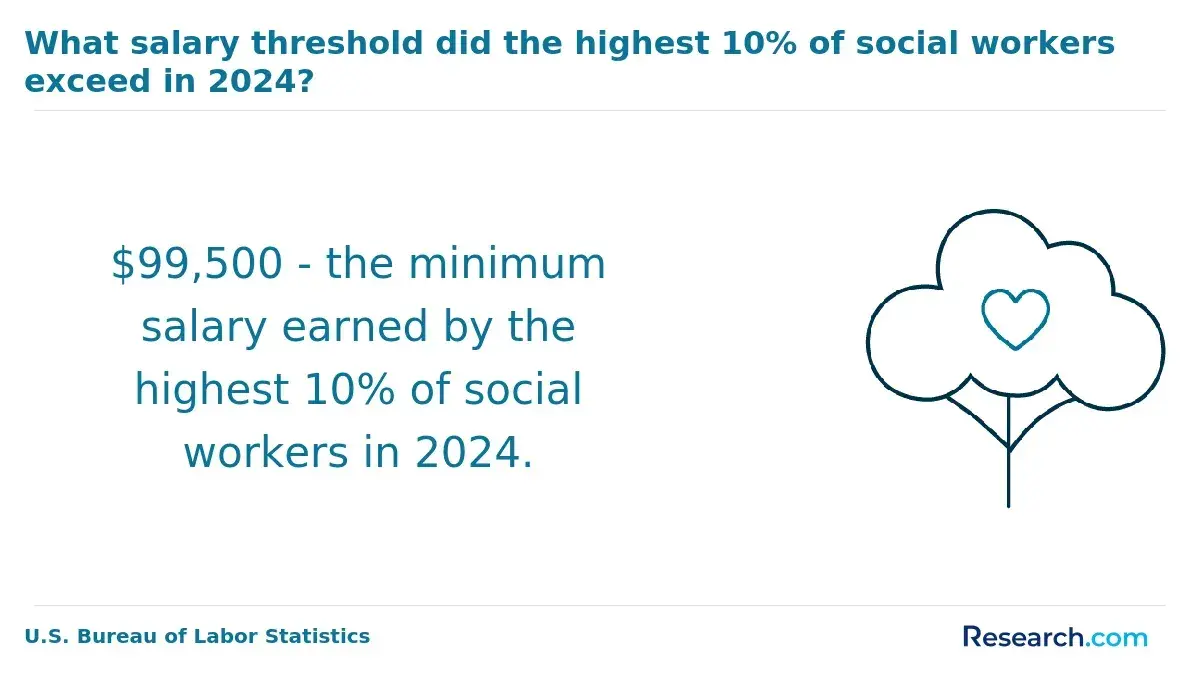
The U.S. Bureau of Labor Statistics reports a median annual wage for social workers of nearly $60,000, with clinical social workers earning closer to $65,000. Entry-level salaries, especially in government or non-profit sectors, often start around $45,000, while roles in healthcare or school settings typically exceed $70,000.
Factors that influence pay
- Licensure: Clinical licensure, such as LCSW status, can expand access to therapy roles, private practice, and advanced clinical positions.
- Specialization: Areas such as healthcare, behavioral health, substance abuse, and child welfare may have different compensation patterns.
- Employer type: Government agencies, hospitals, schools, nonprofits, and private organizations may use different pay scales.
- Location: Graduates in metropolitan areas like New York or California generally earn 15-20% more than those in rural locations.
- Experience: Prior social service experience, leadership skills, and field placement quality can affect competitiveness.
Many online MSW students enroll part-time, with only 27% attending full-time according to CSWE data. Part-time study can allow students to maintain income while advancing their education, but it may also extend the time before they qualify for higher-paying roles.
Graduates aiming for stronger salary outcomes should plan early for licensure, choose field placements strategically, document measurable accomplishments, and consider specialized certifications in areas such as substance abuse or child welfare when relevant to their career goals.
What Is the Job Outlook for Social Workers with an MSW?
The job outlook for social workers with an MSW remains strong. The U.S. Bureau of Labor Statistics projects 12% employment growth from 2024 to 2034, which is faster than many fields. Demand is connected to needs in healthcare, mental health, education, child welfare, aging services, substance use treatment, and community-based support.
Where demand is likely to be strongest
- Healthcare: Hospitals, clinics, hospice providers, and integrated care teams need social workers for care coordination, discharge planning, behavioral health, and patient advocacy.
- Mental health: Demand for counseling, crisis support, and behavioral health services continues to support opportunities for clinically trained social workers.
- Schools: School social workers help students and families address social, emotional, attendance, and resource-related barriers.
- Child and family services: Public agencies and nonprofits continue to need trained professionals for child welfare, family preservation, and foster care-related work.
- Aging services: Social workers support older adults and caregivers through case management, benefits navigation, and long-term care planning.
How online MSW students can improve job prospects
Online students may have fewer built-in in-person networking opportunities than campus students. To offset that, they should be intentional about joining local professional associations, attending virtual job fairs, building relationships during field placements, seeking mentorship, and connecting with alumni.
Students should also develop skills that employers increasingly value, including telehealth familiarity, digital case management, documentation, interprofessional collaboration, crisis response, policy advocacy, and culturally responsive practice. Field placements remain one of the most important career-building tools, so students should choose placements that align with their desired post-graduate roles whenever possible.
Other Things You Should Know About Social Work
In 2027, student-friendly online MSW programs offer flexible scheduling, interactive virtual platforms, accessible faculty, and responsive support services. Additionally, they provide diverse specializations, seamless field education placements, and comprehensive resources for academic success and career development, fostering a supportive and adaptive learning environment.
Many online MSW programs offer specialization options such as clinical social work, macro social work, or social policy. Specializations enable students to focus their studies and skills on specific practice areas or populations. Availability of specialties varies by program, so it is important to review each school's offerings closely.
Students should confirm they have a reliable laptop, webcam, microphone, and high-speed internet, plus current versions of Zoom or the school’s learning platform. Many programs also require fieldwork documentation software and secure file access for practicum submissions and virtual class meetings.
Online MSW programs typically provide multiple avenues for student support, including virtual office hours, email communication, video conferencing, and discussion boards. Academic advising, career counseling, and technical assistance are also commonly available to ensure student success. These services help replicate the support found in traditional campus-based programs.
- Social Worker Salary and Jobs in Social Work https://teach.com/online-ed/social-work-degrees/online-masters-social-work/salary-and-career-outlook/
- Is an Online Master’s in Social Work (MSW) Degree Worth it? https://socialworklicensemap.com/social-work-degrees/online-msw-programs/is-an-online-masters-in-social-work-msw-degree-worth-it/
- Home https://www.onlinemswprograms.com/
- Masterofsocialwork https://masterofsocialwork.com
- 5 High-Paying Jobs You Can Get with an MSW https://onlinedegrees.keuka.edu/blog/highest-paying-msw-jobs
- Best Online MSW Programs - CSWE-Accredited https://www.onlinemastersdegrees.org/best-programs/social-work-msw/cswe-accredited/
- Best Online Master's Programs For Social Work 2025 https://www.psychology.org/social-work/best-masters-programs/
- Online Master of Social Work | Online MSW Degree https://www.pacificoaks.edu/academic-programs/online-master-of-social-work/
- Masterofsocialwork - Pros And Cons https://www.masterofsocialwork.com/pros-and-cons
- MSW online program https://socialwork.wayne.edu/msw/online