2027 Psychology Degree Specialization Pay Report: Which Academic Tracks Lead to the Highest Earnings

Co-Founder and Chief Data Scientist
Choosing a psychology specialization is partly a career strategy: the same major can lead to counseling, analytics, human resources, research, education, or healthcare pathways with very different pay ceilings. BLS May 2024 data shows industrial-organizational psychologists had a median wage above many clinical and school psychology roles, illustrating how track and industry matter. This guide is for students comparing psychology concentrations, graduate options, and career returns. You will learn which tracks tend to pay more, what credentials they require, and how to balance salary potential with cost, fit, and long-term flexibility.
Key Things You Should Know
- Industrial-organizational psychology, quantitative psychology, human factors, and neuropsychology often show the strongest earning potential, but the highest-paying paths usually require graduate study, technical skills, licensure, or industry experience.
- BLS May 2024 wage data places industrial-organizational psychologists at a median annual wage of $147,420, compared with $96,100 for clinical and counseling psychologists and $84,940 for school psychologists.
- Specialization pay depends heavily on degree level, employer type, state licensure rules, location, and whether the track leads to clinical practice, corporate analytics, research, product design, or management roles.
- Which Psychology Degree Specializations Lead to the Highest Earnings?
- How Does Psychology Specialization Pay Vary by Degree Level?
Which Psychology Degree Specializations Lead to the Highest Earnings?
The highest-paying psychology specialization is usually not the one with the broadest name recognition. Tracks that connect psychology to business performance, data analysis, healthcare assessment, product design, or advanced clinical expertise often have stronger salary ceilings than general psychology or entry-level helping-profession roles.
For pay comparisons, it is important to separate academic specialization from job title. A concentration in clinical psychology, for example, does not by itself produce a licensed psychologist role; the credential usually requires a doctorate, supervised experience, and state licensure. Similarly, industrial-organizational psychology may lead to high-paying corporate roles, but students often need research methods, statistics, consulting, and organizational behavior skills.
The table below summarizes the strongest psychology academic tracks by earning signal, typical career direction, and credential intensity. Use it as a decision map rather than a promise of individual salary outcomes.
Psychology academic track | Earnings signal | Common career paths | Typical education level | Best fit |
Industrial-organizational psychology | Very strong; BLS May 2024 median wage for I-O psychologists was $147,420 | Talent analytics, organizational development, employee assessment, leadership consulting | Master's or doctorate for many specialist roles | Students who like psychology, business, statistics, and workplace systems |
Quantitative psychology and psychometrics | Strong, especially in testing, research, education technology, and people analytics | Assessment design, survey research, measurement science, data analysis | Master's or doctorate is common | Students who enjoy statistics, coding, research design, and measurement |
Human factors and engineering psychology | Strong in technology, defense, healthcare safety, and product design | User research, usability, human performance, safety systems, product strategy | Bachelor's plus portfolio for some roles; graduate study helps | Students interested in behavior, design, technology, and applied research |
Neuropsychology and health psychology | Strong long-term ceiling, but usually high credential requirements | Clinical assessment, rehabilitation, medical settings, behavioral health programs | Doctorate plus licensure for clinical practice | Students prepared for a long healthcare-focused training path |
Clinical and counseling psychology | Moderate to strong; BLS May 2024 median wage was $96,100 for clinical and counseling psychologists | Therapy, assessment, behavioral health, private practice, hospitals, community clinics | Doctorate for psychologist licensure; master's for many counselor roles | Students focused on direct care, mental health, and licensure-based practice |
School psychology | Stable public-sector pathway; BLS May 2024 median wage was $84,940 | Student assessment, intervention planning, special education support, consultation | Specialist-level graduate degree or doctorate, depending on state and role | Students who want education settings, assessment, and child development work |
The practical takeaway is clear: the highest earnings tend to come from psychology tracks that either qualify students for licensed advanced practice or translate behavioral science into business, technology, or healthcare decisions. Students should compare not just the wage number, but also the years of training required to reach that job category.
How Does Psychology Specialization Pay Vary by Degree Level?
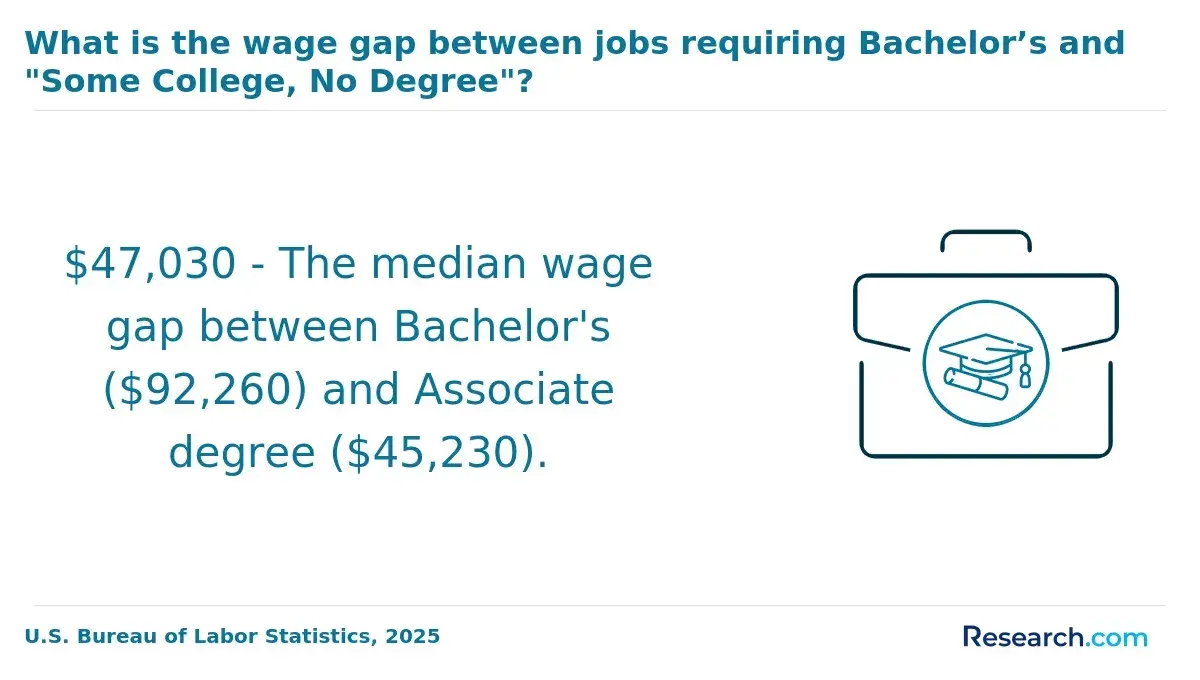
Degree level changes psychology pay more than specialization name alone. A bachelor's concentration may help students enter research assistant, HR, case management, marketing, or behavioral health support roles, while licensed psychologist roles generally require graduate education and supervised practice.
The table below shows how degree level affects likely career access. It is especially useful for students deciding whether a higher-paying specialization is worth a longer and more expensive academic path.
| Degree level | Typical psychology-related options | Pay implications | Main limitation |
| Associate degree or early undergraduate study | Behavioral health aide, human services support, transfer pathway | Usually the lowest psychology-related earnings tier | Limited access to specialized professional roles |
| Bachelor's degree | HR assistant or specialist track, market research support, case management, user research support, lab coordinator | Can be competitive when paired with analytics, business, or technical skills | Does not qualify graduates to practice independently as psychologists |
| Master's degree | I-O psychology, counseling, school psychology, research analysis, assessment, organizational consulting | Often the best balance of specialization, cost, and career access for non-doctoral roles | Licensure and scope of practice vary by state and occupation |
| Doctorate | Clinical psychology, counseling psychology, neuropsychology, academic research, advanced consulting | Can unlock higher ceilings, independent practice, and leadership roles | Longer timeline, higher opportunity cost, and competitive admissions |
Students should be cautious about comparing a bachelor's-level salary outcome in one track with a doctorate-level outcome in another. A fair comparison looks at the full timeline: tuition, living expenses, lost earnings during school, licensure requirements, internship competitiveness, and how quickly the student can enter paid specialized work.
Industry can be the difference between a modest psychology salary and a high-growth career path. The same training in assessment, motivation, cognition, or behavior can be used in schools, hospitals, technology companies, consulting firms, government agencies, or corporate HR departments.
The table below connects major psychology tracks to industries where their skills are commonly valued. This helps students see why a specialization's earning potential depends on employer demand, not just curriculum.
| Specialization | Industries with stronger pay potential | Why employers pay for it |
| Industrial-organizational psychology | Management consulting, corporate HR, workforce analytics, leadership development, assessment firms | Employers use the track to improve hiring, retention, performance, and organizational effectiveness |
| Quantitative psychology and psychometrics | Testing companies, education technology, research organizations, survey firms, government contractors | These employers need valid measurement, statistical modeling, and defensible assessment design |
| Human factors psychology | Technology, healthcare systems, transportation, defense, product design, safety engineering | The work helps reduce user errors, improve product usability, and design safer systems |
| Clinical, counseling, and health psychology | Hospitals, outpatient care, integrated behavioral health, private practice, telehealth providers | Demand is tied to mental health access, insurance reimbursement, and licensed clinical services |
| School psychology | Public schools, private schools, special education services, educational agencies | Schools need assessment, intervention planning, disability evaluation, and student mental health support |
| Forensic psychology | Correctional systems, courts, law enforcement support, evaluation services, government agencies | Pay depends on public budgets, expert evaluation needs, and advanced clinical credentials |
A useful rule is to follow the money trail behind the role. Corporate, technology, healthcare, and specialized assessment employers often pay more when psychology skills affect revenue, risk, compliance, safety, or licensed care delivery.
Long-term advancement depends on whether a specialization leads to independent practice, management responsibility, technical expertise, or high-value consulting. Some tracks start slowly but grow substantially after licensure; others offer stronger early corporate pay but require continuous skill upgrades.
For a useful benchmark, BLS May 2024 data reported a median annual wage of $140,030 for human resources managers. That matters for psychology students because I-O psychology, leadership development, and talent analytics can feed into management paths where pay is tied to business responsibility rather than clinical licensure.
The strongest long-term advancement pathways usually fall into a few categories. Students should compare which model fits their personality, tolerance for school, and preferred work environment.
- Licensed expert path: Clinical psychology, counseling psychology, neuropsychology, and health psychology can lead to independent practice, supervision, assessment specialization, and healthcare leadership after advanced training.
- Corporate strategy path: I-O psychology can lead to talent strategy, organizational development, executive assessment, leadership consulting, and HR leadership.
- Technical specialist path: Quantitative psychology, psychometrics, and human factors can lead to senior research, data science-adjacent, product research, or assessment design roles.
- Education systems path: School psychology can lead to district-level leadership, special education coordination, program evaluation, or private assessment work depending on credentials and state rules.
The best advancement track is not always the one with the highest top salary. A student who dislikes statistics may struggle in psychometrics, while a student who does not want a long doctoral timeline may find I-O or applied research roles more practical than neuropsychology.
Location affects psychology pay because licensing rules, employer budgets, insurance reimbursement, union contracts, cost of living, and industry concentration vary across states and metro areas. A school psychologist in a high-cost urban district, a clinical psychologist in private practice, and an I-O consultant in a corporate hub may face very different compensation structures.
Remote work has also changed the psychology pay discussion, but not equally across tracks. I-O psychology, survey research, UX research, training, and people analytics may offer more remote or hybrid options than roles requiring in-person testing, school-based services, or state-regulated clinical care.
When comparing locations, students should avoid looking only at the salary number. A higher wage may not improve real purchasing power if housing, transportation, taxes, and graduate school debt are also higher. The following checks can help make the comparison more realistic:
- Compare salary by occupation and metro area, not just by state, because psychology jobs are often clustered around hospitals, universities, school districts, corporate headquarters, or government agencies.
- Check whether the role requires state licensure, because remote clinical work may still depend on where the client is located and where the provider is authorized to practice.
- Look for local internship, practicum, and assistantship availability before choosing a graduate program, especially for clinical, counseling, school, and neuropsychology tracks.
- Evaluate remote-friendly specializations carefully; remote eligibility can improve job access, but it may also increase national competition.
The practical decision is to choose a specialization that matches both the national labor market and the local or remote market you realistically plan to enter. Students who cannot relocate may benefit from tracks with strong demand in schools, healthcare systems, local government, or online-capable corporate roles.
A psychology specialization becomes more marketable when it produces evidence of applied skills. Employers rarely hire based on course titles alone; they look for research experience, software fluency, communication ability, supervised practice, assessment knowledge, and proof that students can solve real problems.
AI and automation are making this even more important. Routine survey cleanup, basic literature searches, and simple reporting can be accelerated by software, but employers still need people who can ask valid research questions, interpret human behavior ethically, and explain findings to decision-makers.
The most valuable courses and skills depend on the track, but the strongest psychology students often build a portfolio across several areas:
- Statistics and research methods: Essential for I-O psychology, quantitative psychology, psychometrics, UX research, program evaluation, and graduate admissions.
- Assessment and measurement: Valuable for clinical, school, forensic, neuropsychology, testing, and employee-selection roles.
- Data tools: SPSS, R, Python, SQL, Excel, survey platforms, and visualization tools can help psychology students compete for analytics-adjacent jobs.
- Interviewing and qualitative research: Useful in counseling preparation, UX research, organizational consulting, and consumer insights.
- Ethics, diversity, and cultural competence: Critical in clinical care, education, research, assessment, and workplace consulting.
- Writing and presentation: Strong reports, case notes, research summaries, and stakeholder presentations can separate candidates with similar degrees.
Students drawn to data-heavy psychology tracks may also want to compare adjacent interdisciplinary careers, including bioinformatics major jobs, to understand how statistics, coding, and behavioral research can intersect with health and life-science data careers.
Salary potential only matters if it makes sense relative to program cost, time, debt, and opportunity cost. A doctorate-level clinical or neuropsychology path may have a strong long-term ceiling, but students should compare that outcome against years of graduate study, internship requirements, postdoctoral training, and delayed full-time earnings.
College Board's 2024 pricing data reported average published tuition and fees of $11,610 for in-state students at public four-year institutions. That figure is only a starting point because psychology students may also face graduate tuition, application costs, unpaid or low-paid practicum hours, relocation, test fees, and licensure expenses.
To compare specialization pay against program cost, use a structured ROI process rather than a simple "highest salary wins" approach:
- Estimate the total cost of the full pathway, including undergraduate tuition, graduate tuition, fees, books, living expenses, lost wages, and licensure or certification costs.
- Identify the minimum credential required for the target role, because a bachelor's concentration and a doctorate-level license are not comparable investments.
- Use occupation-level wage data for the actual job title you want, not just broad psychology salary averages.
- Ask programs for outcome details such as internship placement, licensure exam preparation, assistantship availability, employer partnerships, and alumni job titles.
- Compare debt risk with realistic early-career wages, especially if the specialization requires unpaid fieldwork or additional supervised hours after graduation.
- Consider backup options if the first-choice path is highly competitive, such as moving from clinical psychology goals into counseling, social work, research coordination, HR analytics, or program evaluation.
Psychology students considering long professional programs can learn from ROI comparisons in other healthcare fields; for example, PharmD programs show how tuition, licensure, and professional scope can reshape the value of a high-credential career path.
Red flags include programs that advertise salary outcomes without explaining degree level, licensure pass rates, internship match data, local employer demand, or debt levels. A strong program should help students understand both opportunity and risk.
Credentials can significantly change psychology earnings, but the effect depends on whether the credential is legally required, employer-preferred, or merely résumé-enhancing. Licensure has the strongest impact in clinical, counseling, school, and health-related tracks because it defines scope of practice and access to many jobs.
For clinical and counseling psychologists, the typical path includes a doctoral degree, supervised clinical experience, a licensing exam, and state board approval. For school psychology, requirements vary by state and may involve a specialist-level graduate degree, supervised internship, and state or national credentialing. For counseling roles, master's-level licensure may open a different career path from psychologist licensure.
The following credential categories are most relevant when comparing psychology specialization earnings:
- State licensure: Often required for independent clinical practice, diagnosis, therapy, and certain school-based or healthcare roles.
- Board certification: May strengthen credibility in specialty areas such as clinical neuropsychology, but requirements are rigorous and usually come after advanced training.
- School psychology credentials: Can affect eligibility for public school roles, salary schedules, and interstate mobility.
- Analytics and software credentials: Can improve competitiveness for I-O, UX research, psychometrics, and people analytics roles, especially when paired with projects.
- Project management or HR credentials: May help psychology graduates move into organizational development, training, HR, or consulting roles.
Some students discover that they want healthcare work but not a long psychology licensure pathway. In that case, comparing faster patient-care routes such as LPN programs can clarify whether the student wants behavioral science, direct nursing care, or another allied-health direction.
The key is to ask whether a credential changes legal authority, hiring eligibility, reimbursement, or promotion potential. If it does not change any of those, it may still be useful, but it should not be treated like a guaranteed salary booster.
The best psychology specialization is the one that balances earning potential with your strengths, values, preferred work setting, and tolerance for additional education. A high-paying track can become a poor investment if it requires skills you do not want to use every day or credentials you are unlikely to complete.
Students should compare specialization choices using a decision framework that includes money, fit, and risk. This approach prevents the common mistake of choosing a concentration based only on a salary list.
- Start with the role, not the major name: Identify target job titles such as I-O psychologist, UX researcher, school psychologist, clinical psychologist, psychometrician, HR analyst, or behavioral health program manager.
- Check the required credential: Confirm whether the job requires a bachelor's degree, master's degree, doctorate, supervised hours, state licensure, or a portfolio.
- Compare wage data carefully: Use salary data for the specific occupation and location, and remember that medians do not describe every graduate's outcome.
- Audit the curriculum: Look for statistics, research methods, practicum, assessment, data tools, ethics, internships, and employer-connected projects.
- Ask about outcomes: Request information on internship placement, licensure preparation, assistantships, employer partnerships, alumni roles, and graduate school placement.
- Test your fit early: Use research labs, volunteer roles, internships, informational interviews, and student projects before committing to a narrow specialization.
- Plan a backup path: Choose electives and skills that keep doors open if graduate admissions, licensure, relocation, or funding do not work as expected.
Students interested in sport, performance, rehabilitation, or exercise behavior should also compare psychology tracks with movement-science options such as the best kinesiology programs, since some goals fit better in kinesiology, athletic training, occupational therapy preparation, or health coaching than in a traditional psychology concentration.
The smartest choice is usually a specialization that has three qualities: a clear labor-market destination, a credential pathway you can realistically afford, and daily work that matches your abilities. Pay matters, but career durability matters just as much.
Entry-level earnings are often strongest when psychology students pair behavioral science with business, statistics, writing, research operations, or technology. By contrast, direct care and human services roles may be personally meaningful but often have lower early-career pay unless they lead into licensure or management.
BLS May 2024 data reported a median annual wage of $76,950 for market research analysts, a common adjacent path for psychology graduates with survey, consumer behavior, and data skills. That median is not an entry-level guarantee, but it shows why psychology students who build quantitative and applied research experience may have more salary leverage than students who rely on the major alone.
Students comparing early-career tracks should look for roles where a bachelor's degree plus a focused skill set can create immediate value. The strongest options often include the following pathways:
- People analytics or HR analytics: Best for students who like I-O psychology, statistics, employee behavior, and business decision-making.
- Market research and consumer insights: Best for students who like social psychology, survey design, behavior change, and data storytelling.
- User experience research support: Best for students who like cognition, human factors, interviews, usability testing, and product design.
- Research coordinator or lab manager roles: Best for students planning graduate school because the experience can strengthen applications and build technical credibility.
- Behavioral health support roles: Best for students who want direct service experience before counseling, social work, or clinical graduate programs.
The common mistake is assuming "entry-level psychology job" means only counseling-adjacent work. Many psychology graduates can compete more effectively when they translate coursework into employer language: research design, data interpretation, interviewing, program evaluation, training, assessment, and communication.
Other Things You Should Know About Psychology
Industrial-organizational psychology has one of the strongest documented salary signals. BLS May 2024 data reported a median annual wage of $147,420 for I-O psychologists. Quantitative psychology, psychometrics, human factors, and neuropsychology can also lead to high-paying roles, but salary depends on degree level, industry, experience, and credentials.
Yes, but usually by combining psychology with marketable skills such as statistics, HR, research operations, UX research, data analysis, or business communication. A bachelor's degree alone generally does not qualify someone to work as a licensed psychologist.
It can be, especially for students committed to licensed practice, assessment, healthcare, or private practice. However, the path is long and competitive, so students should compare tuition, internship requirements, licensure steps, and expected local wages before committing.
Not automatically. A higher-paying track may require advanced statistics, corporate consulting, medical assessment, or years of graduate training. The better choice is a specialization that offers realistic earnings, strong program quality, manageable cost, and work you can see yourself doing long term.
See What Experts Have To Say About Studying Psychology
Read our interview with Psychology experts

Elizabeth L. Jeglic Ph.D.
Psychology Expert
Professor of Psychology
City University of New York

Joann Farrell Quinn, Ph.D., MBA
Psychology Expert
Director at the College of Medicine Department of Medical Education
Morsani College of Medicine

Robin M. Kowalski. Ph.D.
Psychology Expert
Professor of Psychology
Clemson University

- What Do Psychologists Earn? Highest Paying Psychology Jobs | Walbrook https://www.walbrook.ac.uk/subjects/psychology/psychologist-salaries-highest-paying-jobs/
- Worker location factors into pay decisions at roughly half of employers, Payscale report shows https://www.hrdive.com/news/employee-location-pay-geography/717744/
- What Certifications Can I Get With A Bachelor's In Psychology? https://www.psychology.org/resources/certification-skills-for-psychology-major-resumes/
- Geographic Pay Differentials: HR Guide for 2025 https://taggd.in/hr-glossary/geographic-pay/
- Top 10 Highest Paying Jobs with Psychology Degree 2025 | Nexford University https://www.nexford.edu/insights/highest-paying-jobs-with-psychology-degree
- Top 5 Highest-Paying Psychology Careers - Rivier Academics https://www.rivier.edu/academics/online/resources/program-resources/top-5-highest-paying-psychology-careers-rivier-university/
- What skills do you gain from studying psychology? https://www.law.ac.uk/resources/blog/what-skills-do-you-gain-from-studying-psychology/