2027 Psychology Degree Concentration Outlook Report: Which Tracks Are Growing Faster, Paying More, and Hiring More Consistently

Co-Founder and Chief Data Scientist
Choosing a psychology concentration is also a school-value decision: public, private nonprofit, private for-profit, and online programs can differ sharply in cost, credibility, flexibility, and career support. The stakes are real because College Board's 2024-25 figures place average published tuition and fees at $11,610 for in-state public four-year colleges versus $43,350 at private nonprofit colleges. This guide is for students comparing psychology tracks, career changers, and working adults who need a practical view of growth, pay, hiring reliability, licensure, and return on investment before enrolling.
Key Things You Should Know
- Mental health counseling-related roles show the strongest growth signal among common psychology pathways: BLS projections for 2024-2034 place substance abuse, behavioral disorder, and mental health counselors at 17% growth, but many clinical roles require graduate education and state licensure.
- Salary potential is highest in specialized or advanced roles such as industrial-organizational psychology, clinical psychology, neuropsychology, research, and analytics; BLS lists the 2024 median pay for psychologists at $94,310, while several bachelor's-level roles pay less but are easier to enter.
- The best-value school model is usually the accredited program that minimizes net cost, preserves transfer credit, supports completion, and fits the target credential; online is a delivery format, not an institution type, so it should be evaluated alongside public, private nonprofit, and for-profit status.
- How Do the Major Psychology Degree Concentrations Compare?
- Which Psychology Degree Concentrations Are Growing the Fastest?
How Do the Major Psychology Degree Concentrations Compare?
A psychology concentration is a focused area within a psychology degree, such as clinical, counseling, school, forensic, industrial-organizational, developmental, health, or cognitive psychology. The concentration does not automatically qualify a graduate for a licensed role; in many cases, it shapes graduate-school readiness, internship options, research exposure, and the kinds of entry-level jobs a student can pursue.
The table below compares major psychology tracks by their usual education path, labor-market fit, and institution-type considerations. Use it to separate "interesting subject area" from "career pathway with the right credential, cost, and hiring demand."
| Psychology concentration | Common education path | Typical career direction | Market signal | Institution-type considerations |
| Clinical psychology | Bachelor's plus master's, PsyD, or PhD for licensed practice | Assessment, therapy, diagnosis, behavioral treatment | Strong demand, but credential-intensive | Public universities may lower debt; private nonprofit doctoral programs may be worth it when they offer strong practicum networks and licensure outcomes |
| Counseling psychology | Bachelor's plus master's for most counseling roles | Mental health counseling, career counseling, substance use support | Fast growth in counseling-related occupations | Online and hybrid options can work well for adults if they meet state licensure requirements and include approved supervised fieldwork |
| School psychology | Specialist-level graduate degree, master's, or doctorate depending on state and role | Student assessment, behavioral interventions, school-based mental health | Consistent public-sector demand | Public universities often align well with state credentialing and local district hiring |
| Industrial-organizational psychology | Bachelor's for HR-adjacent roles; master's often preferred for I-O roles | Employee selection, assessment, workplace research, organizational development | High salary ceiling, smaller occupation | Institution reputation, statistics training, internships, and employer partnerships matter more than campus prestige alone |
| Forensic psychology | Bachelor's for justice-adjacent roles; graduate degree for clinical forensic practice | Corrections, victim advocacy, court-related assessment, law enforcement support | Demand is specialized and location-dependent | Students should verify practicum access; purely online programs may be less useful if local placements are weak |
| Developmental or child psychology | Bachelor's for support roles; graduate degree for specialist roles | Child development, family services, early intervention, research | Stable, often tied to healthcare, schools, and social services | Lower-cost public or transfer-friendly online programs can make sense because many roles require later graduate education |
| Health psychology | Bachelor's plus graduate study for clinical or research specialization | Behavioral medicine, public health, patient adherence, wellness programs | Growing interest due to chronic disease and integrated care | Best value comes from programs connected to health systems, public health departments, or research labs |
| Cognitive, neuroscience, or biopsychology | Bachelor's plus graduate study for research, clinical neuropsychology, or lab leadership | Research, human factors, neuropsychology preparation, lab coordination | Strong long-term potential, limited bachelor's-only options | Research facilities, faculty labs, and statistics coursework can justify higher cost if they improve graduate-school competitiveness |
Institution type should be treated as a value filter, not a shortcut. A public university can be the best value for an in-state student, a private nonprofit can be worth the price if it provides unusually strong placement and research access, a for-profit program requires extra scrutiny around debt and completion outcomes, and an online program can be respected when it is accredited, rigorous, and aligned with licensure or career goals.
Students comparing psychology with adjacent health and performance fields may also look at the best kinesiology programs, especially if they are drawn to sport psychology, wellness, rehabilitation support, or human performance rather than counseling or research.
Which Psychology Degree Concentrations Are Growing the Fastest?
The fastest-growing psychology-related concentrations are those connected to mental health, substance use treatment, school-based services, aging, organizational wellbeing, and data-informed human behavior. Growth does not mean easy entry, however; the fastest pathways often require supervised experience, licensure, or graduate credentials.
BLS projections for 2024-2034 show 17% growth for substance abuse, behavioral disorder, and mental health counselors. For students, this means counseling-oriented concentrations may offer the clearest demand signal, but the return depends heavily on whether the chosen program leads to the right state-approved master's curriculum, practicum hours, and exam eligibility.
The strongest growth patterns generally fall into a few practical categories. These categories matter because a student choosing a concentration should match academic interest with the credential level employers actually require.
- Counseling and clinical mental health: Strong growth is supported by demand for therapy, substance use treatment, crisis response, and integrated behavioral healthcare, but students should plan for graduate study and licensure.
- School psychology and child-focused services: Demand is steadier than explosive because schools need assessment, behavioral intervention, and mental health support, especially where districts face shortages.
- Industrial-organizational and workplace psychology: Growth is tied to employee selection, retention, leadership development, and workforce analytics, but the number of specialized I-O roles is smaller than the number of counseling roles.
- Health psychology and behavioral medicine: Growth is supported by healthcare systems using behavioral interventions for chronic disease, adherence, pain management, sleep, stress, and lifestyle change.
- Cognitive science, human factors, and research methods: Growth is linked to usability, AI-human interaction, product research, and data analysis, but students need quantitative skills to compete.
For ROI, growth should be compared with time to credential. A bachelor's concentration in counseling psychology may open case management or behavioral health technician roles, but independent counseling practice usually requires a master's degree. By contrast, I-O or research-oriented students may move into HR analytics, market research, or user research sooner if they build statistics, survey design, and software skills during the undergraduate program.
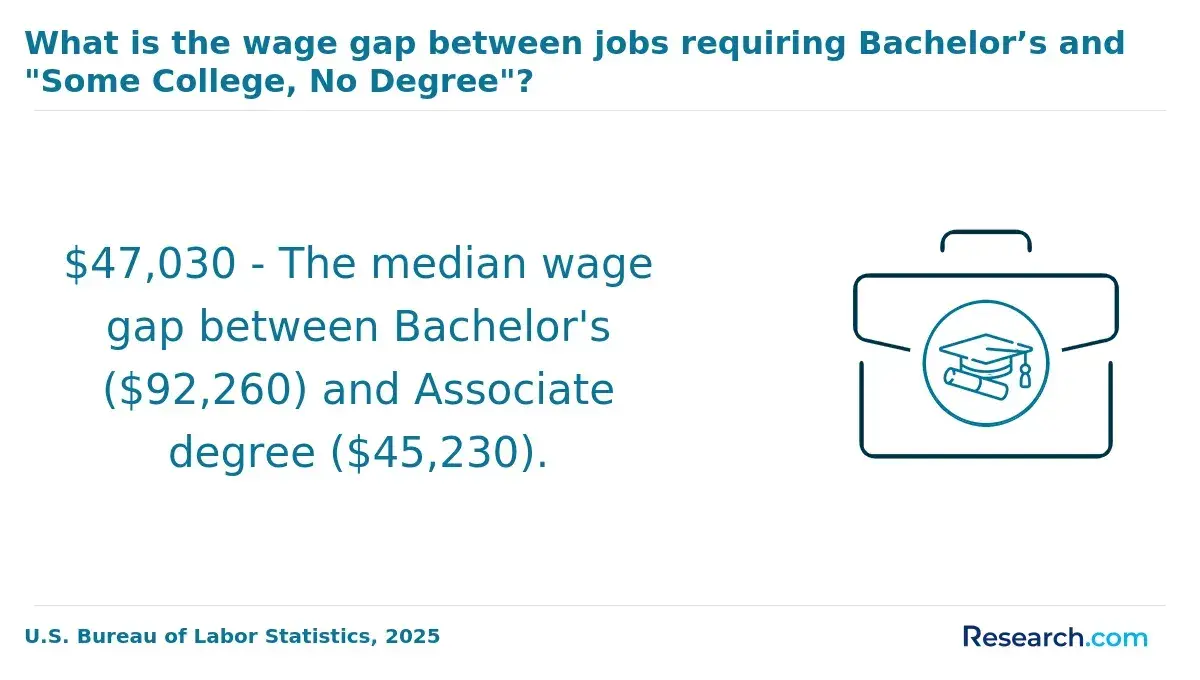
Salary potential in psychology varies more by credential, industry, geography, and technical skill than by concentration name alone. A clinical concentration at the bachelor's level may not pay like a licensed psychologist role, while an I-O, research, or data-heavy concentration can have stronger bachelor's-to-master's earning potential if paired with analytics experience.
The table below uses BLS 2024 wage and outlook categories that commonly connect to psychology concentrations. These are occupational medians, not promises for any graduate, but they help show which tracks tend to have higher salary ceilings.
| Psychology-related pathway | Relevant BLS occupation | 2024 median pay | Best-fit concentration | What affects pay most |
| Licensed psychologist roles | Psychologists | $94,310 | Clinical, counseling, school, neuropsychology, research | Doctoral training, licensure, specialty, setting, supervised experience |
| Mental health counseling | Substance abuse, behavioral disorder, and mental health counselors | $59,190 | Counseling, clinical, addiction, community psychology | Master's degree, state license, employer type, caseload, specialization |
| School and career services | School and career counselors and advisors | $65,140 | School, developmental, counseling psychology | State credential, district pay scale, union structure, graduate training |
| HR and workforce roles | Human resources specialists | $72,910 | Industrial-organizational, social psychology | Analytics, employment law knowledge, recruiting systems, industry |
| Research and consumer behavior | Market research analysts | $76,950 | Social, cognitive, I-O, quantitative psychology | Statistics, survey methods, SQL, visualization, experimentation |
| Training and talent development | Training and development specialists | $65,850 | I-O, educational, adult learning, social psychology | Instructional design, learning technology, corporate experience |
Industrial-organizational psychology often has the best salary upside for students who want business-facing roles rather than clinical licensure. Clinical, counseling, and neuropsychology can also lead to strong earnings, but usually after years of graduate education, supervised training, exam preparation, and state licensing.
Students who like psychology but want a more technical labor-market profile should compare behavioral research careers with analytics-heavy alternatives such as bioinformatics major jobs. That comparison can clarify whether the student is more motivated by human behavior, healthcare data, laboratory science, or computational work.
The strongest entry-level psychology opportunities are usually not titled "psychologist." Most bachelor's graduates start in support, coordination, research, human services, HR, education, or customer-insight roles while deciding whether to pursue graduate school.
Entry-level opportunity should be judged by three factors: whether the role accepts a bachelor's degree, whether it builds experience for graduate school or promotion, and whether it keeps debt manageable. These options are common first steps for psychology graduates.
- Behavioral health technician or psychiatric technician: Fits clinical, counseling, and addiction tracks; useful for students testing whether direct mental health work is the right fit.
- Case manager or human services coordinator: Fits clinical, community, developmental, and forensic interests; often available through nonprofits, public agencies, and healthcare organizations.
- Research assistant or lab coordinator: Fits cognitive, social, developmental, health, and neuroscience concentrations; especially valuable for students planning a PhD or research master's.
- HR assistant or recruiting coordinator: Fits I-O and social psychology; can lead toward talent acquisition, training, employee relations, or HR analytics.
- Registered behavior technician: Fits child, developmental, autism, and behavioral psychology interests; may require a short credential and supervised practice.
- UX research assistant or survey coordinator: Fits cognitive, social, and quantitative psychology; requires stronger methods, statistics, and portfolio evidence than many traditional psychology roles.
BLS lists the 2024 median pay for psychiatric technicians and aides at $39,160, which shows why students should be careful about taking on high debt for a bachelor's-only clinical pathway. Entry-level clinical exposure can be valuable, but the financial plan should assume that higher-paying licensed roles usually require graduate education.
Students who want quicker entry into direct patient care may also compare psychology support roles with LPN programs. That does not replace psychology training, but it can be a useful benchmark for students deciding between mental health support work and licensed practical nursing as a faster healthcare credential.
Psychology graduates are hired across more industries than many students expect, but the best employer fit depends on concentration and credential level. Clinical and counseling tracks point toward healthcare and social services, while I-O and quantitative tracks often lead to corporate, consulting, government, and research settings.
The table below summarizes where psychology concentrations most often translate into employer demand. It helps students choose internships, electives, and institution types that match the employment setting they want after graduation.
| Employer or industry | Common psychology concentrations | Typical roles | What schools should provide |
| Hospitals and behavioral health clinics | Clinical, counseling, health, addiction | Behavioral health technician, care coordinator, counselor after licensure, psychologist after doctoral training | Field placements, supervision partnerships, licensure-aligned curriculum |
| K-12 schools and districts | School, developmental, counseling | School psychologist, counselor, student support specialist, behavior intervention support | State credential alignment, district practicum access, assessment training |
| Government and public agencies | Community, forensic, developmental, clinical | Case manager, victim advocate, corrections program staff, public health program coordinator | Internship access, policy coursework, community partnerships |
| Corporations and consulting firms | I-O, social, quantitative, cognitive | HR specialist, training specialist, workforce analyst, organizational development associate | Statistics, business electives, internship pipelines, applied projects |
| Universities and research institutes | Cognitive, developmental, neuroscience, social, health | Research assistant, lab coordinator, graduate researcher, data coordinator | Faculty labs, methods coursework, grant-funded research opportunities |
| Technology and product companies | Cognitive, social, human factors, quantitative | UX research assistant, survey analyst, product research coordinator | Portfolio projects, experimental design, analytics software, usability testing exposure |
Healthcare employers may also value interdisciplinary understanding. For example, students comparing behavioral health with medication-centered clinical pathways may research PharmD programs to understand how psychology-adjacent patient care differs from pharmacy practice in cost, credential length, and scope of responsibility.
The best job markets for psychology concentrations are usually places with dense healthcare systems, school districts, universities, government agencies, military or correctional facilities, corporate headquarters, and research employers. Large metro areas often offer more specialized roles, while rural and underserved regions may offer stronger demand for counseling and school-based services but fewer niche research or I-O jobs.
Remote opportunities are strongest in roles where psychology overlaps with research, HR, training, coaching operations, survey work, UX research, data analysis, and telehealth administration. Licensed therapy can be delivered through telehealth in many settings, but rules depend on the provider's license, client location, employer policy, state compact participation, and supervision requirements.
Students comparing locations and delivery formats should use a practical checklist before choosing a school or concentration. The goal is to avoid enrolling in a flexible program that does not actually connect to the job market where the student plans to work.
- Check whether the program's practicum, internship, or field-placement network serves the state where you want to work.
- Ask whether online students receive the same career services, research opportunities, and faculty access as campus students.
- Verify whether the curriculum meets state licensure or certification requirements for counseling, school psychology, or clinical practice.
- Compare local employer postings for the exact job titles you want, not just broad psychology-related career lists.
- Look for programs that teach remote-friendly skills such as telehealth documentation, survey platforms, HR systems, statistical software, and virtual assessment ethics.
For working adults, a high-quality online psychology program can offer the best flexibility-to-cost ratio if it is institutionally accredited, transparent about outcomes, and realistic about placement support. However, students pursuing licensure should be cautious with programs that leave them to find clinical sites entirely on their own.
The most valuable psychology concentrations combine human behavior knowledge with measurable skills. Employers and graduate programs often look for evidence that students can collect data, interpret behavior, communicate ethically, and work with diverse populations.
Skill-building is especially important because many psychology bachelor's degrees are broad. The following additions can make a concentration more employable and can also improve graduate-school readiness.
- Statistics and research methods: Learn regression, experimental design, survey methods, psychometrics, and basic data cleaning; these skills strengthen I-O, UX, cognitive, social, health, and graduate-school pathways.
- Software and analytics tools: Build experience with Excel, SPSS, R, Python, SQL, Tableau, Qualtrics, or REDCap depending on whether your target is research, HR analytics, public health, or UX.
- Field experience: Complete internships, practicums, crisis-line work, lab positions, HR projects, or school-based placements that match your concentration.
- Ethics and cultural competence: Employers value graduates who understand confidentiality, mandated reporting, informed consent, bias, accessibility, and culturally responsive practice.
- Writing and documentation: Strong case notes, research summaries, assessment reports, and executive briefs matter across clinical, school, public agency, and business roles.
- Relevant credentials: Depending on the role, consider Registered Behavior Technician, Certified Health Education Specialist, HR certification preparation, crisis intervention training, or state-specific substance use counseling credentials.
Accreditation deserves special attention. Institutional accreditation is the baseline for federal financial aid and transfer recognition. For professional psychology, APA accreditation applies to doctoral programs, internships, and postdoctoral residencies in health service psychology, while counseling, school psychology, and behavior analysis pathways may involve different accrediting bodies or state rules.
Before enrolling, students should avoid these common mistakes: choosing a concentration without checking job titles, assuming a bachelor's degree qualifies them for licensure, comparing advertised tuition instead of total net cost, ignoring transfer-credit rules, and assuming "online" means either lower quality or lower cost. The better approach is to compare total price, completion likelihood, supervised-experience access, and the exact credential required for the career goal.
The best return on investment for a psychology concentration usually comes from the lowest net-cost accredited path that still provides the experiences required for the student's target outcome. For many undergraduates, that means a public in-state university, a community-college transfer pathway, or a reputable online program with generous transfer credit. For some students, a higher-cost private nonprofit can be worthwhile if it materially improves research access, field placement, graduate-school preparation, or employer connections.
The table below compares institution and delivery models by cost, credibility, flexibility, and psychology-specific ROI. Remember that online is a delivery format: an online program can be public, private nonprofit, or private for-profit.
| Model | Typical value strengths | Main trade-offs | Best fit | Use extra caution when |
| Public in-state university | Often the strongest tuition value; broad course offerings; recognized by local employers | Large classes, competitive research labs, less individual advising in some programs | Students planning graduate school who want to limit undergraduate debt | The student cannot access required courses, internships, or timely graduation support |
| Public out-of-state university | May offer specialized labs, strong reputation, or rare concentrations | Higher tuition can weaken ROI if outcomes are similar to in-state options | Students receiving aid or seeking a distinctive research or clinical preparation opportunity | The main reason for attendance is brand appeal without clear career advantage |
| Private nonprofit college or university | Potentially smaller classes, stronger advising, alumni networks, and placement support | Higher sticker price; value depends heavily on scholarships and completion outcomes | Students who receive strong aid or need close mentoring for graduate-school preparation | Net price requires heavy borrowing for a bachelor's degree that will likely need graduate school |
| Private for-profit institution | Flexible scheduling and adult-student convenience in some cases | Requires close review of debt, transferability, employer recognition, and completion outcomes | Working adults only when accreditation, cost, and career alignment are clearly favorable | Credits may not transfer easily or licensure alignment is unclear |
| Online accredited program | Flexibility, location independence, potential transfer-credit savings | May require self-direction; field placements and research access can be harder to secure | Working adults, military students, caregivers, and transfer students | The program lacks transparent outcomes or leaves licensure placements unsupported |
| Community college plus transfer | Often lowers the first two years of cost substantially | Requires careful advising to avoid credit loss | Cost-sensitive students pursuing a bachelor's before graduate study | Courses do not map cleanly to the psychology major or prerequisite sequence |
College Board's 2024-25 published tuition figures show why net cost matters: the gap between in-state public tuition and private nonprofit tuition can be large before grants, scholarships, housing, and fees are considered. Because many higher-paying psychology careers require graduate school, undergraduate debt can reduce long-term ROI even when the concentration itself is a good fit.
Students can compare ROI more accurately by following a short decision process. This is more useful than ranking schools by sticker price or reputation alone.
- Start with the target job title, then identify the required degree, license, supervised hours, and preferred experience.
- Calculate total net cost, including tuition, fees, books, travel, technology, lost work hours, and expected time to completion.
- Ask how many credits will transfer and whether transferred credits shorten the degree instead of merely reducing electives.
- Confirm institutional accreditation and, for graduate or licensure pathways, the relevant programmatic or state approval requirements.
- Compare field placements, research labs, career services, alumni outcomes, and graduate-school admission support.
- Choose the lowest-cost option that still preserves credibility, completion likelihood, and access to the experiences your career path requires.
The strongest long-term job security in psychology is likely to come from concentrations that connect to persistent human needs: mental health care, school support, addiction treatment, aging, workforce assessment, behavioral research, and healthcare behavior change. AI may change documentation, screening, survey analysis, and administrative work, but it does not remove the need for ethical human judgment in assessment, counseling, crisis response, supervision, and applied research.
Psychology students can protect long-term employability by choosing a concentration that pairs with durable credentials and transferable skills. A narrow concentration without licensure, research skill, or applied experience can be risky, while a broad concentration becomes stronger when paired with data, fieldwork, and a clear industry target.
- Best long-term security for licensed practice: Clinical, counseling, school, addiction, and health psychology pathways, provided the student completes the required graduate education and licensure steps.
- Best long-term security outside licensure: I-O, quantitative, cognitive, social, and human factors pathways, especially when paired with analytics, organizational research, HR systems, or UX methods.
- Best public-service stability: School psychology, community mental health, corrections, public health, and social-service-adjacent psychology pathways.
- Best graduate-school foundation: Research-heavy concentrations with faculty lab experience, statistics, writing samples, and strong recommendations.
The safest overall strategy is not to choose the "trendiest" psychology track. It is to choose a concentration that matches your work style, then select an accredited institution model that keeps debt manageable while giving you the supervised experience, research access, or technical skill employers and graduate programs actually value.
Consistent hiring demand is different from fast growth. The most reliable psychology pathways tend to serve ongoing institutional needs: schools need student support, hospitals need behavioral health teams, employers need workforce management, and public agencies need case management and community services.
A practical way to judge consistency is to ask whether the role is tied to recurring demand rather than one-time projects. The following hiring-demand patterns are especially important when deciding whether a higher-priced program is worth the investment.
- Most consistent public-sector demand: School psychology, school counseling, community mental health, corrections, child welfare, and public health programs tend to hire regularly, although salaries and openings vary by state and budget cycle.
- Most consistent healthcare demand: Clinical mental health, addiction counseling, health psychology, behavioral health technician roles, and care coordination benefit from the broader integration of mental health into medical settings.
- Most consistent business demand: I-O psychology, HR, training, assessment, employee engagement, and organizational research are useful across industries, but entry often depends on internship experience and data skills.
- Most consistent research demand: Cognitive, social, developmental, and quantitative psychology can lead to lab coordinator, research assistant, UX research, or survey research roles, especially near universities, hospitals, and research organizations.
Private nonprofit institutions may have an advantage when they maintain strong local practicum pipelines, alumni networks, and employer relationships. Public universities may offer similar or better outcomes at lower net cost, especially for in-state students. Private for-profit and online programs require careful review of completion rates, field-placement support, and whether employers in the student's region recognize the institution positively.
Other Things You Should Know About Psychology
Counseling-related tracks have the clearest growth signal, especially mental health and substance use counseling. However, most counseling careers require a master's degree, supervised experience, and state licensure.
Industrial-organizational psychology, licensed clinical psychology, neuropsychology, and quantitative research pathways tend to have the highest salary potential. Pay depends heavily on graduate education, licensure, industry, location, and technical skills.
It can be, if the institution is properly accredited, the curriculum is rigorous, and the program provides relevant experience. For licensure-track careers, students must verify that online coursework and field placements meet state requirements.
For many students, an in-state public university or transfer-friendly accredited online program offers the best value. A private nonprofit may be worth the higher cost when scholarships, mentoring, research access, and placement outcomes clearly improve the student's career or graduate-school prospects.
See What Experts Have To Say About Studying Psychology
Read our interview with Psychology experts

Elizabeth L. Jeglic Ph.D.
Psychology Expert
Professor of Psychology
City University of New York

Robin M. Kowalski. Ph.D.
Psychology Expert
Professor of Psychology
Clemson University

Joann Farrell Quinn, Ph.D., MBA
Psychology Expert
Director at the College of Medicine Department of Medical Education
Morsani College of Medicine

- Jobs With A Bachelor's Degree In Psychology https://www.psychology.org/resources/jobs-with-a-bachelor-of-arts-in-psychology/
- The 25 Most Lucrative Careers in Psychology https://www.bestpsychologydegrees.com/25-most-lucrative-careers-in-psychology/
- Top 5 Highest-Paying Psychology Careers - Rivier Academics https://www.rivier.edu/academics/online/resources/program-resources/top-5-highest-paying-psychology-careers-rivier-university/
- Careers for Psychology Majors: 12+ Jobs at Every Level | Extern https://www.extern.com/post/careers-for-psychology-majors-guide
- 14 Exciting Psychology Careers in High Demand https://www.ucumberlands.edu/blog/14-exciting-psychology-careers-high-demand