2027 Psychology Degree Education Premium Report: How Pay Changes From Bachelor's to Master's to Doctorate

Co-Founder and Chief Data Scientist
Psychology students often face a hard trade-off: start working sooner with a bachelor's degree or invest years in graduate school for better clinical, research, or leadership options. BLS data shows the median pay for psychologists was $94,310 in May 2024, but many psychology-related jobs pay far less without advanced credentials. This report is for students, career changers, and working professionals comparing bachelor's, master's, and doctoral paths. You'll learn how pay changes by degree level, where graduate school tends to pay off, and when experience, licensure, or specialization may matter more than another degree.
Key Things You Should Know
- A master's degree shows the clearest broad education premium: BLS 2024 data for all full-time workers age 25 and older shows median weekly earnings of $1,840 for master's degree holders versus $1,543 for bachelor's degree holders, an estimated annual difference of $15,444 before taxes.
- A doctorate can raise access to licensed psychologist, professor, neuropsychology, and senior research roles, but the financial return depends heavily on funding, years out of the workforce, internship requirements, and whether the role legally requires a doctoral credential.
- For many psychology majors, the best return is not simply "highest degree wins"; it is the degree that matches the target occupation, because bachelor's-level business, HR, UX, and research roles may out-earn some helping-profession roles that require more schooling.
- How Much More Do Psychology Degree Holders Earn With a Bachelor's, Master's, or Doctorate?
- How Do Entry-Level Salaries Compare for Psychology Bachelor's, Master's, and Doctoral Graduates?
How Much More Do Psychology Degree Holders Earn With a Bachelor's, Master's, or Doctorate?
The psychology education premium is the extra earning power associated with moving from one degree level to the next after accounting for time, tuition, lost income, occupation, and experience. Because the U.S. does not publish a single official salary table for "psychology degree holders" by bachelor's, master's, and doctorate, the cleanest starting point is the BLS national education-pay benchmark, then narrowing the analysis to psychology occupations.
The table below uses BLS 2024 median weekly earnings for full-time wage and salary workers age 25 and older. It is not psychology-specific, but it gives a useful baseline for how the labor market generally prices additional education.
| Highest degree | BLS 2024 median weekly earnings | Estimated annual equivalent | Estimated premium over prior level | How to interpret it for psychology |
| Bachelor's degree | $1,543 | $80,236 | Baseline | Often supports entry into HR, case management, research assistant, marketing, sales, user research support, and social-service roles, but usually not independent clinical practice. |
| Master's degree | $1,840 | $95,680 | $15,444 over bachelor's | Can unlock counseling, school psychology, I/O psychology, applied research, program evaluation, and supervisory roles depending on state rules and program type. |
| Doctoral degree | $2,278 | $118,456 | $22,776 over master's | Often required for licensed psychologist roles, academic careers, advanced assessment, clinical leadership, and specialized research positions. |
The broad pattern is clear: the largest dollar jump in this benchmark is from master's to doctorate, but the master's degree often has the stronger return relative to time and cost. In psychology, the doctorate may be financially worthwhile when it is required for the desired license or role; otherwise, the extra years can reduce ROI if the job could have been reached with a master's degree and supervised experience.
Readers comparing psychology with other health and science paths should also note that "doctorate" does not mean the same thing across fields. A psychology PhD or PsyD leads to a different labor market than clinical pharmacy pathways such as PharmD programs, where the doctorate is the entry-level professional credential for pharmacist practice.
How Do Entry-Level Salaries Compare for Psychology Bachelor's, Master's, and Doctoral Graduates?
Entry-level pay is usually lower than median pay because medians include workers with years of experience. For psychology graduates, the bigger issue is role access: a bachelor's degree can get you into the labor market faster, while a master's or doctorate can qualify you for narrower but often higher-responsibility roles.
The table below compares common early-career destinations. The salary figures are national BLS May 2024 median wages for representative occupations, so they should be treated as labor-market reference points rather than starting-salary promises.
| Degree level | Common early-career roles | Representative BLS 2024 median wage | What the degree premium looks like early on |
| Bachelor's in psychology | Social and human service assistant, HR assistant or specialist track, research assistant, behavior technician, case manager, market research support | Social and human service assistants: $45,120 | The premium is often modest in direct helping roles but can improve quickly if the graduate moves into business, analytics, HR, or operations. |
| Master's in psychology or counseling-related field | Mental health counselor track, school psychology roles where permitted, I/O analyst, program evaluator, applied researcher | Substance abuse, behavioral disorder, and mental health counselors: $59,190 | The premium comes from role eligibility, supervised clinical hours, and specialization, not the diploma alone. |
| Doctorate in psychology | Postdoctoral fellow, supervised psychologist, clinical or counseling psychologist after licensure, research scientist, faculty track | Clinical and counseling psychologists: $95,830 | The premium may appear later because doctoral graduates often complete internship, postdoctoral training, or licensure steps before reaching full earning power. |
A common mistake is comparing a bachelor's-level HR or market research job with a master's-level counseling job and assuming the degree caused the entire salary difference. The occupation, employer, state licensure rules, and experience level may explain as much as the credential itself.
For an apples-to-apples comparison, students should estimate salary in the exact role they want, not the broad degree category. A psychology bachelor's graduate moving into analytics or research operations may see a different payoff than one entering nonprofit case management, even with the same major.
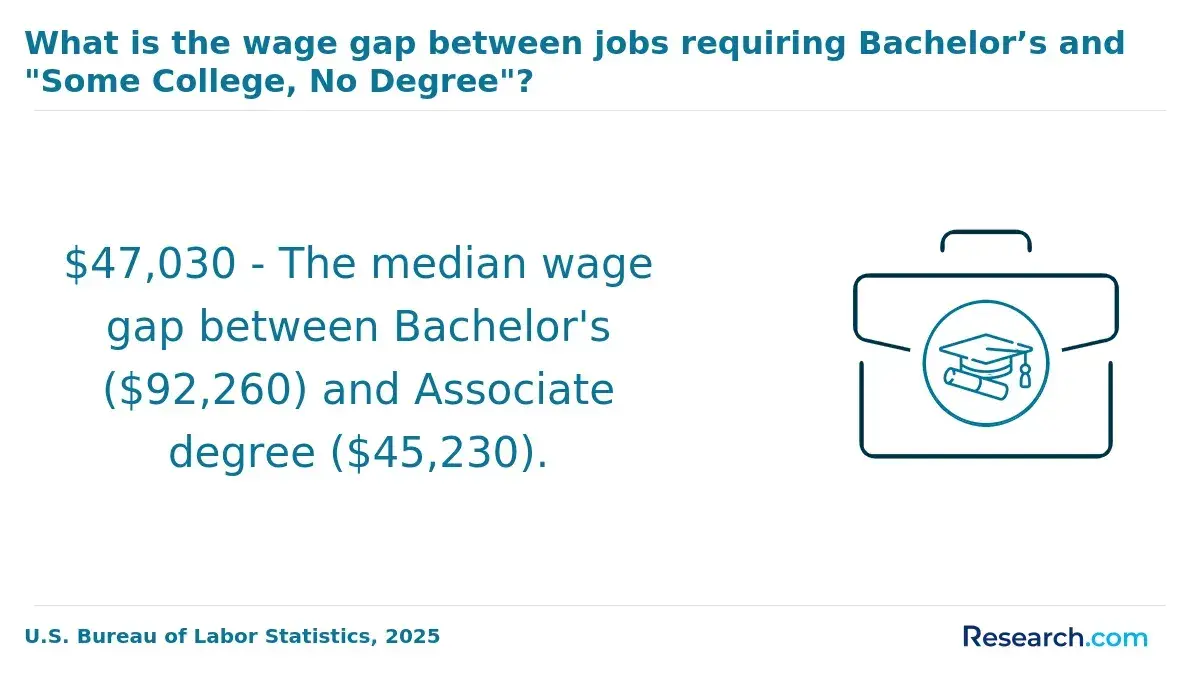
The psychology education premium usually grows over time when the higher degree opens roles with greater autonomy, billable clinical work, management responsibility, or specialized research duties. It may shrink when a bachelor's-degree holder builds strong experience in a higher-paying nonclinical field.
The table below shows how the value of each degree level often changes across the career cycle. Use it to think beyond the first job and evaluate whether the degree supports the work you want to do five to ten years later.
| Career stage | Bachelor's degree | Master's degree | Doctorate |
| First 0-3 years | Fastest route into paid work; may require accepting support, coordinator, or assistant-level roles. | Delayed earnings if enrolled full time; stronger access to counseling, school, research, and analyst roles after graduation. | Longest delay; stipends, internships, and postdoctoral training can keep early earnings lower than expected. |
| Midcareer | Can advance through HR, UX, sales, operations, social services, or management if skills are strong. | Often the strongest practical premium for counseling, I/O, program leadership, and applied research roles. | Becomes more valuable for independent practice, assessment, clinical leadership, faculty work, and specialized consulting. |
| Late career | Pay depends more on industry, leadership, and transferable skills than psychology coursework alone. | Can support supervisory, director, private-practice, or specialized applied roles depending on licensure. | Can support private practice ownership, expert witness work, senior research leadership, tenure-track roles, or hospital leadership. |
Labor demand also matters. BLS projections released for 2024-2034 place psychologist employment growth at 6%, which is faster than the average for all occupations. That does not mean every graduate will see a premium, but it does suggest continued demand for qualified mental health, school, assessment, and applied psychology professionals.
The key career-planning question is whether the advanced degree creates access to higher-paying tasks. Psychological testing, diagnosis, clinical supervision, graduate teaching, and independent practice usually carry more credential weight than entry-level client support or administrative work.
A doctorate in psychology can pay more than a master's degree, especially in licensed psychologist, neuropsychology, academic, assessment, and senior research roles. However, the doctorate does not automatically beat the master's degree on ROI because it often requires more years of study, internship or residency steps, and delayed full-time earnings.
BLS May 2024 data places the median wage for clinical and counseling psychologists at $95,830, while industrial-organizational psychologists have a median wage of $109,840. These figures show that doctoral-level and highly specialized psychology roles can be financially strong, but they also show that specialization matters; the highest payoff is not evenly distributed across all psychology doctorates.
The table below summarizes when a doctorate tends to produce a meaningful premium over a master's degree. The main point is that the doctoral return depends on whether the credential changes what you are legally and professionally allowed to do.
| Doctoral path | Typical payoff driver | When it may make sense | When the ROI may be weaker |
| PhD in psychology | Research training, academic roles, funded study opportunities, clinical licensure if APA-aligned and clinically focused | Best for students who want research, faculty roles, competitive clinical training, or funded doctoral education. | Less ideal if the student wants only master's-level counseling practice and does not need doctoral research training. |
| PsyD in psychology | Clinical practice preparation, assessment, therapy, supervised clinical training | Best for students committed to becoming licensed psychologists and practicing clinically. | Riskier if tuition is high, debt is large, or the program has weak internship and licensure outcomes. |
| EdD or school psychology doctorate | School systems leadership, advanced practice, supervision, district-level roles | Useful for school psychology leaders, administrators, or practitioners seeking advanced responsibility. | May not be necessary where specialist-level or master's-level credentials meet state requirements. |
A doctorate is most financially defensible when at least one of three conditions is true: the role requires it, the program is well-funded, or the specialization leads to a measurable pay increase that exceeds the added cost and time. If none of those conditions applies, a master's degree plus licensure, experience, or business skills may deliver a faster return.
The biggest reason to pursue graduate education in psychology is not always salary; it is eligibility. Many clinical, school, testing, teaching, and research roles are legally or practically closed to bachelor's-only candidates.
The table below outlines common psychology-related roles and the degree level usually associated with entry or advancement. Requirements vary by state, employer, accreditation status, and job duties, so students should verify rules with licensing boards and employers before choosing a program.
| Career goal | Common minimum education | Why the credential matters | Decision note |
| Licensed psychologist | Doctorate plus supervised experience and state licensure | Independent diagnosis, therapy, assessment, and use of the psychologist title are regulated. | A doctorate is usually necessary if this is the goal. |
| Mental health counselor or therapist | Master's degree plus supervised hours and state licensure | States regulate counseling practice and clinical titles. | A master's can be sufficient for many therapy careers. |
| School psychologist | Specialist-level, master's, or doctorate depending on state and role | Schools require credentialed professionals for assessment and student support. | Check state department of education rules before enrolling. |
| Industrial-organizational psychologist | Master's or doctorate commonly preferred | Employers value statistics, testing, selection, organizational research, and consulting skills. | A master's may offer strong ROI if paired with analytics experience. |
| College professor or principal investigator | Doctorate | Tenure-track teaching and grant-funded research typically require doctoral training. | Financial payoff depends on funding, institution type, and research field. |
| Case manager, HR specialist, research coordinator, behavioral support role | Bachelor's degree often sufficient | Work may emphasize communication, documentation, client support, data collection, or operations. | Graduate school may be optional unless promotion requires it. |
Psychology students sometimes compare their options with faster credentialed health pathways. For example, direct-care programs such as LPN programs may appeal to people who want quicker clinical workforce entry, while psychology graduate education is usually a longer route toward counseling, assessment, or behavioral-health specialization.
The promotion question is simple: does the next job require a protected title, supervised clinical authority, advanced assessment work, or graduate-level research methods? If yes, an advanced degree may be necessary. If the next job is management, operations, HR, or customer insights, experience and measurable results may matter more.
The psychology graduate-degree premium is usually highest in specializations where employers pay for technical judgment, licensure, advanced statistics, assessment authority, or business impact. It is usually lower where the work is grant-funded, entry-level, or tied to public-service budgets.
The table below compares specializations by the main reason a graduate degree may increase earnings. This is a decision table, not a ranking, because pay varies significantly by region and employer.
| Specialization or industry | Why an advanced degree can pay more | Best-fit degree level | Important caution |
| Industrial-organizational psychology | Applies testing, analytics, employee selection, leadership development, and organizational research to business decisions. | Master's or doctorate | Data skills and consulting experience can be as important as the degree title. |
| Clinical and counseling psychology | Licensure enables diagnosis, therapy, assessment, private practice, and clinical leadership. | Master's for counseling roles; doctorate for psychologist roles | Debt can be high if the program is unfunded or has weak placement support. |
| Neuropsychology and assessment | Specialized testing and interpretation require advanced supervised training. | Doctorate plus postdoctoral specialization | The pathway is long and should match a strong interest in assessment-heavy work. |
| School psychology | Credentials allow student assessment, intervention planning, and consultation with educators and families. | Specialist-level, master's, or doctorate depending on state | Salary may be shaped by district pay scales more than individual productivity. |
| UX research, people analytics, and behavioral data | Employers value research design, statistics, experimentation, and communication of insights. | Bachelor's plus portfolio, or master's for stronger research roles | A degree alone is not enough without tools, projects, and business fluency. |
Current hiring trends favor psychology graduates who combine human behavior expertise with analytics, digital research tools, and interdisciplinary work. Students interested in computational or health-data roles may also compare psychology research paths with science-heavy options such as bioinformatics major jobs, where the pay premium often comes from technical specialization rather than licensure.
Health psychology, rehabilitation, sport psychology, and wellness-related roles can also benefit from cross-training in movement science, coaching, and health behavior. Students exploring that direction may find it useful to compare psychology pathways with the best kinesiology programs when their goal is performance, wellness, rehabilitation support, or exercise-behavior work rather than clinical mental health practice.
The psychology education premium is usually highest where advanced credentials are scarce, licensure is required, and employers have budgets for specialized mental health, assessment, or organizational consulting. It can be lower in regions where pay scales are fixed or where many candidates compete for the same entry-level roles.
The table below summarizes how location and employer type can affect the value of moving from a bachelor's to a master's or doctorate. It helps readers avoid assuming that one national median applies equally everywhere.
| Setting | How the premium tends to work | Degree level most likely to benefit | What to check before enrolling |
| Hospitals and integrated healthcare systems | Advanced credentials may be rewarded when roles involve diagnosis, assessment, treatment planning, or interdisciplinary care. | Master's or doctorate | State licensure rules, hospital credentialing, supervision requirements, and reimbursement practices. |
| K-12 school districts | Pay may follow salary schedules, so the premium depends on district contracts, advanced-degree lanes, and state certification rules. | Specialist-level, master's, or doctorate | Whether the district pays more for graduate credits or doctoral credentials. |
| Private practice | Higher credentials can support independent practice, assessment services, niche specialization, and self-employment income. | Master's for counseling practice; doctorate for psychologist practice | Referral network, insurance reimbursement, business costs, and local competition. |
| Corporate employers and consulting firms | Pay may rise sharply for candidates who combine psychology, statistics, talent analytics, and business strategy. | Master's or doctorate | Whether the employer values psychology credentials or prioritizes analytics, MBA, HR, or data-science experience. |
| Universities and research organizations | Doctoral credentials are often necessary for faculty roles, grant leadership, and independent research posts. | Doctorate | Funding, publication expectations, postdoctoral norms, and tenure-track competitiveness. |
Location also changes the cost side of the equation. A higher salary in a large metro area may come with higher rent, commuting costs, licensing fees, and unpaid training expenses. For ROI, compare local take-home pay and cost of living rather than relying only on national wage medians.
Employer type can matter as much as geography. A master's-level psychology graduate in corporate analytics may have a different earnings path than a doctoral graduate working in a public school system, even if the doctoral credential is academically higher.
Yes, experience, certifications, and licensure can outweigh an advanced psychology degree in some career tracks. In regulated clinical work, the degree is only one part of the requirement; without the correct supervised hours, exams, and state license, a graduate may not be able to practice at the level they expected.
For nonclinical roles, employers may care more about evidence of performance than the psychology degree level. A bachelor's graduate with strong data analysis, project management, HR systems, UX research, or sales operations experience may out-earn a graduate-degree holder in a lower-paying helping role.
These are the situations where credentials other than another psychology degree can have major career value:
- Licensure for counseling, marriage and family therapy, school psychology, behavior analysis, or psychology practice when the target role is legally regulated.
- Certifications in behavior analysis, HR, project management, data analytics, psychometrics, or UX research when the target employer values technical proof.
- Supervised clinical hours, practicum quality, internship placement, and exam readiness when the goal is mental health practice.
- Portfolio evidence, published research, dashboards, case studies, assessment reports, or consulting projects when the goal is applied research or corporate work.
- Management experience, budget responsibility, and measurable program outcomes when the goal is promotion into director-level roles.
The red flag is pursuing another degree because the current job feels stalled without confirming that the next credential changes hiring eligibility or pay. Before applying, ask employers whether they would promote someone with your current degree plus experience, or whether the advanced credential is a firm requirement.
Another mistake is assuming licensure is portable. Psychology and counseling rules vary by state, so students who plan to move should review reciprocity, supervised-hour rules, exam requirements, and program accreditation before choosing an online or out-of-state program.
Psychology salary data is useful, but it can be misleading when readers treat broad medians as personal predictions. Degree-level earnings reflect many factors at once: occupation, age, region, employer, licensure, specialization, hours worked, and prior experience.
The best way to use salary data is to compare realistic pathways rather than abstract degrees. A bachelor's in psychology followed by HR analytics, a master's in counseling followed by licensure, and a PsyD followed by private practice are three different investments with different timelines and risks.
Use this decision process to interpret the education premium carefully:
- Start with the occupation, not the degree, and identify the exact job title you want after graduation.
- Confirm the legal minimum credential for that job in the state where you plan to work.
- Separate entry-level salary, post-licensure salary, and experienced salary instead of relying on one median.
- Calculate total cost, including tuition, fees, loan interest, unpaid practicum time, relocation, exam fees, and lost income.
- Compare programs by accreditation, placement support, practicum quality, licensure outcomes, faculty fit, and flexibility for working students.
- Build a backup plan in case you decide not to continue to the next degree level.
Several common mistakes can distort the psychology education-premium calculation. Avoid comparing salaries from different data sources without checking whether they measure the same occupation, experience level, and work schedule. Avoid assuming a doctorate always pays more in practice than a master's, especially when debt and delayed earnings are large. Avoid choosing a program based only on prestige if it does not align with licensure, specialization, or local employer demand.
The most practical conclusion is this: a bachelor's degree can be a strong starting point if you build marketable skills; a master's degree often offers the best balance of added access and manageable time; and a doctorate is most valuable when it is required for the professional identity, autonomy, or specialization you truly want.
A master's degree in psychology is most likely to be worth the cost when it leads to a licensed or clearly defined applied role that a bachelor's degree cannot access. It is less likely to pay off when the program is expensive, the student must stop working completely, or the target job does not require graduate training.
The table below shows a simple payback model using the BLS 2024 master's-over-bachelor's earnings difference and NCES graduate tuition averages published in recent federal data. This is a rough decision tool, not a guarantee, because it excludes taxes, fees, books, living costs, loan interest, and lost wages.
| Cost scenario | Tuition assumption | Estimated master's premium used | Simple tuition payback | What it means |
| Two years at average public graduate tuition | $25,192 | $15,444 per year | About 1.6 years | Potentially attractive if the program leads to licensure, I/O roles, school roles, or applied research work. |
| Two years at average private nonprofit graduate tuition | $59,862 | $15,444 per year | About 3.9 years | Can still be worthwhile, but the student should scrutinize placement outcomes, licensure pass rates, debt, and employer demand. |
| Full-time study with major lost earnings | Tuition plus income not earned | $15,444 per year before taxes | Often much longer | Opportunity cost can outweigh the tuition calculation, especially for students who already have stable full-time work. |
To judge whether a master's degree makes financial sense, compare the program to the job you actually want. A counseling master's, I/O psychology master's, school psychology graduate pathway, and research-focused MA or MS can have very different outcomes.
Before enrolling, use this practical sequence to estimate ROI rather than relying on broad salary averages:
- Identify the exact target role and confirm whether a master's degree is required, preferred, or optional in your state and industry.
- Find recent salary ranges for that role in your local labor market, separating entry-level, licensed, and supervisory positions.
- Add tuition, fees, books, required travel, unpaid practicum time, loan interest, and the income you may lose while studying.
- Compare the expected salary gain with the total cost, then calculate how many working years it may take to break even.
- Ask programs for licensure pass rates, internship placement support, employer partnerships, and graduate employment outcomes.
The strongest master's ROI usually comes from programs that are accredited or license-aligned, allow students to keep working, provide supervised field placements, and connect directly to roles with documented demand.
Other Things You Should Know About Psychology
Using BLS 2024 education-level earnings for all full-time workers, master's degree holders had median weekly earnings of $1,840 compared with $1,543 for bachelor's degree holders. That equals an estimated $15,444 annual difference before taxes, but the actual psychology premium depends on occupation, licensure, location, and experience.
It can be worth it when the degree is required for the target role, leads to licensure, or creates access to higher-paying applied, clinical, school, research, or I/O psychology work. It may not be worth it if the program is expensive, unfunded, poorly aligned with licensure, or unnecessary for the career you want.
You do not need a master's degree for every psychology-related job. Bachelor's graduates can work in HR, research support, case management, behavioral support, marketing, and social services. A master's is commonly needed for counseling, school psychology pathways, applied research, and many advancement tracks.
A doctorate is typically required to become a licensed psychologist, pursue many tenure-track faculty roles, lead advanced psychological assessment, or specialize in areas such as clinical psychology or neuropsychology. For many counseling and applied roles, a master's degree plus licensure may be sufficient.
See What Experts Have To Say About Studying Psychology
Read our interview with Psychology experts

Joann Farrell Quinn, Ph.D., MBA
Psychology Expert
Director at the College of Medicine Department of Medical Education
Morsani College of Medicine

Elizabeth L. Jeglic Ph.D.
Psychology Expert
Professor of Psychology
City University of New York

Robin M. Kowalski. Ph.D.
Psychology Expert
Professor of Psychology
Clemson University

- Master's Degree in Psychology: Salary & Career Options https://www.gograd.org/resources/psychology-masters-careers/
- What Can You Do With A Ph.D. In Psychology? | Psychology.org https://www.psychology.org/resources/jobs-with-a-doctorate-in-psychology/
- The 15 Highest-Paying Jobs with a Psychology Master's Degree https://www.bestpsychologydegrees.com/posts/highest-paying-jobs-with-a-psychology-masters-degree/
- Master's vs. Doctorate (Ph.D) in Psychology: Which Degree Path Is Right for You? - Psych Degree Starter https://psychdegreestarter.com/resources/masters-vs-doctorate-in-psychology/
- A Career in Psychology: 17 Paths | USAHS https://www.usa.edu/blog/career-path-in-psychology/
- Where do Psychology Majors End Up? Bachelor's vs. Master's Degrees https://www.onlineu.com/magazine/comparing-career-outcomes-psychology-degrees
- Home https://www.psychologydegree411.com/