
2027 How to Become a Nurse in Alabama

Co-Founder and Chief Data Scientist
Becoming a nurse in Alabama is not just a question of choosing a school. You need to understand which nursing role fits your goals, whether your program qualifies you for licensure, how the Alabama Board of Nursing reviews applicants, and what steps you must complete before you can legally practice. This guide is designed for prospective LPNs, RNs, working nurses considering advancement, and healthcare workers comparing nursing with related career paths.
Alabama’s need for nurses makes this decision especially important. The state is facing a nursing shortage, with 10,000 additional nurses needed by 2030. That demand can create real opportunity, but only for candidates who complete the right education, pass the required exam, meet background check requirements, and maintain an active license.
Below, you will find a practical, decision-focused roadmap covering nursing education options, Alabama licensing rules, Compact license practice, salary and job outlook information, financial aid, online program selection, advanced nursing paths, and common mistakes to avoid before enrolling.
Quick Answer: How do you become a nurse in Alabama?
To become a nurse in Alabama, you must complete a state-approved nursing education program, pass the appropriate NCLEX exam, apply for licensure through the Alabama Board of Nursing, complete required background checks and documentation, and renew your license as required. LPN candidates complete a practical nursing program and take the NCLEX-PN. RN candidates typically earn either an Associate Degree in Nursing (ADN) or a Bachelor of Science in Nursing (BSN) and take the NCLEX-RN.
Alabama is also part of the Nurse Licensure Compact, so eligible nurses with a multistate license from another Compact state may practice in Alabama without obtaining a separate Alabama license, provided they follow Alabama nursing laws and scope-of-practice rules.
Key Things You Need to Know About Becoming a Nurse in Alabama
- Alabama is currently facing a nursing shortage, with 10,000 additional nurses needed by 2030. For new nurses, this can mean more hiring opportunities, especially in facilities and regions with staffing gaps.
- To become a registered nurse (RN) in Alabama, you can complete either an Associate Degree in Nursing (ADN) or a Bachelor of Science in Nursing (BSN). Both routes can prepare you for the NCLEX-RN exam, which is required for RN licensure.
- The average salary for registered nurses in Alabama is approximately $71,370 per year. Actual earnings can vary by location, shift, employer, experience, specialty, and degree level.
- The employment outlook for nurses in Alabama is positive. According to the U.S. Bureau of Labor Statistics, employment for registered nurses is projected to grow by 6% through 2032, which is faster than the average for all occupations.
- What are the steps to becoming a nurse in Alabama?
- What are the educational requirements for becoming a nurse in Alabama?
- What types of nurses can legally practice in Alabama?
- What are the licensing requirements for nurses in Alabama?
- What types of nursing licenses are available in Alabama?
- Can a Compact nurse practice in Alabama?
- What financial aid and scholarship options are available for nursing students in Alabama?
- Can you practice as a nurse without a license in Alabama?
- What options are available for LPN education in Alabama?
- What is the state of nursing in Alabama?
- What is the job outlook for nursing in Alabama?
- How can you diversify your healthcare career in Alabama?
- How do advanced nursing degrees impact career opportunities in Alabama?
- How Can I Evaluate and Select an Accredited Online Nursing Program in Alabama?
- What are the detailed licensure steps and legal criteria for nursing in Alabama?
- Which factors should I consider when choosing a nursing school in Alabama?
- What are the career prospects for nurse midwives in Alabama?
- What steps are required to become a nurse practitioner in Alabama?
- What Are the Benefits of Enrolling in the Best Online Nurse Practitioner Programs?
- Can non-clinical roles like medical billing and coding expand your healthcare opportunities in Alabama?
- How can I pursue an LVN career in Alabama?
What are the steps to becoming a nurse in Alabama?
As of July 2023, there were 97,364 licensed nurses in Alabama. If you want to join that workforce, your first decision is whether you are pursuing practical nursing, registered nursing, or an advanced practice role. Each path has a different education level, exam requirement, and scope of practice.
For most first-time nursing students, the Alabama nursing pathway looks like this:
- Choose the nursing role you want. LPN programs are generally shorter and prepare students for practical nursing. RN programs require an ADN or BSN and lead to broader responsibilities. Advanced practice roles require graduate education and certification.
- Enroll in an approved nursing program. Your program should meet Alabama Board of Nursing expectations or be approved by a comparable board in another state. Accreditation and state approval matter because an unapproved program can block you from licensure.
- Complete required classroom, lab, and clinical training. Nursing is not only an academic program. You must develop patient care skills through supervised clinical experiences.
- Pass the required NCLEX exam. LPN candidates take the NCLEX-PN. RN candidates take the NCLEX-RN. Passing the exam demonstrates that you meet entry-level safety and competency standards.
- Apply for licensure through the Alabama Board of Nursing. You will submit proof of education, required identity and background documentation, and applicable fees. One application fee cited for Alabama nursing licensure is $125.
- Keep your license active. Alabama nursing licenses must be renewed every two years. Nurses are required to complete 24 hours of continuing education during the renewal cycle. For advanced practice registered nurses, six of those hours must focus on pharmacology.
If you are planning to specialize later, it helps to understand how certification choices can affect your career path. For example, family nurse practitioner candidates often compare board credentials such as those discussed in this guide to FNP-C and FNP-BC certifications.
| Step | What to verify before moving forward | Why it matters |
| Select a pathway | Whether you want to become an LPN, RN, APRN, CNA, or pursue a related healthcare role | Your role determines your education level, exam, scope of practice, and career options |
| Choose a program | State approval, accreditation, clinical placement support, and NCLEX preparation | Program quality can affect licensure eligibility and job readiness |
| Apply for licensure | Application requirements, fees, background checks, and education verification | Missing documents can delay your license |
| Renew your license | Continuing education hours and renewal deadlines | An expired or inactive license can prevent legal practice |
What are the educational requirements for becoming a nurse in Alabama?
Alabama nursing education requirements depend on the license you want. Practical nursing, registered nursing, and advanced practice nursing are different levels of preparation. Before you apply to a school, confirm that the program is approved for your intended license and that it includes the clinical training needed for exam eligibility.
Education for Licensed Practical Nurses
To become an LPN in Alabama, you must graduate from a state-approved practical nursing program. These programs are often available through community colleges, vocational schools, and technical institutes. They usually take about one year to complete and focus on foundational nursing skills, medication administration, patient monitoring, basic care, and supervised clinical practice.
Education for Registered Nurses
RN candidates must complete a nursing degree that prepares them for the NCLEX-RN. The two most common options are the ADN and BSN.
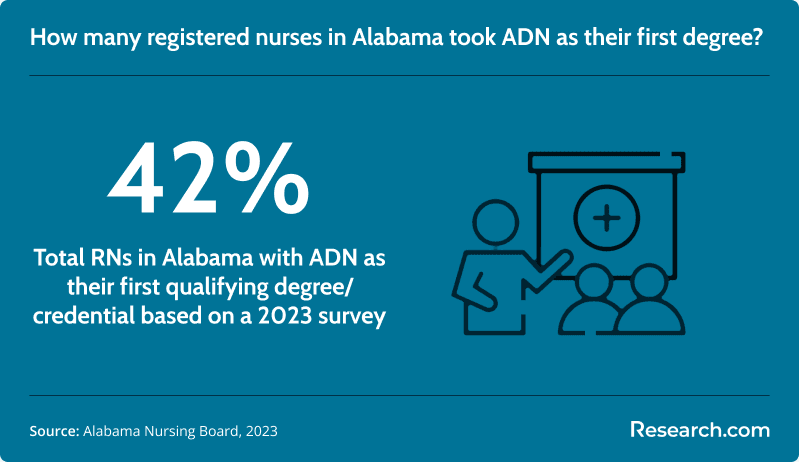
- Associate Degree in Nursing (ADN): This is commonly a two-year program offered by community colleges. In Alabama, 42% of nurses have ADN as their first qualifying degree. An ADN can be a cost-conscious way to enter RN practice faster.
- Bachelor of Science in Nursing (BSN): This is commonly a four-year degree offered by colleges and universities. A BSN can be useful if you want stronger preparation for leadership, public health, specialty nursing, graduate school, or employers that prefer bachelor-prepared nurses.
- State-approved nursing program: Whether you study on campus or online, your program must be approved by the Alabama Board of Nursing or a comparable board in another state. Students entering nursing from another field may want to compare online nursing programs for non-nurses carefully, especially clinical placement requirements.
| Pathway | Typical education | Licensure exam | Best fit |
| LPN | State-approved practical nursing program, usually about one year | NCLEX-PN | Students who want a shorter route into direct patient care |
| RN through ADN | Associate Degree in Nursing | NCLEX-RN | Students seeking an efficient route to RN licensure |
| RN through BSN | Bachelor of Science in Nursing | NCLEX-RN | Students aiming for broader career mobility, leadership, or graduate study |
| RN-to-BSN | BSN completion program for licensed RNs | Not a first-time RN licensure exam route | Working RNs who want to upgrade from ADN or diploma preparation |
What types of nurses can legally practice in Alabama?
Alabama recognizes several nursing and nursing-related roles. The right path depends on how much autonomy you want, how long you are willing to study, and whether you plan to provide basic bedside care, comprehensive RN care, or advanced clinical services.
- Registered Nurses: RNs assess patients, coordinate care, administer treatments and medications, educate patients, and help build care plans. To become an RN in Alabama, you must complete an approved nursing program and pass the NCLEX-RN. Current RNs who want a bachelor’s degree may compare options such as the easiest RN-to-BSN programs, while still confirming accreditation and employer acceptance.
- Licensed Practical Nurses: LPNs provide basic nursing care under the supervision of RNs, physicians, or other authorized providers. Their duties may include medication administration, vital sign monitoring, wound care support, and assistance with daily patient needs.
- Advanced Practice Registered Nurses: APRNs include Nurse Practitioners, Clinical Nurse Specialists, Nurse Anesthetists, and Nurse Midwives. In Alabama, APRNs must hold a master's degree from an accredited program and obtain national certification in their specialty area.
- Certified Nursing Assistants: CNAs are not licensed nurses, but they play an important support role in healthcare settings. They help patients with daily activities, mobility, hygiene, and basic comfort needs under nursing supervision.
| Role | Primary work | Level of preparation | Important limitation |
| CNA | Supportive patient care and daily living assistance | State-approved CNA training | Not a nursing license |
| LPN | Basic nursing care under supervision | Approved practical nursing program | Scope is narrower than RN practice |
| RN | Assessment, care planning, medication administration, patient education | ADN or BSN | Must pass NCLEX-RN and hold an active license |
| APRN | Advanced clinical practice in a specialty area | Graduate nursing education and national certification | Must meet Alabama advanced practice requirements |
What are the licensing requirements for nurses in Alabama?
Alabama nursing licensure is built around three core requirements: approved education, successful exam completion, and Board review. For RNs, approved education usually means an ADN or BSN. For LPNs, it means completion of a practical nursing program. Students who already hold a bachelor’s degree in another field may also consider accelerated options, including the best accelerated BSN programs, as long as the program meets licensure standards.
After graduation, candidates must pass the appropriate National Council Licensure Examination: NCLEX-PN for LPNs or NCLEX-RN for RNs. The exam is designed to confirm that a new nurse can practice safely at the entry level.
Once you pass the NCLEX, you apply to the Alabama Board of Nursing. The process generally includes:
- Application and fee: Candidates submit the required application and pay the applicable fee. One cited fee level is around $100 for RNs and $75 for LPNs.
- Fingerprinting and background check: Alabama requires nursing candidates to complete a criminal background review. Fingerprints are submitted as part of this process.
- Education verification: You must provide proof that you completed the required nursing education. The Board reviews this documentation before granting a license.
What types of nursing licenses are available in Alabama?
The main Alabama nursing license categories are RN, LPN, and APRN. Each license carries a different scope of practice, level of responsibility, and education requirement. Choosing between them should be based on your timeline, finances, long-term career plans, and desired role in patient care.
- Registered Nurse: RNs provide patient assessment, care coordination, medication administration, patient education, and clinical decision support. RN candidates generally complete an ADN or BSN and pass the NCLEX-RN.
- Licensed Practical Nurse: LPNs deliver basic nursing care and work under appropriate supervision. Candidates complete a practical nursing program, usually lasting about a year, and pass the NCLEX-PN.
- Advanced Practice Registered Nurse: APRNs include Nurse Practitioners, Clinical Nurse Specialists, Nurse Anesthetists, and Nurse Midwives. APRNs require a master's degree in nursing and must pass a national certification exam in their specialty area.
Can a Compact nurse practice in Alabama?
Yes. Alabama participates in the Nurse Licensure Compact, so a nurse with a valid multistate license from another Compact state can practice in Alabama without applying for a separate Alabama nursing license. This applies to eligible RNs and LPNs/VNs whose primary state of residence is a Compact state and whose license is in good standing.
The Nurse Licensure Compact allows nurses to hold one multistate license and practice in other Compact states, either physically or through remote care, without separate state-by-state licensing. The purpose is to support workforce mobility, expand access to care, and maintain public protection through shared licensure standards.
Compact practice does not mean nurses can ignore Alabama law. When practicing in Alabama, nurses must follow Alabama’s scope-of-practice rules, professional standards, and Board regulations. This is especially important for APRNs and nurses whose duties involve medication prescribing or controlled substances.
Alabama nursing practice laws and regulations are governed by the Alabama Board of Nursing. RNs and LPNs are typically required to complete 24 hours of continuing education every two years. Nurses with prescriptive authority must also comply with Alabama-specific prescribing rules, applicable federal law, and Drug Enforcement Administration requirements when relevant. Alabama requirements include 4 hours of pharmacology for those with prescriptive authority.
| Situation | Can you practice in Alabama? | What to check first |
| You hold a multistate license from a Compact state | Yes, if your license is valid and you meet Compact rules | Primary state of residence, license status, and Alabama practice laws |
| You hold a single-state license from another state | Not automatically | Whether you need Alabama licensure by endorsement |
| You are an APRN from another state | Additional requirements may apply | Alabama APRN recognition, certification, prescribing rules, and collaborative requirements if applicable |
What financial aid and scholarship options are available for nursing students in Alabama?
Nursing school can be expensive, especially when you include fees, books, uniforms, background checks, exam costs, transportation to clinical sites, and lost work hours. Alabama nursing students should compare several funding sources instead of relying on one scholarship or loan.
Potential funding options may include federal aid, institutional scholarships, employer tuition support, hospital-based tuition reimbursement, state or workforce initiatives, and service-based programs for students who commit to high-need communities. Availability, award amounts, and service obligations can change, so always confirm current terms directly with the scholarship provider or school financial aid office.
One option students may encounter is support connected to the Alabama Nursing Resource Center scholarship, which is intended to help students who commit to working in rural or high-need areas after graduation. Students should verify current eligibility rules, service commitments, funding limits, and whether living expense support is available.
Federal aid can also be important. Pell Grants may be available to eligible undergraduate students, and the Nurse Corps Scholarship Program can provide full tuition coverage and a monthly stipend for students who agree to work in underserved communities after graduation.
Advanced nursing students should also ask about loan repayment assistance, employer-sponsored graduate education, and program-specific scholarships. Those comparing graduate routes can review the best NP programs in Alabama and then contact each institution for current aid, clinical placement, and service-obligation details.
| Funding source | Who it may help | Questions to ask before accepting |
| Federal grants and loans | Eligible undergraduate and graduate students | What is the total repayment obligation after graduation? |
| Nurse Corps Scholarship Program | Students willing to serve underserved communities | What are the service requirements and penalties for not completing them? |
| School-based scholarships | Students with merit, need, diversity, or program-specific eligibility | Is the award renewable, and what GPA is required? |
| Employer tuition reimbursement | Working healthcare employees advancing their education | Do you need to remain employed for a set period after graduation? |
| Loan repayment programs | Nurses working in shortage areas or high-need specialties | Which workplaces and specialties qualify? |
Can you practice as a nurse without a license in Alabama?
No. Practicing as a nurse in Alabama without a valid license is illegal and can put patients, employers, and the unlicensed individual at serious risk. Even if a program is flexible or designed for working adults, such as some online RN-to-BSN programs without clinical requirements, you still need the appropriate active nursing license to practice as a nurse.
Nursing licensure exists to protect the public. Alabama requires candidates to complete approved education, pass the NCLEX-RN or NCLEX-PN, and satisfy Board requirements before using a protected nursing title or performing licensed nursing duties.
Key risks of unlicensed nursing practice include:
- Possible fines, disciplinary action, and criminal charges.
- Patient harm caused by care delivered without verified training and authority.
- Employment consequences for both the individual and the organization.
- Damage to public trust in nurses and healthcare institutions.
The stakes are high in every care setting, including long-term care. In 2020, $196.8 billion was spent on nursing home care, primarily from public sources. Licensed nurses are part of the accountability structure that helps protect patients in these environments.
-
: "
“When I first started my nursing career, I was eager to help but overwhelmed by the responsibilities. I remember a time when I volunteered at a local clinic before I had my license. I thought I could assist under supervision, but I quickly learned that even well-intentioned help without proper credentials could jeopardize patient care. That moment was a wake-up call. I realized that my passion for nursing needed to be backed by the right education and licensing. Now, as a licensed nurse, I feel empowered to make a difference, knowing I have the skills to provide safe and compassionate care.”
"
The lesson is simple: interest in patient care is not enough. Alabama nursing practice requires education, examination, licensure, and professional accountability.
What options are available for LPN education in Alabama?
Alabama LPN students can choose from practical nursing programs offered through technical colleges, community colleges, vocational schools, and some hybrid or online-supported formats. The most important rule is that the program must prepare you for Alabama licensure and the NCLEX-PN, not just award a certificate.
When comparing online LPN programs in Alabama, pay close attention to how clinical training is handled. Practical nursing cannot be completed entirely through reading modules or virtual lectures; students need supervised patient care experience. Also confirm whether the program is accredited by a recognized nursing education accreditor, such as the Accreditation Commission for Education in Nursing or the Commission on Collegiate Nursing Education, and whether it is approved for Alabama practical nursing licensure.
What is the state of nursing in Alabama?
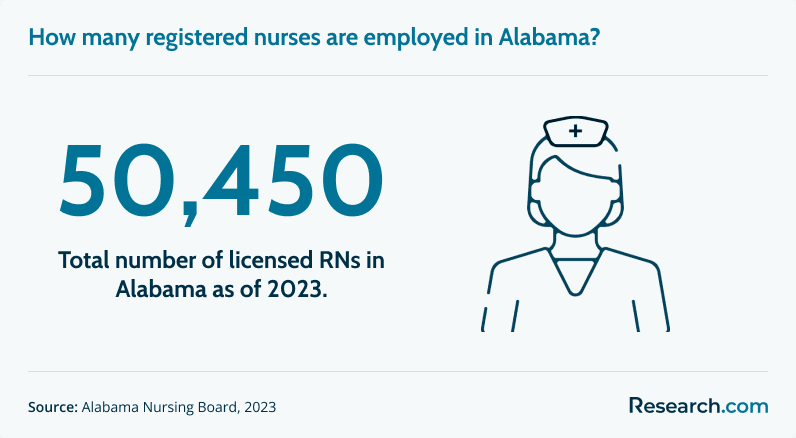
The nursing workforce in Alabama presents a promising landscape but also faces pressure from staffing shortages, rural access challenges, and rising healthcare demand. As of 2023, there were 50,450 licensed RNs in Alabama.
Demand is shaped by several factors: an aging population, hospital staffing needs, long-term care demand, outpatient service growth, and the continued expansion of care delivery outside traditional hospital units. Rural communities may feel shortages more sharply because facilities have smaller labor pools and fewer nearby training pipelines.
For nurses, Alabama can offer a range of work environments, including hospitals, outpatient centers, long-term care facilities, rural clinics, public health agencies, home health, school health, and telehealth-supported roles. The state’s lower cost of living compared with many other states can also affect the overall value of a nursing salary, although individual finances depend on location, household size, debt, and work schedule.
Current trends affecting Alabama nurses include more employer interest in BSN completion, growing use of telehealth, demand for nurses comfortable with electronic health records and digital care tools, and greater need for clinicians who can work across interdisciplinary teams. Nurses who build skills in patient education, chronic disease management, geriatrics, behavioral health, and care coordination may find more ways to adapt as healthcare delivery changes.
What is the job outlook for nursing in Alabama?
The nursing profession is experiencing robust growth, with the U.S. Bureau of Labor Statistics projecting a 7% increase in employment for registered nurses from 2019 to 2029. In Alabama, healthcare employers continue to need nurses in hospitals, outpatient care, long-term care, home health, and rural care settings.
Registered nurses in Alabama earn an average annual wage of approximately $71,370, or about $34.31 per hour. Salary varies by employer, location, shift differential, credentials, union or non-union setting, specialty, overtime, and years of experience.
Among the top-paying metropolitan areas include:
- Birmingham-Hoover: $66,000 average annual salary
- Huntsville: $65,000 average annual salary
- Mobile: $62,000 average annual salary
| Career factor | What it means for Alabama nursing students |
| Shortage pressure | More openings may exist, especially in high-need regions and hard-to-staff shifts |
| Education level | ADN can lead to RN licensure, while BSN may support advancement or employer preference |
| Location | Pay and openings can differ between metro, rural, hospital, outpatient, and long-term care settings |
| Specialization | Critical care, geriatrics, behavioral health, advanced practice, and leadership roles may require added training |
What Alabama nurses say about the career
-
: "
“I chose nursing because I wanted to make a difference in people's lives. In Alabama, the sense of community is strong, and I feel that every day in my work. The support from colleagues and the gratitude from patients make every challenge worthwhile. Plus, Alabama offers a variety of healthcare settings, from rural clinics to urban hospitals, allowing me to grow my skills in diverse environments.” Jessica
"
-
: "
“As a Licensed Practical Nurse, I’ve found that Alabama has a high demand for nursing professionals. The job market is robust, with a projected growth rate of 7% for LPNs in the state. This means job security and opportunities for advancement. I’ve been able to further my education while working, and I appreciate the encouragement from my employer to pursue my RN degree. The support is truly inspiring.” Michael
"
-
: "
“Nursing in Alabama has been a fulfilling career choice for me. The state offers competitive salaries, with registered nurses earning an average of $63,000 annually. Beyond financial benefits, the relationships I build with my patients and their families are incredibly rewarding. I love being part of a profession that values compassion and care, and I encourage anyone considering nursing to take the leap.” Riley
"
How can you diversify your healthcare career in Alabama?
Nursing is not the only healthcare pathway in Alabama. Some professionals expand their options by adding credentials in related clinical, administrative, or technical fields. This can be useful if you want broader healthcare knowledge, a backup career route, or a future role that combines patient care with operations, medication management, compliance, or health information.
For example, nurses interested in medication systems, patient counseling, or interdisciplinary care may compare nursing advancement with pharmacy education. If that path interests you, review the steps for how to become a pharmacist in Alabama before committing to a long graduate-level route.
How do advanced nursing degrees impact career opportunities in Alabama?
Advanced nursing degrees can move nurses beyond entry-level bedside roles into advanced practice, leadership, education, policy, quality improvement, and healthcare administration. A Doctor of Nursing Practice can be especially relevant for nurses who want advanced clinical expertise and systems-level leadership responsibilities.
Advanced education can also influence earning potential, but salaries are never guaranteed. Pay depends on specialty, employer, geography, experience, and scope of responsibility. Nurses comparing the financial side of graduate education can review information on doctor of nursing practice salary while also calculating tuition, fees, loan costs, and time away from work.
How Can I Evaluate and Select an Accredited Online Nursing Program in Alabama?
Online nursing programs can be convenient, but they require careful review. A program that looks flexible may still fail to meet Alabama licensure expectations, may not arrange clinical placements near you, or may lack strong NCLEX preparation. Before enrolling, confirm approval, accreditation, clinical requirements, faculty access, student support, and graduate outcomes.
Use rankings and curated lists as a starting point, not the final decision. For example, reviewing the best online nursing programs in Alabama can help you identify options, but you should still contact each program directly and verify current approval status with the Alabama Board of Nursing.
| Program feature | Why it matters | Question to ask |
| State approval | Determines whether the program can support licensure eligibility | Is this program approved for Alabama nursing licensure? |
| Accreditation | Can affect transfer, graduate study, employer acceptance, and financial aid | Which nursing accreditor recognizes the program? |
| Clinical placement | Online coursework does not replace hands-on training | Does the school arrange Alabama clinical sites, or must students find their own? |
| NCLEX preparation | Licensure depends on passing the exam | What support is provided for NCLEX readiness? |
| Student support | Working adults often need advising, tutoring, and scheduling flexibility | Are advisors available outside standard business hours? |
What are the detailed licensure steps and legal criteria for nursing in Alabama?
Alabama licensure requires more than graduating from a nursing program. Applicants should be prepared for education verification, NCLEX results, identity documentation, background review, application fees, and ongoing renewal obligations. Delays often happen when applicants submit incomplete documents, misunderstand endorsement rules, or assume a program’s advertising guarantees licensure.
For a step-by-step review of current documentation and Board expectations, use this guide to the requirements for nursing licensure in Alabama. Keep copies of transcripts, exam records, background check confirmations, continuing education certificates, and license renewal notices.
Which factors should I consider when choosing a nursing school in Alabama?
The best nursing school for you is not always the highest-ranked or most advertised program. It is the program that fits your license goal, budget, schedule, learning style, clinical needs, and long-term career plan. Alabama students should compare both academic quality and practical barriers, including commuting distance, clinical site access, program competitiveness, and total cost.
Independent rankings can help you build a shortlist. Reviewing the best nursing schools in Alabama can be useful, but you should also verify accreditation, Board approval, NCLEX preparation, clinical partnerships, and support for working students.
| Common mistake | Why it can hurt you | Better approach |
| Choosing based only on tuition | Low tuition may not include fees, supplies, exam costs, or travel to clinical sites | Compare total program cost |
| Ignoring accreditation and approval | An unapproved program may not lead to licensure | Verify state approval and nursing accreditation before applying |
| Assuming online means fully remote | Nursing programs still require clinical experiences | Ask exactly where and how clinical hours are completed |
| Relying only on rankings | A highly ranked program may not fit your schedule, budget, or location | Use rankings as one input among many |
| Assuming salary outcomes are guaranteed | Pay depends on employer, region, shift, experience, and specialty | Compare local job postings and employer requirements |
What are the career prospects for nurse midwives in Alabama?
Nurse midwives provide advanced maternal and reproductive healthcare, including prenatal, perinatal, and postnatal care. In Alabama, this role can be especially important in communities where access to maternal health services is limited. The pathway requires advanced nursing education, national certification, and compliance with Alabama APRN requirements.
If you are interested in this specialty, review the full pathway for how to become a nurse midwife in Alabama. Pay close attention to program accreditation, clinical training in women’s health and birth care, certification eligibility, and state practice rules.
What steps are required to become a nurse practitioner in Alabama?
Becoming a nurse practitioner in Alabama is an advanced pathway for RNs who want expanded clinical responsibilities. The usual route includes earning an RN license, completing graduate-level nurse practitioner education, choosing a population focus, completing required clinical training, passing national certification, and applying for state recognition to practice as an APRN.
Prospective NPs should review nurse practitioner education requirements in Alabama before enrolling in a graduate program. This is especially important if you are considering an online NP program, because clinical placements, state authorization, and certification eligibility can vary.
What Are the Benefits of Enrolling in the Best Online Nurse Practitioner Programs?
Online nurse practitioner programs can help working RNs continue earning income while completing graduate coursework. They may also provide access to programs outside a student’s immediate region. However, online convenience should not outweigh licensure fit, clinical placement support, faculty quality, or certification pass preparation.
Students comparing the best online nurse practitioner programs should confirm whether the program accepts Alabama residents, supports Alabama clinical placements, prepares graduates for the intended national certification exam, and meets Alabama APRN requirements.
Can non-clinical roles like medical billing and coding expand your healthcare opportunities in Alabama?
Yes. Non-clinical healthcare credentials can broaden your options if you want to work in healthcare but prefer administrative, revenue cycle, compliance, documentation, or remote-friendly roles. Medical billing and coding can also appeal to nurses who want to move away from bedside care while still using healthcare knowledge.
These roles are not substitutes for nursing licensure, but they can complement clinical experience. If you want a structured non-clinical route, review how to become a medical biller and coder in Alabama and compare training length, certification requirements, employer expectations, and remote work possibilities.
How can I pursue an LVN career in Alabama?
Alabama generally uses the term Licensed Practical Nurse rather than Licensed Vocational Nurse. The LVN title is more common in some other states, but the practical nursing pathway is similar in purpose: complete an approved vocational or practical nursing program, pass the required licensure exam, and practice within the legal scope allowed by the state.
If you are searching for LVN information because you are moving from another state or comparing entry-level nursing routes, review how to become an LVN in Alabama. Then confirm with the Alabama Board of Nursing which license title, application process, and endorsement rules apply to your situation.
Related Articles for Nearby States
- 2027 How to Become a Nurse in Mississippi
- 2027 How to Become a Nurse in Tennessee
- 2027 How to Become a Nurse in Georgia
- 2027 How to Become a Nurse in Florida
- 2027 How to Become a Nurse in Louisiana
- 2027 How to Become a Nurse in Arkansas
- 2027 How to Become a Nurse in Kentucky
- 2027 How to Become a Nurse in South Carolina
- 2027 How to Become a Nurse in North Carolina
- 2027 How to Become a Nurse in Missouri
Key Insights
- Alabama nursing careers start with the correct license pathway. LPN, RN, APRN, and CNA roles have different education requirements, exams, responsibilities, and legal limits.
- RN candidates can qualify through either an ADN or BSN. An ADN may be a faster entry route, while a BSN can support broader advancement options.
- Licensure is mandatory. You cannot legally practice as a nurse in Alabama without the proper active license, even if you have healthcare experience or are enrolled in a nursing program.
- Alabama participates in the Nurse Licensure Compact, but Compact nurses must still follow Alabama practice laws when working in the state.
- Program approval, accreditation, clinical placement, NCLEX preparation, and total cost are more important than marketing claims or rankings alone.
- Nursing demand in Alabama is strong, but salaries and opportunities vary by location, specialty, employer, experience, and education level.
- Advanced degrees, NP programs, nurse midwifery, pharmacy, and medical billing and coding can expand healthcare career options, but each path has its own training, licensure, and return-on-investment considerations.
References:
- Alabama Board of Nursing (2024)
- Grabowski, D., Chen, A., and Saliba, D. (2023). Paying for Nursing Home Quality: An Elusive But Important Goal.
- nursejournal.org (2024). Becoming a Registered Nurse in Alabama + Requirements & Licensing.
Other Things You Need to Know About Nursing in Alabama
To become a nurse in Alabama in 2027, start with a nursing program (ADN or BSN) from an accredited school. Pass the NCLEX-RN exam, apply for licensure with the Alabama Board of Nursing, and clear a background check. Continuous education may be needed to maintain licensure.
No. Alabama requires a background check for nursing licensure, and certain criminal convictions can delay or prevent approval by the Alabama Board of Nursing. Applicants must disclose prior offenses and may need to provide court records, fingerprints, and a written explanation before the board reviews the application.


