
2027 Best Online Nursing Programs in New Mexico – Accredited RN to BSN Programs

Co-Founder and Chief Data Scientist
Choosing a nursing program in New Mexico is not only a school decision. It is also a licensure, cost, clinical placement, and career-location decision. The state needs nurses across hospitals, rural clinics, community health centers, long-term care settings, and advanced practice roles, but students must still verify accreditation, New Mexico Board of Nursing approval, clinical requirements, transfer policies, and total cost before enrolling.
This guide explains how nursing education works in New Mexico, what online nursing students should check before applying, how RN to BSN programs compare, and what career paths are available after graduation. It is designed for prospective nursing students, working RNs considering a BSN, LPNs planning advancement, and nurses evaluating whether New Mexico is the right place to build a long-term healthcare career. If you are already licensed as an RN and want a flexible bachelor’s completion pathway, you can also compare accredited online RN to BSN programs that may support leadership, public health, and graduate-study goals.
Best Online Nursing Programs in New Mexico Table of Contents
- How do you become a nurse in New Mexico?
- How much do nursing programs in New Mexico usually cost?
- How long is the nursing pathway in New Mexico?
- Can an online nursing degree qualify you for New Mexico licensure?
- Online nursing programs in New Mexico for 2027
- Is New Mexico a strong state for nurses?
- What jobs can you pursue with a nursing degree in New Mexico?
- How can New Mexico nurses move up through education and certifications?
- What nursing license rules and regulatory updates should applicants know?
- How should you choose a fast-track online RN to BSN program?
- Why is mental health nursing important in New Mexico?
- What financial aid options can help pay for nursing school in New Mexico?
- What trends are changing nursing practice in New Mexico?
- What clinical requirements apply to online nursing programs?
- Should you become a nurse practitioner next?
- Can nurses move into medical billing and coding?
- How do you become a nurse midwife in New Mexico?
- What is the outlook for LPNs in New Mexico?
- Should allied health training be part of your nursing plan?
- How are LPN and medical assistant roles different?
- How can you become an LVN in New Mexico?
Quick answer: What should you know about nursing programs in New Mexico?
New Mexico offers several nursing routes, including CNA training, LPN programs, associate degree nursing, BSN programs, RN to BSN completion programs, MSN programs, and advanced practice pathways. Online coursework is common, especially for RN to BSN and graduate nursing students, but pre-licensure students should expect in-person clinical training. For licensure, applicants generally need a state-approved program, required exams, background checks, fingerprints, official transcripts, and any certification required for their role.
The best choice depends on your current status. New students who want the fastest clinical entry may start with CNA or LPN training. Students aiming for RN licensure can pursue an associate degree or BSN. Working RNs who already hold an ADN often choose online RN to BSN programs because they can continue working while completing upper-division nursing coursework.
| Student goal | Common pathway | Best fit | Main caution |
| Enter healthcare quickly | CNA training | Students testing the field before committing to a longer degree | Scope of practice is limited compared with licensed nursing roles |
| Provide licensed bedside care | LPN program and licensure | Students seeking practical nursing work and a possible bridge to RN later | Advancement may require more education |
| Become a registered nurse | ADN or BSN plus NCLEX-RN | Students seeking broader clinical responsibility | Program approval and clinical placement quality matter |
| Advance as a working RN | Online RN to BSN | Licensed RNs who need flexibility and bachelor’s-level preparation | Transfer credits, tuition structure, and practicum requirements vary |
| Move into advanced practice | MSN or DNP with certification | RNs pursuing NP, CRNA, CNS, leadership, or specialty roles | Licensure, certification, and clinical requirements are more complex |
How to become a nurse in New Mexico?
Nursing licensure in New Mexico is handled primarily through the New Mexico Board of Nursing (NMBON). The board oversees several nursing licenses, certifications, and related healthcare credentials, including:
- Licensed Practical Nurse (LPN)
- Registered Nurse (RN)
- Advanced Practice Registered Nurse Certified Registered Nurse Anesthetist (APRN-CRNA)
- Advanced Practice Registered Nurse Clinical Nurse Specialist (APRN-CNS)
- Advanced Practice Registered Nurse Certified Nurse Practitioner (APRN-CNP)
- APRN Prescriptive Authority
- Medication Aide
- Lactation Care Provider
- Hemodialysis Technician
The NMBON website provides role-specific instructions, but most applicants should expect the same core steps. You must complete the required nursing education through an approved school or program, pass the exam required for your license level or specialty, submit official records, complete a criminal background check and fingerprinting, and provide continuing education documentation when it applies. Advanced practice nurses also need the appropriate national certification for their specialty area.
Certified Nurse Midwives (CNMs) and Certified Nurse Aides (CNAs) follow a different process. Those credentials are handled through the New Mexico Department of Health rather than the NMBON.
| Credential | Typical education requirement | Licensing or certification authority | Decision point for students |
| CNA | State-approved nurse aide training | New Mexico Department of Health | Good short-term entry point, but not equivalent to LPN or RN practice |
| LPN | State-approved practical nursing program | New Mexico Board of Nursing | Useful for direct patient care and future bridge options |
| RN | Approved ADN or BSN program | New Mexico Board of Nursing | ADN may be faster; BSN may support broader advancement |
| APRN | Graduate nursing degree and specialty certification | New Mexico Board of Nursing | Best for experienced RNs seeking more autonomy and specialization |
Additional tips for nurse license applications in New Mexico
New Mexico participates in the Nurse Licensure Compact (NLC), which can be important for nurses who may practice across compact states. The NMBON also has processes for endorsement applicants and internationally educated nurses, but applicants should verify current instructions directly before submitting documents.
One important access-related policy is New Mexico’s Senate Bill 137, which states that immigration status will no longer block eligible applicants from seeking professional or occupational licenses. The purpose is to let qualified individuals apply regardless of citizenship or immigration status. For a state working to address healthcare workforce needs, this policy may help expand the pool of licensed professionals, including nurses.
The University of New Mexico (UNM) Health Sciences Center released a 2024 report on the state’s healthcare workforce. According to that report, New Mexico had 5,704 licensed RNs and CNSs, but only 54.33%, or an estimated 3,099, were practicing in the state as of 2023. Among the 231 certified nurse practitioners and 11 certified nurse midwives licensed in New Mexico, 50.79% (117) of those CNPs and 73.88% (8) of those CNMs were reported as practicing in-state as of 2023 (UNM HSC, 2024).
What is the typical cost of nursing programs in New Mexico?
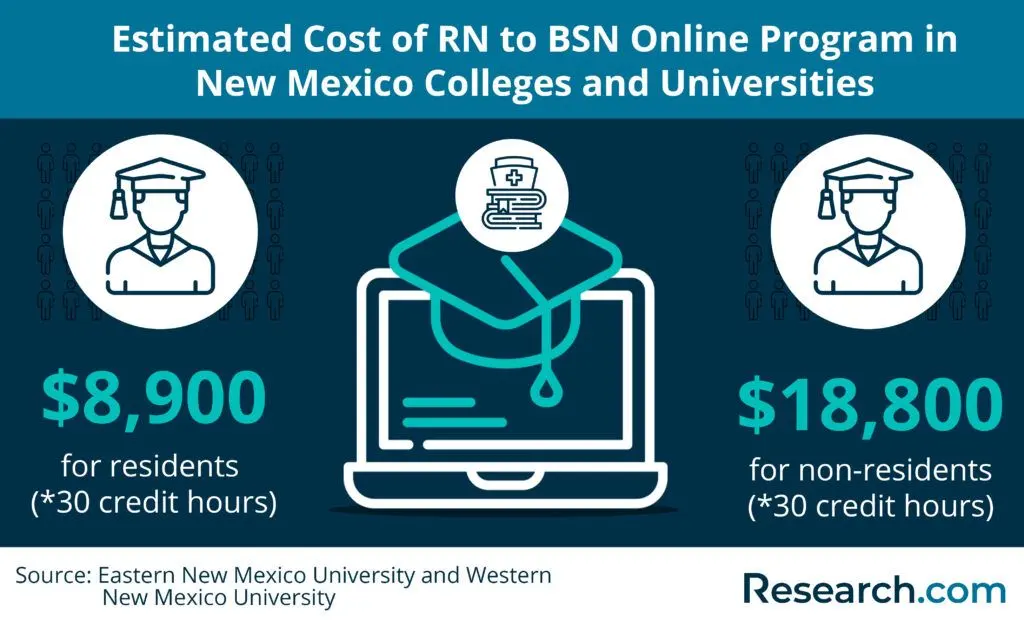
Nursing program costs in New Mexico vary by school, degree level, residency status, number of transfer credits, and whether the program charges flat-rate or per-credit tuition. Based on our review of in-state online RN to BSN options, students can expect tuition and fees of about $8,900 or up to $18,600 for a program requiring at least 30 credits.
In-state students often pay less than non-residents at public institutions. Out-of-state students should still compare options carefully because financial aid, institutional discounts, employer tuition benefits, and regional tuition agreements may reduce the final price. If price is your main concern, it may also help to compare affordable online RN to BSN programs before committing.
New Mexico participates in the Western Undergraduate Exchange (WUE), which includes states and territories in the WICHE region. Through this tuition-savings arrangement, 160 plus participating colleges and universities may offer in-state or discounted tuition rates to eligible out-of-state students from WICHE member states. The University of New Mexico (UNM) and Eastern New Mexico University (ENMU) are among the New Mexico institutions that participate.
Graduate nursing study can cost substantially more than RN to BSN completion programs. For example, a student considering a master’s degree in nursing administration at UNM can review the Master in Nursing concentration cost estimate. UNM lists a total cost of admission (COA) of $27,442.12 for residents and $53,571.92 for non-residents (UNM, n.d.). The difference between those two amounts is $26,129.80, so residency status, discounts, and eligibility for aid can significantly affect affordability.
Tuition structure also matters. ENMU charges part-time resident undergraduate students $174.75 per credit. Full-time undergraduate residents pay $2,097 per semester (ENMU, n.d.). A student taking the full 18 credits in a semester would pay the equivalent of $116.50 per credit hour, which shows why students should compare both per-credit and full-time pricing.
| Cost factor | Why it matters | Question to ask before enrolling |
| Residency status | Resident and non-resident rates can differ sharply | Can I qualify for in-state, WUE, military, employer, or other reduced tuition? |
| Transfer credits | Accepted credits can reduce the number of courses you pay for | How many of my ADN, general education, and prior nursing credits will transfer? |
| Fees | Online, technology, lab, clinical, and student fees can raise total cost | What is the full program cost, not just tuition? |
| Clinical or practicum expenses | Students may need immunizations, background checks, travel, or documentation | Are clinical placement costs included or separate? |
| Enrollment pace | Full-time flat rates may be cheaper per credit, but part-time enrollment may fit work schedules better | What pace gives me the best balance of cost, workload, and completion time? |
How long does it take to become a nurse in New Mexico?
The timeline depends on the credential you want. A CNA route can take only a few months, while RN and advanced practice pathways take longer. If you are comparing pathways more broadly, this guide to how long nursing school takes can help you understand common timelines by degree level.
Certified Nurse Aides
To become a CNA in New Mexico, students complete a state-approved 75-hour training program, including 16 hours of supervised practical training. This can usually be completed in about one to three months. After training, candidates apply for the Nurse Aide Competency Evaluation Program Testing and receive three attempts to pass. If they do not pass within those three attempts, they are generally required to repeat CNA classes before testing again. After passing, candidates register with the New Mexico Nurse Aide Registry and submit the remaining application materials.
Registered Nurses
Prospective RNs must complete an NMBON-approved nursing program in New Mexico or another jurisdiction. Students usually choose either an associate degree in nursing or a bachelor’s degree in nursing. An associate degree commonly takes about two years, while a BSN commonly takes about four years. Graduates then prepare for the NCLEX-RN; spending around three months on focused preparation is often recommended for first-time test takers. After passing the exam, applicants submit licensing materials to the NMBON and typically wait three to four weeks for approval.
Advanced Practice Registered Nurses
APRNs generally need a master’s in nursing or a doctor of nursing practice degree. Graduate nursing programs in New Mexico often take about two to four years, depending on degree type, specialty, enrollment pace, and clinical requirements. After finishing the degree, candidates must pass the certification exam required for their specialty through the relevant national certifying organization. New Mexico allows APRNs to apply for a work permit so they can practice while waiting for national certification. Cost-conscious students can also compare low-cost online MSN programs before choosing a graduate pathway.
Which New Mexico nursing license should you pursue?
The right license depends on your desired scope of practice, timeline, and long-term goals. CNA training may fit students who want quick healthcare exposure. LPN programs can lead to licensed patient-care work and may later support bridge pathways. ADN and BSN routes are the primary paths to RN licensure. MSN and DNP programs are for RNs who want advanced practice, leadership, education, or specialty care.
Demand is a major part of the decision. According to the 2024 Health Care Workforce Report by Think New Mexico, the state is projected to be short more than 5,140 nurses by 2035. The report states that registered nurses make up a large share of the projected gap, with 2030 projections showing a deficit of 5,750 registered nurses against demand. New Mexico also continues to face uneven distribution of nursing practitioners between rural and urban areas, and over 90% of New Mexico counties are designated as Health Professional Shortage Areas.
Can you become a nurse in New Mexico with an online degree?
Yes, an online nursing degree can support New Mexico nursing licensure if the program meets state requirements. The key issue is not whether coursework is online; it is whether the school and program are approved, accredited, and able to provide the required clinical or practicum experiences. Students should confirm approval with the New Mexico Board of Nursing before enrolling, especially in pre-licensure programs.
For an online nursing program to be a strong choice, the institution should hold national or regional accreditation, and the nursing program should be accredited by one of the following:
- Accreditation Commission for Education in Nursing (ACEN)
- Commission on Collegiate Nursing Education (CCNE)
- National League for Nursing Commission for Nursing Education Accreditation (NLN CNEA)
New Mexico students can find online options at both undergraduate and graduate levels. The University of New Mexico, a research university recognized under the Carnegie Classification of Institution of Higher Education, also offers a PhD nursing program that is primarily online.
State institutions and policymakers have also been working to increase the number of RN graduates and expand access to advanced nursing education. Local needs remain significant: New Mexico requires more than 8,000 registered nurses and licensed practical nurses by 2030 (LFC, 2026). For 2025, approximately 1,400 new nurses graduated from nursing programs in New Mexico (NM Legislature, 2026).
| Online nursing program type | Can coursework be online? | Clinical or practicum expectation | Best for |
| Pre-licensure RN program | Some didactic courses may be online | In-person clinical training is required | Students who are not yet licensed as RNs |
| RN to BSN | Often fully or mostly online | May include community health, project-based, or local practice experiences | Working RNs with an ADN or diploma |
| MSN or DNP | Many programs offer online theory courses | Specialty clinical hours are typically required | RNs pursuing APRN, leadership, or specialty roles |
| PhD in nursing | May be primarily online depending on school | Research expectations vary by program | Nurses interested in research, academia, or policy |
Online Nursing Programs in New Mexico for 2027
New Mexico institutions have been working to expand access to nursing education, especially for students who cannot relocate or stop working. One important effort is the New Mexico Nursing Education Consortium (NMNEC), a partnership among tribal and state-funded nursing programs that uses a shared pre-licensure curriculum and creates multiple entry points into nursing.
There is also a continued effort to increase the share of nurses with bachelor’s-level preparation. Online RN to BSN programs are especially useful because they allow licensed RNs to complete upper-division nursing coursework while continuing to work in hospitals, clinics, community health settings, or long-term care facilities. For New Mexico, this flexibility matters: losing working nurses to full-time campus study could worsen staffing pressure.
Research.com reviewed current RN to BSN completion options available to New Mexico learners and online students. The comparison below focuses on accreditation, tuition, completion time, required credits, curriculum structure, and flexibility. Most listed programs deliver didactic coursework online, but students should still confirm any local practicum, project, or practice-experience requirements before enrolling.
| Program | Estimated length | Credits noted | Cost details | Accreditation |
| University of New Mexico | Approximately one year | 120 credits with 30 credit hours of nursing coursework at UNM | $362.16 per credit for the 30 credits program requirement; $343.26 per credit for residents and $1,107 per credit for non-residents for courses taken over the 30 credits required | CCNE |
| Eastern New Mexico University | Approximately 16 months for full-time students who have completed general education credits | 32 credit hours as part of the BSN Completion Program Nursing Course requirements | $174.75 per credit hour for part-time residents and $257.27 per credit hour for part-time non-residents, with additional fees of $106 per credit hour; full-time tuition is $2,097 per semester for residents and $3,087 for non-residents, with $1,272 per semester in student fees | ACEN |
| New Mexico Highlands University | Approximately 14 months | 120 credits total with 32 credit hours from 11 core courses at NMHU; accepts up to 95 transfer credits | $325 per credit | CCNE |
| Western New Mexico University | As little as two years | Minimum of 42 credits of upper-division courses, 120 credits total | $327.82 per credit hour for residents, $414.64 for non-residents, and an additional online fee of $30 per credit hour | CCNE |
| Chamberlain University | Approximately one year with full-time enrollment | 122 credits; working RNs receive at least 77 transfer credits | $699 per credit hour | CCNE |
1. University of New Mexico
The University of New Mexico (UNM) is a Research 1 institution with a College of Nursing that offers an online RN to BSN pathway for licensed RNs. The program emphasizes leadership, management, research literacy, and critical thinking. Courses run in eight-week formats, and students may choose from five start dates during the year. UNM also notes that many students receive financial aid and that its student body is highly diverse.
- Program Length: Approximately one year
- Tracks/concentrations: RN to BSN
- Cost per Credit: $362.16 per credit for the 30 credits program requirement; $343.26 per credit for residents and $1,107 per credit for non-residents for courses taken over the 30 credits required
- Required Credits to Complete: 120 credits with 30 credit hours of nursing coursework completed at UNM (requires a minimum of 26 credits transferable coursework for admission to the program)
- Accreditation: Commission on Collegiate Nursing Education (CCNE)
2. Eastern New Mexico University
Eastern New Mexico University (ENMU) positions itself as one of the more affordable college choices in New Mexico and the U.S. Southwest. Its BSN completion program is fully online and designed for working RNs. Courses are offered in eight-week sessions, and rolling admission allows students to begin in any semester. Applicants must apply to both ENMU and the Nursing Program, hold an active RN license, and have completed an ADN.
- Program Length: Approximately 16 months for full-time students who have already completed their general education credits
- Tracks/concentrations: RN to BSN
- Cost per Credit: For part-time students taking less than 12 credit hours, the tuition is $174.75 per credit hour for residents and $257.27 per credit hour for non-residents (both have to pay additional fees of $106 per credit hour). For full-time enrollees (12-18 credit hours), the tuition is $2,097 per semester for residents and $3,087 for non-residents (both have to pay $1,272 per semester in student fees).
- Required Credits to Complete: 32 credit hours as part of the BSN Completion Program Nursing Course requirements
- Accreditation: Accreditation Commission for Education in Nursing (ACEN)
3. New Mexico Highlands University
New Mexico Highlands University (NMHU) offers asynchronous online coursework in eight-week terms. Its RN to BSN program is built for licensed nurses managing work, family, and school responsibilities. The curriculum is fully online and uses a research project rather than an in-person practicum. Students receive one-on-one faculty advising and study topics such as healthcare technology, clinical judgment, communication, leadership, critical thinking, and evidence-based practice.
- Program Length: Approximately 14 months
- Tracks/concentrations: RN to BSN
- Cost per Credit: $325 per credit
- Required Credits to Complete: 120 credits total with 32 credit hours from 11 core courses taken at NMHU (accepts up to 95 transfer credits)
- Accreditation: Commission on Collegiate Nursing Education (CCNE)
4. Western New Mexico University
The RN to BSN pathway at Western New Mexico University (WNMU) prepares RNs for leadership, community health, school health, and direct patient-care responsibilities. The online format supports working nurses and highlights nursing scholarship, professional practice, and community service. Students complete a Community Health Nursing course with 96 hours of practicum experience in the community where they live. Enrollment requirements include current CPR certification, specific immunizations, and current results for required lab tests.
- Program Length: As little as two years
- Tracks/concentrations: RN to BSN
- Cost per Credit: $327.82 per credit hour for residents, $414.64 for non-residents, and an additional online fee of $30 per credit hour
- Required Credits to Complete: Minimum of 42 credits of upper-division courses, 120 credits total
- Accreditation: Commission on Collegiate Nursing Education (CCNE)
5. Chamberlain University
Chamberlain University offers a fully online RN to BSN program intended for licensed nurses who need scheduling flexibility. Students may enroll full-time, part-time, or one course at a time, depending on workload and personal responsibilities. Coursework covers areas such as professional leadership, disaster planning, community health concerns, and services for at-risk populations. The practice experience component may be completed at the student’s workplace.
- Program Length: Approximately one year with full-time enrollment
- Tracks/concentrations: RN to BSN
- Cost per Credit: $699 per credit hour
- Required Credits to Complete: 122 credits (working RNs will receive at least 77 transfer credits)
- Accreditation: Commission on Collegiate Nursing Education (CCNE)
Is New Mexico good for nurses?
New Mexico can be a meaningful place to work as a nurse, particularly for professionals interested in rural health, culturally responsive care, public health, and service to underserved communities. It is not a perfect labor market. Staffing shortages, geographic access issues, and workforce retention challenges are real. Still, the state is investing in education pathways, workforce programs, and policy efforts that may create opportunities for nurses at several levels.
1. Rural and community-based nursing opportunities
Many New Mexico residents live in rural areas where access to healthcare can be limited. Nurses who want hands-on community health experience may find roles in clinics, small hospitals, tribal health settings, home health, long-term care, and public health programs. This environment can be especially rewarding for nurses who want broad responsibilities and close patient-community relationships.
2. Policy attention on working conditions and workforce access
Nursing associations, unions, educators, and state leaders have been discussing workplace safety, staffing levels, and violence prevention for healthcare workers. Proposals have included limits on nurse-to-patient ratios and stronger policies addressing violence against healthcare staff. There is also continued interest in building a more diverse healthcare workforce, especially by improving access for underrepresented tribal and ethnic communities.
3. Support for nursing education
Governor Michelle Lujan Grisham has supported investments in healthcare workforce education, training, loan repayment, and employment opportunities. In 2025, healthcare support occupations are expected to grow by 21.15 percent in 2026, adding 5,782 jobs, with home health aides, medical assistants, and nursing assistants driving much of this demand. Nursing students and working nurses may also find scholarships, grants, employer tuition reimbursement, and other education benefits through schools, employers, and private organizations.
4. A distinctive cultural and geographic setting
New Mexico’s communities are culturally diverse, with many residents connected to Native American tribes and Hispanic heritage. Nurses serving in the state may work with patients from many cultural, linguistic, and geographic backgrounds. Outside of work, the state offers heritage sites, distinctive architecture, arts communities, White Sands National Park, Carlsbad Caverns, and landscapes that have been featured in music videos, television, and films, including Breaking Bad.
5. Lower cost of living than the national average
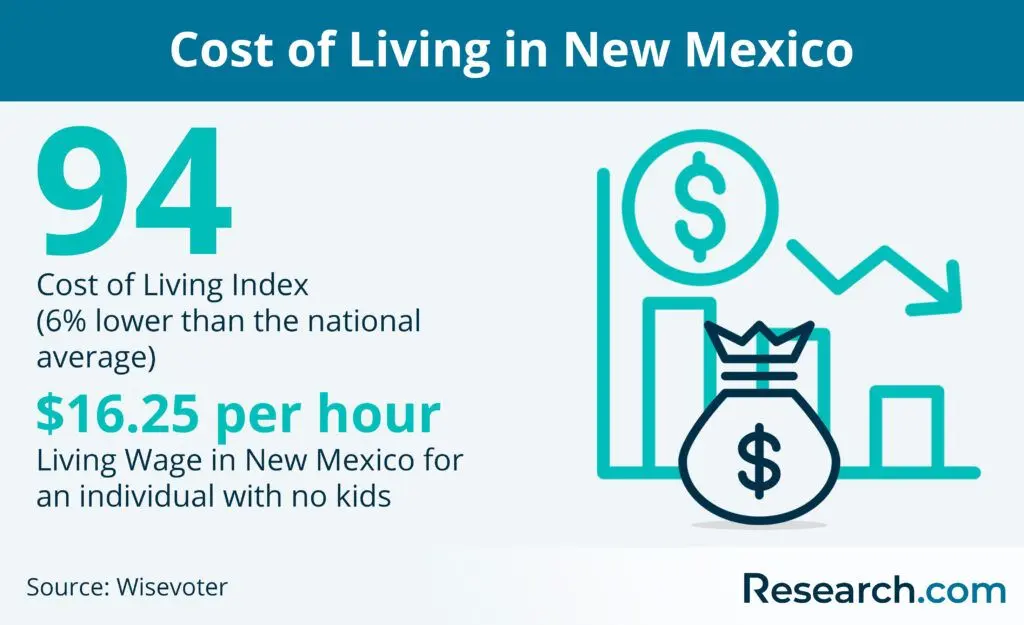
New Mexico has a cost of living index of 94, meaning the cost of living is 6% below the national average. However, the reported minimum wage is $11.50 per hour, while the livable wage is listed as $16.25 for an individual without children (Wisevoter, n.d.). Nurses may earn more than minimum-wage workers, but students should still compare expected pay, debt, housing costs, commuting distance, and job location before relocating.
What can I do with a nursing degree in New Mexico?
A nursing degree in New Mexico can lead to employment in hospitals, outpatient clinics, community health organizations, long-term care facilities, veteran services, home health, schools, public health programs, and advanced practice settings. Students comparing online nursing degree programs should align the program type with the job setting they want after graduation.
New Mexico includes specialized hospitals and major healthcare systems. Presbyterian Health Institution, known for services in women’s health, children’s health, heart health, and surgeries, operates hospitals and primary and specialty clinics across the state.
The Raymond G. Murphy Department of Veterans Affairs Medical Center in Albuquerque is another major healthcare setting, offering services such as mental health care, creative arts and recreation therapy, LGBTQ services, and care for spinal cord injuries or disorders.
New Mexico is also a retirement destination with an aging population, which can increase demand for nurses in elder care, chronic disease management, home health, rehabilitation, and long-term care settings.
| Career direction | Possible settings | Education usually needed | Good fit for nurses who want... |
| Bedside RN care | Hospitals, rural facilities, specialty units | ADN or BSN plus RN licensure | Direct patient care and varied clinical experience |
| Community health | Clinics, tribal health programs, public health agencies | RN license; BSN may help | Population health and underserved-community work |
| Long-term and geriatric care | Nursing homes, assisted living, home health | CNA, LPN, RN, or advanced credentials depending on role | Ongoing patient relationships and chronic care management |
| Leadership and administration | Hospitals, systems, clinics, academic settings | BSN, MSN, or leadership-focused graduate study | Operations, staffing, quality improvement, and policy |
| Advanced practice | Primary care, specialty clinics, mental health, anesthesia, women’s health | Graduate degree, certification, and APRN licensure | Greater clinical responsibility and specialized practice |
How can nurses advance their careers with ongoing education and certifications in New Mexico?
Nurses in New Mexico can improve career mobility through continuing education, specialty certifications, employer training, and graduate study. The best advancement plan depends on your current license. An LPN may work toward RN licensure; an ADN-prepared RN may complete a BSN; a BSN-prepared RN may pursue MSN, DNP, leadership, educator, or nurse practitioner pathways.
High-value continuing education areas include telehealth, community-based care, geriatric nursing, chronic disease management, behavioral health, and culturally responsive care. Nurses who are early in the process can start with this guide on how to become an RN in New Mexico, then use certifications and advanced degrees to build a more specialized career plan.
What are the current nursing license requirements and regulatory updates in New Mexico?
New Mexico applicants should expect license processes that emphasize verified education, completed background checks, fingerprints, official transcripts, and role-specific exam or certification results. Digital submission processes and ongoing continuing education expectations may also affect timing and renewal, so applicants should confirm current instructions before applying rather than relying on older school or employer information.
Because requirements differ by license type, the safest approach is to review official instructions and application checklists before enrolling in a program, applying for endorsement, or seeking advanced practice authority. For a focused overview, see Research.com’s guide to New Mexico nursing license requirements.
What Factors Should Be Considered for Choosing an RN to BSN Online Fast Track Program?
A fast RN to BSN program is only a good choice if it is accredited, realistic for your schedule, and transparent about costs and transfer credits. Working RNs should not choose based on speed alone. A shorter format can save time, but eight-week courses and accelerated pacing may require steady weekly study, writing, projects, and discussion participation.
Before enrolling, verify nursing accreditation, total program cost, how many credits transfer from your ADN, whether the curriculum includes community or practicum experiences, whether you can complete requirements near your home, and what support exists for working nurses. To compare accelerated options, review Research.com’s guide to fast-track online RN to BSN programs.
| Selection factor | Why it matters | Red flag |
| Accreditation | Supports licensure, employer recognition, and graduate school eligibility | The school cannot clearly identify ACEN, CCNE, or NLN CNEA accreditation when relevant |
| Transfer policy | Determines how much time and money you can save | You receive a vague transfer estimate before admission |
| Clinical or practice experience | Some RN to BSN programs require local projects or practicum hours | The program cannot explain where or how requirements are completed |
| Course pace | Accelerated courses can be demanding for full-time nurses | The advertised completion time assumes a workload you cannot maintain |
| Total cost | Fees and extra credits can change affordability | The school promotes tuition only and does not provide a full cost estimate |
Specialization in Mental Health Nursing: A Growing Need
Mental health nursing is especially relevant in New Mexico because behavioral health needs exist in both urban and rural communities. Nurses interested in psychiatric care may consider becoming Psychiatric Mental Health Nurse Practitioners (PMHNPs), who are trained to care for patients with conditions such as anxiety, depression, and more severe mental health disorders, including schizophrenia.
RNs who want to specialize in psychiatric mental health should compare program accreditation, clinical placement support, state authorization, and affordability. Research.com’s list of affordable online PMHNP programs can help nurses evaluate cost-conscious routes while continuing to work.
Advanced practice roles in New Mexico
APRNs in New Mexico include nurse practitioners, nurse anesthetists, and clinical nurse specialists. These roles generally involve more advanced assessment, treatment planning, patient education, and clinical decision-making than RN roles. Depending on specialty, APRNs may work in primary care, acute care, pediatrics, family medicine, mental health, women’s health, or anesthesia.
Nursing leadership and administrative positions
Nurses who prefer systems-level impact may pursue leadership roles such as nurse manager, director of nursing, or chief nursing officer. These positions focus on staffing, quality improvement, budgets, patient safety, policy implementation, and care coordination. A BSN may support early leadership opportunities, while graduate study can be useful for higher-level administrative roles.
Exploring Financial Aid Options for Nursing Programs in New Mexico
Paying for nursing school requires more than comparing sticker prices. Students should build a full funding plan that includes tuition, fees, books, background checks, immunizations, testing costs, transportation for clinical work, and possible lost work hours.
The New Mexico Higher Education Department sponsors the Health Professional Loan Repayment Program (HPLRP), which helps licensed nurses repay educational loans in exchange for service in underserved areas of the state. The New Mexico Nursing Education Consortium (NMNEC) also connects students with initiatives intended to expand the state’s nursing workforce.
Hospitals, private organizations, and universities may offer scholarships or tuition reimbursement for eligible nursing students and working nurses. Employer tuition benefits can be especially valuable for RNs pursuing RN to BSN programs or advanced practice degrees while remaining employed.
Federal financial aid, including Pell Grants and subsidized loans, may be available to eligible students in accredited programs. Students interested in high-need specialties such as mental health or geriatric care should also ask schools whether any merit-based or specialty-specific awards are available.
If your goal is advanced practice, compare both cost and licensure fit before applying. Research.com’s guide to nurse practitioner programs in New Mexico can help you evaluate accredited routes for NP preparation.
What are the emerging trends in nursing practice in New Mexico?
Several shifts are shaping nursing education and practice in New Mexico. Telehealth and digital patient monitoring are becoming more important in care delivery, particularly when distance makes in-person access difficult. Online programs are also using virtual simulations and remote learning platforms to strengthen clinical reasoning and technical preparation before students enter live clinical settings.
Curricula are also responding to local needs in mental health, geriatric care, community-based care, and chronic disease management. Students should look for programs that connect coursework to New Mexico’s demographic and geographic realities rather than offering a generic curriculum. To verify school quality, compare accredited nursing schools in New Mexico and confirm whether the program supports your preferred licensure or career path.
What are the clinical requirements for online nursing programs in New Mexico?
Online nursing programs can move lectures, assignments, discussions, and exams online, but nursing remains a hands-on profession. Pre-licensure programs require in-person clinical training because students must demonstrate patient-care skills in real healthcare environments. RN to BSN and graduate programs may also include community health experiences, practice projects, specialty clinical hours, or supervised practicum requirements.
Many online programs work with hospitals, clinics, community agencies, and healthcare facilities near the student’s residence. However, placement support varies. Some schools arrange sites; others expect students to identify potential locations with faculty approval. This should be clarified before enrollment.
Students considering online RN programs for non-nurses should be especially careful. These programs must bridge classroom theory and direct patient care, and they must meet New Mexico Board of Nursing standards if the student plans to seek licensure in the state.
Before choosing an online program, ask where clinicals occur, who approves preceptors, whether there are travel requirements, what background checks and immunizations are needed, and whether the program has a history of placing students in your region.
Is Becoming a Nurse Practitioner the Next Step in My Nursing Career?
Becoming a nurse practitioner may be a strong next step if you want more advanced clinical responsibilities, broader diagnostic work, and a larger role in treatment planning. It is not the right move for every RN. NP preparation requires graduate education, clinical hours, certification, and state approval, so the investment should match your long-term specialty goals.
Before applying, compare NP specialties, clinical placement support, certification requirements, and New Mexico licensing rules. For a step-by-step overview, read Research.com’s guide on how to become a nurse practitioner in New Mexico.
Can I Transition to a Role in Medical Billing and Coding in New Mexico?
Nurses and healthcare workers who want a less bedside-focused career may consider medical billing and coding. This path uses knowledge of medical terminology, documentation, compliance, and healthcare workflows, but the day-to-day work is more administrative than clinical. It may appeal to professionals seeking healthcare roles with different schedules or less physical patient-care demand.
If you are exploring this option, compare training length, certification expectations, remote-work possibilities, and employer requirements. Research.com’s guide on how to become a medical biller and coder in New Mexico explains the transition in more detail.
What is the pathway to become a nurse midwife in New Mexico?
Nurses interested in midwifery generally need accredited graduate education with focused coursework in maternal and neonatal care, along with supervised clinical experience. Candidates must also meet certification requirements for midwifery and follow the state process that applies to nurse midwife practice.
This pathway is best for nurses committed to reproductive health, pregnancy care, birth support, postpartum care, and patient education. For a clearer breakdown of prerequisites, clinical expectations, and credentialing, review Research.com’s guide on how to become a nurse midwife in New Mexico.
What are the growth prospects for LPNs in New Mexico?
LPNs remain an important part of New Mexico’s healthcare workforce, especially in long-term care, clinics, rehabilitation, and community-based settings. Career growth often depends on gaining experience, completing targeted certifications, and deciding whether to bridge into RN education.
LPNs who want more autonomy, broader clinical responsibility, or stronger advancement options should compare LPN-to-RN, LPN-to-BSN, and employer-supported education pathways. If you are still at the starting point, Research.com’s guide to how to become an LPN in New Mexico can help you understand the practical nursing route.
What are the top professional organizations and resources for nurses in New Mexico?
Professional organizations can help nurses stay current, build networks, find continuing education, understand policy changes, and access leadership opportunities. New Mexico nurses may benefit from the following groups and resources:
- New Mexico Nurses Association (NMNA): NMNA advocates for nurses throughout the state and provides professional development, networking, and policy updates related to New Mexico healthcare.
- New Mexico Center for Nursing Excellence (NMCNE): NMCNE supports workforce development through leadership programs, workforce data, educational initiatives, workshops, and conferences.
- New Mexico Board of Nursing (NMBON): NMBON is the primary source for licensure, renewal, continuing education, and regulatory information for nurses in the state.
- Southwest Region of the American Association of Nurse Practitioners (AANP): This regional AANP group supports nurse practitioners through advocacy, education, clinical resources, research updates, and specialty certification information.
- National Association of Hispanic Nurses – New Mexico Chapter (NAHN NM): NAHN NM supports Hispanic nurses through mentorship, scholarships, networking, and advocacy for culturally competent care and health equity.
- Continuing Education and Certification Programs: Institutions such as the University of New Mexico and Eastern New Mexico University offer online continuing education and certification options in areas such as community health, geriatrics, and public health.
- Nursing Workforce Resources: The New Mexico Health Care Workforce Committee and the New Mexico Higher Education Department provide workforce data, projections, scholarships, and loan repayment information.
Should I Consider Allied Health Roles to Complement My Nursing Career in New Mexico?
Allied health training can be useful if it strengthens your patient-care, administrative, or team-based skills. For example, some students explore medical assistant programs in New Mexico before committing to nursing or as a way to understand outpatient clinical workflows. Current nurses may use allied health knowledge to improve care coordination, documentation, and interprofessional communication.
Before adding another credential, check whether it has clear value for your goal. Ask whether the program is accredited, whether credits transfer into nursing pathways, whether employers recognize the training, and whether the time and cost will actually improve your career options.
How Do LPN Roles Compare to Medical Assistant Positions in New Mexico?
LPNs and medical assistants both support patient care, but they are not the same role. LPNs complete practical nursing education, hold state licensure, and perform nursing duties under the supervision of RNs or physicians. Their work is more clinically focused and may include medication administration, patient monitoring, and direct nursing care within their permitted scope.
Medical assistants usually complete shorter training that combines clinical and administrative tasks. In New Mexico, medical assistants do not have the same licensure status or nursing scope as LPNs. Students deciding between these options should compare education time, cost, job duties, advancement potential, and whether they eventually want to become an RN. For more detail, review this comparison of the difference between an LPN and a medical assistant.
How Can I Become an LVN in New Mexico?
The LVN title is commonly used in some states, while New Mexico uses the Licensed Practical Nurse pathway. Candidates who want this type of nursing role should complete an approved practical nursing program with classroom and clinical training, meet state application requirements, and pass the required licensing examination.
Employers generally look for practical nurses who can provide safe patient care, administer medications within scope, communicate clearly, and continue developing their clinical skills. For a state-specific explanation, see Research.com’s guide on how to become an LVN nurse in New Mexico.
Common mistakes to avoid when choosing a nursing program in New Mexico
| Mistake | Why it can hurt you | Better approach |
| Choosing a program before checking approval and accreditation | You may face licensure, transfer, or employer-recognition problems | Confirm NMBON approval and nursing accreditation before applying |
| Comparing tuition only | Fees, clinical costs, books, and extra credits can change the real price | Request a full cost estimate for your exact transfer-credit situation |
| Assuming online means no in-person requirements | Clinical and practicum experiences may still be mandatory | Ask where clinicals occur and who arranges placements |
| Ignoring transfer-credit rules | You may repeat courses or extend your completion timeline | Get a written transfer evaluation before committing when possible |
| Choosing only by speed | Accelerated programs can be hard to manage with full-time work | Match course pace to your schedule, support system, and work shifts |
| Assuming a degree guarantees a specific salary or job | Outcomes vary by employer, location, experience, and specialty | Research local employers and ask programs about career support, not promises |
Follow Your Nursing Dreams in the Land of Enchantment
New Mexico offers real opportunity for nurses, but it also asks students and professionals to make informed choices. The state needs nurses across many settings and across different nursing degree types and levels, yet workforce shortages, retirements, rural access challenges, and competition from other regions continue to affect healthcare delivery.
For students, the upside is clear: New Mexico has several affordable public nursing options, online RN to BSN pathways for working nurses, tuition-saving programs such as WUE, and financial support possibilities such as the Health Professional Loan Repayment Program from the New Mexico Higher Education Department. For nurses who want to serve rural communities, work with diverse populations, or build a career in community health, the state can offer meaningful professional experiences.
The best next step is to define your target role first, then work backward. Decide whether you need CNA, LPN, RN, BSN, MSN, DNP, or specialty preparation. Then verify accreditation, licensure fit, clinical placement support, transfer credits, total cost, and financial aid. A nursing program should not just get you enrolled; it should move you toward the license and work setting you actually want.
Key Insights
- New Mexico needs nurses at multiple levels: Legislative Finance Committee analysts project a need for more than 8,000 registered nurses and licensed practical nurses by 2030, making nursing education and retention important statewide priorities.
- Online study can work, but clinical rules still matter: RN to BSN and graduate nursing coursework may be online, but students should confirm clinical, practicum, or project requirements before enrolling.
- Accreditation is non-negotiable: Look for recognized nursing accreditation such as ACEN, CCNE, or NLN CNEA, and verify that the program supports New Mexico licensure goals.
- Cost depends on more than tuition: Residency status, WUE eligibility, transfer credits, fees, enrollment pace, and employer tuition reimbursement can all change the real price of a nursing degree.
- Rural and community health experience is a major opportunity: Nurses who want to serve underserved areas may find New Mexico especially meaningful because many communities need accessible healthcare services.
- Career advancement should be planned in stages: CNA, LPN, RN, BSN, MSN, DNP, NP, midwifery, mental health, leadership, and allied health pathways all serve different goals, so choose the route that matches your desired scope of practice.
- Policy changes may broaden access: Senate Bill 137 removes immigration status as a barrier to professional or occupational licensure for qualified applicants, which may help expand the nursing workforce.
Related Articles for Nearby States
- 2027 Best Online Nursing Programs in Arizona – Accredited RN to BSN Programs
- 2027 Best Online Nursing Programs in Colorado – Accredited RN to BSN Programs
- 2027 Best Online Nursing Programs in Texas – Accredited RN to BSN Programs
- 2027 Best Online Nursing Programs in Utah: Accredited RN to BSN Programs
- 2027 Best Online Nursing Programs in Oklahoma – Accredited RN to BSN Programs
- 2027 Best Online Nursing Programs in Nevada – Accredited RN to BSN Programs
- 2027 Best Online Nursing Programs in Kansas – Accredited RN to BSN Programs
- 2027 Best Online Nursing Programs in Wyoming – Accredited RN to BSN Programs
- 2027 Best Online Nursing Programs in Nebraska – Accredited RN to BSN Programs
- 2027 Best Online Nursing Programs in California: Accredited RN to BSN Programs
References:
- Eastern New Mexico University (n.d.). Tuition and Fees for Undergraduate Students. https://www.enmu.edu/admission/tuition-fees
- NCSBN. (2025). 2024 National Nursing Workforce Study. https://www.ncsbn.org/workforce
- University of New Mexico College of Nursing (n.d.). Tuition & Fees. https://hsc.unm.edu/nursing/admissions/tuition.html
- Western New Mexico University (n.d.). Undergraduate Online. https://online.wnmu.edu/tuition
- Wisevoter (n.d.). Cost of Living by State. https://wisevoter.com/state-rankings/cost-of-living-by-state/#new-mexico
Other Things You Should Know About Online Nursing Programs in New Mexico
Pursuing an online nursing program in New Mexico offers flexibility for working professionals, allowing study schedules to accommodate work and life commitments. These programs often offer competitive tuition rates, a diverse curriculum, and the opportunity to gain practical experience at local healthcare facilities, enhancing career prospects within the state.
In 2027, the cost of online RN to BSN programs in New Mexico typically ranges from $8,000 to $15,000. This may vary based on the institution and additional fees. It's important for prospective students to research specific programs for the most accurate and up-to-date information.
In 2027, online RN to BSN students in New Mexico can access various financial aid options, including federal financial aid, New Mexico state scholarships, and grants. Some universities also offer specific scholarships for nursing students. Additionally, programs like the Nurse Corps Loan Repayment Program can assist with loan repayment for students who commit to working in underserved areas.
Yes, New Mexico is a good place for nurses due to the high demand for nursing professionals, diverse job opportunities, supportive legislation, and financial aid programs. Additionally, the state's unique cultural heritage, lower cost of living, and scenic landscapes offer an attractive living environment for nurses.
Nurses in New Mexico can find job opportunities in specialized hospitals, renowned medical centers, community clinics, long-term care facilities, and more. The state has a growing need for nursing professionals in rural areas and underserved communities. Additionally, New Mexico offers roles in healthcare administration, public health, mental health services, and elderly care.


