
2027 Most Affordable Online MBA – No GMAT Required

Co-Founder and Chief Data Scientist
Acquiring an MBA can lead to significant advancements in both career and financial prospects. Those who complete business school often secure lucrative six-figure incomes and potential perks like sign-on bonuses and career advancement. However, the upfront investment for the degree can pose a significant hurdle, as the expenses for certain programs can reach tens or even hundreds of thousands of dollars.
In response, online options are available, catering to part-time students, with costs as low as a few hundred dollars per credit. For individuals searching for more cost-effective pathways to obtain their MBA, Research.com has curated a list of the top 10 most budget-friendly online MBA programs.
What are the benefits of getting an online MBA degree without a GMAT requirement?
- Graduates of online MBA programs without a GMAT requirement find success in industries like finance, consulting, technology, and healthcare management.
- Obtaining an online MBA degree typically results in an average yearly income ranging from approximately $84,500 to $221,500.
- Online MBAs without GMAT offer career advancement flexibility with essential business skills taught through convenient online coursework, allowing self-paced study.
What can I expect from an online MBA degree without a GMAT requirement?
Earning an online MBA without a GMAT can provide a valuable pathway to career advancement while offering flexibility. These programs equip you with the knowledge and skills sought in business, like accounting, finance, and marketing, all through online coursework. You will benefit from a comprehensive curriculum but with the convenience of studying at your own pace.
While the GMAT is waived, some schools may consider factors like work experience and essays to assess your preparedness. An online MBA without a GMAT can be a strategic option to gain a competitive edge and leadership abilities, but it requires strong self-discipline to manage your online studies.
Where can I work with an online MBA degree without a GMAT requirement?
An online MBA degree that does not require a GMAT opens doors to various industries and companies. Many graduates succeed in traditional business sectors like finance, consulting, and healthcare management. Financial service firms value your understanding of accounting and financial analysis, while consulting firms leverage your strategic thinking and problem-solving skills. The healthcare industry increasingly seeks MBAs to manage hospitals, clinics, and insurance companies.
Beyond these core areas, online MBAs can be a strategic asset in new and growing fields. Tech startups look for individuals with business acumen to navigate rapid growth, while established tech companies value your ability to bridge the gap between business and technology. The online MBA's adaptability positions you for success in a diverse and evolving job market.
How much can I make with an online MBA degree without a GMAT requirement?
The median annual salary for jobs in the MBA category in the US stands at $165,372, as reported by ZipRecruiter. While observed yearly salaries range from a high of $241,000 to a low of $84,500, most salaries fall between $125,500 at the 25th percentile and $200,000 at the 75th percentile. Top earners at the 90th percentile earn $221,500 annually nationwide.
The average salary range for MBA positions exhibits a variance of up to $74,500, indicating numerous opportunities for career progression and increased compensation based on factors such as skill level, geographic location, and years of experience.
- List of the Best Online MBA Programs Without a GMAT Requirement for 2027 List of Programs
- How long does it take to complete an online MBA degree without a GMAT requirement? How long does it take to complete an online MBA degree without a GMAT requirement?
- How does an online MBA degree without a GMAT requirement compare to an on-campus program? How does an online MBA degree without a GMAT requirement compare to an on-campus program?
- What is the average cost of an online MBA program without a GMAT requirement? Program Cost
- What are the financial aid options for students enrolling in an online MBA program without a GMAT requirement? Financial Aid Options
- What are the prerequisites for enrolling in an online MBA program without a GMAT requirement? What are the prerequisites for enrolling in an online MBA program without a GMAT requirement?
- What courses are typically in an online MBA program without a GMAT requirement? What courses are typically in an online MBA program without a GMAT requirement?
- What types of specializations are available in online MBA programs without a GMAT requirement? What types of specializations are available in online MBA programs without a GMAT requirement?
- How to Choose the Best Online MBA Programs Without a GMAT Requirement How to Choose the Best Online MBA Programs Without a GMAT Requirement
- How do online MBA programs without a GMAT requirement support entrepreneurial innovation? How do online MBA programs without a GMAT requirement support entrepreneurial innovation?
- What advantages do accelerated online MBA programs offer? What advantages do accelerated online MBA programs offer?
- What career paths are available for graduates of online MBA programs without a GMAT requirement? Career Paths
- What is the job market for graduates of online MBA programs without a GMAT requirement? Job Market
- How can networking opportunities be maximized in an online MBA program without a GMAT requirement? How can networking opportunities be maximized in an online MBA program without a GMAT requirement?
- How can I ensure the quality and accreditation of an online MBA program without a GMAT requirement? How can I ensure the quality and accreditation of an online MBA program without a GMAT requirement?
- What are the challenges of pursuing an online MBA without a GMAT requirement? What are the challenges of pursuing an online MBA without a GMAT requirement?
- How do online MBA programs bolster career services and alumni support? How do online MBA programs bolster career services and alumni support?
- How can an online MBA without a GMAT requirement boost my earning potential? How can an online MBA without a GMAT requirement boost my earning potential?
- Maximizing ROI from Affordable AACSB-Accredited Online MBAs Maximizing ROI from Affordable AACSB-Accredited Online MBAs
- How do online MBA programs utilize technology to enhance learning outcomes? How do online MBA programs utilize technology to enhance learning outcomes?
- How can an online MBA program strengthen project management skills? How can an online MBA program strengthen project management skills?
- Can an accelerated online MBA fast-track my career growth? Can an accelerated online MBA fast-track my career growth?
Best Online MBA Programs Without a GMAT Requirement for 2027
Choosing an online MBA without taking the GMAT can save time, reduce application stress, and make graduate business education more accessible for working professionals. But a waived test requirement should not be the only reason to enroll. The stronger question is whether the program is accredited, affordable, flexible enough for your schedule, aligned with your career goals, and respected by employers.
This guide is for professionals comparing online MBA programs that do not require the GMAT, including applicants who want a faster admissions process, career changers seeking broader business skills, and managers looking for a credential that can support advancement. You will find ranked program options, cost comparisons, admissions expectations, curriculum details, online-versus-campus trade-offs, career paths, networking strategies, and practical questions to ask before applying.
Quick Answer: Is an Online MBA Without the GMAT Worth Considering?
An online MBA without a GMAT requirement can be a strong option if the school is properly accredited, the curriculum matches your career direction, and the total cost fits your expected return on investment. GMAT waivers or test-optional admissions do not automatically mean a program is easier or lower quality; many schools place more weight on undergraduate performance, work experience, essays, recommendations, and professional goals.
The programs listed below range from 30 to 42 credits, with full-time completion timelines from one year to two years. Based on the 10 universities included, the average cost per credit is approximately $357, the average credit requirement is 36.5 credits, and the estimated average total program cost is around $13,011.
How We Ranked These Online MBA Programs
To identify online MBA programs that do not require the GMAT, we used a ranking approach based on publicly available institutional and government data. The review considered program availability, affordability, accreditation, credit requirements, and other indicators that help students compare practical value rather than relying on name recognition alone.
Sources used in the evaluation included:
Rankings should be used as a starting point, not a final decision. Before applying, confirm current tuition, admissions requirements, accreditation, concentration availability, course delivery format, and student support services directly with each university.
Best Online MBA Programs Without a GMAT Requirement
| Rank | School | Credits | Cost per Credit | Estimated Total Cost | Program Length | Accreditation |
| 1 | University of North Georgia | 36 | $290 | $10,440 | One and a half years | SACSCOC |
| 2 | Eastern University | 30 | $300 | $9,000 | One year | MSCHE |
| 3 | Missouri State University | 33 | $348 | $11,544 | One year | HLC |
| 4 | Northeastern State University | 36 | $279 | $10,044 | One and a half years | HLC |
| 5 | Lamar University | 36 | $388 | $13,968 | One and a half years | SACSCOC |
| 6 | Fitchburg State University | 36 | $438 | $15,768 | One and a half years | NECHE |
| 7 | University of Texas Permian Basin | 36 | $378 | $13,608 | One and a half years | SACSCOC |
| 8 | Sam Houston State University | 36 | $423 | $15,228 | One and a half years | SACSCOC |
| 9 | Oklahoma State University | 33 | $364 | $11,992 | One year | HLC |
| 10 | Florida Gulf Coast University | 42 | $291 | $12,222 | Two years | SACSCOC |
1. University of North Georgia
The University of North Georgia offers a 36-credit online MBA with concentrations in Data Analytics, Healthcare Management, and Sports Management. The university is regionally accredited by the Southern Association of Colleges and Schools Commission on Colleges (SACSCOC). At $290 per credit, the estimated total program cost is approximately $10,440.
- Program length: One and a half years
- Tracks or concentrations: Data Analytics, Healthcare Management, Sports Management
- Cost per credit: $290
- Credits required: 36
- Accreditation: SACSCOC
2. Eastern University
Eastern University provides a 30-credit online MBA centered on ethical leadership, with a Healthcare Management concentration. The program is accredited by the Middle States Commission on Higher Education (MSCHE). At $300 per credit, the estimated tuition total is $9,000.
- Program length: One year
- Tracks or concentrations: Healthcare Management, with a focus on ethical leadership
- Cost per credit: $300
- Credits required: 30
- Accreditation: MSCHE
3. Missouri State University
Missouri State University offers a 33-credit online MBA accredited by the Higher Learning Commission (HLC). The program does not list concentrations, making it a better fit for students who want a broad business administration foundation. With tuition at $348 per credit, the estimated total cost is around $11,544.
- Program length: One year
- Tracks or concentrations: No concentrations offered
- Cost per credit: $348
- Credits required: 33
- Accreditation: HLC
4. Northeastern State University
Northeastern State University has a 36-credit online MBA accredited by HLC. Students can choose from Management, Marketing, and Finance concentrations. The program costs $279 per credit, with an estimated total cost of approximately $10,044.
- Program length: One and a half years
- Tracks or concentrations: Management, Marketing, Finance
- Cost per credit: $279
- Credits required: 36
- Accreditation: HLC
5. Lamar University
Lamar University offers a 36-credit online MBA accredited by SACSCOC. Concentrations include Healthcare Administration, Project Management, and Management Information Systems. At $388 per credit, the estimated program cost is around $13,968.
- Program length: One and a half years
- Tracks or concentrations: Healthcare Administration, Project Management, Management Information Systems
- Cost per credit: $388
- Credits required: 36
- Accreditation: SACSCOC
6. Fitchburg State University
Fitchburg State University delivers a 36-credit online MBA accredited by the New England Commission of Higher Education (NECHE). The program offers a general MBA track and emphasizes business problem-solving and critical thinking. At $438 per credit, the estimated total cost is $15,768.
- Program length: One and a half years
- Tracks or concentrations: General MBA
- Cost per credit: $438
- Credits required: 36
- Accreditation: NECHE
7. University of Texas Permian Basin
The University of Texas Permian Basin offers a 36-credit online MBA with an emphasis on leadership and innovation. The program is accredited by SACSCOC and does not list concentrations. Tuition is $378 per credit, bringing the estimated total to $13,608.
- Program length: One and a half years
- Tracks or concentrations: No concentrations offered
- Cost per credit: $378
- Credits required: 36
- Accreditation: SACSCOC
8. Sam Houston State University
Sam Houston State University provides a 36-credit online MBA accredited by SACSCOC. Concentration options include Healthcare Administration, Management Information Systems, and Project Management. The program costs $423 per credit, for an estimated total of around $15,228.
- Program length: One and a half years
- Tracks or concentrations: Healthcare Administration, Management Information Systems, Project Management
- Cost per credit: $423
- Credits required: 36
- Accreditation: SACSCOC
9. Oklahoma State University
Oklahoma State University offers a 33-credit online MBA accredited by HLC. The program follows a general MBA structure designed to prepare students for a variety of business roles. At $364 per credit, the estimated total cost is $11,992.
- Program length: One year
- Tracks or concentrations: General MBA
- Cost per credit: $364
- Credits required: 33
- Accreditation: HLC
10. Florida Gulf Coast University
Florida Gulf Coast University has a 42-credit online MBA accredited by SACSCOC. The program does not list concentrations and is structured around a broad business curriculum. Tuition is $291 per credit, resulting in an estimated total cost of $12,222.
- Program length: Two years
- Tracks or concentrations: No concentrations offered
- Cost per credit: $291
- Credits required: 42
- Accreditation: SACSCOC
What Online MBA Graduates Say About the Experience
- : "Working full time while taking care of family responsibilities made a traditional campus schedule unrealistic for me. The online MBA gave me enough flexibility to keep moving through courses at a manageable pace, and the virtual discussions introduced me to classmates with very different professional backgrounds. Finishing the degree helped me think more strategically about business and gave me renewed energy for career growth. — Bev"
- : "I was unsure whether an online format would feel engaging, but the instructors made the virtual classroom active and practical. They used case studies, interactive tools, and group activities that kept the courses from feeling passive. Collaborating with students in other parts of the country also expanded my network in ways I did not expect. — Ram"
- : "The program was challenging, especially because online learning requires discipline. I had to become much better at planning my time, studying independently, and asking for help when needed. The resources were strong, and professors were accessible through email and video meetings. Those habits will continue to help me professionally. — Jessica"
Key Findings
- Online MBA programs without a GMAT requirement can reduce application barriers, but applicants still need to evaluate accreditation, curriculum quality, cost, support services, and career alignment.
- The 10 listed programs require between 30 and 42 credits, with full-time completion timelines ranging from one year to two years.
- Estimated total program costs in this list range from $9,000 to $15,768, based on the stated credit prices and credit requirements.
- Students interested in specialized career paths should compare concentrations carefully; some programs offer focused tracks, while others provide a general MBA only.
- A no-GMAT MBA can still require a bachelor’s degree, minimum GPA, essays, recommendations, and professional experience.
How Long Does It Take to Complete an Online MBA Without the GMAT?
Most online MBA programs without a GMAT requirement can be completed in one to two years by full-time students. Part-time students may need up to four years or more, depending on the school’s course schedule, maximum course load, and personal availability. Students comparing faster formats may also want to review the shortest MBA program options.
Program Structure
- Credit requirements: The programs listed here range from 30 to 42 credits. A program with more required credits may take longer unless it offers compressed terms or heavier course loads.
- Course format: Some schools use accelerated sessions, while others follow traditional semesters. Shorter terms can help students progress quickly but often require steady weekly time commitments.
Student Pace
- Full-time study: A full-time schedule usually shortens the path to graduation but may be difficult for students with demanding jobs or family obligations.
- Part-time study: Part-time enrollment gives students more breathing room but extends the completion timeline.
- Course load per term: Taking more courses at once may reduce time to graduation, but it can also increase the risk of burnout if work responsibilities are heavy.
Transfer Credits
Some schools, including programs similar to a 6-month MBA program, may allow eligible graduate transfer credits. Transfer policies vary widely, so students should ask how many credits can be accepted, whether prior courses must meet a recency rule, and whether transfer credits affect financial aid or graduation timelines.
Online MBA Without GMAT vs. On-Campus MBA: What Changes?
Students often ask, “Does an online MBA have value?” In most cases, the degree awarded is still an MBA, and the core curriculum commonly covers finance, marketing, accounting, operations, strategy, and leadership. The differences usually involve delivery format, networking style, schedule structure, admissions process, and total cost of attendance.
| Factor | Online MBA Without GMAT | On-Campus MBA |
| Best fit | Working professionals who need flexibility and may prefer test-optional admissions | Students who want an immersive campus experience and frequent in-person interaction |
| Schedule | Often includes asynchronous coursework with possible live online sessions | Usually follows set class times, campus attendance, and fixed schedules |
| Networking | Built through virtual events, group projects, alumni platforms, and career services | Often supported by campus events, student organizations, and in-person recruiting |
| Admissions | May emphasize work experience, GPA, essays, recommendations, and career goals instead of the GMAT | More likely to include traditional application materials and may require standardized test scores |
| Cost considerations | May reduce commuting and relocation costs, though fees vary by school | May involve housing, transportation, campus fees, and possible relocation costs |
What Is the Average Cost of an Online MBA Without a GMAT Requirement?
Based on the 10 universities listed, the average cost per credit for an online MBA program without a GMAT requirement, including an online MBA in healthcare management, is approximately $357. The average number of credits required to graduate is 36.5. Using those figures, the estimated average total program cost is around $13,011.
Tuition and fees can change, and published per-credit prices may not include all expenses. Before enrolling, ask each school about technology fees, graduation fees, books, residency requirements, travel, payment plans, and whether online students pay different rates based on residency.
| School | Total Program Cost |
| University of North Georgia | $10,440 |
| Eastern University | $9,000 |
| Missouri State University | $11,544 |
| Northeastern State University | $10,044 |
| Lamar University | $13,968 |
| Fitchburg State University | $15,768 |
| University of Texas Permian Basin | $13,608 |
| Sam Houston State University | $15,228 |
| Oklahoma State University | $11,992 |
| Florida Gulf Coast University | $12,222 |
Financial Aid Options for Online MBA Students Without a GMAT Requirement
Online MBA students may be able to combine several funding sources. The best approach is to calculate the full cost first, then compare aid that does not require repayment before considering loans.
Federal Aid
Federal student loans are government-backed loans and may offer borrower protections that private loans do not. Eligibility depends on the school, program, enrollment status, and federal aid rules, so students should confirm that the online MBA participates in federal student aid programs.
Non-Federal Aid
- Employer sponsorship or tuition reimbursement: Some employers help pay for graduate business education when the degree supports the employee’s current role or future leadership potential.
- Scholarships: Universities, private organizations, and professional associations may offer awards for MBA students, including online learners.
- Grants: Graduate-level grants are less common than undergraduate grants, but students should still ask about school-based and need-based options.
- Private loans: Private loans can help cover remaining costs, but borrowers should compare interest rates, repayment terms, cosigner requirements, and total repayment obligations carefully.
Admissions Requirements for Online MBA Programs Without the GMAT
A GMAT waiver does not mean open admission. Online MBA programs typically review several indicators to decide whether an applicant is prepared for graduate-level business coursework.
Common Baseline Requirements
- Bachelor’s degree: Applicants generally need a bachelor’s degree from an accredited institution.
- Minimum GPA: Many programs expect a minimum GPA, typically ranging from 2.7 to 3.0.
Other Materials Schools May Review
- Professional experience: Many online MBA programs value work history, especially for applicants who want to move into leadership or change industries. Requirements can range from a few years to a minimum of five or more.
- Essays or statements of purpose: These help admissions committees understand your career goals, communication skills, and reasons for pursuing the MBA.
- Letters of recommendation: Recommendations may be used to evaluate leadership potential, workplace performance, and readiness for graduate study.
- Optional standardized tests: Some programs waive the GMAT but may still allow applicants to submit scores if they believe the scores strengthen the application.
What Courses Are Usually Included in an Online MBA Without the GMAT?
Most online MBA programs without a GMAT requirement still cover the core areas expected in graduate business education. The exact course names differ by school, but students should expect a mix of quantitative analysis, leadership, strategic decision-making, and applied business problem-solving.
Typical Core MBA Courses
- Accounting: Students learn how financial statements work and how accounting information supports managerial decisions.
- Finance: Coursework may cover corporate finance, financial management, investment decisions, and risk.
- Marketing: Students study market research, consumer behavior, branding, and marketing strategy.
- Operations management: Courses focus on supply chains, process improvement, production systems, and efficiency.
- Management information systems: Students examine how technology, data, and enterprise systems support business operations.
- Business statistics: Coursework introduces statistical tools used to interpret data and guide business decisions.
- Business ethics: Students evaluate ethical responsibilities in leadership, governance, and organizational decision-making.
- Business law: Courses may address contracts, regulations, compliance, and legal issues affecting organizations.
- Strategic management: Students learn competitive analysis, strategic planning, and policy formulation.
- Leadership: Coursework develops communication, team management, organizational behavior, and leadership theory.
Common Concentration Areas
Concentrations help students tailor the MBA toward a specific function or industry. They can be useful when your career goal requires specialized knowledge beyond a general management curriculum.
- Healthcare Management
- Project Management
- Human Resource Management
- Information Technology Management
- Marketing Analytics
Possible Electives
Electives vary by university, but they are often used to deepen skills in a career-relevant area.
- Entrepreneurship
- International Business
- Business Analytics
- Digital Marketing
- Negotiation and Conflict Resolution
Specializations Available in Online MBA Programs Without the GMAT
Specializations can make an MBA more targeted. They are most helpful when they connect directly to the roles, industries, or technical skills you want to pursue.
| Specialization | When It May Make Sense |
| Healthcare Management | You work in healthcare or want leadership roles in hospitals, clinics, health systems, or related organizations. |
| Project Management | You manage cross-functional work, timelines, budgets, and project teams. |
| Information Technology Management | You want to connect business strategy with systems, data, digital transformation, or IT leadership. |
| Marketing Analytics | You want to use data to improve campaigns, customer insights, and marketing decisions. |
Online EMBA programs may also include specializations such as:
- Operations Management
- Entrepreneurship
- Finance
- Strategy
- Innovation
- Accounting
- Corporate Finance
Specializations should be chosen for strategic fit, not just interest. A concentration can support your job search when it aligns with your target role, but it cannot guarantee employment or a specific salary.
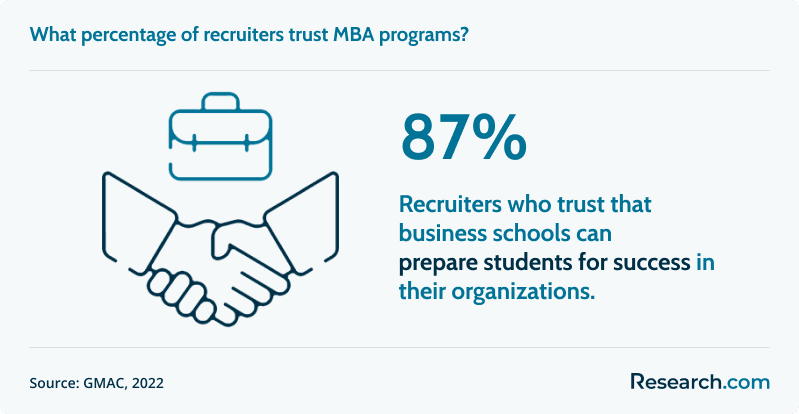
Industry confidence in business education remains an important consideration. According to the cited GMAC survey, 87% of corporate recruiters reported feeling confident, including 36% highly confident and 52% confident, in business schools’ ability to prepare students for success in their organizations.
How to Choose the Best Online MBA Without a GMAT Requirement
The best no-GMAT online MBA is not necessarily the cheapest, fastest, or most heavily marketed program. It is the program that fits your career plan, learning style, budget, and need for support while meeting recognized academic standards.
Start With Your Career Goal
- Target role: Decide whether you want a promotion, a career change, a consulting role, entrepreneurial training, or broader management preparation.
- Industry fit: Choose a concentration only if it supports the type of employer or role you want.
- Skill gaps: Identify whether you need stronger finance, analytics, leadership, marketing, operations, or technology skills.
Evaluate Program Design
- Accreditation: Confirm institutional accreditation and, when relevant, business-specific accreditation.
- Curriculum: Review required courses, electives, capstone projects, and whether assignments use real business cases.
- Faculty background: Look for instructors with relevant academic credentials and practical business expertise.
- Student support: Compare advising, tutoring, technical help, library access, career coaching, and networking resources.
Compare Admissions Requirements
- Prerequisite expectations: Confirm GPA requirements, work experience expectations, and any foundation courses for students without a business background.
- Application materials: Prepare transcripts, essays, recommendations, a resume, and any optional test scores if they strengthen your profile.
Check Accreditation and Program Quality
Accreditation matters because it indicates that a school or program has been reviewed against recognized educational standards. Institutional accreditors in this guide include SACSCOC, MSCHE, HLC, and NECHE. Business-specific accreditation, such as AACSB or ACBSP, can add another layer of quality assurance for business programs.
- Institutional accreditation: Verify that the school is accredited by a recognized accrediting body.
- Business accreditation: If important to your employer or career field, check whether the business school holds accreditation from AACSB or ACBSP.
- Learning outcomes: Ask what graduates are expected to know and do by the end of the program.
- Career support: Look for employer connections, career coaching, networking events, alumni mentoring, and resume support.
Students who want stronger data skills may also compare options such as an affordable online MBA in business analytics. The right choice should combine relevant curriculum, credible accreditation, manageable cost, and realistic career support.
How Do No-GMAT Online MBA Programs Support Entrepreneurship and Innovation?
Online MBA programs can support entrepreneurs by combining business fundamentals with courses or projects in innovation, venture planning, finance, leadership, and strategic risk. Students interested in startups should look for programs that offer entrepreneurship electives, business plan development, mentorship, pitch opportunities, innovation labs, or connections to local business communities.
Professionals with significant leadership experience may also compare executive-format options, including an online executive MBA, if they want coaching, peer learning, and advanced leadership development rather than a traditional MBA structure.
What Are the Advantages of Accelerated Online MBA Programs?
Accelerated online MBA programs are designed for students who want to finish quickly and can handle a demanding schedule. They may reduce the time spent in school and help professionals apply new skills sooner, but they also require strong time management and consistent availability.
- Faster completion: Shorter terms and condensed course sequences can reduce time to graduation.
- Lower opportunity cost: Students may move toward career goals sooner, depending on their circumstances.
- Focused momentum: A compressed schedule can help students stay engaged, though it leaves less room for breaks.
- Workload intensity: The same graduate-level expectations may be packed into a shorter calendar, so students should evaluate whether the pace is realistic.
Students comparing faster options can review an accelerated online MBA to understand how condensed formats differ from standard part-time or full-time models.
Career Paths for Graduates of Online MBA Programs Without the GMAT
An online MBA can support a variety of business careers, especially for students who pair the degree with relevant experience, measurable accomplishments, and a focused career strategy. The degree alone does not guarantee a role, but it can help build broader management, analytical, and leadership skills.
Management Roles
- Business Operations Manager: Coordinates daily operations, improves processes, and supports organizational efficiency.
- Project Manager: Leads teams, budgets, timelines, resources, and project delivery.
- Product Manager: Guides product strategy, development priorities, market positioning, and cross-functional coordination.
- Marketing Manager: Plans marketing strategies, manages campaigns, analyzes audiences, and supports revenue goals.
- Human Resources Manager: Oversees hiring, employee relations, benefits, compensation, and workforce policies.
Business Analysis and Consulting
- Business Analyst: Uses data and process analysis to identify operational improvements and business needs.
- Management Consultant: Advises organizations on business challenges, strategic decisions, and performance improvements.
Finance and Accounting Roles
- Financial Analyst: Reviews financial data, evaluates performance, and supports investment or budgeting decisions.
- Accountant: Maintains financial records, prepares statements, and supports regulatory compliance.
Other Business Paths
- Business Development Manager: Finds growth opportunities, builds partnerships, and supports revenue expansion.
- Sales Manager: Leads sales teams, sets goals, tracks performance, and develops sales strategies.
- Entrepreneur: Applies business planning, finance, marketing, and operations skills to launch or manage a business.
Job Market Outlook for Online MBA Graduates
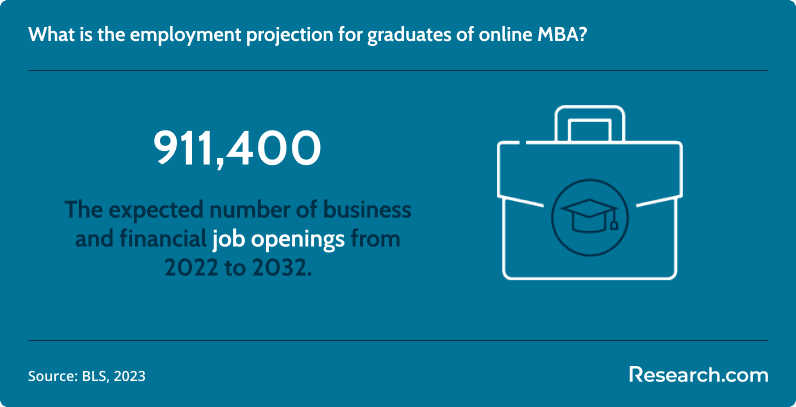
According to the US Bureau of Labor Statistics (BLS), employment in business and financial occupations is expected to grow faster than the average for all occupations between 2022 and 2032.
BLS projections indicate an annual average of approximately 911,400 job openings in these fields, reflecting both employment growth and the need to replace workers who permanently leave their roles.
Job outcomes still vary by location, prior experience, industry, concentration, networking effort, and employer demand. Students should review job postings in their target market before choosing a concentration so they can see which skills employers actually request.
How to Maximize Networking in an Online MBA Without the GMAT
Online MBA students do not have to wait for in-person events to build a professional network. The key is to treat networking as part of the program, not as something that happens only after graduation.
- Attend virtual networking events: Participate in online panels, employer sessions, alumni talks, and breakout discussions whenever the school offers them.
- Engage in discussion forums: Thoughtful posts, peer feedback, and group project participation can help classmates remember your expertise and professionalism.
- Use alumni networks: Contact alumni for informational interviews, industry advice, mentorship, and insight into career transitions.
- Join professional organizations: Industry associations can provide webinars, conferences, job boards, and member communities beyond the university.
- Build a stronger LinkedIn presence: Connect with classmates, faculty, guest speakers, and alumni; share relevant achievements; and participate in field-specific groups.
How to Verify the Quality and Accreditation of a No-GMAT Online MBA
A no-GMAT admissions policy should never replace quality checks. Before applying, verify that the program is legitimate, academically rigorous, and aligned with your career goals.
- Confirm regional or institutional accreditation. Check whether the university is accredited by a recognized agency such as the Higher Learning Commission (HLC) or the Southern Association of Colleges and Schools (SACS). You can also verify accreditation through the U.S. Department of Education or the Council for Higher Education Accreditation (CHEA).
- Review the program’s reputation. Look at employer recognition, alumni feedback, graduate outcomes when available, and whether the school has a track record in business education.
- Check faculty credentials. Review faculty biographies to see academic qualifications, research areas, professional experience, and industry relevance.
- Read the curriculum carefully. Make sure the program covers core business areas and offers electives or concentrations that match your goals.
- Look for business-specific accreditation when relevant. AACSB or ACBSP accreditation can be important for some students and employers, especially when comparing business schools. Students interested in technology-focused business roles may also explore an affordable online MBA in Information Technology in the USA.
- Evaluate career services and alumni support. Ask about career coaching, job search support, employer events, internship access, alumni mentoring, and networking opportunities for online students.
Challenges of Pursuing an Online MBA Without a GMAT Requirement
Online MBA programs without the GMAT can be convenient, but they are not effortless. Students should understand the trade-offs before enrolling.
| Challenge | Why It Matters | How to Reduce the Risk |
| Self-discipline | Online programs often require students to manage readings, assignments, and deadlines independently. | Create a weekly study schedule before classes begin and protect that time. |
| Limited face-to-face contact | Spontaneous networking and informal mentoring may be less common than on campus. | Attend virtual events, schedule professor meetings, and connect with peers early. |
| Variable online platforms | The quality of online delivery can affect engagement and satisfaction. | Ask for a course demo or speak with current students when possible. |
| Cost uncertainty | Tuition may not include all fees, materials, or technology expenses. | Request a full cost breakdown and compare it with inexpensive MBA programs. |
| Employer perception | Some employers may care more about accreditation, school reputation, and experience than format. | Choose an accredited program and build a portfolio of measurable accomplishments. |
How Online MBA Programs Support Career Services and Alumni Connections
Strong career support can make an online MBA more useful, especially for students who want to change industries or move into management. Quality programs often provide virtual advising, resume help, interview preparation, employer events, alumni access, and job search resources for online students.
When comparing schools, ask whether online learners receive the same career services as campus students. Students considering intensive formats may also compare options like a one year full time MBA, where career support and cohort networking can be especially important because of the compressed timeline.
Can an Online MBA Without the GMAT Improve Earning Potential?
An online MBA can support earning potential when it helps a student move into higher-responsibility roles, develop in-demand skills, or qualify for leadership opportunities. However, salaries are not guaranteed and depend on prior experience, industry, location, job level, employer, and specialization.
Students aiming for stronger financial outcomes should compare concentrations, employer demand, and career services before enrolling. It may also help to research fields associated with the highest paying MBA programs, then decide whether those paths match your background and interests.
How to Maximize ROI From Affordable AACSB-Accredited Online MBAs
An AACSB-accredited online MBA may offer additional value for students who want a business degree aligned with widely recognized business education standards. When affordability is also a priority, the return on investment depends on more than tuition alone.
To evaluate ROI, compare total program cost, time to completion, employer tuition support, opportunity cost, career services, alumni network strength, concentration relevance, and how well the curriculum supports your target roles. A lower-cost program can be a smart choice if it is accredited, rigorous, and connected to your career plan.
Students seeking recognized programs at a lower price point may want to compare the cheapest AACSB online MBA options. The goal is not simply to find the lowest tuition, but to find a credible degree that limits unnecessary debt while supporting long-term professional mobility.
How Online MBA Programs Use Technology to Improve Learning
Online MBA programs increasingly rely on digital platforms to deliver lectures, discussions, simulations, analytics tools, group work, and faculty feedback. The best technology supports learning rather than overwhelming students with disconnected tools.
When evaluating programs, ask how courses are delivered, whether live sessions are required, how group projects work, what technical support is available, and whether students can access recorded sessions. Students interested in digitally supported healthcare leadership training may also compare options such as the cheapest online MBA healthcare management.
How an Online MBA Can Strengthen Project Management Skills
Many online MBA programs include project-based assignments that help students practice planning, budgeting, team coordination, risk assessment, communication, and strategic execution. Programs with a project management concentration may go deeper into agile methods, resource planning, stakeholder management, and project controls.
Students who want a credential focused more directly on project leadership may also consider an affordable project management online degree, especially if they need specialized project management training rather than a broader MBA curriculum.
Can an Accelerated Online MBA Fast-Track Career Growth?
An accelerated online MBA can shorten the time to graduation and help students apply business skills sooner, but it is best for learners who can commit to an intensive pace. The format may be useful for professionals who already have relevant experience and want the MBA credential quickly, but it can be difficult for students balancing unpredictable work schedules.
Programs such as an MBA online one year can reduce the time spent in school, but students should compare workload, support services, course sequencing, and whether the schedule leaves enough room for networking and career planning.
Common Mistakes to Avoid When Choosing a No-GMAT Online MBA
- Choosing only because there is no GMAT: A waived test is convenient, but accreditation, curriculum, support, and cost matter more.
- Looking only at tuition per credit: Total cost depends on credits required, fees, books, technology costs, and time to completion.
- Ignoring accreditation: Always verify institutional accreditation and consider business-specific accreditation if it matters for your goals.
- Assuming online means easier: Online MBA courses can be rigorous and may require more self-management than campus classes.
- Choosing a concentration without checking job demand: Review job postings and employer expectations before selecting a specialization.
- Relying only on rankings: Rankings help narrow options, but the best program depends on your goals, schedule, budget, and preferred learning format.
- Underestimating networking: Online students need to be proactive about connecting with classmates, faculty, alumni, and employers.
Questions to Ask Before Applying
- Is the university institutionally accredited, and does the business school hold AACSB or ACBSP accreditation?
- Is the GMAT fully waived, test-optional, or waived only for applicants who meet certain criteria?
- What is the total estimated cost, including fees and course materials?
- How many credits are required, and how long do full-time and part-time students usually take?
- Are courses asynchronous, synchronous, or a mix of both?
- Does the program offer concentrations that match your career goal?
- What career services are available specifically to online MBA students?
- Can you speak with current students or alumni before enrolling?
- How are group projects, presentations, and exams handled online?
- What happens if you need to pause enrollment because of work or personal obligations?
References
- BLS. (2023). Business and Financial Occupations: Occupational Outlook Handbook.
- GMAC. (2022). Corporate Recruiters Survey – 2022 Summary Report. Graduate Management Admission Council.
- ZipRecruiter. (2024). Salary: MBA United States.
Key Insights
- A no-GMAT online MBA can be worthwhile when it is accredited, affordable, career-aligned, and supported by strong advising and career services.
- The listed programs range from 30 to 42 credits and from $9,000 to $15,768 in estimated total program cost, so comparing total price is more useful than comparing cost per credit alone.
- GMAT-free admissions still require preparation. Most applicants should expect to submit transcripts, a resume, essays, recommendations, and evidence of academic or professional readiness.
- Online and campus MBA programs often cover similar business fundamentals, but they differ in schedule flexibility, networking format, and student experience.
- Concentrations are valuable only when they support a clear career direction. Choose one based on employer demand and your target role, not simply because it sounds interesting.
- Before enrolling, verify accreditation, ask about total costs, review the curriculum, evaluate career services for online students, and confirm whether the program’s pace is realistic for your schedule.
Other Things You Should Know About Online MBA Programs Without a GMAT Requirement
The application deadlines for the most affordable online MBA programs in 2027 vary by institution. Generally, many programs have deadlines around May and October, aligning with fall and spring admissions. For exact dates, check with each school's admissions office directly.
Most no-GMAT online MBA programs require 30 to 36 credit hours for students with an accredited bachelor’s degree. Some schools ask for 42 to 48 credits if the applicant lacks a business background and must complete foundation courses in accounting, economics, or statistics.


